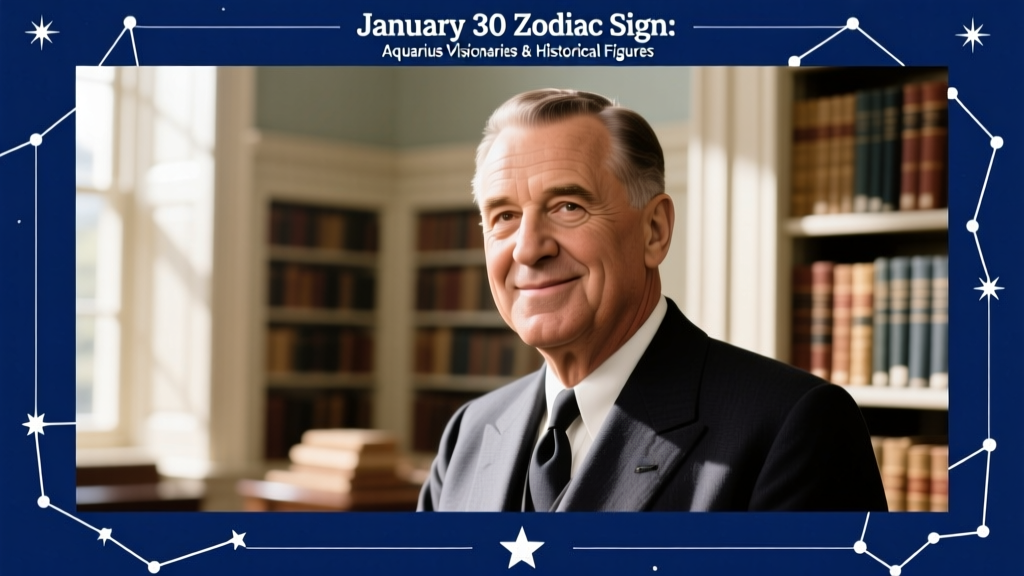
When examining the January 30 zodiac sign, we are not merely looking at a generic sun sign profile; we are observing a highly specific degree of the ecliptic that has historically produced systemic disruptors, diplomatic visionaries, and architectural thinkers. Born under the fixed air sign of Aquarius, individuals arriving on this date possess a unique astrological fingerprint. By analyzing the lives of famous historical figures and cultural icons born on January 30, we can decode the profound depth of this specific placement, moving beyond superficial pop-astrology into the realm of predictive and psychological astrology.
The January 30 Zodiac Sign: Decoding the Aquarian Blueprint
The Sun enters the sign of Aquarius in late January, and by the 30th, it has established a firm footing in the middle of the first decan, approaching the cusp of the second. Aquarius is a Fixed Air sign, traditionally ruled by Saturn and modernly ruled by Uranus. This dual rulership creates an inherent psychological tension: Saturn demands structure, tradition, and enduring legacy, while Uranus demands innovation, rebellion, and sudden paradigm shifts.
Natives born on January 30 embody this synthesis. They are not reckless revolutionaries; rather, they are architects of the future. They understand that to dismantle an outdated system (Uranus), one must build a superior, sustainable framework in its place (Saturn). This makes them exceptional strategists, policymakers, and long-term planners.
Historical Case Study: Franklin D. Roosevelt and the Saturn-Uranus Synthesis
To truly understand the January 30 zodiac sign, we must look at its most prominent historical figure: Franklin D. Roosevelt, born on this date in 1882. With his Sun at approximately 10 degrees Aquarius, FDR’s astrological profile perfectly illustrates the highest octave of this placement.
FDR’s presidency was defined by the 'New Deal'—a massive, systemic restructuring of the American economy during the Great Depression. This is the quintessential expression of a 10-degree Aquarius Sun. The Uranian impulse recognized that the existing capitalist framework had failed the collective and required radical, unprecedented intervention. However, it was the Saturnian discipline that allowed him to codify these radical ideas into enduring institutions (like Social Security and the SEC).
'The test of our progress is not whether we add more to the abundance of those who have much; it is whether we provide enough for those who have too little.'
— Franklin D. Roosevelt (Reflecting the Aquarian mandate for collective equity)
FDR’s chart demonstrates that the January 30 native is capable of bearing immense collective burdens. The fixed modality of Aquarius provides the stamina to see long-term crises through to their resolution, refusing to yield to immediate pressures or populist whims.
The Micro-Zodiac: Decans and Egyptian Bounds
To gain deeper predictive accuracy, astrologers divide signs into smaller segments. January 30 typically falls at 9° or 10° Aquarius, placing it on the cusp of the first and second decans.
- The First Decan (Uranus/Saturn): Pure Aquarian energy. Focuses on humanitarianism, systemic logic, and societal structures.
- The Second Decan (Mercury/Gemini): As the Sun approaches 10°, the sub-rulership of Mercury begins to bleed into the native's psyche. This adds intellectual agility, a talent for mass communication, and a highly networked approach to problem-solving.
Furthermore, in traditional Hellenistic astrology, 10° Aquarius falls within the Egyptian Bound (or Term) of Venus. While Aquarius is naturally detached and cerebral, the Venusian bound grants the January 30 native a surprising degree of social grace, diplomatic tact, and aesthetic refinement. They can sell their radical ideas with a disarming charm that more abrasive Aquarians lack.
Famous January 30 Natives: An Astrological Roster
Observing contemporary figures born on this date further validates the astrological signature of the visionary communicator and the intense, transformative artist.
| Name | Birth Year | Approx. Sun Degree | Aquarian Trait Exhibited |
|---|---|---|---|
| Franklin D. Roosevelt | 1882 | 10° Aquarius | Systemic restructuring, collective welfare, enduring legacy. |
| Christian Bale | 1974 | 10° Aquarius | Extreme physical transformation, detachment from ego, eccentric character immersion. |
| Phil Collins | 1951 | 9° Aquarius | Mass communication, rhythmic innovation, blending of pop and progressive structures. |
| Wilmer Valderrama | 1980 | 10° Aquarius | Cultural bridging, unconventional career pivots, ensemble networking. |
Christian Bale’s career is a fascinating study of the Aquarian detachment from the 'self.' Unlike Leonine actors who project their own persona onto every role, Bale (with his 10° Aquarius Sun) completely erases his identity to become a vessel for the character. This requires the fixed air ability to intellectualize and deconstruct the human ego, a hallmark of the January 30 psychological profile.
Synastry and Relational Compatibility
When analyzing relationship compatibility for the January 30 zodiac sign, we must look beyond basic sun sign trines. Because this date hovers around the 9°–10° mark of Aquarius, the native requires a partner who can engage with their specific degree of intellectual and ideological intensity.
Degree-Specific Compatibility Matrix
- The Harmonic Trine (9°–11° Gemini or Libra): Partners with Sun, Moon, or Venus in these degrees provide effortless intellectual stimulation. The Gemini placement (ruled by Mercury, echoing the native's second decan) ensures rapid-fire communication, while the Libra placement (ruled by Venus, echoing the native's Egyptian bound) provides the diplomatic harmony they crave in their private sanctuary.
- The Polarity Opposition (9°–11° Leo): According to AstroWiki's comprehensive sign profiles, the opposition represents the 'shadow' we must integrate. A Leo partner brings warmth, ego-expression, and theatricality, pulling the detached January 30 native out of their cerebral fortress and into the realm of the heart and personal joy.
- The Friction Square (9°–11° Taurus or Scorpio): These aspects create profound growth through tension. Taurus forces the Aquarian to ground their theories into material reality, while Scorpio demands emotional vulnerability, challenging the native's instinct to intellectualize their feelings.
Vocational Astrology: Career and Life Path
The vocational trajectory of a January 30 native is rarely linear. They are not built for repetitive, micro-managed tasks. Instead, their career path is defined by systemic optimization. They thrive in environments where they are handed a broken mechanism—be it a failing corporation, a flawed piece of legislation, or a stagnant creative genre—and given the autonomy to rebuild it.
Due to the Mercury sub-rulership of their approaching decan, careers involving mass media, telecommunications, data science, and sociology are highly favored. They possess the rare ability to understand complex, macro-level data sets (Uranus) and translate them into digestible, actionable narratives for the public (Mercury/Venus).
The Life Path Challenge: Avoiding Cerebral Isolation
The primary shadow of the January 30 zodiac sign is the tendency toward emotional isolation. Because they process the world through the lens of fixed air, they can inadvertently alienate loved ones by treating emotional crises as logical puzzles to be solved rather than experiences to be felt. The ultimate life lesson for this native is learning that true humanitarianism begins with intimate, one-on-one empathy. By integrating the warmth of their Venusian bound and the heart-centered expression of their Leo polarity, the January 30 visionary evolves from a brilliant architect of systems into a profound healer of the human condition.