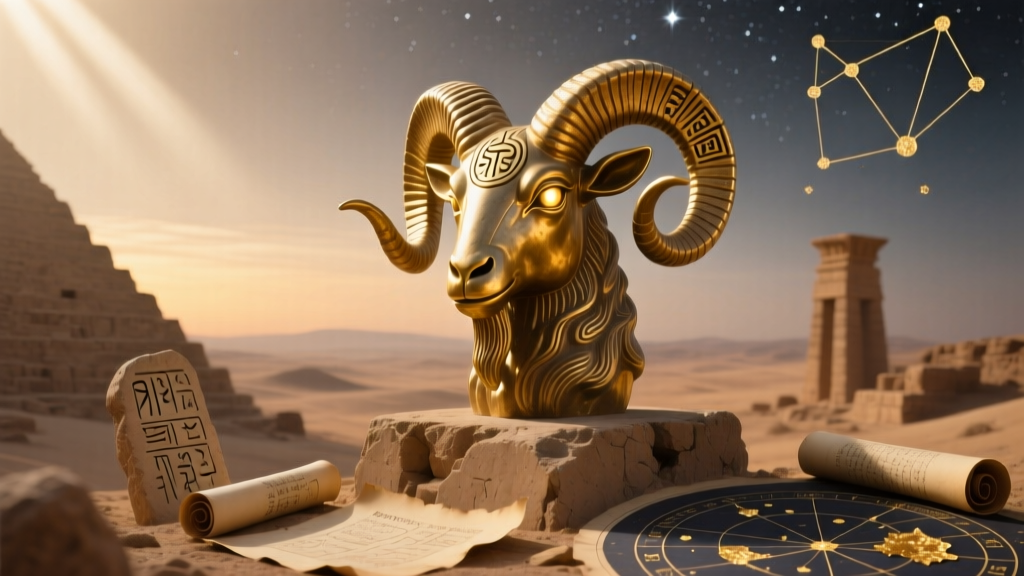
The astrological profile of the 12th April zodiac native extends far beyond modern sun-sign generalizations. Falling between the 22nd and 23rd degrees of Aries (depending on the solar year's exact ingress), this placement resides in the final ten-degree segment of the sign. To understand the psychological and spiritual blueprint of individuals born on this date, we must excavate the historical strata of the Ram archetype. This analysis traces the lineage of the mid-Aries degrees from ancient Mesopotamian star catalogs to the esoteric decan system of Ptolemaic Egypt, providing a rigorous framework for understanding this specific astrological signature.
The Babylonian Roots: From Agrarian Worker to the Ram
The earliest recorded origins of the Aries constellation do not feature a ram. In the Babylonian astronomical compendium MUL.APIN (compiled circa 1000 BCE), the stars occupying this region of the ecliptic were designated as LU.HUN.GA, translating to 'The Agrarian Worker' or 'The Hired Man.' This figure was intimately tied to Dumuzi (Tammuz), the Sumerian god of shepherds, vegetation, and the spring harvest. As detailed in Britannica's historical archives on astrology, the transition from the Agrarian Worker to the Ram (UDU.HUN.GA) occurred gradually during the Neo-Babylonian period.
Linguists and historians attribute this shift to phonetic similarities in Sumerian and Akkadian, combined with the ram's rising prominence as a symbol of aggressive spring fertility and the vernal equinox. For the April 12th native, this historical root implies an underlying archetype of 'cultivation'—the raw Martian energy of Aries is fundamentally geared toward sowing seeds and initiating agricultural or intellectual cycles, rather than mere destruction or conflict.
Hellenistic Astrology and the 12th April Zodiac Degrees
When Hellenistic astrologers synthesized Babylonian observational data with Egyptian time-keeping and Greek geometry, they created the horoscopic system used today. The specific degrees governing the 12th April zodiac fall within the Third Decan of Aries (20° to 30°). The decan system originated in Hellenistic Egypt, adapting the Egyptian bkn (star clocks) to divide the 360-degree zodiac into 36 ten-degree segments, known as the paranatellonta.
According to the Chaldean order of planetary rulers, the first decan of Aries is ruled by Mars, the second by the Sun, and the third by Jupiter. Therefore, an individual born on April 12 is influenced by a Mars-Jupiter synthesis. While Mars provides the cardinal fire and initiatory drive of Aries, the Jupiter sub-rulership introduces Sagittarian undertones: philosophical expansion, higher education, and a drive for ideological conquest. Ptolemy’s foundational text, the Tetrabiblos (accessible via the Perseus Digital Library), outlines how planetary sub-rulers modify the base nature of a sign. For the April 12 native, the Jupiterian influence tempers Martian impulsivity, replacing blind aggression with strategic, visionary foresight.
Mythological Origins: Chrysomallos and the Golden Fleece
The Greeks mapped their own mythological narratives onto the Babylonian constellations. The Ram of Aries is specifically identified as Chrysomallos, the flying, golden-fleeced ram. The Theoi Project's archive on Greek mythology details how this divine beast was sent by the cloud-nymph Nephele to rescue her children, Phrixus and Helle, from being sacrificed by their wicked stepmother, Ino.
As the ram carried the children across the sky, Helle lost her grip and fell into the strait now known as the Hellespont. Phrixus, however, was carried safely to Colchis, where he sacrificed the ram to Zeus and hung its Golden Fleece in a sacred grove. This myth is not merely a fairy tale; it is an allegorical map of the Aries psychological journey. The April 12 native often experiences life as a series of sudden, divine rescues followed by arduous quests. The 'Golden Fleece' represents the ultimate spiritual or material prize that requires navigating treacherous waters and facing the 'dragons' (guardians of the fleece) of one's own psyche.
The Archetypal Shift: From Sacrifice to Sovereignty
Notice the paradox in the myth: the ram is both the savior and the ultimate sacrifice. Historically, this reflects the ancient springtime rites where the first ram of the flock was offered to ensure the survival of the rest. Individuals born on this date must learn to identify what outdated aspects of their identity must be 'sacrificed' to secure their Golden Fleece and achieve long-term sovereignty.
| Era / Culture | Designation | Ruling Deity / Planet | Core Symbolism |
|---|---|---|---|
| Sumerian (c. 2000 BCE) | LU.HUN.GA (Agrarian Worker) | Dumuzi (Tammuz) | Sowing, seasonal death/rebirth, pastoral labor. |
| Neo-Babylonian (c. 600 BCE) | UDU.HUN.GA (The Ram) | Marduk / Agrarian Gods | Vernal equinox, fertility, aggressive spring growth. |
| Hellenistic (c. 100 BCE) | Krios (The Ram - 3rd Decan) | Mars (Sign) / Jupiter (Decan) | Martial drive tempered by philosophical expansion. |
| Greco-Roman Myth | Chrysomallos (Golden Ram) | Zeus / Nephele | Divine rescue, sudden transit, the ultimate prize. |
Actionable Frameworks for the April 12th Native
Translating ancient astrological history into modern psychological application requires specific, actionable frameworks. The April 12 native can leverage their unique historical and planetary signatures using the following methodologies:
- The Jupiter Sub-Rule Strategy: Because the third decan is governed by Jupiter, physical confrontation or hyper-competitive business tactics often lead to burnout for this placement. Instead, channel Martian initiative into Jupiterian domains: publishing, higher education, legal advocacy, or international trade. When faced with a roadblock, pivot from 'fighting' the obstacle to 'out-educating' or 'out-publishing' the competition.
- The Dumuzi Energy Cycle: Drawing from the Sumerian roots of the Agrarian Worker, the April 12 native is subject to intense seasonal energy fluctuations. Implement a rigid 6-week energy management protocol. After 6 weeks of aggressive 'sowing' (launching projects, high-output work), mandate a 1-week period of 'fallow' (complete detachment from professional output). This mirrors the ancient descent/ascent cycles of Dumuzi and prevents the chronic adrenal fatigue common in mid-Aries natives.
- The Golden Fleece Objective Matrix: Use the myth of Chrysomallos as a decision-making filter. Before committing to a new venture, ask: 'Is this the Golden Fleece (the ultimate, life-altering prize), or is this a distraction in the Hellespont?' If a project does not offer long-term sovereignty or deep philosophical alignment (Jupiter), abandon it. The Aries tendency to chase every shiny object must be curbed by the Sagittarian demand for profound meaning.
- The Sacrifice Audit: Annually, during the vernal equinox, conduct a 'Sacrifice Audit.' Identify one major habit, relationship, or financial commitment that served as a 'rescue' in the past but is now hindering your arrival at Colchis. Systematically dismantle it to free up the energetic bandwidth required for your next major expansion.