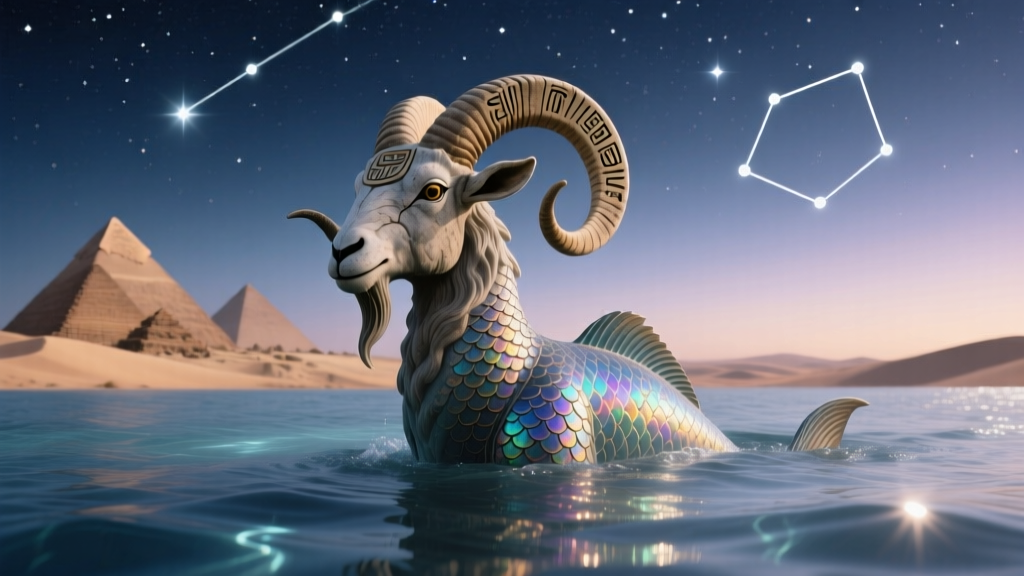
Individuals born under the 13 January star sign fall squarely within the third decan of Capricorn. Modern pop astrology frequently reduces this earth sign to a one-dimensional archetype of corporate ambition, rigid stoicism, and material climbing. However, the historical and mythological origins of Capricorn reveal a far more complex chimera: the Sea-Goat. By tracing the lineage of this symbol back to ancient Mesopotamia and Hellenistic Greece, we uncover a dual nature that blends terrestrial pragmatism with profound emotional and intellectual depth. Understanding the true psychological profile of this placement requires excavating the Sumerian abyss and the Hellenistic myths of divine survival.
The Astronomical and Mythological Roots of the 13 January Star Sign
The symbol for Capricorn is not merely a goat, but a creature with the head and torso of a caprid and the tail of a fish. This hybrid imagery is not a medieval artistic error; it is a direct inheritance from the earliest astronomical catalogs in human history. To understand the behavioral drivers of those born on January 13, we must examine the two distinct mythological epochs that forged this archetype.
Sumerian Origins: Enki and the Abzu
The earliest recorded iteration of the Capricorn constellation appears in the Babylonian star catalog known as the MUL.APIN (compiled around 1000 BCE). It was designated as SUḪUR.MAŠ, translating directly to 'The Goat-Fish.' This celestial marker was intrinsically linked to Enki (known as Ea in Akkadian), one of the most vital deities in the Mesopotamian pantheon. According to Britannica's historical archives on Mesopotamian deities, Enki was the god of water, knowledge, mischief, crafts, and creation. His primary domain was the Abzu—the primeval, subterranean ocean of freshwater that existed beneath the earth.
Enki was not a god of brute force or rigid authority; he was the master of me (divine decrees and civilizational arts) and the patron of intellect, magic, and problem-solving. Therefore, the foundational DNA of the 13 January star sign is not merely 'earthly ambition.' It represents intellectual mastery over chaotic waters. Individuals born on this date possess an innate, historically rooted drive to bring order, technology, and wisdom to emotionally or socially turbulent environments. The 'goat' aspect represents the ability to climb the highest earthly mountains, while the 'fish' tail signifies the capacity to navigate the deepest, darkest psychological and intellectual currents.
Hellenistic Shift: Pan, Typhon, and Crisis Adaptation
When Hellenistic astrologers in Alexandria adapted the Babylonian zodiac to Greek mythology, the Goat-Fish was syncretized with the god Pan. The origin story of this specific chimera is rooted in a narrative of crisis and rapid adaptation. According to the mythological accounts preserved by the Theoi Project, the monstrous titan Typhon attacked Mount Olympus, sending the gods into a panic. To escape, the deities fled to Egypt and shapeshifted into animals.
Pan, in his haste, leaped into the Nile River to hide. However, his transformation was incomplete: the half of his body submerged in the water turned into a fish, while the half remaining above water retained its goat form. This myth provides a crucial psychological key for the 13 January star sign. It represents radical adaptability under extreme duress. Where modern astrology views Capricorn as rigid, the ancient Hellenistic origin story reveals a sign capable of instantaneous, hybridized problem-solving when faced with existential threats. The January 13 native thrives in crisis, utilizing both grounded logic (the goat) and fluid intuition (the fish) to survive and outmaneuver obstacles.
The Third Decan: Mercurial Influence on January 13
To achieve absolute precision in astrological profiling, we must apply the Chaldean decan system, which divides each 30-degree sign into three 10-degree sectors. January 13 falls in the third decan of Capricorn (roughly January 11 to January 20). While the primary ruler of Capricorn is Saturn (representing structure, time, and limitation), the sub-ruler of the third decan is Mercury.
Mercury's influence drastically alters the expression of the Saturnian foundation. It injects a highly analytical, communicative, and data-driven energy into the native's psyche. This placement creates 'The Architect of Systems.' A January 13 Capricorn is less concerned with physical labor or brute-force management than they are with designing the underlying algorithms, logistical frameworks, and communication networks that make large-scale ambitions possible. They are the ultimate synthesizers of information, capable of taking abstract Mercurial data and grounding it into Saturnian reality.
Evolution of the Sea-Goat Archetype
The table below maps the historical evolution of the Capricorn archetype, demonstrating how ancient domains translate into modern psychological traits for the January 13 native.
| Era / Origin | Deity / Mythos | Core Domain | Psychological Translation for Jan 13 |
|---|---|---|---|
| Sumerian (c. 2000 BCE) | Enki / Abzu | Wisdom, Freshwater, Magic | Deep intellectual curiosity; emotional intelligence masked by pragmatism. |
| Babylonian (c. 1000 BCE) | SUḪUR.MAŠ | Agricultural cycles, Stars | Long-term strategic planning; alignment with natural market/social cycles. |
| Hellenistic (c. 200 BCE) | Pan / Typhon | Crisis survival, Duality | Rapid adaptability; thriving in high-stakes, chaotic environments. |
| Modern (Chaldean Decan) | Mercury / Saturn | Systems, Data, Structure | Information architecture; building scalable frameworks and networks. |
Precession of the Equinoxes: The Astronomical Reality
Any rigorous historical analysis of astrology must address the astronomical reality of the tropical zodiac versus the sidereal sky. Due to the precession of the equinoxes—a slow wobble of the Earth's rotational axis that completes a cycle approximately every 26,000 years—the astrological signs no longer align with their namesake constellations. As detailed in NASA's astronomical data regarding precession, the Sun's actual position against the backdrop of the stars on January 13 is in the constellation of Sagittarius, not Capricornus.
However, Western astrology operates on the Tropical Zodiac, established by Claudius Ptolemy in the 2nd century CE. Ptolemy anchored the zodiac to the seasons (the vernal equinox) rather than the shifting constellations. Therefore, the '13 January star sign' remains definitively Capricorn in the Western esoteric tradition, representing the mid-winter period of maximum earthly consolidation and structural planning in the Northern Hemisphere, regardless of the background stars.
Applied Antiquity: Actionable Frameworks for the Modern Capricorn
Understanding the ancient origins of the 13 January star sign provides highly specific, actionable frameworks for personal and professional development. By consciously adopting the archetypes of Enki and Pan, natives can bypass the limitations of modern pop-astrology stereotypes.
- Implement 'Abzu Hours' (Deep Work): Channel the Sumerian god Enki by scheduling two hours of uninterrupted, subterranean 'deep work' daily. The January 13 native's greatest asset is the ability to dive into complex, unglamorous data or emotional undercurrents that others avoid. Use this time for systemic problem-solving, not surface-level administration.
- Run 'Typhon Simulations' (Crisis Adaptability): Acknowledge the Hellenistic Pan archetype by actively preparing for worst-case scenarios. In business or personal finance, build contingency protocols. The January 13 psyche is uniquely equipped to remain calm and execute hybridized solutions when the 'monsters' of market crashes or sudden life disruptions attack.
- Leverage Mercurial Synthesis: Utilize the third decan's Mercury rulership to become a translator between departments or disciplines. Your value lies in taking the esoteric or highly technical (the fish) and structuring it into actionable, authoritative reports or systems (the goat). Focus on mastering data visualization, technical writing, or logistical software.
- Balance the Chimera: Recognize that the 'Sea-Goat' requires both water and earth. If you experience burnout, it is likely because you have over-indexed on Saturnian rigidity (the mountain) and neglected the Enki/Pan need for fluid, unstructured exploration (the water). Schedule mandatory periods of unstructured learning or proximity to bodies of water to reset your neuro-astrological baseline.
The history of the 13 January star sign proves that Capricorn was never meant to be a symbol of mere labor. It is the ancient emblem of the civilizing intellect, the survivor of divine wars, and the architect who builds bridges between the chaotic depths and the highest peaks.