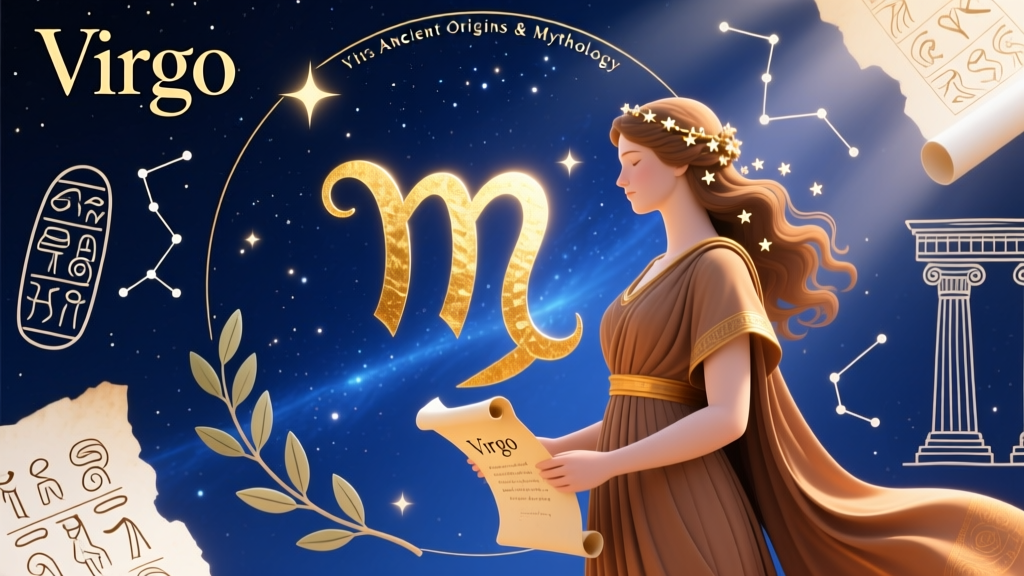
The 13 Sep star sign corresponds to the 20th and 21st degrees of the tropical Virgo zodiac. Far from modern generalizations, the historical origin of this specific celestial coordinate reveals a complex synthesis of Babylonian agricultural tracking, Hellenistic geometric divisions, and Mediterranean mythological syncretism. To understand the astrological architecture of a September 13 birth, one must examine the ancient catalogs that first mapped this region of the ecliptic, tracing its evolution from Sumerian grain harvests to the Hellenistic decan system. This analysis explores the primary source texts, astronomical shifts, and mythological frameworks that defined the Virgo archetype across ancient civilizations. By examining these roots, we uncover the precise esoteric mechanics governing this specific placement.
The Astronomical and Historical Roots of the 13 Sep Star Sign
Long before the Hellenistic Greeks formalized the twelve-sign zodiac, the celestial equator and ecliptic were mapped by Babylonian astronomers. The foundational text for this early astronomical tradition is the MUL.APIN, a comprehensive catalog compiled around 1000 BCE. According to the World History Encyclopedia's overview of Babylonian Astronomy, this text organized the stars along the ecliptic into distinct constellations that tracked the agricultural calendar.
In the Babylonian system, the region of the sky occupied by the 13 Sep star sign was known as AB.SIN, which translates to 'The Furrow.' This constellation was intrinsically linked to the goddess Shala, a deity of grain and agriculture, who was frequently depicted holding an ear of barley or wheat. The heliacal rising and setting of stars within this sector served as critical temporal markers for the sowing and reaping seasons in ancient Mesopotamia. The transition from the physical observation of 'The Furrow' to the abstract, geometric 30-degree sign of Virgo occurred centuries later, as Babylonian mathematical astronomy was adopted and adapted by the Persian and subsequently the Hellenistic empires.
Hellenistic Syncretism and the Myth of Astraea
When Greek astronomers, notably Aratus in his 3rd-century BCE poem Phaenomena and later Claudius Ptolemy in the 2nd-century CE Almagest, cataloged the sky, they overlaid their own mythological pantheon onto the existing Babylonian framework. The Furrow was reimagined as the figure of a winged maiden, eventually identified with Virgo. The Britannica entry on the Virgo constellation notes that this figure became a canvas for multiple overlapping Greek myths, reflecting the cultural importance of justice, agriculture, and the changing of the seasons.
The primary mythological identifications for this celestial figure include:
- Dike (Astraea): The goddess of justice who lived among humans during the Golden Age. As humanity grew corrupt during the Bronze and Iron Ages, she fled to the heavens, becoming the constellation Virgo, forever turning her back on earthly injustice.
- Demeter and Persephone: The earth goddess of the harvest and her daughter. The ear of grain held by the constellation (marked by the star Spica) directly mirrors Demeter's agricultural dominion and the cyclical descent of Persephone into the underworld, which triggers the onset of autumn.
- Erigone: A lesser-known but significant myth involving the daughter of Icarius. After her father was unjustly killed, Erigone took her own life in grief and was placed in the stars alongside her father (Boötes) and their dog Maera (Canicula).
Decans, Terms, and the Micro-Zodiac of September 13
Ancient astrologers did not rely solely on the broad 30-degree boundaries of the zodiac signs. To achieve greater predictive and psychological specificity, they subdivided the ecliptic using micro-zodiacal systems. The most prominent of these were the Chaldean Decans (10-degree divisions) and the Ptolemaic Terms or Bounds (unequal divisions based on planetary dignities). Because the Sun traverses approximately one degree of the ecliptic per day, a September 13 birth typically places the Sun at 20°20' to 21°20' of Virgo, depending on the exact year and leap year cycle.
This specific coordinate is highly significant in historical astrology, as it sits precisely on the boundary between different planetary rulerships. The following table outlines the historical subdivisions governing the late degrees of Virgo:
| Subdivision System | Division Name | Degree Range | Planetary Ruler | Historical Function |
|---|---|---|---|---|
| Chaldean Decan | Third Face | 20° - 30° Virgo | Mercury | Accounting, grain storage, commerce |
| Ptolemaic Terms | Bounds of Jupiter | 17° - 21° Virgo | Jupiter | Expansion of resources, legal contracts |
| Ptolemaic Terms | Bounds of Mars | 21° - 28° Virgo | Mars | Severing, final harvest cuts, defense |
Interpreting the September 13 Boundary
For an individual born on September 13, the Sun is often caught in the transitional tension between the Jupiter and Mars terms, while firmly residing within the Mercury-ruled third decan. In Hellenistic practice, the third decan of Virgo was associated with the cognitive categorization of resources—the mental labor required to inventory the harvest and prepare for winter. Mercury's rulership here emphasizes analytical precision, data management, and logistical foresight.
Simultaneously, the cusp of the Jupiter and Mars bounds introduces a dynamic friction. Jupiter seeks to expand, protect, and formalize agreements (reflecting the legal and communal aspects of the ancient harvest distribution), while Mars introduces the necessity of severing, editing, and defending boundaries (reflecting the physical cutting of the grain and the protection of silos). Modern practitioners utilizing traditional techniques interpret this specific degree as a marker for individuals who possess a profound drive to systematize their environments, yet who frequently experience internal tension between their desire to generously expand their projects and their critical need to ruthlessly edit and prune inefficiencies.
Spica: The Anchor Star of the Virgo Constellation
No historical analysis of this sector of the sky is complete without addressing Alpha Virginis, commonly known as Spica. Spica is a spectroscopic binary star system and the brightest star in the Virgo constellation. According to the International Astronomical Union (IAU) constellation archives, Spica has served as a vital navigational and calendrical anchor for multiple ancient civilizations.
In ancient Egypt, the heliacal rising of Spica was closely monitored, as it coincided with the critical periods of the Nile's flooding and subsequent agricultural cycles. The Greeks and Romans utilized Spica to mark the autumnal equinox in earlier epochs. The name 'Spica' itself derives from the Latin spica virginis, meaning 'the virgin's ear of grain,' directly linking the physical star to the mythological bundle of wheat held by the constellation. While the tropical zodiac is based on the seasons rather than the physical stars, traditional astrologers who integrate sidereal stellar influences note that the precession of the equinoxes has slowly shifted Spica's position relative to the tropical signs. Nevertheless, its historical resonance as a symbol of concentrated, refined, and highly valuable resources remains a core component of the Virgo archetype.
Axial Precession and the Tropical vs. Sidereal Divide
Understanding the origin story of the 13 Sep star sign requires addressing the astronomical phenomenon of axial precession. The Earth's axis wobbles in a cycle lasting approximately 25,772 years, causing the vernal equinox to drift backward through the physical constellations at a rate of about one degree every 72 years. When the Babylonian and early Hellenistic astrologers first mapped the zodiac, the tropical sign of Virgo and the physical constellation of Virgo were roughly aligned in the sky.
Today, due to this precessional drift, the physical constellation of Virgo has shifted westward. When the Sun occupies the tropical sign of Virgo on September 13, it is actually positioned in front of the physical constellation of Leo in the sidereal sky. Western astrology, following the framework established by Ptolemy in the Tetrabiblos, deliberately anchors the zodiac to the seasons (the equinoxes and solstices) rather than the shifting backdrop of stars. Therefore, the '13 Sep star sign' remains unequivocally Virgo in the tropical system, preserving the seasonal symbolism of the late summer harvest, the waning of solar light, and the preparation for the autumnal descent, regardless of the physical constellation currently occupying that spatial coordinate.
Synthesis of the Historical Archetype
The historical trajectory of the 13 Sep star sign transforms it from a simple daily horoscope placement into a profound repository of human agricultural and intellectual history. From the Babylonian Furrow of Shala to the Hellenistic bounds of Jupiter and Mars, the late degrees of Virgo encode the ancient necessity of critical analysis, resource management, and the relentless pursuit of systemic order. By applying these historical subdivisions and understanding the mythological weight of Astraea and Demeter, modern analysis can move beyond superficial traits. The September 13 native operates within a legacy of celestial accountants and harvest guardians, driven by the Mercurial imperative to categorize the chaos of the material world into structured, sustainable, and enduring systems.