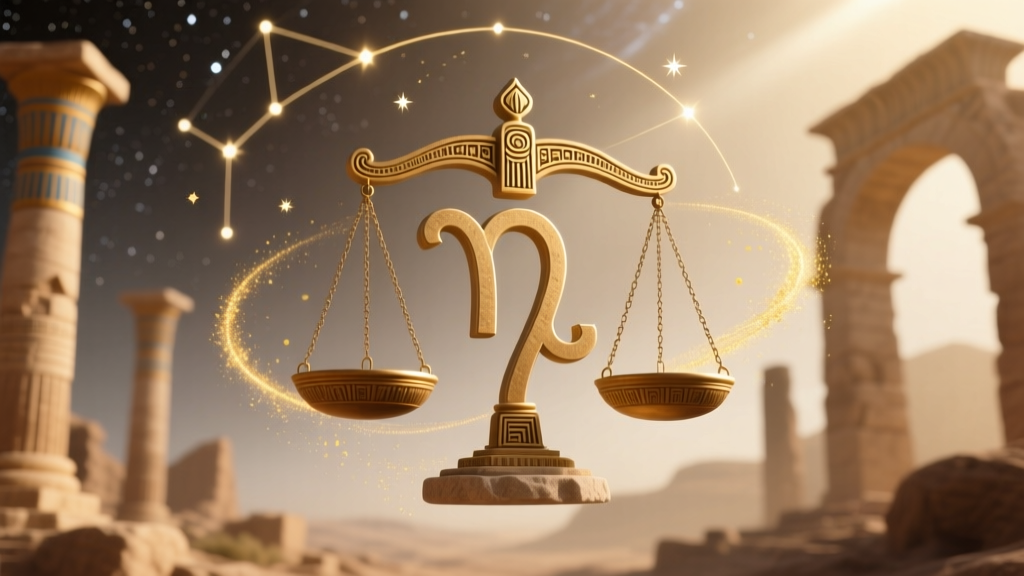
The astrological profile of the 13th of October star sign presents a unique historical paradox. Born under the sign of Libra, individuals on this date inherit the only inanimate object in the zodiacal pantheon. While Aries, Taurus, and Leo draw their archetypal power from living beasts, the 13th of October star sign is rooted in the cold, precise geometry of the Scales. To understand the psychological and spiritual blueprint of an October 13 Libra, we must excavate the astronomical records of ancient Babylon, the philosophical shifts of Hellenistic Alexandria, and the imperial propaganda of Augustan Rome.
The Anomaly of the 13th of October Star Sign
Modern astrology often treats the zodiac as a static, unchanging wheel. However, historical astronomy reveals that the constellation we now call Libra was not always a set of scales. For those born on October 13, understanding this historical fluidity is key to unlocking the deeper, often contradictory layers of their personality. The tension between the 'Claws' of the ancient scorpion and the 'Scales' of Roman justice creates a psychological push-and-pull between fierce self-preservation and a desperate desire for societal harmony.
Mesopotamian Origins: The Scorpion’s Claws and the Harvest Balance
Long before the Romans codified the tropical zodiac, the ancient Sumerians and Babylonians mapped the heavens. In the Oracc (Open Richly Annotated Cuneiform Corpus), which houses translations of ancient Mesopotamian texts like the MUL.APIN star catalog (c. 1000 BCE), the stars of modern Libra held a dual identity.
Zibanu and the Autumnal Equinox
The Sumerians recognized this region of the sky as Zibanu (the Balance). Because the sun passed through this constellation during the autumnal equinox, day and night were of equal length. This celestial equilibrium associated the stars with Utu, the sun god of justice and truth. However, the Babylonians more frequently referred to these stars as the 'Claws of the Scorpion' (MUL.GIR.TAB), viewing them as an integral, dangerous appendage of the massive Scorpius constellation. Therefore, the ancient ancestor of the 13th of October star sign was inherently dual-natured: an instrument of divine balance, yet armed with a venomous sting.
The Hellenistic Transition: From Claws to Scales
When Greek astronomers synthesized Babylonian data, they largely retained the Scorpion's Claws, referring to the constellation as Chelae. Yet, the philosophical underpinnings began to shift. In his foundational text Ptolemy's Tetrabiblos (2nd century CE), Claudius Ptolemy categorized the stars of Libra as temperate, blending the influences of Venus and Mercury.
Ptolemy noted that the stars in the middle of the Claws (which would later become the pans of the scales) possessed a nature 'similar to Mercury and moderately to Venus.' This Hellenistic synthesis laid the groundwork for the modern Libra archetype: diplomatic, communicative, and aesthetically driven. For an October 13 native, this Mercurial-Venusian blend manifests as a sharp, analytical mind wrapped in a highly sociable, charming exterior.
'The stars in the middle of the Claws are like Mercury and Venus; they bring temperance, a sense of justice, and a desire for intellectual harmony.' — Adapted from Ptolemy's Tetrabiblos, Book I.
Roman Mythology: Astraea and the Imperial Scales
The definitive transformation from 'Claws' to 'Scales' occurred during the Roman Empire, specifically under the reign of Augustus Caesar. Augustus actively promoted the imagery of the Scales of Justice to associate his new imperial regime with cosmic balance, fairness, and the return of the Golden Age.
The Flight of Astraea
Roman poets cemented this mythology. In Ovid's Fasti and Metamorphoses, the constellation is linked to Astraea, the virgin goddess of justice and innocence. According to the myth, Astraea lived among humans during the Golden Age, weighing their deeds on her scales. As humanity descended into the Bronze and Iron Ages, becoming greedy and violent, a disgusted Astraea fled to the heavens, taking her scales with her to become the constellation Libra. This mythological origin imbues the 13th of October star sign with a profound, almost tragic idealism—a perpetual longing for a utopian fairness that rarely exists in the mortal realm.
October 13 Specifics: Fixed Stars and the Decans
To achieve true astrological depth, we must look at the specific degree of the zodiac the sun occupies on October 13. Depending on the exact time and leap year cycles, the sun sits at approximately 19° to 20° Libra on this date. This specific coordinate is historically rich.
The Second and Third Decans of Libra
In Hellenistic and Chaldean astrology, the zodiac was divided into decans (10-degree segments). The 19°-20° mark represents the critical threshold between the second decan (ruled by Saturn) and the third decan (ruled by Jupiter).
- The Saturnian Influence (10°-19° Libra): Imbues the early October 13 native with a serious, structured approach to relationships. They do not take partnerships lightly and often act as the 'anchor' in their social circles.
- The Jovian Influence (20°-29° Libra): Expands the Libran desire for harmony into a broader philosophical or legal framework. Natives born late on the 13th or carrying this degree in their natal chart often excel in law, diplomacy, or higher education.
The Shadow of Zubenelgenubi
Historically, the fixed star Zubenelgenubi (the Southern Claw) was located in the late degrees of Libra before the precession of the equinoxes shifted it into early Scorpio. This star, associated with the goddess Ishhara and the concepts of oaths and karma, casts a shadow over the late degrees of Libra. It suggests that October 13 Libras possess a hidden psychological resilience and a karmic awareness that prevents them from being pushed around, debunking the modern myth that Libras are perpetual pushovers.
Historical Timeline of Libra's Evolution
| Era | Designation | Ruling Concept | Primary Deity / Association |
|---|---|---|---|
| Sumerian (c. 2100 BCE) | Zibanu | The Balance / Harvest Equinox | Utu (Sun God / Justice) |
| Babylonian (c. 1000 BCE) | MUL.GIR.TAB (Claws) | Scorpion's Grasp / Oaths | Ishhara (Goddess of Oaths) |
| Hellenistic (c. 150 CE) | Chelae / Zygos | Equinox Point / Temperance | Dike (Goddess of Justice) |
| Roman (c. 27 BCE) | Libra | Imperial Justice / Golden Age | Astraea / Augustus |
Actionable Historical Frameworks for Modern Libras
Understanding the ancient lineage of the 13th of October star sign provides a practical framework for navigating modern life. By integrating these historical layers, October 13 natives can harness their full archetypal potential.
- Channel the Babylonian Claw for Boundaries: Modern astrology overemphasizes Libran agreeableness. When faced with exploitation in the workplace or relationships, October 13 natives must consciously invoke their ancient 'Scorpionic' roots. Setting hard, non-negotiable boundaries is not a betrayal of your sign; it is a return to its original Mesopotamian form.
- Leverage the Jovian Decan for Advocacy: If your sun or rising sign falls on the 20° Libra threshold, you possess a historical mandate for systemic justice. Move beyond one-on-one mediation and engage in macro-level diplomacy, legal advocacy, or community organizing. Your archetype thrives when balancing the scales for the collective, not just the individual.
- Embrace Astraea’s Idealism in Creative Pursuits: The myth of Astraea fleeing a corrupt world highlights a deep sensitivity to ugliness and injustice. Channel this sensitivity into aesthetic creation, art, or design. By creating environments of physical and structural beauty, you actively manifest the 'Golden Age' that Astraea left behind.
The 13th of October star sign is far more than a simple desire for peace and partnership. It is an ancient, complex mechanism of cosmic justice, forged in the observatories of Babylon, refined by Greek philosophers, and elevated by Roman emperors. By reclaiming this history, the October 13 Libra transforms from a passive peacemaker into an active, formidable architect of balance.