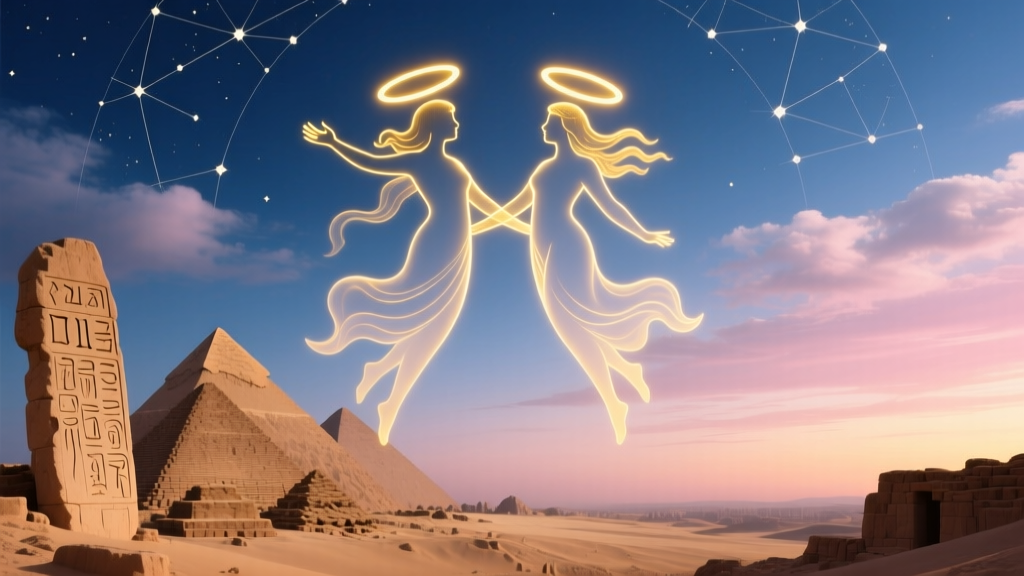
Explore the 18th June zodiac history and ancient origins. Uncover the Babylonian roots of late-degree Gemini and the enduring myth of the divine twins.
The
18th June zodiac placement corresponds precisely to the 27th degree of the tropical sign of Gemini. While modern pop astrology frequently reduces this birthdate to generic traits of communication and adaptability, the historical and archaeoastronomical origins of this specific zodiac coordinate reveal a far more complex archetype. Situated just days before the summer solstice, the late degrees of Gemini served as critical temporal markers for ancient agrarian and mythological systems. Understanding the true lineage of the 18th June zodiac requires tracing its evolution from Sumerian star catalogs to Hellenistic planetary bounds, revealing a personality profile defined by duality, mediation, and aesthetic intellect.
The Babylonian Roots of the 18th June Zodiac
The earliest recorded origins of the constellation governing the 18th June zodiac date back to the Babylonian
MUL.APIN, an astronomical compendium compiled around 1000 BCE. In this ancient text, the constellation was designated as
MUL.MASH.MASH, translating directly to 'The Twins.' However, these were not the Greek brothers Castor and Pollux familiar to modern readers. According to the
World History Encyclopedia's records on Mesopotamian Astronomy, the Sumerian twins were originally identified as Meshlamtaea and Lugalgira, minor underworld deities closely associated with Nergal, the god of pestilence and the afterlife.
For individuals born on June 18, this Sumerian origin provides a foundational layer of psychological depth. Meshlamtaea and Lugalgira were guardians of the underworld gates, representing the duality of life and death, the conscious and the subconscious. This ancient association explains the profound, often hidden psychological resilience found in those born on this specific date. They possess an innate ability to navigate psychological 'underworlds'—crises, transformations, and deep interpersonal conflicts—with the diplomatic grace of Mercury and the protective instinct of ancient guardian deities. The historical weight of these underworld twins suggests that the 18th June native is not merely a superficial communicator, but a psychopomp who guides others through intellectual and emotional transitions.
Hellenistic Astrology and the Dioscuri Mythos
As astrological knowledge transferred from Babylon to Alexandria and eventually to the Greco-Roman world, the twins were syncretized with the Dioscuri: Castor (the mortal) and Pollux (the immortal). This mythological shift, heavily documented in Claudius Ptolemy’s foundational 2nd-century text, the
Tetrabiblos via the Perseus Digital Library, fundamentally altered the interpretation of the late degrees of Gemini.
The myth of the Dioscuri centers on brotherly devotion and the sharing of immortality. When the mortal Castor died, Pollux refused to live without him, prompting Zeus to allow them to share immortality by alternating days between Mount Olympus and the Underworld. For the 18th June zodiac profile, this historical mythos translates into a modern psychological framework of extreme loyalty, codependency dynamics, and the ability to seamlessly bridge disparate social or intellectual worlds. The late-degree Gemini native operates as a mediator between opposing factions, much like the twins bridging the realm of gods and mortals. They are historically predisposed to partnerships, often finding that their greatest successes occur when they are operating as part of a complementary duo rather than in isolation.
The 27th Degree: Venusian Bounds and the Third Decan
To understand the precise astrological mechanics of June 18, one must examine the Hellenistic system of planetary bounds (or 'terms') and decans. The tropical zodiac divides each 30-degree sign into five unequal segments ruled by different planets. The 27th degree of Gemini—the exact coordinate for June 18—falls within the final bound of the sign, which is traditionally ruled by Venus (spanning 25° to 30°). Furthermore, in the Chaldean decan system, the third decan of Gemini (20° to 30°) is also sub-ruled by Venus. This double Venusian influence drastically modifies the baseline Mercurial energy of Gemini.
- Aesthetic Intellect: Unlike early-degree Geminis who prioritize raw data and rapid communication, the 18th June native filters information through a lens of aesthetics, harmony, and relational value. They are less concerned with being 'right' and more concerned with being 'diplomatic.'
- Diplomatic Mediation: The Venusian bound grants an exceptional ability to de-escalate intellectual conflicts. They do not just argue; they curate consensus and design compromises that satisfy all parties.
- Sensory Duality: The combination of Mercury (nervous system/air) and Venus (senses/earthiness) creates a personality that requires both high-level intellectual stimulation and deep physical comfort. They are prone to nervous exhaustion if their environment lacks aesthetic harmony.
Archaeoastronomy: Solstice Proximity and Agrarian Calendars
Historically, the 18th of June holds immense archaeoastronomical significance. Falling just three to four days prior to the Summer Solstice (the longest day of the year in the Northern Hemisphere), this period marked the absolute zenith of solar expansion. In ancient Roman religion, mid-June was dominated by the
Vestalia (festival of Vesta) and the subsequent
Quinquatrus Minusculae.
Agrarian societies viewed the late degrees of Gemini as the final window of intellectual and physical preparation before the harvest cycles initiated by the solstice and the subsequent Cancer season. Therefore, the historical origin of the 18th June zodiac personality is deeply tied to preparation, synthesis, and the finalization of social contracts before a period of emotional and domestic retreat. This historical context explains the 'urgency' often felt by June 18 individuals to wrap up projects, finalize agreements, and secure their social networks before the emotional inward turn of late June and July.
Historical Evolution of the 18th June Zodiac Personality
The interpretation of this specific birthdate has evolved dramatically across different astrological epochs. The following table outlines how the core archetype has shifted from ancient omen-based astrology to modern psychological frameworks.
| Era / System |
Primary Archetype |
Core Function & Societal Role |
| Babylonian (MUL.APIN) |
Underworld Guardians (Meshlamtaea & Lugalgira) |
Protecting thresholds; managing crises and transitions. |
| Hellenistic (Ptolemaic) |
The Dioscuri (Castor & Pollux) |
Mediating between mortal and divine; fostering alliances. |
| Medieval / Renaissance |
Venus-Bound Merchant |
Negotiating contracts; utilizing charm for economic gain. |
| Modern Psychological |
The Aesthetic Synthesizer |
Integrating opposing viewpoints; curating harmonious environments. |
Actionable Synthesis: Applying Ancient Gemini Wisdom Today
Understanding the historical origins of the 18th June zodiac provides a concrete framework for personal and professional development. Rather than relying on vague daily horoscopes, individuals born on this date can leverage their specific astrological lineage through targeted, actionable strategies:
- Leverage the Venusian Bound in Negotiations: Because your specific degree is ruled by Venus, you possess a historical advantage in contract negotiation and dispute resolution. Do not use aggressive, Mercurial debate tactics. Instead, focus on aesthetic presentation, relational harmony, and mutual benefit. Your highest ROI comes from making the opposing party feel valued and understood.
- Honor the Dioscuri Partnership Model: The myth of Castor and Pollux dictates that you thrive in complementary partnerships. Actively seek out business or creative partners who possess the skills you lack (e.g., if you are the visionary 'Pollux', partner with a grounded, operational 'Castor'). Attempting to operate as a solo founder or isolated creator will historically lead to burnout.
- Manage Solstice Energy Through Environmental Design: As a pre-solstice native, your nervous system is highly attuned to environmental shifts. To prevent the anxiety associated with late-degree Gemini, curate your physical workspace to include Venusian elements: live plants, balanced lighting, and tactile, high-quality materials. This grounds your Mercurial air energy into physical reality.
Integrating the Historical Archetype
The 18th June zodiac coordinate is far more than a simple marker of the Gemini season; it is a convergence point of ancient underworld mythology, Hellenistic planetary geometry, and agrarian solstice tracking. By recognizing the Venusian influence on the 27th degree and the enduring legacy of the divine twins, individuals born on this date can move beyond superficial astrological stereotypes. They are the historical mediators, the aesthetic intellectuals, and the guardians of the threshold, uniquely equipped to synthesize opposing forces into harmonious, enduring alliances.