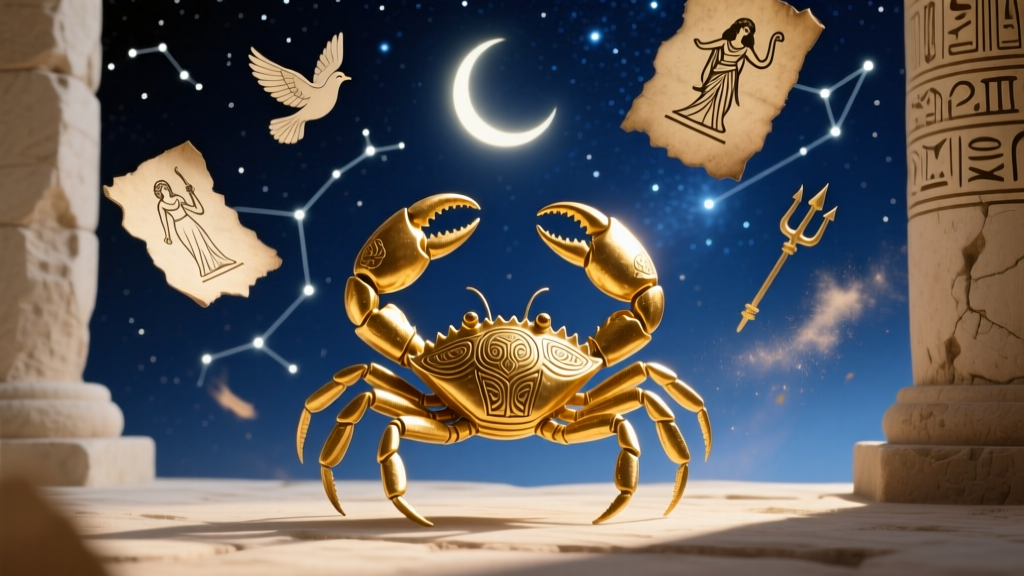
The 19 July star sign falls squarely within the tropical zodiac boundary of Cancer, specifically occupying the final ten degrees of this cardinal water sign. While modern pop astrology frequently reduces mid-July Cancer placements to basic emotional tropes, the historical and mythological lineage of this specific celestial coordinate reveals a complex framework of ancient cosmology, agricultural cycles, and esoteric philosophy. To understand the precise astrological mechanics of a July 19 birth, we must excavate the Babylonian star catalogs, Greek etiological myths, and Hellenistic decan systems that originally defined it.
The Ancient Babylonian Roots of the 19 July Star Sign
Long before the Hellenistic astrologers formalized the twelve-sign zodiac, the ancient Mesopotamians mapped the ecliptic based on the heliacal rising of specific constellations. In the MUL.APIN, a comprehensive Babylonian astronomical compendium compiled around 1100 BCE (but based on much older Sumerian observations), the region of the sky we now associate with Cancer was designated as MUL.AL.LUL.
Translating directly to 'crayfish' or 'crab,' this designation was not arbitrary. In the marshy ecology of ancient Sumer and Babylon, the crayfish represented the ultimate liminal creature. It dwelled in the mud at the boundary between solid earth and deep water, capable of surviving in both realms but belonging entirely to neither. This ecological observation formed the bedrock of the psychological profile associated with the 19 July star sign: an inherent comfort with liminality, the subconscious, and the transitional spaces between emotional depths and material reality.
Furthermore, the Babylonians recognized this constellation as a marker for the summer solstice. The sun's zenith in this muddy, water-adjacent sector of the sky coincided with the vital, life-giving inundation cycles necessary for Mesopotamian agriculture, cementing the sign's ancient association with nourishment, protection, and the preservation of life.
Karkinos and the Greek Mythological Shift
When Babylonian astrology was absorbed and adapted by the Greeks, the crayfish was upgraded to a crab, and a specific etiological myth was attached to it. According to the Theoi Project's archive of Greek mythology, the crab Karkinos was sent by the goddess Hera to distract Heracles during his battle with the Lernaean Hydra. Though Heracles crushed the crab, Hera rewarded its loyalty by placing it in the heavens as the constellation Cancer.
However, the deeper Hellenistic interpretation of this myth, particularly by Neoplatonic philosophers like Porphyry and Macrobius, viewed Cancer not merely as a crab, but as the 'Gate of Men.' In ancient esoteric astrology, the solstitial points were viewed as cosmic portals. Cancer, marking the descent of the sun after the summer solstice, was believed to be the portal through which souls descended from the Milky Way into physical incarnation. Capricorn, conversely, was the 'Gate of the Gods,' through which liberated souls ascended. Therefore, individuals born under the 19 July star sign are historically positioned near the closing of this incarnational gateway, suggesting a soul contract heavily focused on deep material and emotional integration.
Evolution of Symbolism Across Ancient Cultures
| Era / Culture | Constellation Name | Primary Symbolism | Astrological Function |
|---|---|---|---|
| Sumerian / Early Babylonian | AL.LUL | Crayfish, Mud-dweller | Liminality, boundary navigation |
| Classical Babylonian (MUL.APIN) | MUL.AL.LUL | Water/Earth intersection | Summer solstice marker, inundation |
| Ancient Egyptian | Khepri / Scarab | Scarab Beetle rolling the sun | Rebirth, cyclical time, soul evolution |
| Classical Greek | Karkinos | The Crab, Hera's champion | Protection, defensive loyalty |
| Hellenistic / Neoplatonic | Cancer (The Gate) | Portal of Descent | Soul incarnation, material attachment |
The Third Decan: Specific Mechanics for July 19
To achieve true astrological precision, we must look beyond the broad 30-degree span of Cancer and examine the specific decan (or 'face') that governs July 19. The zodiac is divided into 36 decans of 10 degrees each. July 19 falls into the third decan of Cancer (20° to 30°), a highly specific coordinate that drastically alters the baseline expression of the sign.
In the Chaldean decan system, which was later synthesized by Hellenistic astrologers like Vettius Valens, the third face of Cancer is ruled by Jupiter and corresponds to the sign of Pisces. This is a crucial piece of information gain for understanding this specific birth date. While the primary ruler of Cancer is the Moon (governing instinct, memory, and immediate emotional reactions), the decanic ruler Jupiter injects a philosophical, expansive, and deeply intuitive current into the psyche.
Consequently, the 19 July star sign personality is not solely driven by the Moon's need for localized security. The Jupiter-Pisces influence demands a search for universal meaning, spiritual expansion, and empathetic dissolution of boundaries. Where early-decan Cancers might build walls to protect their inner world, the third-decan Cancer born on July 19 is historically and astrologically predisposed to build bridges, utilizing their emotional depth for philosophical inquiry, spiritual mentorship, or large-scale caregiving.
Egyptian Astrology and the Scarab Connection
Prior to the total Hellenization of the Mediterranean, Egyptian priests mapped the same region of the ecliptic with a different, yet conceptually aligned, symbol: the Scarab Beetle (Khepri). As noted in historical analyses of Britannica's astronomical archives, the Egyptians observed that the summer solstice originally occurred in this sector of the sky (prior to the precession of the equinoxes shifting the solstice into Gemini over millennia).
The scarab was observed rolling a ball of dung across the earth, from which new life would eventually emerge. The Egyptians mapped this behavior onto the cosmos, envisioning a celestial scarab rolling the sun across the sky. For the 19 July star sign, this ancient Egyptian layer adds a dimension of relentless, self-generated momentum. It suggests that the emotional and psychological burdens carried by this placement are not merely sources of pain, but the very raw material required for continuous spiritual rebirth and self-actualization.
Actionable Historical Framework: Applying Ancient Wisdom
Understanding the historical origins of your astrological placement provides a practical decision-making framework. If you or a subject of your analysis was born on July 19, you can leverage these ancient archetypes for personal development:
- Leverage the Liminal Ecotype: Drawing from the Babylonian crayfish, you possess a natural aptitude for navigating transitional environments. Seek careers or roles that require mediating between distinct groups (e.g., translating technical data for laymen, or bridging executive strategy with frontline operations).
- Activate the Gate of Men: Recognizing the Neoplatonic concept of Cancer as the portal of incarnation, focus on grounding spiritual concepts into tangible, material realities. Your historical archetype demands that you do not just 'feel' or 'believe,' but that you physically manifest your emotional insights into the world.
- Utilize the Jupiter-Pisces Decan: When experiencing the typical Cancerian tendency toward emotional claustrophobia or defensive withdrawal, consciously engage your decanic ruler. Counteract isolation by engaging in expansive activities: studying foreign philosophies, traveling near large bodies of water, or participating in collective spiritual practices.
- Emulate the Scarab's Alchemy: Reframe emotional baggage not as a psychological deficit, but as the raw dung-ball of the Khepri archetype. Implement a weekly practice of 'composting'—journaling or creatively processing difficult emotions with the explicit intent of extracting the fertile insights hidden within them.
By anchoring the 19 July star sign in its rigorous historical, mythological, and decanic realities, we strip away modern superficialities and reveal a profound, ancient blueprint designed for emotional alchemy, spiritual incarnation, and liminal mastery.