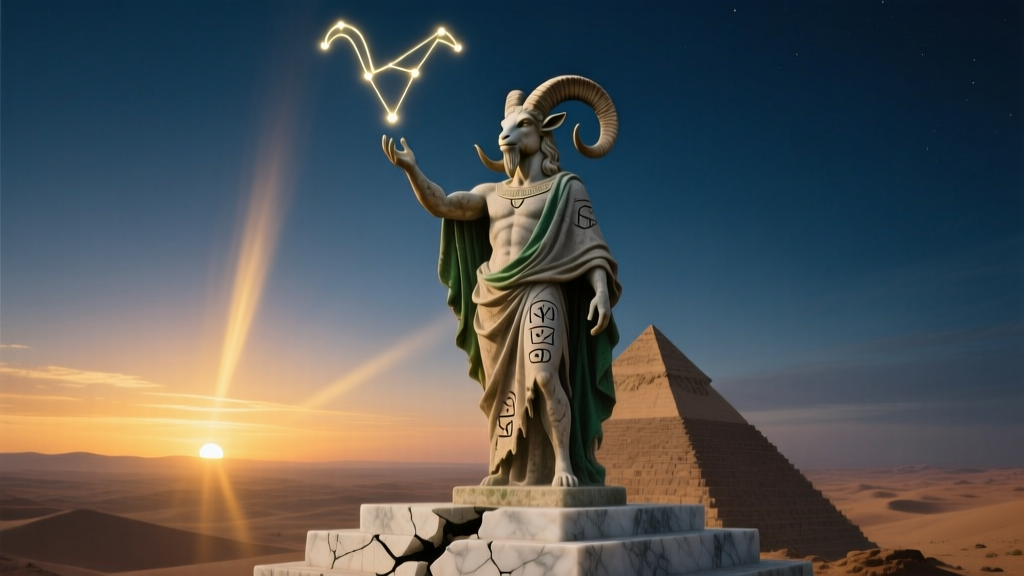
Individuals researching the 25th December zodiac sign are investigating the core of Capricorn, the tenth astrological sign of the zodiac. Far beyond modern newspaper horoscopes, the origins of this earth sign are deeply entwined with ancient Mesopotamian deities, Hellenistic astronomical mapping, and the Roman winter solstice. Born on this date, an individual falls under the cardinal earth modality, traditionally ruled by Saturn. To understand the specific astrological weight of December 25th, one must examine the historical evolution of the sea-goat mythos, the Julian calendar's solstice alignment, and the Chaldean decan system.
The Sumerian and Hellenistic Roots of the Sea-Goat
The symbol for Capricorn—the sea-goat—predates Hellenistic astrology by millennia, originating in ancient Sumeria as the deity Enki (later known as Ea in Akkadian). Enki was the god of water, knowledge, mischief, crafts, and creation, often depicted as a goat with a fish's tail. According to Britannica's historical archives on Mesopotamian religion, Enki's domain over the subterranean waters (the Abzu) established the foundational duality of the sign: the goat's ambition to climb the highest material peaks, combined with the fish's navigation of deep, unconscious emotional waters.
When Greek astrologers adopted the Babylonian zodiac, they mapped this imagery onto their own mythology, specifically the rustic god Pan. In the mythological war against the monster Typhon, the gods fled to Egypt, disguising themselves as animals. Pan attempted to transform into a fish to hide in the Nile, but only his lower half submerged, resulting in the hybrid sea-goat form. As documented by the Theoi Project's compendium of Greek mythology, this myth of Aegipan (Pan's son or aspect) solidified the archetype of Capricorn as a survivor capable of adapting to extreme environmental pressures through pragmatic transformation.
Astrological Mapping: Ptolemy and the Tropical Zodiac
The formalization of the 25th December zodiac sign within the Western astrological canon occurred during the Hellenistic period, culminating in Claudius Ptolemy's foundational text, the Tetrabiblos, in the 2nd century CE. Ptolemy codified the tropical zodiac, anchoring the sign of Capricorn to the winter solstice rather than the physical constellation.
The Shift from Constellation to Tropical Sign
Due to the precession of the equinoxes, the physical constellation of Capricorn no longer aligns with the tropical sign. A person born on December 25th is a tropical Capricorn, but astronomically, the sun is transiting the constellation of Sagittarius. Hellenistic astrologers prioritized the seasonal cycle over stellar backdrops. Capricorn was designated as the "tropic" sign because it marked the exact point where the sun's declination reached its southernmost limit before turning back north, symbolizing the ultimate triumph of light over darkness and the structural rebuilding of the solar year.
Why the 25th December Zodiac Sign Aligns with Sol Invictus
The specific date of December 25th holds profound historical astrological significance due to the Julian calendar. Introduced by Julius Caesar in 45 BCE, the Julian calendar miscalculated the solar year by 11 minutes. By the 1st century CE, the winter solstice had drifted to December 25th.
Consequently, in the Roman Empire, December 25th was celebrated as Dies Natalis Solis Invicti (the Birthday of the Unconquered Sun). Astrologically, this date marked the precise moment the sun halted its southern descent and began its return. Individuals born on this specific date historically carried the astrological burden of the "sun's rebirth," intertwining Capricorn's Saturnian discipline with the solar promise of renewed vitality. This historical overlap explains why December 25th Capricorns often exhibit a paradoxical blend of stoic responsibility (Saturn) and radiant, regenerative leadership (Sol Invictus).
The Saturnalian Legacy
Preceding Sol Invictus was Saturnalia, the Roman festival honoring Saturn, Capricorn's traditional ruling planet. Occurring in late December, Saturnalia involved the temporary subversion of social hierarchies. This historical context provides a crucial psychological key for the December 25th Capricorn: beneath their rigid, structured exterior lies an inherent understanding of systemic inversion and the necessity of dismantling outdated hierarchies to rebuild them more efficiently.
Decan Analysis: The First Decan of Capricorn
December 25th typically falls between 3° and 5° Capricorn, placing it firmly in the First Decan. In the Chaldean decan system, the First Decan of Capricorn is ruled by Saturn itself, doubling the planetary influence.
This specific degree range is associated with the Tarot card of the Two of Pentacles in the Golden Dawn system, representing the juggling of material resources, adaptability, and the maintenance of equilibrium amidst fluctuating circumstances. Historically, astrologers noted that individuals born in this exact decan possess an innate architectural mindset, viewing life not as a series of random events, but as a structure requiring continuous maintenance and strategic load-bearing.
Historical vs. Modern Astrological Frameworks
Understanding the 25th December zodiac sign requires contrasting how ancient traditions interpreted this placement versus modern psychological astrology.
| Astrological Framework | Ruling Planet / Concept | Interpretation of Dec 25th Capricorn | Primary Life Focus |
|---|---|---|---|
| Hellenistic / Traditional | Saturn (Greater Malefic) | Bound by duty, karmic debt, and material restriction. Success achieved only through prolonged hardship and endurance. | Public reputation, structural legacy, and survival. |
| Vedic (Jyotish) - Makara | Shani (Karma / Justice) | Highly pragmatic, deeply tied to societal structures and earthly ambitions. Strong potential for political or administrative power. | Dharma (duty), Artha (wealth), and societal contribution. |
| Modern Psychological | Saturn / Earth Element | Driven by a core wound of inadequacy. Overcompensates through hyper-independence, ambition, and rigid boundary-setting. | Self-actualization, shadow integration, and career mastery. |
Applying Ancient Capricorn Wisdom Today
To leverage the historical and astrological origins of the 25th December zodiac sign, individuals must move beyond generic horoscopes and apply traditional frameworks to modern life.
- Leverage Saturnian Hours: In traditional electional astrology, Saturn rules Saturdays and the first hour after sunrise on Saturday. Schedule your most demanding structural work—such as financial auditing, legal reviews, or long-term strategic planning—during these specific temporal windows to align with Capricorn's ancient planetary ruler.
- Embrace the Sea-Goat Duality: The Sumerian Enki mastered both the mountain and the abyss. If your material ambitions (the goat) lead to burnout, you must actively engage with the unconscious (the fish). Implement strict, non-negotiable periods of digital detachment and deep-water immersion (literally swimming or sensory deprivation) to reset your nervous system.
- Honor the Sol Invictus Shift: Recognize that your birth date historically marks the return of the light. When facing systemic failures or personal "winters," use the Sol Invictus framework: focus entirely on the smallest, most actionable step forward. Capricorn's power lies in incremental, unglamorous progress that compounds over decades.
- Study Historical Precedents: Analyze the biographies of historical figures born on or near December 25th (such as Humphrey Bogart or Annie Lennox) not for their fame, but for their crisis management strategies. Capricorn's true genius is revealed in how it stabilizes chaotic environments.
By anchoring your understanding of Capricorn in its Sumerian myths, Hellenistic geometry, and Roman solstice traditions, you transform the 25th December zodiac sign from a simple personality descriptor into a profound, actionable blueprint for structural mastery and enduring legacy. For further reading on the evolution of astrological rulerships, consult Britannica's comprehensive biography of Claudius Ptolemy and his impact on Western esoteric traditions.