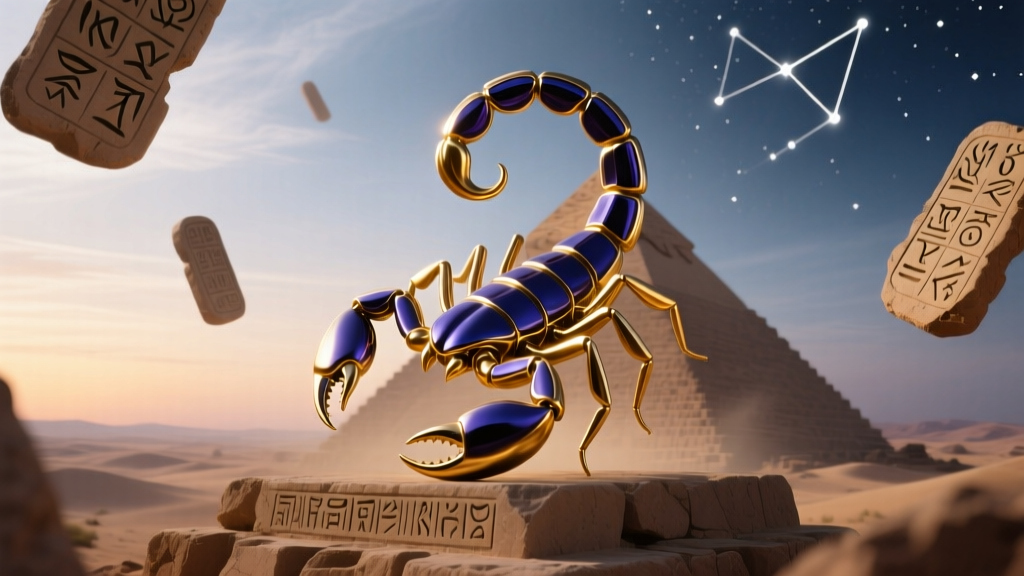
When analyzing the 28th October zodiac profile, we must look beyond modern horoscope columns and examine the deep historical and mythological strata of Scorpio. Falling squarely in the first decan of the eighth astrological sign, this date carries the compounded historical weight of ancient Mesopotamian star catalogs, Hellenistic mythmaking, and esoteric planetary rulerships. The celestial archetype associated with late October was not invented in a vacuum; it was forged through millennia of human observation of the night sky, agricultural cycles, and the psychological need to map human temperament onto the cosmos. To understand the true origin story of this specific zodiac placement, we must trace its lineage from the clay tablets of Babylon to the esoteric traditions of the 20th century.
Babylonian Origins of the 28th October Zodiac
The foundation of Western astrology rests on the Babylonian star catalogs, specifically the MUL.APIN compiled around 1000 BCE. In this ancient text, the constellation we now recognize as Scorpio was recorded as GIR.TAB, which translates directly to 'the scorpion.' However, the historical context of GIR.TAB was deeply intertwined with the goddess Ishhara, a Mesopotamian deity associated with love, war, and the underworld. Ishhara’s symbol was the scorpion, representing the dual nature of venom (destruction) and the antidote (healing). For those born under the 28th October zodiac alignment, this ancient duality remains a core psychological marker. The Babylonians did not view the scorpion merely as a dangerous pest; it was a guardian of the underworld's gates, a psychopomp guiding souls through transitions. This historical framework explains the profound transformative resilience and comfort with psychological depth inherent in late-October Scorpios. World History Encyclopedia's analysis of ancient astrology highlights how these early Mesopotamian archetypes formed the unshakeable bedrock of all subsequent zodiacal interpretations.
Hellenistic Astrology and the Myth of Orion
As astrological knowledge migrated from Babylon to Greece during the Hellenistic period (circa 3rd century BCE), the scorpion was absorbed into Greek mythology, most notably through the catasterism of Orion. According to the myth, the giant hunter Orion boasted that he could kill every beast on Earth. Gaia (the Earth goddess) or Artemis (goddess of the hunt), enraged by his hubris, sent a giant scorpion to sting him to death. Zeus subsequently placed both Orion and the Scorpion in the sky as constellations, positioning them on opposite sides of the celestial sphere so they would eternally chase one another.
This mythological origin story provides a structural metaphor for the 28th October zodiac personality: the eternal conflict between ego (Orion) and the shadow self (the Scorpion). The Greek tradition formalized Scorpio as a fixed water sign, cementing its association with emotional depth, fixed determination, and the hidden undercurrents of the human psyche. Britannica's astronomical records confirm that Scorpius remains one of the most prominent and historically consistent constellations in the zodiacal band, uniquely resembling its namesake and anchoring the autumn sky.
The Chaldean Decan System: Planetary Rulers of October 28th
To achieve granular historical accuracy, we must apply the Hellenistic and Chaldean decan system, which divides each 30-degree zodiacal sign into three 10-degree decans. October 28th falls at approximately 5 degrees Scorpio, placing it firmly in the first decan.
| Scorpio Decan | Degree Range | Traditional Ruler | Archetypal Focus |
|---|---|---|---|
| First Decan | 0° - 10° (Includes Oct 28) | Mars | Raw power, survival, strategic aggression |
| Second Decan | 11° - 20° | Moon | Emotional security, psychic intuition |
| Third Decan | 21° - 30° | Neptune/Jupiter | Spiritual transcendence, hidden motives |
In the traditional Chaldean order, the first decan of Scorpio is ruled by Mars. This means that individuals born on this date possess a 'pure' or undiluted Scorpio archetype, unmodified by the sub-rulerships of the Moon or Neptune that influence the later decans. Mars endows this placement with raw, pioneering energy, strategic aggression, and an unyielding will. Unlike the cardinal fire of Aries (also ruled by Mars), Mars in the fixed water sign of Scorpio operates as a submarine force—calculated, enduring, and deeply strategic.
The Modern Shift: Mars to Pluto
Historically, Mars was the sole ruler of Scorpio from antiquity until 1930, when astronomer Clyde Tombaugh discovered Pluto. The astrological community subsequently assigned Pluto as the modern ruler of Scorpio, representing the subconscious, power dynamics, and regeneration. Therefore, a person born on October 28th operates under a co-rulership model: the classical, tactical drive of Mars combined with the modern, psychological depth of Pluto. This dual rulership creates a personality that is both outwardly strategic and inwardly philosophical, capable of executing long-term plans while simultaneously deconstructing their own psychological motives.
Calendar Alignments: Samhain and the Thinning Veil
The historical timing of late October is inextricably linked to ancient agrarian and spiritual calendars. In the Celtic tradition, the period surrounding October 28th leads directly into Samhain (October 31st to November 1st). Samhain marked the end of the harvest and the beginning of the 'darker half' of the year. It was believed that during this time, the veil between the physical world and the Otherworld was at its thinnest.
While the zodiac is based on the ecliptic longitude of the sun rather than the fixed calendar dates of terrestrial festivals, the historical synchronization of the 28th October zodiac placement with the Samhain season reinforces its archetypal association with death, rebirth, and the occult. Astrologers historically noted that children born during this liminal window exhibited heightened intuition and a natural affinity for esoteric subjects. The Roman equivalent, the festival of Pomona or the later Lemuria (though celebrated in May, sharing underworld themes), further underscores the late-October focus on ancestral veneration and spiritual transformation.
Actionable Framework: Applying Ancient Scorpio History
Understanding the historical origins of your zodiac placement is not merely an academic exercise; it provides a practical framework for personal development. By leveraging the ancient archetypes of Ishhara, the Orion myth, and the Mars-Pluto co-rulership, individuals born on October 28th can optimize their natural tendencies.
- Shadow Integration (The Orion Protocol): Recognize that the 'hunter' (ego/ambition) and the 'scorpion' (shadow/sabotage) are perpetually linked. When experiencing self-sabotage, trace the behavior back to an inflated ego claim. Neutralize the scorpion's sting by acknowledging the hubris of the hunter.
- Strategic Patience (Fixed Water Mars): Avoid the Aries-style impulse to act immediately. Utilize the historical Mars-in-Scorpio framework to gather intelligence, observe power dynamics, and strike only when the outcome is mathematically certain. Your historical advantage is endurance, not speed.
- Venom-to-Medicine Alchemy (Ishhara's Gift): The Babylonian association with Ishhara highlights the ability to turn poison into an antidote. In professional and personal conflicts, actively seek the hidden utility in painful experiences. Document your failures and extract the precise operational lessons required to inoculate yourself against future risks.
- Liminal Networking (The Samhain Connection): Capitalize on the historical association with the 'thinning veil' by scheduling deep psychological research, ancestral genealogy work, or high-stakes negotiations during the late October window. Your natural resonance with the underworld archetype peaks during this solar transit.