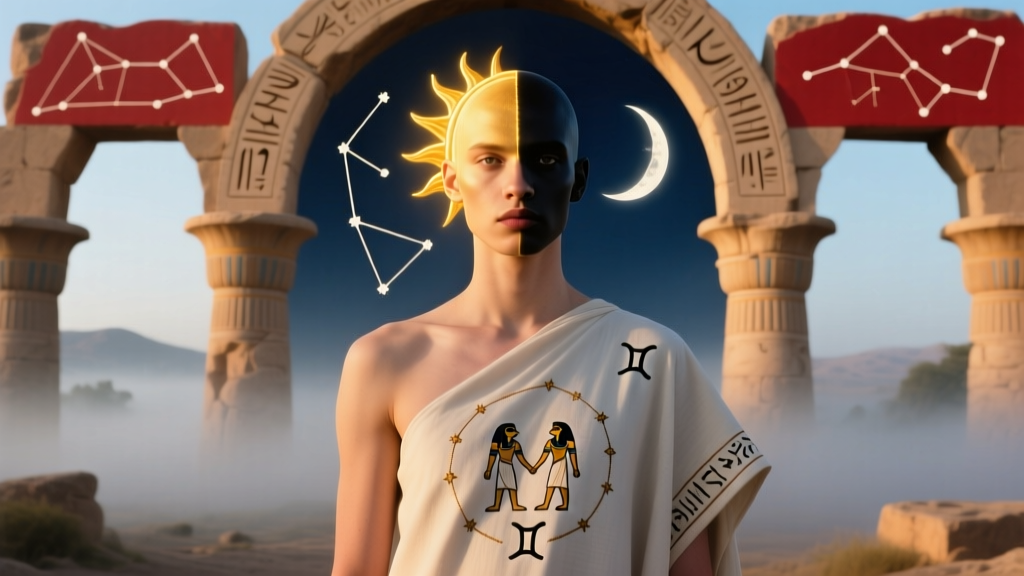
Individuals researching the 30th May zodiac sign are investigating a birth date that falls squarely within the domain of Gemini, the third astrological sign of the tropical zodiac. While modern pop astrology often reduces this mutable air sign to mere dual personality tropes or superficial communication quirks, the historical and mythological origins of Gemini reveal a complex framework of celestial navigation, agricultural timing, and Hermetic philosophy. Tracing the 30th May zodiac sign back through Hellenistic, Babylonian, and Sumerian records provides a profound understanding of the Mercurial energy that governs this specific degree of the ecliptic.
The Mesopotamian Blueprint: MUL.APIN and the Great Twins
The earliest verifiable origins of the Gemini constellation do not feature the Greek heroes Castor and Pollux. Instead, they are rooted in the Babylonian astronomical compendium known as the MUL.APIN, compiled around 1000 BCE. In this cuneiform tradition, the constellation was recorded as MUL.MASH.TAB.BA.GAL.GAL, translating to 'The Great Twins.'
According to records preserved in the British Museum's Cuneiform Collection, these twins were identified as Meshlamtaea and Lugalirra, two manifestations of Nergal, the Mesopotamian god of the underworld and pestilence. Unlike the later Hellenistic association with intellect and commerce, the Babylonian twins were deeply tied to the cyclical nature of life, death, and the heliacal rising of stars that dictated the agricultural calendar. For those born on May 30, this ancient underworld association hints at a psychological depth and a capacity for psychological regeneration that is often missed in modern horoscope columns.
Hellenistic Evolution: The Dioscuri and Ptolemaic Synthesis
As astrological knowledge migrated from Babylon to Alexandria, the Great Twins were syncretized with the Greek mythological figures Castor and Pollux (the Dioscuri). This shift fundamentally altered the archetypal expression of the sign. Castor, the mortal son of Tyndareus, and Pollux, the immortal son of Zeus, represented the bridging of the mortal and divine realms—a theme of mediation that remains central to the Gemini archetype.
The formalization of the 30th May zodiac sign's elemental and planetary rulerships occurred during the Hellenistic period, most notably codified by Claudius Ptolemy in the 2nd century CE. In his foundational text, the Tetrabiblos, Ptolemy assigned Mercury as the domicile ruler of Gemini and classified it as a masculine, diurnal, and airy sign. Ptolemy's systematic approach stripped away some of the earlier mythological fatalism, replacing it with a framework of elemental qualities (hot and wet) that defined the sign's physiological and psychological correlations for the next two millennia.
Decoding the 30th May Zodiac Sign Through Hellenistic Decans
To understand the specific historical flavor of a May 30 birth date, we must look at the degree-specific rulership systems developed by Hellenistic and Chaldean astrologers. May 30 typically falls between the 9th and 10th degrees of Gemini, placing it firmly in the first decan of the sign.
Triplicity and Decan Rulerships
In the Hellenistic system of triplicity rulers, outlined by Dorotheus of Sidon in the 1st century CE Carmen Astrologicum, the air signs are governed by a specific sequence of planets depending on whether the birth occurred during the day or night. Furthermore, the Chaldean decan system assigns a specific planetary ruler to every 10-degree segment of the zodiac.
| Astrological System | Ruling Planet(s) | Historical Function & Archetype |
|---|---|---|
| Domicile (Ptolemaic) | Mercury | Base intellect, commerce, neurology, and data synthesis. |
| Chaldean Decan (1st) | Mercury | Amplifies Mercurial traits; pure, unadulterated cognitive processing. |
| Triplicity (Day Chart) | Saturn | Structure, discipline, and the architectural framing of ideas. |
| Triplicity (Night Chart) | Mercury | Adaptability, nocturnal networking, and rapid information exchange. |
| Triplicity (Participating) | Jupiter | Expansion of knowledge, publishing, and higher education. |
This table reveals a critical piece of information gain: a May 30 Gemini is not merely ruled by Mercury. If born during daylight hours, the historical triplicity ruler is Saturn. This Saturnine influence provides the structural discipline necessary to turn Mercurial brainstorming into tangible, long-lasting intellectual property.
Hermetic Philosophy and the Principle of Polarity
The esoteric origins of the Gemini archetype are deeply intertwined with Hermeticism, the philosophical system attributed to Hermes Trismegistus (the Greek syncretism of the god Hermes and the Egyptian god Thoth). Both deities are intrinsically linked to the planet Mercury, the undisputed ruler of the 30th May zodiac sign.
In the Kybalion, a foundational text of modern Hermetic philosophy, the 'Principle of Polarity' states that everything has its pair of opposites, and extremes meet. The 'Twins' of Gemini are the ultimate astrological embodiment of this principle. They do not represent a fractured or dual personality, as modern psychology might misinterpret; rather, they represent the mastery of polarity. The historical initiate of the Mercurial mysteries was expected to hold two opposing ideas in their mind simultaneously without losing cognitive function—a highly actionable cognitive framework for modern problem-solving.
Actionable Synthesis: Applying Historical Gemini Traits Today
Understanding the ancient origins of your zodiac sign moves astrology from passive entertainment to an active psychological framework. Based on the historical data of the MUL.APIN, Ptolemaic elemental theory, and Hermetic philosophy, here are three actionable strategies for individuals born under the 30th May zodiac sign:
- Leverage Saturnine Structuring (Day Births): If you were born during the day, your Hellenistic triplicity ruler is Saturn. Do not rely solely on rapid ideation (Mercury). Implement a strict 'capture and organize' system for your ideas. Use databases like Notion or Obsidian to build structural lattices for your thoughts, satisfying the Saturnine need for architectural order.
- Apply the Hermetic Polarity Framework: When facing a negotiation or conflict, actively map out the exact opposite of your current stance. Because your archetype governs the mediation of extremes (Castor and Pollux bridging mortal and divine), your highest cognitive function is activated when you synthesize two opposing viewpoints into a third, novel solution.
- Honor the Underworld Cycle (Mesopotamian Roots): The Babylonian association with Nergal suggests a need for periodic psychological descent. Schedule quarterly 'dark days'—periods of zero digital communication and zero intellectual output. This honors the ancient cyclical nature of the Great Twins and prevents the neurological burnout common in highly Mercurial individuals.
By anchoring the 30th May zodiac sign in its rigorous historical and mythological context, we uncover a sophisticated archetype. Far from the superficial 'chatterbox' stereotype, the true historical Gemini is a structural mediator, an underworld navigator, and a master of Hermetic polarity.