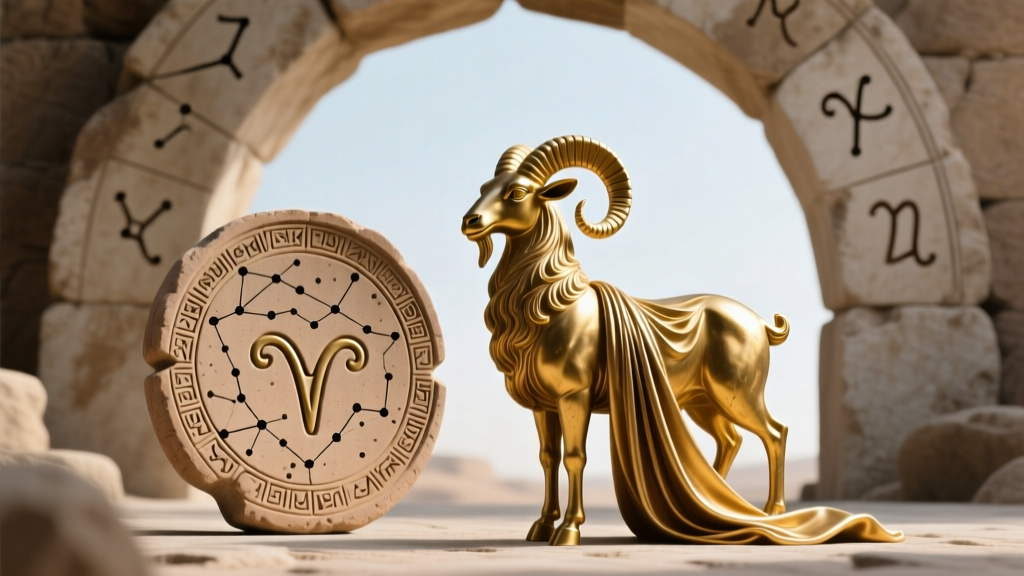
Individuals researching the 7 April zodiac are exploring a highly specific coordinate in the tropical astrological calendar: the 17th degree of Aries. While modern pop astrology reduces this date to generic horoscopes, the historical and mythological origins of this zodiacal placement reveal a complex tapestry of ancient Mesopotamian agriculture, Hellenistic myth-making, and esoteric decanate rulerships. To understand the true historical weight of the April 7 birth chart, we must trace the Aries archetype back to its Babylonian roots, examine the mythological evolution of the Ram, and analyze the specific historical significance of the second Aries decan. This analysis bridges ancient celestial observation with modern natal chart interpretation.
The Babylonian Roots: From Agrarian Worker to Ram
The origins of the zodiac do not begin in Greece, but in the fertile crescent of Mesopotamia. According to the World History Encyclopedia's records on Babylonian Astronomy, early Sumerian and Babylonian star catalogs mapped the ecliptic into distinct constellations tied to agricultural cycles. In the foundational compendium known as the MUL.APIN (compiled around 1000 BCE), the constellation we now recognize as Aries was originally designated as MUL.LÚ.ḪUN.GÁ, translating to the "Agrarian Worker" or "Hired Man."
This figure was intimately associated with Dumuzi (the Sumerian god of shepherds and vegetation), representing the seasonal cycle of death and rebirth tied to the spring harvest. The transition from the Agrarian Worker to the Ram (MUL.Ú.RÚ) occurred gradually during the late Babylonian period (circa 500 BCE). Historians attribute this shift to the rising socio-economic importance of pastoralism and sheep herding in the region, as well as potential linguistic wordplay in Akkadian. By the time the zodiac was formalized into the 12-sign system, the Ram had entirely superseded the human agrarian figure, establishing the foundational livestock symbolism that would later be exported to the Hellenistic world.
The Hellenistic Shift and the Golden Fleece Myth
When Babylonian astrology was absorbed by the Greeks during the Hellenistic period (following Alexander the Great's conquests), the 7 April zodiac sign was recontextualized through the lens of Greek mythology. The Ram became identified with Chrysomallus, the divine, golden-fleeced flying ram sent by the cloud nymph Nephele to rescue her children, Phrixus and Helle, from being sacrificed to the gods.
While Helle tragically fell from the ram's back into the strait now known as the Hellespont, Phrixus survived and fled to Colchis. There, he sacrificed the ram to Zeus and hung its magical Golden Fleece in a sacred grove guarded by a dragon. This mythological overlay profoundly altered the astrological interpretation of Aries. It was no longer merely a symbol of agricultural fertility; it became the ultimate catalyst for the heroic quest. The Golden Fleece was the very prize that Jason and the Argonauts sought, embedding themes of martial courage, initiation, and the pursuit of the impossible into the psychological profile of the Aries archetype. For those born on April 7, this mid-degree placement historically signifies the active, arduous pursuit of the "fleece"—the personal grail or life mission.
Decanate History: The 17th Degree and the Solar Influence
To understand the specific nuance of April 7, one must look beyond the primary sign of Aries and examine the historical decan system. The zodiac was divided into thirty-six decans (10-degree segments) by Hellenistic and later medieval astrologers. April 7 typically falls at 17 degrees of Aries, placing it squarely in the Second Decan.
In the ancient Chaldean decan rulership system, the first decan of Aries is ruled by Mars, but the second decan is sub-ruled by the Sun. This is a critical piece of information gain for natal chart analysis. The martial, aggressive, and pioneering energy of Mars (the primary ruler of Aries) is synthesized with the vitalizing, authoritative, and creative expression of the Sun.
Furthermore, in the Triplicity rulership system favored by medieval astrologers like Guido Bonatti, the second decan of Aries aligns with the fire sign of Leo. This historical layering suggests that individuals born under the 7 April zodiac possess a dual-layered fire signature: the raw, initiating spark of the cardinal fire (Aries) combined with the sustained, organizing, and regal brilliance of fixed fire (Leo/Sun).
Historical Evolution of the April 7 Archetype
| Era | Designation | Ruling Deity/Planet | Core Archetype |
|---|---|---|---|
| Early Babylonian (c. 2000 BCE) | Agrarian Worker (Dumuzi) | Inanna / Dumuzi | Agricultural fertility, seasonal sacrifice |
| Late Babylonian (c. 500 BCE) | The Ram (MUL.Ú.RÚ) | Marduk / Nabu | Pastoral wealth, spring initiation |
| Hellenistic (c. 200 BCE) | Aries / Chrysomallus | Mars (Ares) | Heroic quest, martial courage |
| Medieval / Renaissance | Second Decan of Aries | Sun / Leo | Nobility, creative authority, stamina |
The Precession of the Equinoxes and Tropical Anchoring
A rigorous historical analysis of the 7 April zodiac must address the astronomical phenomenon of axial precession. Discovered by the Greek astronomer Hipparchus around 127 BCE, the precession of the equinoxes dictates that the Earth's axial wobble causes the vernal equinox point to drift backward through the constellations at a rate of approximately one degree every 72 years. As noted in Britannica's astronomical records on precession, the "First Point of Aries" (0° Aries) was actually located in the constellation of Aries during the Babylonian era. Today, the sun is physically located in the constellation of Pisces on April 7.
However, Western astrology operates on the Tropical Zodiac, a system formalized by Claudius Ptolemy in the 2nd century CE. Ptolemy anchored the zodiac to the seasons rather than the distant stars. Therefore, the 7 April zodiac remains permanently fixed to the onset of Northern Hemisphere spring and the 17th degree of Aries, prioritizing the Earth-Sun seasonal relationship over sidereal constellation drift. This distinction is vital for astrologers reconciling historical astronomy with modern tropical chart casting.
Synthesizing the 7 April Zodiac for Modern Chart Interpretation
Integrating this historical data transforms how an astrologer or enthusiast interprets an April 7 natal chart. The Babylonian roots highlight a foundational need to cultivate, plant, and initiate new cycles of personal growth, echoing the ancient Agrarian Worker. The Hellenistic myth of Chrysomallus points to a life path requiring immense courage to escape stagnant environments and pursue a distant, hard-won prize. Finally, the Chaldean and Triplicity decan rulerships (Sun/Leo) provide the psychological stamina and charismatic authority required to see those pioneering Aries impulses through to completion. Rather than viewing this birth date as a generic Aries placement, recognizing its deep historical stratigraphy allows for a highly specific, actionable framework for understanding personal drive, leadership styles, and mythological life themes.