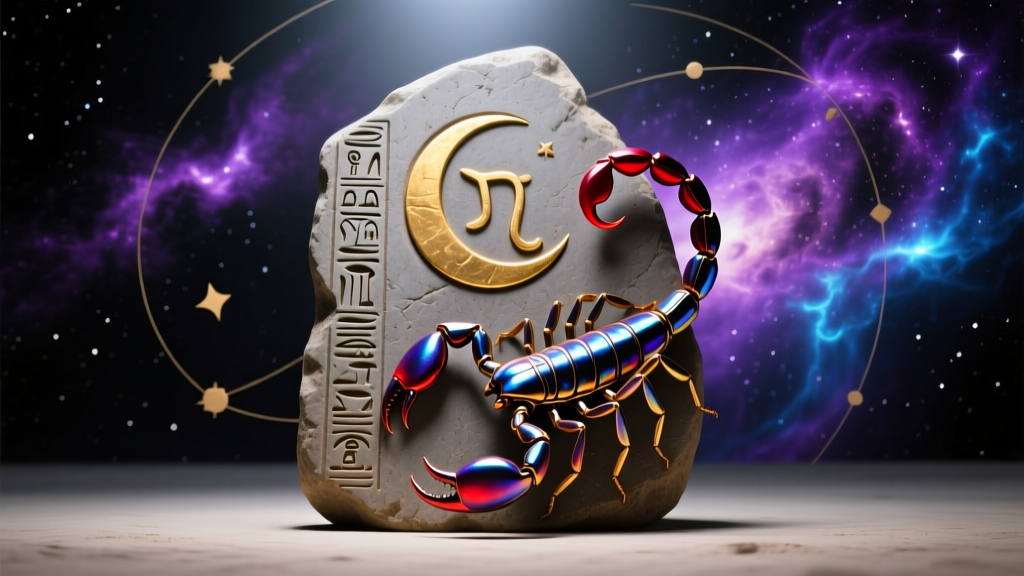
Individuals born under the 7th November star sign fall within the second decan of Scorpio, a fixed water sign historically governed by Mars and, in modern astrology, Pluto. To comprehend the esoteric depth of this specific natal placement, one must look beyond contemporary sun-sign columns and examine ancient astronomical records. The origins of this zodiacal sector trace back over three millennia to Mesopotamian star catalogs, where the scorpion was revered as a divine guardian of the underworld and a marker of seasonal transitions. This historical analysis traces the evolution of the Scorpio archetype from Babylonian clay tablets to Hellenistic horoscopic frameworks, revealing how ancient sky-watchers codified the celestial mechanics that define this date.
The Babylonian Roots of the 7th November Star Sign
The conceptual foundation of the zodiac originated in ancient Mesopotamia. According to historical astrology overviews on Britannica, the earliest comprehensive star catalog, the MUL.APIN (compiled circa 1000 BCE), divided the ecliptic into specific constellations rather than the equal 30-degree signs used today. In this compendium, the region of the sky corresponding to the modern 7th November star sign was designated as GIR.TAB, literally translating to 'the scorpion.'
Unlike later Greek interpretations that emphasized the scorpion's venomous sting, Babylonian astronomers associated GIR.TAB with the goddess Ishhara, a complex deity governing oaths, divination, and the underworld. The heliacal rising and setting of this constellation served as a critical agricultural calendar marker, signaling the onset of the autumn rains and the descent of the natural world into dormancy. Priests utilized the precise transit of stars within GIR.TAB to formulate omens for the king, establishing the foundational premise that celestial movements in this sector correlated with themes of transformation, hidden knowledge, and mortality.
Hellenistic Codification and the Tropical Zodiac
The transition from Babylonian observational astronomy to the structural zodiac utilized by Western astrologers occurred during the Hellenistic period, culminating in the works of Claudius Ptolemy in the 2nd century CE. Ptolemy’s Tetrabiblos formalized the tropical zodiac, anchoring the first degree of Aries to the vernal equinox. This mathematical decision permanently locked the dates of October 23 through November 21 to the sign of Scorpio, regardless of the actual physical constellations shifting in the sky.
Consequently, the 7th of November was mathematically fixed at approximately 14 to 15 degrees of Scorpio. Hellenistic astrologers introduced the doctrine of essential dignities, assigning Mars as the diurnal and nocturnal ruler of this sector. Furthermore, this specific degree range falls within the exaltation bounds of certain traditional planets, creating a complex interplay of martial aggression and deep, fixed emotional retention. The Hellenistic synthesis transformed the scorpion from a mere seasonal omen into a sophisticated psychological and predictive archetype, embedding the concepts of crisis, regeneration, and occult investigation into the natal interpretation of this date.
The Mythological Catasterism of Orion and Scorpius
Greek mythology provided a narrative framework for the astronomical realities observed by earlier cultures. The most prominent origin myth associated with this constellation involves the hunter Orion and his celestial adversary. According to the myth, Orion boasted that he could slay any beast on Earth, prompting Gaia (or in some versions, Artemis) to send a giant scorpion to strike him down. Upon their mutual destruction, Zeus placed both figures in the sky as constellations.
This mythological catasterism directly mirrors an observable astronomical phenomenon: the constellations of Orion and Scorpius are situated on exactly opposite sides of the celestial sphere. As Scorpius rises in the east, Orion sets in the west, ensuring the hunter and the scorpion are eternally chasing one another but never occupying the night sky simultaneously. This eternal celestial pursuit reinforced the astrological themes of the sign: inescapable fate, the consequences of hubris, and the cyclical nature of destruction and rebirth.
Astronomical Precession and the Ophiuchus Misconception
A frequent point of confusion in modern astrological discourse involves the astronomical position of the Sun on November 7th. Due to the precession of the equinoxes—a slow, 26,000-year wobble of the Earth’s rotational axis first documented by Hipparchus in 127 BCE—the tropical zodiac no longer aligns with the visible constellations. As defined by the modern boundaries established by the International Astronomical Union (IAU), the Sun actually transits through the constellation of Libra from approximately October 31 to November 22.
Furthermore, the Sun passes through the constellation of Ophiuchus (the Serpent Bearer) from November 29 to December 17. However, Western astrology relies on the tropical zodiac, which measures the Earth's seasonal relationship to the Sun, not the irregular, unequal physical constellations. Therefore, the 7th November star sign remains unequivocally Scorpio in astrological practice. The tropical framework preserves the seasonal integrity of the Hellenistic system, where mid-autumn in the Northern Hemisphere demands a fixed water sign representing the deep, conserving, and transformative forces of nature preparing for winter.
Historical Timeline of Scorpio's Astrological Identity
| Era | Civilization | Designation / Concept | Primary Significance |
|---|---|---|---|
| c. 3000 BCE | Sumerian | GIR.TAB | Associated with the underworld deity Ishhara; marker of autumn. |
| c. 1000 BCE | Babylonian | MUL.APIN Catalog | Codified as a distinct ecliptic constellation for omen reading. |
| 5th Century BCE | Babylonian | Equal-Sign Zodiac | First division of the ecliptic into twelve equal 30-degree signs. |
| 2nd Century CE | Hellenistic | Ptolemy's Tetrabiblos | Fixed to the tropical zodiac; Mars established as traditional ruler. |
| 1930 CE | Modern | IAU Constellation Boundaries | Astronomical borders redrawn; Sun is physically in Libra on Nov 7. |
Decan Rulership and the Fixed Star Antares
To extract actionable specificity from the history of the 7th November star sign, practitioners must examine the Chaldean decans and the influence of fixed stars. November 7th typically corresponds to 14° or 15° Scorpio, placing it squarely in the second decan. In the traditional Hellenistic and medieval systems (such as those preserved in the Picatrix), the second decan of Scorpio is sub-ruled by the Sun. This introduces a fascinating paradox: the dark, secretive nature of Mars-ruled Scorpio is illuminated by the vital, expressive force of the Sun, granting individuals born on this date a unique capacity to bring hidden truths to light and lead through transformative crises.
Additionally, this degree range is historically associated with the influence of Antares (Alpha Scorpii), the 'Heart of the Scorpion.' Antares is a red supergiant and one of the four Royal Stars of ancient Persian astrology, functioning as the Watcher of the West. When prominent in a natal chart, Antares bestows immense strategic capability and a drive for monumental achievement, but it carries a strict historical caveat: success must be achieved with absolute integrity, or the 'sting' of the scorpion will manifest as a sudden fall from grace. Integrating the Sun-ruled decan with the martial intensity of Antares provides a highly precise framework for analyzing the psychological drive of this specific birth date.
Archival Sources and Further Study
The historical trajectory of the zodiac demonstrates that astrological archetypes are not arbitrary inventions, but complex syntheses of observational astronomy, seasonal agriculture, and mythological storytelling. The 7th November star sign encapsulates thousands of years of human attempts to map the descent into the underworld and the subsequent regeneration of the soul. For researchers seeking primary translations of the MUL.APIN or the Tetrabiblos, academic repositories and translations by historians of science, such as those found via Britannica's astronomical entry on Scorpius, provide essential context for separating ancient empirical observation from modern astrological embellishment. Understanding these roots allows for a far more rigorous and historically grounded application of astrological principles.