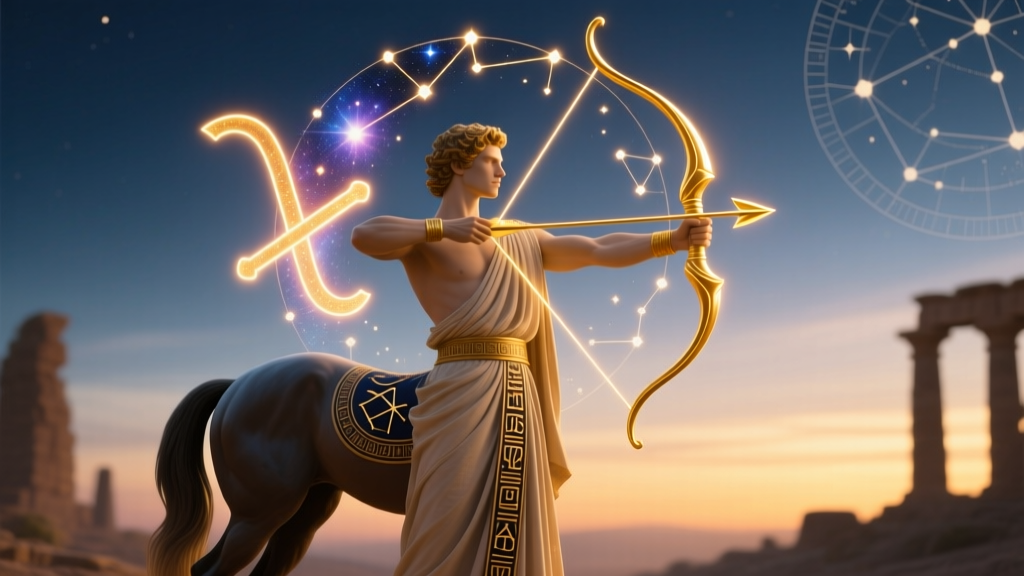
The 8th December zodiac placement positions the Sun at approximately 16 degrees of Sagittarius. To understand the psychological and spiritual blueprint of this birthdate, one must bypass modern pop-astrology and examine the ancient astrological stratigraphy of this specific degree. Born under a mutable fire sign, individuals emerging on this date inherit a complex lineage spanning Babylonian star catalogs, Egyptian decanic systems, and Hellenistic planetary bounds. This historical analysis decodes the origin story of the December 8th archetype, revealing how ancient celestial cartographers mapped the martial and philosophical energies that define this specific natal placement.
Babylonian Star Catalogs: Pabilsag and the Scorpion-Man
The western zodiac's Sagittarius is a direct descendant of Mesopotamian celestial cartography. In the MUL.APIN, a comprehensive Babylonian star catalog compiled around 1000 BCE, the constellation we now recognize as the Archer was not originally depicted as a centaur. Instead, it was identified as Pabilsag, a tutelary deity of the ancient Sumerian city of Larak, or as the Girtablullu (the Scorpion-Man). Pabilsag was a god of war and hunting, often depicted with a bow, arrow, and the tail of a scorpion, sometimes featuring wings.
For those born on December 8th, this Babylonian origin provides a foundational layer of meaning. The Scorpion-Man was a guardian figure in the Epic of Gilgamesh, protecting the sacred mountain Mashu where the sun rose and set. This mythological function translates astrologically into the December 8th archetype's innate drive to protect philosophical truths and guard the thresholds of higher knowledge. The martial energy of Pabilsag's bow and arrow establishes the proactive, target-oriented nature of this birthdate, distinguishing it from the more purely intellectual pursuits of adjacent air signs.
The Hellenistic Synthesis: Decans and Planetary Bounds
During the Hellenistic period (circa 2nd century BCE to 2nd century CE), astrologers synthesized Babylonian observations with Egyptian time-keeping and Greek geometry. This era birthed the system of planetary bounds (or horia) and decans, which provide microscopic precision for the 8th December zodiac profile. The Sun at 16 degrees Sagittarius falls into the second decan of the sign, a sector historically sub-ruled by Mars (the ruler of Aries). This Martian sub-rulership injects a pioneering, combative, and highly independent streak into the otherwise jovial and expansive nature of Sagittarius.
Furthermore, according to the Egyptian system of planetary bounds recorded by Claudius Ptolemy in his foundational text, the Tetrabiblos, the 16th degree of Sagittarius falls within the bound of Venus. This creates a highly specific planetary triad for December 8th: Jupiter (sign ruler), Mars (decan ruler), and Venus (bound ruler). As noted by scholars analyzing the historical transmission of Ptolemaic astrology, this triad forces the native to balance the urge for philosophical expansion (Jupiter) and aggressive truth-seeking (Mars) with a need for aesthetic harmony, diplomacy, and relational cohesion (Venus). This historical framework explains the internal friction December 8th individuals often feel between their blunt honesty and their desire for social grace.
| Astrological Layer | Historical Origin | Planetary Ruler | Archetypal Influence on Dec 8th |
|---|---|---|---|
| Sign (Sagittarius) | Babylonian / Greek | Jupiter | Philosophical expansion, higher learning, spatial mobility. |
| Decan (2nd Decan) | Hellenistic / Egyptian | Mars (Aries) | Martial drive, pioneering spirit, blunt communication. |
| Bound (12° - 17°) | Hellenistic (Egyptian Terms) | Venus | Aesthetic refinement, mediation, relational diplomacy. |
| Constellation Myth | Greek (Eratosthenes) | N/A (Crotus) | Innovation, artistic patronage, synthesis of arts and hunt. |
Greek Mythological Origins: Crotus and the Muses
Modern horoscopes frequently conflate the Sagittarius constellation with Chiron, the wise centaur who mentored Achilles and Heracles. However, historical astronomical texts tell a different story. In the Catasterismi (Star Myths), a compendium of Hellenistic constellations attributed to Eratosthenes of Cyrene, the Archer is explicitly identified as Crotus (or Krotos), a satyr rather than a centaur. According to the historical analysis of ancient astrological myths, distinguishing between the Centaur (Centaurus constellation) and the Archer (Sagittarius) is vital for accurate archetypal interpretation.
Crotus was the son of Pan and Eupheme, the nurse of the Muses. He lived on Mount Helicon and was deeply beloved by the Muses for his devotion to the arts, music, and poetry. Crucially, Crotus was credited with inventing the bow and arrow and was the first to hunt on horseback, mimicking the centaurs. To honor his innovations and his dedication to the intellectual and artistic pursuits of the Muses, Zeus placed him in the heavens as the Archer. For the 8th December zodiac native, the myth of Crotus is far more relevant than that of Chiron. It highlights a personality that bridges the gap between the raw, physical pursuit of goals (the hunt/the bow) and the refined, elevated pursuit of the arts, music, and intellectual patronage (the Muses). This origin story validates the December 8th individual's capacity to be both a pragmatic strategist and a creative visionary.
Applying Historical Astrology to the 8th December Zodiac
Understanding the historical stratigraphy of this birthdate provides actionable frameworks for modern natal chart interpretation and personal development. By leveraging the ancient triad of Jupiter, Mars, and Venus, individuals born on December 8th can optimize their decision-making processes and career trajectories.
- Leveraging the Martial Decan: The Mars-ruled second decan demands physical or intellectual conquest. Passive roles lead to stagnation. Natives should seek environments that require strategic offense, such as litigation, entrepreneurial market penetration, or investigative journalism, where the 'archer's' aim can be utilized.
- Harmonizing the Venusian Bound: Because the 16th degree sits in the bound of Venus, blunt Martian honesty must be filtered through diplomatic tact. When negotiating or leading, December 8th individuals will achieve higher success rates by framing their visionary (Jovian) ideas in terms of mutual benefit and aesthetic or social harmony, rather than sheer force of will.
- Emulating Crotus: The mythological mandate of Crotus requires the integration of physical discipline with artistic or intellectual cultivation. A daily regimen that pairs rigorous physical exercise (the hunt) with dedicated time for reading, musical appreciation, or creative writing (the Muses) will stabilize the nervous system and prevent the burnout common to mutable fire signs.
The history of the 8th December zodiac is not merely a collection of archaic myths; it is a precise, layered diagnostic tool. By tracing the lineage from the Babylonian Pabilsag to the Hellenistic decans and the satyr Crotus, we uncover a sophisticated blueprint for mastering the tension between the warrior's bow and the scholar's scroll.