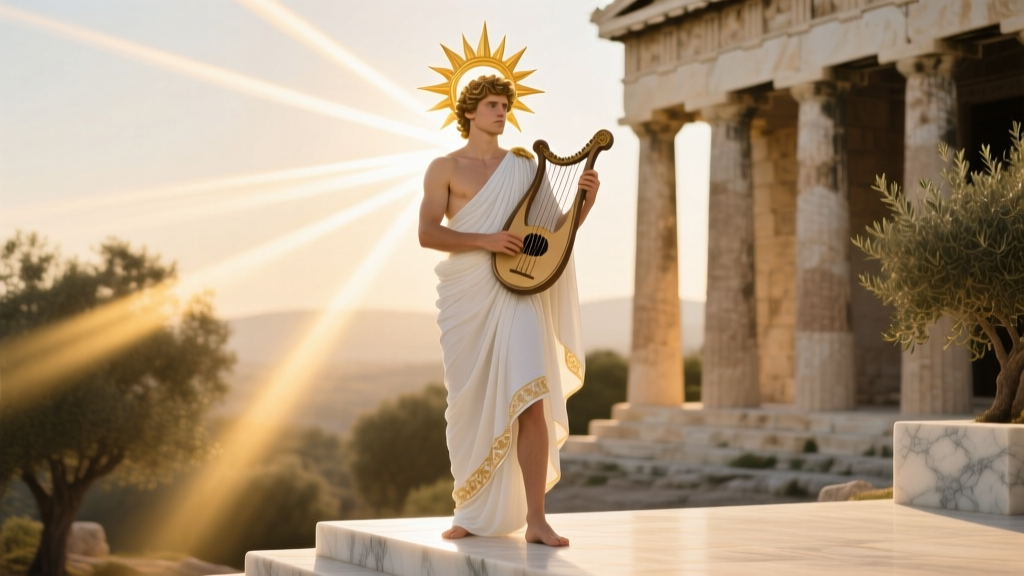
The pantheon of Olympus is vast, yet few deities command the psychological and cultural resonance of the apollo god in greek tradition. Far beyond the simplified pop-culture depiction of a mere sun deity, Apollo represents the ultimate synthesis of order, reason, and artistic mastery. For modern practitioners of Hellenic polytheism, esoteric psychology, and archetypal analysis, understanding Apollo requires moving past superficial myths and examining the structural mechanics of his worship, his complex epithets, and his enduring symbolic footprint. This analysis deconstructs the Apollonian archetype, offering expert insights and actionable frameworks for integrating this energy into contemporary spiritual and psychological practices.
The Core Domains of the Apollo God in Greek Antiquity
To analyze Apollo accurately, one must discard the modern conflation of Apollo and Helios. In classical antiquity, particularly prior to the late Hellenistic period, Apollo was not the personification of the physical sun. Instead, his domains were governed by the principles of light as illumination, truth, and structural harmony. According to the Homeric Hymns housed in the Perseus Digital Library, Apollo’s authority is categorized through specific epithets that reveal his multifaceted nature:
- Apollo Mousagetes (Leader of the Muses): Governing music, poetry, and the mathematical ratios underlying cosmic harmony. This is not mere entertainment; it is the esoteric science of frequency and vibration.
- Apollo Loxias (The Oblique): As the patron of the Delphic Oracle, Apollo delivers truth through riddles and indirect vectors. This epithet highlights the necessity of interpretive frameworks when engaging with prophetic data.
- Apollo Acesius (The Healer): While his son Asclepius took over the clinical aspects of medicine, Apollo governs the purificatory and preventative aspects of health, utilizing incantations and ritual cleansing to ward off miasma (spiritual pollution).
- Apollo Alexicacus (The Averter of Evil): Functioning as a boundary-keeper, this aspect of the deity is invoked to establish protective perimeters against chaotic or malevolent forces.
Symbolic Framework: Decoding Apollo’s Iconography
Apollonian symbols are highly functional tools in esoteric practice. Rather than viewing them as mere artistic motifs, practitioners should utilize them as cognitive anchors and ritual implements. The following matrix breaks down classical symbols and their modern spiritual applications.
| Classical Symbol | Mythological Origin & Function | Modern Esoteric Application (Pro Tip) |
|---|---|---|
| The Lyre (Chelys) | Invented by Hermes, gifted to Apollo. Represents the harmonization of cosmic spheres and divine intellect. | Use in sound healing and frequency alignment. Chanting in mathematical ratios (like the Pythagorean tuning) invokes Apollonian order in chaotic mental states. |
| Laurel Wreath (Daphne) | Derived from the myth of Daphne. Symbolizes victory, purification, and the untouchable nature of divine truth. | Burn dried bay leaves for ritual cleansing and cognitive focus prior to divination or deep study. The smoke acts as a sensory trigger for heightened alertness. |
| Silver Bow & Arrows | Forged by Hephaestus. Represents precision, distant healing, and the sudden strike of plague or enlightenment. | Employ in boundary-setting rituals. Visualizing the silver bow helps in establishing firm psychological boundaries and directing targeted intention over long distances. |
| The Omphalos Stone | The 'navel of the world' located at Delphi, marking the center of the earth and the axis mundi. | Utilize for grounding and somatic centering. Meditating on the concept of the Omphalos aligns the practitioner's physical center of gravity with their spiritual axis. |
The Apollonian vs. Dionysian Dichotomy: A Psychological Analysis
Any expert analysis of Apollo must address the philosophical framework established by Friedrich Nietzsche in The Birth of Tragedy. Nietzsche posited that Greek culture and, by extension, human psychology, is driven by the tension between two opposing forces: the Apollonian and the Dionysian.
Apollo represents the principium individuationis (the principle of individuation). He is the architect of boundaries, logic, sculpture, epic poetry, and the illusion of the separate self. Dionysus, conversely, represents intoxication, dissolution of boundaries, music, and the return to the primal, undifferentiated collective.
Pro Tips for Balancing the Dichotomy in Ritual Practice
Many modern spiritual practitioners suffer from 'Dionysian burnout'—an over-reliance on ecstatic, ungrounded, and emotionally exhausting rituals. Integrating Apollonian structure is critical for sustainable spiritual development.
- Structure the Container: Before engaging in deep trance or shadow work (Dionysian), establish a rigid, mathematically precise ritual space (Apollonian). Measure your circle, define your time limits, and write your intentions with exact syntax.
- The Cool-Down Protocol: After an emotionally cathartic working, invoke Apollonian energy to seal the psyche. This can be achieved through the recitation of structured poetry, the playing of a stringed instrument, or organizing your physical altar space.
- Dream Incubation: While Dionysus rules the chaotic landscape of the subconscious, Apollo rules the interpretation of the dream. Keep a highly structured dream journal, categorizing symbols and cross-referencing them over time to extract actionable data.
Historical Cult Centers and Pilgrimage Data
Understanding the geographic spread of Apollo’s worship provides insight into how his archetype adapted to different cultural needs. While Delphi is the most famous oracle, the Hellenistic and Roman periods saw a massive shift toward the oracular sanctuaries of Didyma and Claros in Ionia (modern-day Turkey).
According to epigraphic data cataloged by institutions like the British Museum, Didyma operated differently than Delphi. At Didyma, the oracle was a male priest (the prophetes), and the responses were often delivered in prose rather than hexameter verse, indicating a shift toward more direct, administrative, and civic guidance. Claros, meanwhile, specialized in purification rituals and dealing with miasma resulting from civic plagues or wars.
Actionable Pilgrimage Tip: For modern Hellenic practitioners planning heritage pilgrimages, visiting the Sacred Way at Didyma offers a profound spatial experience. The sheer scale of the Temple of Apollo at Didyma—where the inner sanctuary (adyton) was an open-air grove of laurel trees sunken below ground level—physically embodies the concept of descending into the earth to access divine light.
The Delphic Maxims: An Ethical Framework for the Modern Mind
The Oracle of Delphi, Apollo’s primary mouthpiece, was inscribed with the Delphic Maxims. These are not mere moral suggestions; they are cognitive algorithms for navigating a complex world. The two most prominent maxims offer a masterclass in psychological regulation.
1. Gnothi Seauton (Know Thyself)
In an Apollonian context, self-knowledge is not about indulging in emotional narratives. It is an objective, almost clinical audit of one's capacities, limitations, and biases.
Pro Tip: Conduct a quarterly 'Apollonian Audit.' Strip away emotional justifications and map your actual behaviors against your stated goals. Use data tracking (habit trackers, time logs) to achieve objective self-knowledge, removing the ego's capacity for self-deception.
2. Meden Agan (Nothing in Excess)
This is the ultimate Apollonian safeguard against hubris and Dionysian dissolution. It champions the golden mean, homeostasis, and systemic sustainability.
Pro Tip: Apply 'Meden Agan' to your spiritual and esoteric consumption. Avoid the trap of 'spiritual bypassing' or consuming endless amounts of occult literature without practical application. Cap your study hours, enforce periods of integration, and prioritize the embodiment of a single teaching over the superficial collection of many.
Hymnic Resonance and the Orphic Tradition
For those utilizing devotional frameworks, the Orphic Hymns provide a highly structured method of connecting with the deity. The Orphic Hymn to Apollo specifically calls upon his role as the illuminator of the cosmos and the healer of mortal afflictions. Burning traditional offerings such as frankincense or manna while reciting the hymn in a measured, rhythmic cadence aligns the practitioner's nervous system with the Apollonian frequency of order and clarity.
Synthesizing the Apollonian Archetype for Personal Mastery
Engaging with the apollo god in greek mythology is ultimately an exercise in mastering the architecture of the mind. Apollo demands clarity, precision, and the courage to face unvarnished truth. By adopting his epithets as psychological lenses, utilizing his symbols as functional ritual tools, and applying the Delphic Maxims as cognitive algorithms, practitioners can cultivate an unshakeable inner sovereignty. The Apollonian path is not one of cold detachment, but of brilliant, focused illumination—a necessary counterweight to the chaos of the modern era, providing the structural integrity required for profound spiritual and intellectual elevation.