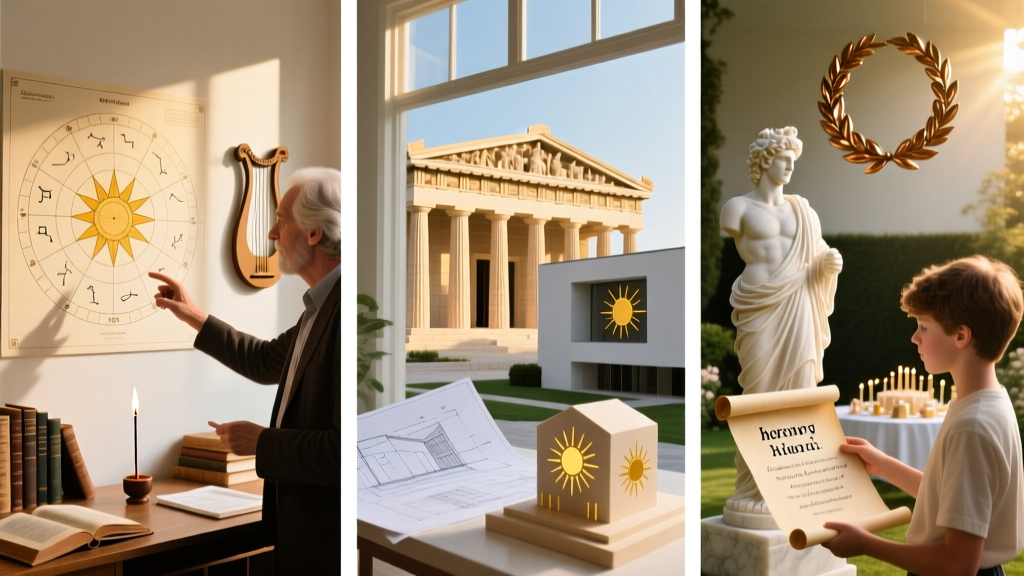
The study of Apollo and Greek mythology extends far beyond ancient texts, marble statues, and poetic hymns. As the deity of light, reason, music, and prophecy, Apollo represents the ultimate principle of order, intellect, and the logos. While many view these ancient narratives purely as historical artifacts, the Apollonian archetype actively shapes modern human behavior, institutional design, and cultural milestones. By analyzing specific real-world applications, we can decode how ancient mythological frameworks continue to govern contemporary psychology, aesthetics, and even aerospace engineering.
Case Study 1: The Apollo Archetype in Depth Psychology
In clinical and depth psychology, the myths surrounding the Sun God are not merely stories; they are diagnostic frameworks. The dichotomy between Apollonian order and Dionysian chaos was famously codified by Friedrich Nietzsche in The Birth of Tragedy, but modern Jungian analysts have adapted this into actionable therapeutic models. Apollo represents the principium individuationis—the principle of individuation, boundaries, and rational structure.
Why Apollo and Greek Mythology Matter in Depth Psychology
Archetypal psychologist James Hillman utilized the Apollo myth to diagnose what he termed the 'Apollo Complex' in high-achieving individuals. In clinical settings, an over-identification with the Apollo archetype manifests as emotional detachment, rigid perfectionism, and hyper-rationality. Patients exhibiting this archetype often excel in structured environments (law, medicine, engineering) but suffer from profound alienation and somatic symptoms because they repress the irrational, emotional, and chaotic elements of their psyche.
Therapeutic intervention in these cases involves 'shadow work' aimed at integrating Dionysian traits. According to the Stanford Encyclopedia of Philosophy, the Apollonian drive provides the necessary boundaries for human survival, but without the Dionysian release, the psyche fractures under the weight of its own rigidity. Therapists use the myth of Apollo's pursuit of Daphne—who transforms into a laurel tree to escape him—as a clinical metaphor for how the hyper-rational mind attempts to grasp and control the elusive, organic nature of human emotion, ultimately only capturing a rigid symbol (the laurel) rather than the living experience.
Case Study 2: Architectural Manifestations of the Sun God
The translation of Apollo and Greek mythology into physical space provides a masterclass in how societies use architecture to project power, order, and divine right. The 'Apollonian' architectural style prioritizes mathematical harmony, bilateral symmetry, and the manipulation of light. This is not merely an aesthetic choice; it is a psychological tool used to induce feelings of awe, obedience, and rational clarity in the observer.
The following table analyzes three distinct historical case studies where Apollonian mythos dictated architectural and sculptural execution:
| Site / Artifact | Creator / Era | Apollonian Principle Applied | Real-World Impact |
|---|---|---|---|
| Temple of Apollo Epicurius (Bassae) | Ictinus, c. 420 BC | Rational order over wild nature; first use of the Corinthian capital. | Established the architectural vocabulary for civic order in ancient democracies, using mathematical ratios to harmonize a remote, untamed mountain landscape. |
| Apollo Basin (Versailles) | Jean-Baptiste Tuby, 1671 | Light, truth, and absolute centralization of power. | Used by Louis XIV (The Sun King) to visually map the political hierarchy of France onto the myth of Apollo rising from the sea, reinforcing absolute monarchial control. |
| Apollo Belvedere | Leochares (attributed), c. 120-140 AD | Perfect physical proportion and emotional detachment (contrapposto). | Became the supreme standard of aesthetic perfection during the Renaissance and Neoclassical periods, dictating European art academy curricula for over 300 years. |
In each instance, the mythological attributes of the god were weaponized or utilized to enforce societal structures. As documented in the primary texts preserved by the Perseus Digital Library, the Homeric Hymn to Apollo emphasizes his role as a bringer of civilization and law. Architects and monarchs leveraged this exact association to legitimize their earthly rule through stone and bronze.
Case Study 3: NASA’s Apollo Program as Mythological Branding
Perhaps the most ambitious real-world application of this mythos occurred in the mid-20th century. When NASA was tasked with landing a human on the moon, the project required unprecedented public funding, global cooperation, and a unifying psychological narrative. The naming of the Apollo program was not a casual aesthetic choice; it was a calculated deployment of mythological branding.
In 1960, NASA manager Abe Silverstein selected the name after consulting a book of mythology. Silverstein noted that the image of 'Apollo riding his chariot across the sun' best represented the massive scale, illuminating purpose, and technical brilliance of the proposed lunar mission. By invoking Apollo, NASA framed the Cold War space race not merely as a geopolitical military struggle, but as a heroic, civilizing quest for light and knowledge conquering the dark, unknown void of space.
This mythological framing had measurable real-world impacts. According to NASA's official historical archives, the Apollonian narrative helped sustain public and congressional support through the program's most grueling and expensive phases, including the aftermath of the Apollo 1 tragedy. The archetype of the Sun God provided a psychological buffer, framing the astronauts not just as test pilots, but as modern mythic heroes bringing the 'light' of human consciousness to a dead world.
Synthesizing the Apollonian Framework for Modern Life
Understanding the real-world footprint of Apollo and Greek mythology allows us to harness the archetype for personal and organizational development. The Apollonian drive is essential for executing complex projects, establishing boundaries, and pursuing mastery. However, as demonstrated in clinical psychology, an imbalance leads to burnout and alienation.
To practically integrate the Apollonian archetype without falling into its shadow, consider the following actionable framework:
- Audit Your Logos-to-Pathos Ratio: Track your weekly activities. If 90% of your time is spent on structured, analytical, and goal-oriented tasks (Apollo), intentionally schedule unstructured, sensory, or emotionally vulnerable activities (Dionysus) to prevent psychological rigidity.
- Apply Apollonian Proportion to Environments: Just as Neoclassical architects used symmetry to induce calm, restructure your physical workspace. Remove visual clutter, introduce bilateral symmetry to your desk layout, and maximize natural light to trigger the cognitive clarity associated with the Sun God.
- Mythological Branding in Leadership: When leading a team through a chaotic transition, use Apollonian communication. Frame the objective as a quest for clarity, order, and illumination, providing your team with a structured, rational narrative that cuts through organizational anxiety.
By studying how Apollo has been utilized in therapy, architecture, and space exploration, we move beyond passive mythological reading. We gain a functional toolkit for applying ancient wisdom to the complexities of modern human achievement.