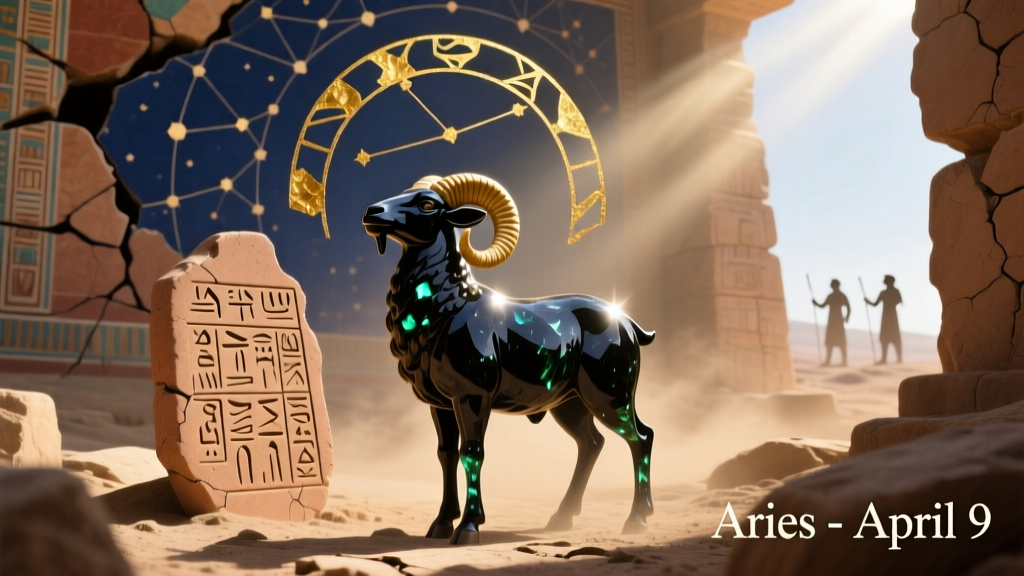
Analyzing the april 9th zodiac requires examining a highly specific coordinate in the history of Western astrology: the 20th degree of Aries. This placement marks the final day of the second decan, serving as a historical bridge between the raw, martial beginnings of the Ram and the expansive domains of late Aries. To understand the personality traits of those born on this day, one must bypass modern generalizations and investigate the ancient Babylonian, Hellenistic, and Roman frameworks that originally defined this exact solar longitude. The historical evolution of this date reveals a remarkably complex, dual-ruled archetype.
Babylonian Star Catalogs: The Agrarian Worker and the Vernal Point
Long before the Greeks associated this sector of the ecliptic with a Ram, the ancient Mesopotamians documented it in the MUL.APIN Babylonian Star Catalog, compiled around 1000 BCE. In this foundational astronomical text, the constellation we now call Aries was known as LÚ.ḪUN.GÁ, which translates to 'The Agrarian Worker' or 'The Hired Man.' This figure was intrinsically linked to Dumuzi, the Sumerian god of shepherds, vegetation, and the spring harvest.
For those born on April 9, the solar longitude corresponds to the 20th degree of the zodiac. In the Babylonian era, due to the precession of the equinoxes, the vernal equinox actually occurred in the early degrees of Aries. The 20th degree—where April 9 sits—represented a critical phenological threshold in ancient Mesopotamia. It marked the transition from the initial planting and lambing seasons into the period of active growth and agricultural management. Therefore, the original archetype of the April 9 birthday was not the impulsive warrior of modern pop-astrology, but rather the strategic, hardworking steward of resources. This historical foundation explains the enduring April 9 trait of combining Aries initiative with a highly practical, resource-oriented mindset.
Decoding the April 9th Zodiac Through Hellenistic Decans
The shift from the Babylonian 'Hired Man' to the martial Ram occurred during the Hellenistic period, but the most crucial layer of historical astrological analysis for April 9 lies in the decan system. Hellenistic astrologers, synthesizing Egyptian and Babylonian traditions, divided each 30-degree zodiacal sign into three 10-degree segments called decans, each governed by a sub-ruling planet.
According to the Chaldean decan system, later codified in texts like Ptolemy's Tetrabiblos, April 9 falls precisely on the cusp of the second and third decans of Aries. It is the anaretic, or final, degree of the second decan. While Mars rules the overarching sign of Aries, the second decan is sub-ruled by the Sun, carrying the fiery, regal influence of Leo. This creates a profound historical synthesis: the martial drive of Mars is focused and elevated by the sovereign, identity-driven power of the Sun.
| Aries Decan | Degree Span | Sub-Ruler | Historical Archetype |
|---|---|---|---|
| First Decan | 0° - 10° | Mars | The Warrior / Pioneer |
| Second Decan (April 9) | 10° - 20° | Sun (Leo) | The Sovereign / Protector |
| Third Decan | 20° - 30° | Jupiter (Sagittarius) | The Philosopher / Explorer |
Being born on the final degree of the Sun-ruled decan means the individual possesses a culminating solar confidence. Historically, astrologers viewed the 20th degree as a point of mastery over the sign's initial impulsive tendencies, replacing raw aggression with strategic leadership and a desire for lasting legacy.
The Mythological Shift: Chrysomallus and the Golden Fleece
As Hellenistic astrology absorbed Greek mythology, the Babylonian Agrarian Worker was entirely replaced by Chrysomallus, the mythical Ram with the Golden Fleece. The myth of Phrixus and Helle, who were rescued from sacrifice by this flying Ram, became the central narrative for Aries. However, the specific sub-influence of the Sun on the April 9 degree aligns perfectly with the 'Golden' aspect of the Fleece. The Golden Fleece was not merely a symbol of escape; it was a symbol of divine kingship, sovereignty, and ultimate authority in the ancient Greek world. Those born on April 9 inherit this mythological mandate: their Aries energy is historically tied to the pursuit of a 'golden fleece'—a high-value, hard-to-reach objective that confers status and authority upon its captor.
Roman Antiquity: April Festivals and Martial-Solar Syncretism
To fully grasp the historical environment of the April 9 zodiac, one must examine the Roman calendar. In ancient Rome, early April was dominated by the Megalesia, a massive festival honoring Cybele, the Magna Mater (Great Mother). According to Ovid's Fasti, the Megalesia ran from April 4 to April 10, meaning April 9 was deeply embedded in the climax of these celebrations.
Cybele's worship involved intense, ecstatic martial energy, but it was fundamentally tied to the protection of the state and the sovereignty of the empire. The Roman astrological perspective viewed the April 9 placement not just as a period of individualistic Aries drive, but as a time when personal ambition was expected to serve a larger, structural purpose. The culmination of the Megalesia on April 9 and 10 required the integration of wild, untamed energy (Aries/Mars) into civic duty and regal authority (Sun/Leo). This historical context provides a vital key to the April 9 personality: a deep-seated psychological need to channel personal ambition into institutional or communal leadership.
Actionable Synthesis: Applying the Historical Archetype Today
Understanding the ancient origins of your zodiac placement moves astrology from passive entertainment to an active framework for psychological and strategic development. Based on the historical synthesis of the Babylonian Agrarian Worker, the Hellenistic Solar-Decan, and the Roman civic festivals, individuals born on April 9 can leverage their specific archetype through the following actionable practices:
- Transition from Pioneer to Sovereign: The 20th degree marks the end of the pioneering phase and the beginning of the ruling phase. Stop initiating new, chaotic projects. Instead, audit your current ventures and apply Leo-ruled solar energy to build infrastructure, delegate tasks, and establish long-term authority over what you have already conquered.
- Pursue the 'Golden Fleece' Objectives: Align your career goals with high-value, high-visibility targets. The Sun-ruled decan demands recognition. Avoid behind-the-scenes roles; position yourself where your strategic decisions are visible and directly tied to organizational success or public impact.
- Anchor Ambition in Civic or Communal Value: Drawing from the Roman Megalesia, your martial Aries drive will burn out if used solely for selfish gain. Channel your competitive energy into leading a team, mentoring others, or building a system that protects and elevates your community. Your historical archetype thrives when personal victory equates to collective security.
By anchoring your modern decision-making in these ancient, historically verified astrological frameworks, you bypass the superficial traits of daily horoscopes and operate in alignment with the profound, dual-ruled architecture of the 20th degree of Aries.