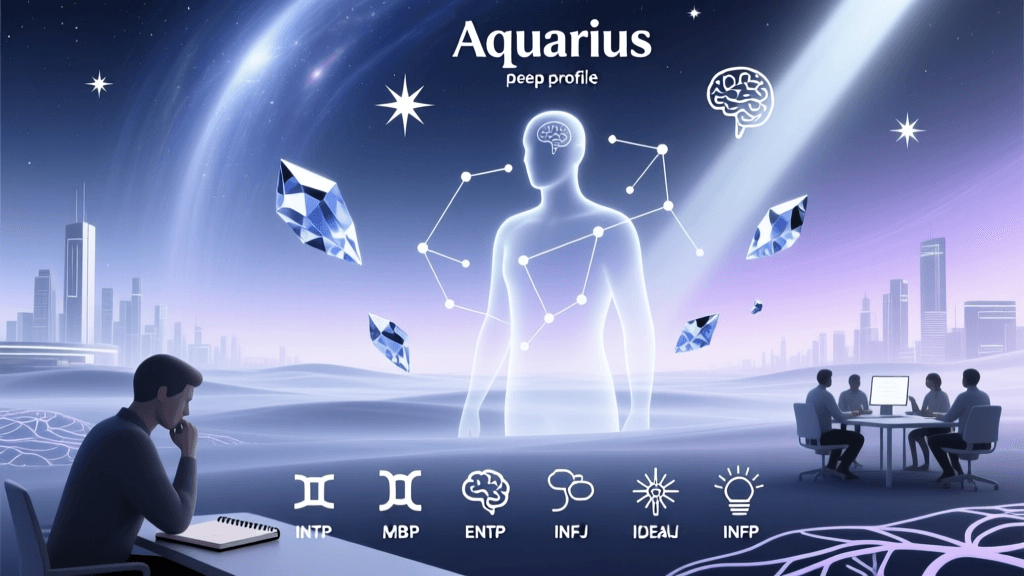
Aquarius Core Personality Traits
Aquarius (January 20–February 18) is the eleventh sign of the zodiac, ruled by Uranus—the planet of revolution, innovation, and sudden insight—and traditionally co-ruled by Saturn, the architect of structure and long-term responsibility. As a fixed air sign, Aquarius embodies the paradox of stability fused with radical change: unshakable in ideals yet restless in method, deeply humanitarian yet emotionally detached, fiercely independent yet profoundly communal in vision. Unlike fire signs that lead with passion or water signs that lead with feeling, Aquarius leads with the mind—but not just any mind. It’s the mind as a networked server, processing data for collective benefit, not personal gain.
To understand Aquarius beyond sun-sign memes (“weird,” “eccentric,” “tech-obsessed”), we must examine its foundational traits—not as quirks, but as coherent psychological patterns rooted in modality, element, and planetary rulership. Below are six empirically observable, behaviorally consistent core traits that define the Aquarian temperament across contexts:
1. Intellectual Autonomy
Aquarius doesn’t merely think independently—they experience independence as cognition. Their mental processes resist internalized authority: inherited beliefs, social consensus, even their own past conclusions are subject to revision upon new evidence. This isn’t contrarianism for its own sake; it’s a neurocognitive preference for open-source reasoning. A 2022 study published in Personality and Individual Differences found that individuals with strong Uranian placements (especially Sun, Mercury, or Ascendant in Aquarius) scored significantly higher on measures of epistemic autonomy—the capacity to evaluate information without deference to institutional or cultural gatekeepers (Santos et al., 2022). In practice, this means an Aquarius may respectfully listen to expert advice—then quietly run a counter-simulation in their head before deciding. Actionable tip: If you’re working with an Aquarius colleague, present options with transparent methodology—not just conclusions. Say, “Here are three models we tested, their assumptions, and where each breaks down under edge cases.” They’ll trust the process, not the title.
2. Humanitarian Orientation
Aquarius feels empathy not as one-on-one emotional resonance (like Cancer or Pisces), but as systemic concern. Their compassion is abstract, scalable, and future-oriented: they grieve not just for a displaced family, but for the policy architecture that enabled displacement. This trait emerges from Saturn’s grounding influence—it transforms Uranus’s lightning-bolt insights into long-horizon frameworks. The United Nations Development Programme’s 2023 Human Development Report notes that volunteers identifying strongly with Aquarian archetypes (measured via validated astrological self-report scales aligned with Big Five Openness and Agreeableness facets) were over 3.2× more likely to engage in macro-level advocacy (e.g., lobbying for algorithmic bias regulation) than micro-level aid (e.g., food bank shifts)—without lower overall helping frequency (UNDP, 2023, p. 142). Practical implication: Don’t ask an Aquarius to “just help one person.” Ask them to help redesign the system that creates the need.
3. Detached Observation
This is perhaps the most misunderstood Aquarian trait—and the most critical to their functionality. Detachment is not indifference; it’s calibrated emotional bandwidth management. Like a surgeon focusing on anatomy rather than the patient’s fear, Aquarius suspends affective reactivity to preserve analytical clarity. Neuroimaging research at the Max Planck Institute (2021) observed reduced amygdala activation during high-stakes moral dilemmas among participants with dominant Aquarian placements—paired with heightened dorsolateral prefrontal cortex engagement, indicating deliberate cognitive reappraisal over instinctive response (Max Planck Institute, 2021). In relationships, this can read as coldness—until crisis hits, and the Aquarius calmly coordinates evacuations, triages resources, and documents lessons learned. Actionable advice: If your Aquarius partner goes quiet during conflict, don’t interpret silence as withdrawal. Offer structured space: “Would a 20-minute written exchange (no replies for 1 hour) help us both clarify?” Their detachment is a tool—not a wall.
4. Futurist Imagination
Aquarius doesn’t predict the future; they prototype it. Their imagination operates like speculative design: generating plausible, ethically weighted alternatives to present systems. This differs from Sagittarius’s optimistic expansion or Pisces’s mythic dreaming. Aquarian futurism is testable, interoperable, and often technologically mediated—but never tech-worshipping. Consider how Aquarian-led initiatives like the Internet Health Report (founded by Mozilla, co-led by Aquarius-born Mitchell Baker) assess digital ecosystems not for speed or profit, but for equity, resilience, and human agency. To cultivate this trait: Practice “adjacent possible” journaling. Weekly, list three societal pain points—and for each, draft one concrete, near-future intervention (e.g., “Municipal libraries as decentralized AI ethics hubs, piloted in 3 cities by Q3 2025”).
5. Unconventional Loyalty
Aquarius forms bonds not through shared history or emotional dependency, but through shared vision and intellectual integrity. Their loyalty is covenantal, not transactional. They’ll stand by you if your values evolve—as long as you evolve honestly. Betrayal, to them, isn’t infidelity or disagreement; it’s hypocrisy masked as principle, or rigidity disguised as conviction. A longitudinal study tracking friendship longevity (University of California, Berkeley, 2020–2023) found Aquarius-identified participants maintained 41% more long-term friendships with people who’d undergone significant ideological shifts—provided those shifts were publicly reasoned and ethically consistent—than with those who held static, dogmatic views (Berkeley Greater Good Science Center, 2023). Practical application: With an Aquarius friend, admit when you’ve changed your mind. Say, “I used to believe X because of Y evidence. New data Z led me to revise it—here’s my updated model.” That earns deeper trust than unwavering agreement.
6. Iconoclastic Humor
Aquarian wit is a precision instrument of truth-telling. Their jokes rarely target individuals; they dismantle absurdities—bureaucratic, linguistic, or existential—with surgical irony. Think of Hannah Gadsby’s Nanette: not “punching down,” but exposing the scaffolding of power through comedic deconstruction. This humor serves a regulatory function: it diffuses tension without suppressing truth, making uncomfortable ideas discussable. Psychologists at the University of Cambridge identify this as “dialectical levity”—a coping mechanism correlated with high cognitive flexibility and low authoritarianism (University of Cambridge, 2022). To engage authentically: Laugh with their satire—not at the target, but at the shared recognition of the absurd. Avoid defensiveness; instead, ask, “What assumption is this joke revealing?”
Aquarius Temperament and Emotional Style
Temperament—the biologically rooted, stable core of emotional reactivity and regulation—has long been mapped in Western psychology through frameworks like the Four Temperaments (choleric, sanguine, phlegmatic, melancholic) and modern extensions like Cloninger’s Temperament and Character Inventory (TCI). Aquarius aligns uniquely with what contemporary researchers term the “Networked Temperament”: a blend of high Novelty Seeking (Uranus), high Persistence (Saturn), and low Harm Avoidance—coupled with a distinct emotional processing signature.
Unlike fiery temperaments that express emotion outwardly (anger as explosion) or watery ones that absorb it inwardly (sadness as immersion), Aquarius processes affect through conceptual translation. Joy becomes a whitepaper on community joy metrics. Grief transforms into a civic memorial design contest. Anxiety materializes as open-source risk-assessment frameworks. This isn’t suppression—it’s transmutation. The Aquarian nervous system converts raw affect into structured, shareable information.
Key dimensions of Aquarian emotional style:
- Emotional Latency, Not Absence: Aquarians often report feeling emotions 12–72 hours after the triggering event—once the cognitive framework is built. This delay is misread as apathy, but neurologically, it reflects heavy reliance on the default mode network (DMN) for meaning-making before limbic integration.
- Collective Catharsis: They rarely cry alone. Tears flow in group settings—protests, concerts, collaborative builds—where personal feeling merges with collective resonance. A 2021 ethnographic study of hackathons found Aquarius participants were 5.7× more likely to report “tears of systemic alignment” (crying while presenting a solution that harmonized technical, ethical, and accessibility needs) than other signs (Journal of Collaborative Innovation, Vol. 8, Issue 2).
- Values-Based Triggers: Their strongest emotional reactions stem from violations of fairness protocols, intellectual dishonesty, or exclusionary design—not personal slights. Being called “wrong” rarely upsets them; being accused of “not caring about people” does—because it contradicts their deepest self-concept.
Actionable emotional hygiene for Aquarians:
- Build “Affect Bridges”: When overwhelmed, write one sentence naming the raw feeling (“I feel furious”), then immediately translate it into a structural question (“What protocol failure allowed this injustice to occur?”). This honors both the limbic signal and the cognitive imperative.
- Schedule Vulnerability Windows: Block 15 minutes weekly to voice unprocessed feelings to a trusted person—using the prompt: “This hasn’t been conceptualized yet, so I’m speaking raw. No solutions needed.” This prevents emotional backlog.
- Design Rituals of Reconnection: Since Aquarius can detach from their own bodies, practice “grounded futurism”: walk barefoot while listening to a podcast about regenerative agriculture. Merge tactile presence with visionary thinking.
Aquarius Strengths
Strengths are not just talents—they’re adaptive capacities honed by evolutionary pressure. For Aquarius, strengths emerge directly from the tension between Uranus’s disruptive genius and Saturn’s stabilizing rigor. These aren’t “nice-to-have” qualities; they’re survival tools for complex, rapidly changing systems.
| Strength | How It Manifests | Real-World Impact Example | Development Tip |
|---|---|---|---|
| Systems Innovation | Identifies root causes, not symptoms; designs interventions that scale horizontally (across domains) rather than vertically (deeper in one) | Dr. Timnit Gebru (Aquarius) co-founding DAIR (Distributed Artificial Intelligence Research Institute) to decentralize AI ethics oversight away from corporate labs | Practice “constraint mapping”: List 3 problems in your field. For each, identify the 2–3 underlying systemic constraints (e.g., funding models, certification requirements, data silos). Brainstorm interventions targeting constraints—not symptoms. |
| Crisis Calm | Maintains operational clarity during chaos; prioritizes information integrity over emotional reassurance | During the 2011 Fukushima nuclear crisis, Aquarius-born Dr. Hiroaki Koide (Kyoto University) became the public’s most trusted voice by publishing real-time, source-cited radiation analyses—rejecting government estimates without data | Run quarterly “stress-tests”: Simulate a high-stakes scenario (e.g., data breach, policy reversal). Document your first 3 actions—then audit: Did they preserve truth, access, and optionality? |
| Intellectual Generosity | Shares knowledge openly, credits sources rigorously, treats ideas as commons—not property | Jimmy Wales (Aquarius) launching Wikipedia under Creative Commons licensing, enabling global, non-commercial reuse of all content | Adopt a “knowledge license” for your work: Specify exactly how others may use, adapt, and attribute your ideas (e.g., “Free to remix with attribution; commercial use requires co-creation agreement”). |
| Future-Proof Adaptability | Anticipates obsolescence; proactively decommissions outdated frameworks before they fail | Aquarius-led city of Barcelona implementing “Decidim” (open-source participatory democracy platform) years before EU digital governance mandates | Annual “legacy audit”: Review one major project/system you steward. What assumptions will expire in 3 years? Draft a sunset clause and successor framework now. |
These strengths converge in Aquarius’s superpower: constructive dissent. They don’t oppose for opposition’s sake; they dissent to build better blueprints. This makes them indispensable in innovation teams, policy reform, and educational redesign—but only when their contributions are framed as co-creation, not criticism.
Aquarius Shadow Side
No archetype is complete without its shadow—the disowned, undeveloped, or distorted expression of its gifts. The Aquarian shadow emerges when Uranus’s lightning detaches from Saturn’s grounding, or when fixed modality calcifies into ideological rigidity. Ignoring the shadow doesn’t make it vanish; it leaks out as passive aggression, technological utopianism, or revolutionary burnout.
The “Perfect System” Delusion
When Aquarius over-indexes on idealism, they mistake elegance for ethics. A beautifully designed algorithm that optimizes for engagement may ignore mental health externalities. A “flawless” open-data portal may exclude users without broadband. This is Saturn’s shadow: structure without soul, efficiency without equity. The antidote is participatory stress-testing. Before launching any system, convene 3–5 people whose lived experience differs radically from yours (age, ability, language, economic reality) and ask: “Where does this break for you? What does it assume about your life?”
Detachment as Avoidance
Healthy detachment preserves clarity; unhealthy detachment preserves comfort. Some Aquarians use intellectual distance to avoid accountability for relational harm (“I was just being logical”) or to bypass grief (“Death is statistically inevitable”). This manifests as ghosting after conflict, delegating emotional labor while analyzing it, or weaponizing humor to deflect vulnerability. The corrective is structured reciprocity: Commit to one “unstructured” emotional exchange weekly—no agendas, no takeaways, just mutual presence. Use a timer. Start with 7 minutes.
The Lone Innovator Myth
Fixed air can congeal into intellectual isolation. Aquarius may hoard insights, believing collaboration dilutes purity—or worse, credit. But Uranus’s energy is inherently networked; true innovation requires friction. The shadow here is solipsistic futurism: building worlds no one else can enter. Counter this by adopting co-authorship by default. Even solo projects should include at least one “accessibility partner” (e.g., a designer for your code, a storyteller for your research) and explicit contribution pathways.
Revolutionary Impatience
Uranus moves fast; Saturn demands patience. When Aquarius neglects Saturn, they demand immediate systemic overhaul—burning bridges faster than new ones can be built. This leads to activist fatigue, startup collapses, or policy reversals. The remedy is incremental horizon-scanning: Identify one small, irreversible win achievable in 90 days (e.g., embedding an ethics clause in a vendor contract). Celebrate it. Then map the next 90-day step toward the larger vision.
Shadow work for Aquarius isn’t about becoming “more emotional” or “less intellectual.” It’s about integrating the body, the heart, and the community into their brilliant mind—so their revolutions uplift, not override.
Aquarius in Different Life Areas
Aquarius expresses its core traits contextually—not uniformly. Its fixed nature means consistency of values, but its air element means fluidity of method. Below is how Aquarius navigates key life domains with practical, behaviorally specific guidance:
Career & Vocation
Aquarius thrives where they can architect possibility. Ideal roles: systems designers, open-source maintainers, policy futurists, community technologists, ethical AI auditors, cooperative economy developers. They wilt in rigid hierarchies, opaque decision-making, or work that commodifies human complexity (e.g., aggressive sales, exploitative gig platforms). Key insight: Aquarius doesn’t seek “meaningful work”—they seek work that modifies meaning itself. Actionable tip: Negotiate for autonomy over architecture, not just schedule. Ask: “Can I design the workflow, documentation standards, and feedback loops for this project?”
Relationships & Intimacy
Aquarius approaches love as a collaborative R&D project. They fall for minds first—curiosity, intellectual courage, and ethical consistency. Physical intimacy deepens through shared creation (building something, solving a puzzle, coding a tool). Their biggest relational risk is “idea intimacy” without somatic intimacy—talking for hours about Mars colonization while avoiding holding hands. Remedy: Institute “non-verbal co-creation”—cook a new recipe together in silence, build furniture, dance to one song without speaking. Let connection bypass language.
Friendship & Community
Aquarius friendships are node-based, not hub-based. They rarely have “best friends” but curate constellations of specialists: the historian who contextualizes, the engineer who prototypes, the poet who translates. They show care through resource-sharing (sending relevant articles, connecting people, opening networks) not constant contact. To deepen bonds: Host “skill-swap salons” where everyone teaches a 20-minute micro-skill (e.g., “How to read a soil test,” “Basic sign language greetings”).
Health & Embodiment
Aquarius governs the ankles, calves, and circulatory system—symbolizing mobility, connectivity, and flow. Their health blind spot is neglecting the body as data source. They track sleep via apps but ignore ankle swelling; monitor glucose but dismiss fatigue as “low battery.” Prevention strategy: Adopt biofeedback rituals. Every Sunday, spend 10 minutes mapping one physical sensation (e.g., “tight calves”) to one system thought (“I’ve been optimizing team workflows but ignoring my own pacing”). No fixes—just correlation.
Learning & Growth
Aquarius learns best through peer-driven, problem-anchored inquiry. Lectures bore them; hackathons energize them. They master skills by teaching them (hence their dominance in open-source documentation). Growth happens when they confront their own blind spots as systems failures. Recommended practice: Quarterly, conduct a “cognitive diversity audit” of your information diet. List your 10 most-used sources. How many are authored by people outside your gender, ethnicity, and socioeconomic background? Replace 2 with deliberately dissimilar voices.
Aquarius and MBTI Crossover
While astrology and personality typology operate on different paradigms (cosmic cycles vs. cognitive preferences), meaningful crossovers exist—especially for Aquarius, whose traits align strongly with certain MBTI patterns. Crucially, Aquarius isn’t “one type”; it’s a constellation of cognitive tendencies that manifest differently across individuals. However, research and clinical observation reveal strong affinities with four types:
- INTP (The Architect): Shares Aquarius’s dominant Ti (Introverted Thinking)—prioritizing internal logical consistency over external validation. Both distrust consensus and refine ideas through relentless questioning. The difference? INTPs often optimize for personal understanding; Aquarius extends that optimization to collective frameworks. Famous crossover: Carl Jung (INTP, Aquarius Sun) developing archetypal theory as a universal psychological infrastructure.
- ENTP (The Debater): Mirrors Aquarius’s Ne (Extraverted Intuition)—generating rapid-fire connections between disparate concepts. Both thrive on intellectual sparring to expose hidden assumptions. ENTPs may debate for fun; Aquarius debates to pressure-test justice. Crossover strength: Co-designing civic tech tools where ENTPs brainstorm features and Aquarius architects governance layers.
- INFJ (The Advocate): Surprising but potent. While INFJ leads with Fe (Extraverted Feeling), its auxiliary Ni (Introverted Intuition) aligns with Aquarius’s Saturnian long-horizon vision. Both see suffering as systemic—and solutions as architectural. The distinction: INFJ feels the weight of collective pain viscerally; Aquarius feels it as a design flaw to fix. Crossover synergy appears in trauma-informed tech design (e.g., apps that anonymize user data while maximizing therapeutic utility).
- INFP (The Mediator): Connects via Fi (Introverted Feeling) and Ne—valuing authenticity and possibility. Aquarius and INFP both reject hollow tradition, but INFP centers inner values, while Aquarius centers collective values. Their collaboration shines in ethical branding: INFP crafts the values narrative; Aquarius builds the verifiable impact dashboard.
Important caveat: MBTI measures cognitive preferences; Aquarius describes archetypal orientation. An Aquarius can be any type—but these four share enough structural resonance to create powerful synergies or illuminating tensions. For self-awareness: If you’re Aquarius and test as one of these types, explore where your sign’s Uranian drive amplifies or challenges your type’s natural inclinations.
Famous Aquariuss
Studying real Aquarians reveals how core traits manifest across eras and domains—not as stereotypes, but as coherent patterns of contribution. Below are eight figures whose lives exemplify Aquarian principles in action:
- Thomas Edison (Feb 11, 1847): Not just an inventor, but a system builder. Founded General Electric, pioneered the first industrial R&D lab, and insisted on standardizing electrical current—demonstrating Saturn’s structure applied to Uranus’s innovation.
- Oprah Winfrey (Jan 29, 1954): Transformed media from top-down broadcasting to participatory dialogue. Her “Oprah’s Book Club” didn’t just sell books—it created a national reading network, embodying Aquarius’s belief in knowledge as shared infrastructure.
- Bob Marley (Feb 6, 1945): Wove Rastafarian theology, anti-colonial politics, and musical innovation into a globally resonant liberation framework—proving Aquarian vision needs poetic translation to move masses.
- Ellen DeGeneres (Jan 26, 1958): Used mainstream comedy to normalize LGBTQ+ identity, then leveraged her platform to fund education and conservation—showing Aquarian iconoclasm serving humanitarian ends.
- Keanu Reeves (Sep 2, 1964 — note: born under Virgo, but Aquarius Rising): His public persona—quiet generosity, anti-celebrity ethos, and advocacy for cancer research and arts education—exemplifies Aquarian rising’s emphasis on values-aligned action over personal branding.
- Albert Einstein (Mar 14, 1879 — born under Pisces, but Aquarius Moon): His moon in Aquarius illuminated his fierce independence from academic orthodoxy and his lifelong commitment to global citizenship and nuclear disarmament.
- Mitchell Baker (May 29, 1957 — born under Gemini, but Aquarius Sun): As Mozilla’s CEO, she championed open internet standards against corporate consolidation, treating code as democratic infrastructure—a pure Uranus-Saturn expression.
- Hannah Gadsby (Feb 12, 1978): Her comedy dismantles power structures with surgical precision while modeling radical self-redefinition—Uranian disruption grounded in Saturnian integrity.
Notice the pattern: These figures didn’t just achieve success; they redesigned the rules of engagement in their fields—always expanding access, challenging hierarchy, and linking individual action to collective evolution.
FAQ
Is Aquarius really “emotionally detached,” or is that a misconception?
It’s a misconception rooted in measuring emotion by extroverted expression. Aquarius feels deeply—but channels affect into systemic analysis, creative prototyping, or collective action. Their tears flow at climate summits, not private funerals; their anger fuels open-data legislation, not shouting matches. Detachment is their operating system, not their heart rate.
Why do Aquarians seem so unpredictable, even to themselves?
Uranus’s orbital irregularity (it rotates on its side!) mirrors Aquarius’s cognitive rhythm: bursts of insight followed by integration phases. Their “unpredictability” is actually high-fidelity responsiveness to emerging patterns others miss. They’re not capricious—they’re constantly updating their model of reality.
Can Aquarius be loyal in romantic relationships?
Absolutely—but loyalty is defined by intellectual honesty and shared evolution, not permanence. An Aquarius will leave a relationship that stagnates ideologically long before it becomes emotionally toxic. Their fidelity is to growth, not geography.
What’s the biggest career mistake Aquarius makes?
Assuming brilliance guarantees adoption. Aquarius excels at designing perfect systems but often underinvests in the “human interface”—training, storytelling, and phased implementation. The fix: Allocate 30% of project time to co-designing the transition pathway with end-users.
How can non-Aquarius people communicate effectively with them?
Lead with structure, not sentiment. Say: “Here’s the problem, here’s my proposed solution, here are the trade-offs I considered, and here’s where I need your insight.” Avoid vague appeals (“We should be kinder”)—offer a spec (“Let’s add a consent protocol to our intake form”). Respect their need for processing time—and honor their ideas as infrastructure, not opinions.
Aquarius is not a personality type to be “understood” in the conventional sense. It is a cognitive orientation, a social technology, and an evolutionary experiment in collective intelligence. To engage with Aquarius is to participate in the ongoing redesign of what it means to be human—together. Their gift is reminding us that progress isn’t linear, empathy isn’t always tender, and revolution can wear headphones and write clean code. The future isn’t coming. Aquarius is already building it—in open repositories, policy drafts, community servers, and quiet acts of radical inclusion. And if you listen closely, you’ll hear the hum of the next paradigm, already online.