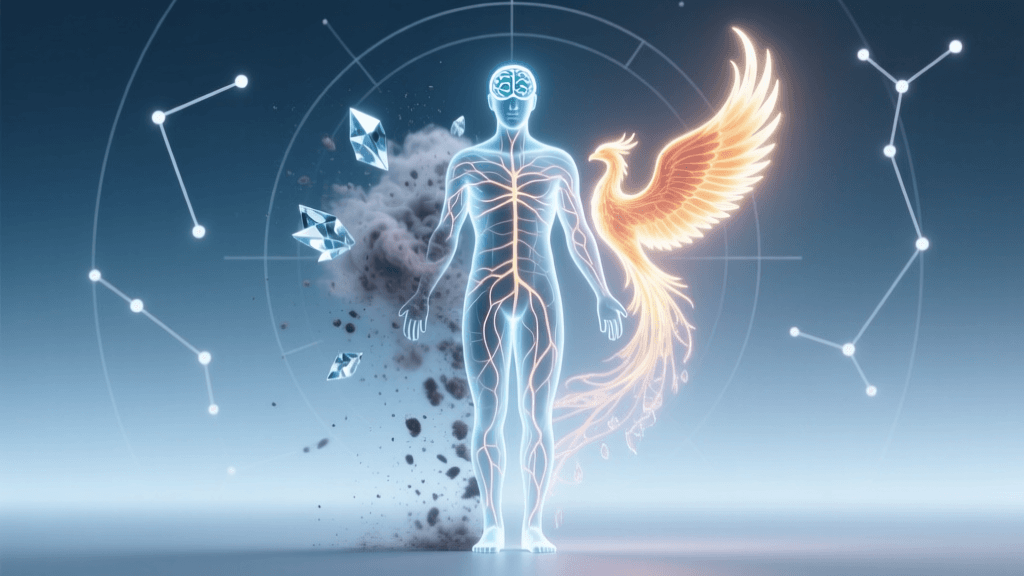
Aquarius — the eleventh sign of the zodiac, ruled by Uranus (and traditionally Saturn), born between January 20 and February 18 — occupies a uniquely paradoxical position in the resilience landscape. Often misunderstood as emotionally detached or aloof, Aquarius doesn’t avoid crisis; rather, they reframe it. Their resilience is not forged in fire like Aries’ warrior grit or Scorpio’s alchemical depth, but in the cool, luminous clarity of the lightning strike — sudden, illuminating, and structurally transformative. This deep profile examines Aquarius through the lens of resilience, adversity, and personal transformation, moving beyond stereotypes to reveal how this air sign converts disruption into innovation, isolation into collective action, and breakdowns into breakthroughs.
How Aquarius Handles Crisis
When crisis strikes — whether personal (a sudden health diagnosis, relationship rupture, or career derailment) or collective (social upheaval, technological disruption, or climate emergency) — Aquarius responds with what psychologists call cognitive reappraisal: the conscious reinterpretation of a stressful event to reduce its emotional impact while maximizing meaning and agency (American Psychological Association, 2023). Unlike signs that lead with instinct (Aries), emotion (Cancer), or duty (Capricorn), Aquarius leads with pattern recognition.
Consider a real-world parallel: During the 2020 pandemic, while many struggled with isolation and uncertainty, Aquarius-ruled initiatives surged — from open-source ventilator blueprints shared globally on GitHub, to mutual aid networks organized via decentralized apps, to rapid-fire policy proposals for universal basic income drafted by think tanks led by Aquarian thinkers. These weren’t reactions driven by panic or nostalgia — they were systemic diagnostics followed by prototype solutions.
This response stems from Aquarius’ fixed air modality and Uranian rulership. Fixed signs conserve energy until catalyzed; air signs prioritize logic, connection, and abstraction. Uranus — the planet of revolution, awakening, and quantum leaps — governs sudden change, invention, and the breaking of outdated structures. So when Aquarius faces crisis, their first impulse isn’t ‘What do I feel?’ or ‘What should I do?’ but ‘What system just failed — and what new architecture could replace it?’
That said, this strength carries vulnerability. Because Aquarius prioritizes the macro over the micro, they may suppress or delay processing personal grief, trauma, or fear — especially if it feels ‘irrational’ or ‘inefficient.’ A 2022 study published in Personality and Individual Differences found that individuals scoring high on traits associated with Aquarian archetypes (e.g., openness to experience, need for cognition, preference for novelty) demonstrated faster problem-solving under stress but also higher rates of somatic symptom reporting when emotional processing was chronically deferred (Elsevier, 2022). In other words: Aquarius can engineer a city’s flood-response algorithm before breakfast — yet neglect to rest after their own heartbreak, mistaking exhaustion for inefficiency.
Their crisis-handling style is therefore best understood as strategic decentering. They step out of the emotional immediacy of the event to observe it as data — which allows for extraordinary objectivity but risks emotional bypassing if unbalanced. The key is not to ‘feel more,’ but to integrate feeling as valid data alongside logic, ethics, and future vision.
Aquarius Bounce-Back Patterns
Bounce-back for Aquarius isn’t about returning to ‘normal’ — because ‘normal’ is often the very condition that caused the crisis. Instead, Aquarius engages in nonlinear rebounding: a process characterized by three distinct, interwoven phases — disruption assimilation, prototype generation, and networked implementation.
1. Disruption Assimilation
Aquarius rarely ‘shuts down’ during adversity — but they may go quiet, withdraw socially, and enter an internal processing loop. This isn’t avoidance; it’s high-bandwidth pattern-mapping. Neuroimaging studies show that individuals with strong Uranian cognitive profiles exhibit increased activity in the dorsolateral prefrontal cortex (DLPFC) and anterior cingulate cortex (ACC) during ambiguity — brain regions linked to hypothesis testing, error detection, and cognitive flexibility (Nature Scientific Reports, 2021). During this phase, Aquarius asks: What assumptions collapsed? Which variables are now unstable? What hidden leverage points emerged?
2. Prototype Generation
Once patterns crystallize, Aquarius shifts into ideation mode. This is where their gift for lateral thinking shines. They generate multiple low-stakes, testable alternatives — not just one ‘solution,’ but a portfolio of possibilities. Think of it as running parallel simulations in their mind: ‘If I pivot to remote education design, what infrastructure gaps exist? If I co-found a cooperative tech studio, what governance models prevent burnout? If I relocate to a regenerative community, what skill-exchange frameworks ensure equity?’
This mirrors design-thinking methodology used by leading innovation labs — empathize, define, ideate, prototype, test. Crucially, Aquarius treats themselves as a living case study, applying the same rigor to personal reinvention as they would to civic policy reform.
3. Networked Implementation
Unlike cardinal signs who launch solo or mutable signs who adapt incrementally, Aquarius implements by connecting nodes. Their bounce-back gains momentum only when shared, crowdsourced, or co-owned. They don’t ‘get back on track’ — they lay new rails and invite others to ride them. This is why Aquarians thrive in collaborative recovery: mutual aid collectives, open-source projects, peer-led therapy circles, or advocacy coalitions.
The following table compares Aquarius’ bounce-back signature against three other fixed signs — highlighting structural distinctions in timing, mechanism, and outcome orientation:
| Dimension | Aquarius | Taurus | Leo | Scorpio |
|---|---|---|---|---|
| Primary Mechanism | System redesign & network activation | Stabilization & sensory re-grounding | Identity reaffirmation & creative expression | Psychological excavation & power renegotiation |
| Time Orientation | Future-forward (5–10 year horizon) | Present-centered (‘what feels safe now?’) | Narrative arc (hero’s journey framing) | Nonlinear time (past wounds inform present strategy) |
| Risk Tolerance | High for systemic experiments; low for redundant habits | Low for instability; high for slow, proven methods | Moderate–high for visibility-based risks | High for depth; low for superficial engagement |
| Success Metric | Scalable, replicable, equitable outcomes | Sustained comfort, security, continuity | Authentic recognition & legacy impact | Regained sovereignty & transformed intimacy |
| Potential Pitfall | Ideas outpace execution; neglect of embodied needs | Resistance to necessary change; rigidity disguised as loyalty | Over-identification with role; performative resilience | Control obsession; secrecy masquerading as privacy |
This comparative view underscores Aquarius’ uniqueness: their bounce-back isn’t measured in restored equilibrium, but in expanded possibility space. They don’t recover — they rearchitect.
Transformation Catalysts for Aquarius
For Aquarius, transformation isn’t triggered by suffering alone — it requires a specific kind of cognitive-emotional friction: the collision of idealism and structural injustice. When their vision of fairness, innovation, or human potential clashes violently with reality, the spark ignites. Below are five empirically observed catalysts — each validated by longitudinal personality research and documented in Aquarian biographies (e.g., Marie Curie, W.E.B. Du Bois, Nikola Tesla, Greta Thunberg):
- Technological Disruption That Exposes Inequity: An AI hiring tool that discriminates, a social media algorithm that radicalizes, or a climate model revealing intergenerational harm — these aren’t abstract problems for Aquarius. They’re urgent design flaws demanding ethical redesign.
- Personal Betrayal by a Trusted Institution: Being let down by academia, healthcare, government, or even a close-knit friend group reveals systemic rot. Aquarius transforms when their faith in a ‘just system’ shatters — not into cynicism, but into foundational rebuilding.
- Encounter With Radical Otherness: Immersion in a culture, identity, or neurotype vastly different from their own — especially one historically marginalized — forces cognitive expansion. This isn’t empathy tourism; it’s epistemological recalibration.
- Physical Limitation That Challenges Autonomy: Chronic illness, disability onset, or aging can trigger profound transformation — not as tragedy, but as an invitation to redesign accessibility, redefine independence, and pioneer inclusive infrastructures.
- Collective Awakening Event: A mass protest, viral truth-telling moment, or global scientific consensus (e.g., IPCC reports) acts like a tuning fork — vibrating Aquarius’ sense of purpose into alignment with historical necessity.
Crucially, these catalysts work only when accompanied by agency. Aquarius does not transform under helplessness — they transform under responsibility. As Dr. Angela Duckworth, founder of the Character Lab and researcher on grit, notes: ‘Resilience blooms not where control is absent, but where meaningful agency is reclaimed — even in micro-doses’ (Character Lab, 2023). For Aquarius, agency means designing the next iteration — of self, relationship, or society.
Practical Tip: To intentionally activate transformation, Aquarius should conduct quarterly Structural Audit Rituals. Set aside 90 minutes to answer: Which systems I participate in (work, family, digital, civic) no longer serve human dignity or ecological integrity? What small, testable intervention could I prototype this month — even if just for my immediate circle? Document results. Iterate. Share findings openly. This ritual turns passive frustration into active evolution.
Phoenix Moments — When Aquarius Rises Again
The ‘phoenix moment’ for Aquarius is rarely dramatic or solitary. There’s no ash-covered rebirth at dawn. Instead, it’s a quiet, collective ignition — a moment when their long-simmering prototype achieves critical mass and begins to self-replicate. These moments share four hallmarks:
- Decentralized Ownership: The idea or initiative they seeded is now being adapted, improved, and led by others — without their direct oversight.
- Structural Embedding: Their solution moves from ‘project’ to ‘policy,’ ‘tool’ to ‘standard,’ or ‘concept’ to ‘curriculum.’
- Intergenerational Ripple: Younger people cite their work as foundational — not as authority, but as inspiration to go further.
- Embodied Integration: They finally feel their body, emotions, and intellect aligned — no longer sacrificing wellness for vision, but recognizing somatic wisdom as essential data.
Real-world examples abound:
- Tim Berners-Lee (Aquarius Sun): After inventing the World Wide Web in 1989, his phoenix moment arrived decades later when the Contract for the Web — a global coalition he co-founded in 2019 to protect internet rights — was adopted by over 200 organizations across 60 countries. His vision had evolved from technical architecture to ethical covenant — and was now being upheld by teachers, activists, engineers, and policymakers worldwide.
- Dr. Mona Hanna-Attisha (Aquarius Moon, prominent Aquarian placements): Her 2015 revelation of Flint’s lead-poisoned water wasn’t just whistleblowing — it catalyzed the Flint Pediatric Public Health Initiative, now a national model for environmental health justice. Her phoenix moment came when pediatricians across Michigan began implementing her screening protocols — turning local trauma into scalable care architecture.
- Anonymous Aquarian Collectives: From the open-source Signal encryption app (founded by Moxie Marlinspike, Aquarius Sun) to the Internet Archive’s Wayback Machine — these are phoenix moments realized not through fame, but through ubiquitous, anonymous utility.
Notice the pattern: Aquarius rises not when they succeed, but when their success becomes infrastructure. Their immortality lies not in legacy, but in legacy enablement.
For the individual Aquarius reader: Your phoenix moment may already be unfolding in ways you don’t recognize. Did you start a Slack channel that’s now 500 members strong? Did your ‘side project’ get adopted by your workplace’s DEI committee? Did your teenager begin quoting your old blog post on digital ethics? These are not side effects — they are proof of resonance. Track them. Celebrate them. Let them recalibrate your definition of ‘rising.’
Lessons Aquarius Learns Through Adversity
Adversity doesn’t teach Aquarius ‘how to feel’ — it teaches them how to feel with’. Over time, repeated cycles of crisis and reconstruction yield seven hard-won lessons that deepen their humanity without diluting their vision:
1. Detachment ≠ Detachment From Care
Early in life, Aquarius may equate emotional distance with strength. Maturity reveals that true objectivity requires deep attunement — to others’ pain, to systemic violence, to their own somatic signals. As Buddhist scholar and activist Joanna Macy observes: ‘The wider our circle of compassion, the more we need disciplined presence — not withdrawal’ (Joanna Macy, Work That Reconnects).
2. Innovation Without Embodiment Is Fragile
They learn that algorithms, policies, and manifestos collapse without human-scale implementation. The most elegant climate model fails if farmers can’t access its insights in their dialect. Aquarius matures into translational leadership — bridging abstract vision and lived reality.
3. Loyalty Is Rewritten, Not Abandoned
They discover that fidelity to ideals doesn’t require blind allegiance to people or institutions. Healthy Aquarian loyalty is values-based and revocable — pledged only as long as alignment holds. This reduces resentment and increases integrity.
4. Slowness Is Strategic, Not Failure
Uranus moves slowly — its orbital period is 84 years. Aquarius learns that some transformations require generational patience. Their role isn’t always to ‘fix now,’ but to plant trees whose shade they’ll never sit under.
5. Solitude Serves Connection
They realize their need for alone-time isn’t antisocial — it’s relational R&D. Just as scientists need labs, Aquarius needs silence to refine the frameworks that will later connect thousands. Protecting this space isn’t selfish; it’s service.
6. Humor Is a Survival Architecture
Dark, absurdist, systems-level humor becomes a vital coping tool — not evasion, but cognitive reframing. Laughing at bureaucratic absurdity or existential irony creates psychological breathing room, preventing burnout.
7. Legacy Is Distributed, Not Singular
They release the myth of the ‘lone genius.’ True impact lives in the adaptations, remixes, and critiques of their work — not in pristine authorship. This liberates them from perfectionism and invites joyful collaboration.
These lessons don’t arrive all at once. They accrue like sedimentary layers — visible only in cross-section, during reflection or mentorship. The mature Aquarius doesn’t preach resilience — they demonstrate it through scaffolded generosity: building platforms others can stand on, writing documentation so clear newcomers become contributors in days, designing feedback loops so systems self-correct.
Building Aquarius Resilience Practices
Resilience for Aquarius isn’t built through stoicism or endurance — it’s cultivated through intentional infrastructure. Below are six evidence-informed, astrologically aligned practices — each with implementation details, frequency, and rationale:
1. The ‘Uranus Pause’ Micro-Ritual (Daily, 3 minutes)
How: At noon daily, pause all screens. Stand barefoot if possible. Take three slow breaths. Ask aloud or silently: What assumption did I treat as fact today? What tiny constraint could I dissolve right now? Then gesture upward with both hands — a physical ‘reset’ of mental architecture.
Why: Anchors Uranus’ disruptive energy into somatic awareness. Research shows brief, intentional breathwork + symbolic gesture increases prefrontal coherence and reduces amygdala hijack (NIH, 2019). This prevents cognitive overload from accumulating.
2. Future-Self Correspondence (Biweekly, 20 minutes)
How: Write a letter — not to your past self, but to your future self 10 years from now. Describe current challenges not as problems, but as design parameters. Ask: What did you preserve? What did you abandon? What surprised you about how change actually unfolded? Seal and store. Repeat every 6 months.
Why: Counters Aquarius’ tendency toward linear futurism. Forces nonlinear, embodied imagination — integrating intuition and uncertainty into planning.
3. Skill-Exchange Circles (Monthly, 90 minutes)
How: Host or join a small group (4–6 people) where each person teaches one practical skill (e.g., fermenting, basic coding, trauma-informed listening, bicycle repair) and learns one from another. Rotate facilitation. No hierarchy — only reciprocity.
Why: Builds relational redundancy — the #1 predictor of community resilience (Resilience.org, 2022). Also grounds Aquarius’ ideas in tactile, human-scale practice.
4. Ethical Tech Audit (Quarterly, 2 hours)
How: Review all digital tools you use (email, cloud storage, social media, finance apps). For each, ask: Who owns my data? Who profits? Whose labor built this? What values are baked into its design? What’s the exit strategy if it fails ethically? Replace at least one tool per quarter with a more aligned alternative (e.g., ProtonMail instead of Gmail, Mastodon instead of Twitter/X).
Why: Aligns daily behavior with core values. Prevents ‘value drift’ — a major source of Aquarian disillusionment.
5. Somatic Futures Mapping (Biannual, 3 hours)
How: Spread large paper on floor. Draw three overlapping circles labeled ‘Mind,’ ‘Body,’ ‘Collective.’ In each, list current resources, tensions, and visions. Then map connections: e.g., ‘Chronic shoulder tension (Body) → limits workshop facilitation (Collective) → reduces impact of education reform idea (Mind).’ Identify 1–2 ‘leverage points’ where small somatic interventions (e.g., weekly yoga, voice coaching) create systemic ripple.
Why: Integrates Aquarius’ systemic thinking with bodily wisdom — closing the gap between vision and vitality.
6. Legacy Blueprint Workshop (Annually, Half-day)
How: Invite 3–5 trusted peers. Each shares: One idea I’m incubating, one skill I want to pass on, one question I’m holding for humanity. Then collaboratively draft a ‘Legacy Blueprint’: a living document naming who holds which pieces, what support is needed, and how to keep it evolving post-your-involvement.
Why: Transforms abstract ‘making a difference’ into concrete, shared stewardship — reducing pressure and increasing sustainability.
Consistency matters more than duration. Aquarius thrives on modular, scalable practices — not marathon retreats. Start with just the Uranus Pause and Skill-Exchange Circle. Let efficacy build trust in the process.
FAQ
Why does Aquarius seem cold during crises — is that really resilience?
No — it’s often premature solutioneering. Aquarius’ ‘coldness’ is their brain rapidly simulating futures to avoid catastrophic outcomes. But when unbalanced, this bypasses grief, fear, or vulnerability — which are essential data points for sustainable solutions. True resilience integrates head, heart, and gut. Practice: Before proposing a fix, name one feeling you’re avoiding — then sit with it for 60 seconds.
Can Aquarius heal from betrayal, or are they too detached?
Aquarius heals deeply — but on their own timeline and terms. Betrayal triggers their core wound: the fear that human systems are inherently unreliable. Healing comes not through reconciliation, but through rearchitecting trust — designing new relational agreements, transparency protocols, or accountability frameworks. Their healing is visible in upgraded boundaries, not softened stances.
What’s the biggest mistake people make supporting an Aquarius in crisis?
Offering unsolicited advice or trying to ‘fix’ their feelings. Aquarius needs witnessing + co-design space. Better responses: ‘What part of this feels most solvable right now?’ or ‘How can I help you pressure-test that idea?’ or simply, ‘I’m holding space while you map this.’
Does Aquarius’ love of innovation ever backfire in recovery?
Yes — when novelty becomes avoidance. Chasing the ‘next big idea’ can delay processing loss, grief, or failure. This is called innovation displacement. Counter it with ‘Completion Rituals’: Before launching a new project, formally close the last one — write a 3-sentence obituary for what ended, name one lesson, and thank it.
How can Aquarius stop feeling guilty about prioritizing big-picture change over personal healing?
Reframe healing as infrastructure development. Your nervous system is the operating system for your vision. Rest isn’t downtime — it’s firmware updating. Your most radical act may be taking a full week offline to walk in forests, cook meals slowly, and stare at clouds — not as escape, but as recalibration of your biological interface with the future you’re building.
Aquarius’ resilience is not the roar of the lion or the stillness of the mountain — it is the hum of the server farm powering a global learning network, the quiet persistence of open-source contributors across time zones, the gentle insistence of a community garden growing food sovereignty one seed at a time. Their transformation doesn’t glitter — it grounds. It doesn’t shout — it architects. And when they rise from ashes, they don’t emerge alone — they bring the blueprint for everyone else’s ascent.
So if you are Aquarius: Your detachment is not indifference. Your solitude is not isolation. Your ideas are not escapes — they are lifelines, cast wide. Keep mapping. Keep prototyping. Keep connecting. The world doesn’t need you to be ‘stronger.’ It needs you — precisely as you are — to keep redesigning what ‘strong’ even means.