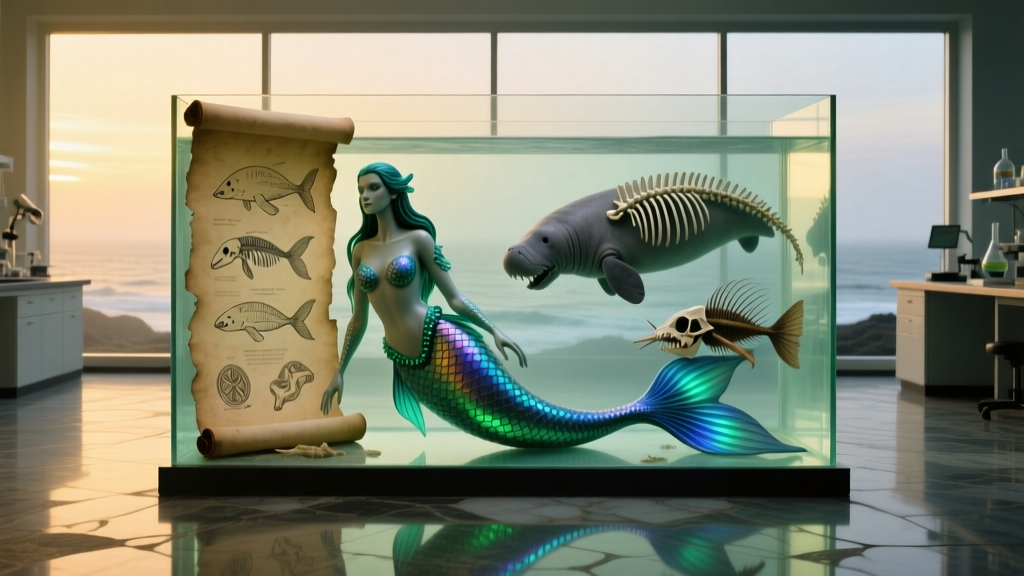
The question of whether mermaids are real has persisted across millennia, bridging ancient maritime folklore and modern cryptozoology. When analyzing search queries like "are mermaids are mermaids real," it becomes clear that public fascination stems from a collision of mythological conditioning and unexplained maritime encounters. To answer this definitively, we must move beyond simple dismissal and conduct a rigorous comparison between mythological records and biological alternatives. By analyzing cross-cultural archetypes alongside marine biology, optical physics, and psychological phenomena, we can map the exact origins of the aquatic humanoid phenomenon. This analysis contrasts the esoteric symbolism of water spirits with the tangible, scientific realities of the ocean, providing a definitive framework for understanding what sailors throughout history actually encountered.
Cross-Cultural Comparison of Mermaid Archetypes
Before evaluating biological alternatives, we must establish the baseline of mermaid mythology. The concept of the half-human, half-fish entity is not isolated to European folklore; it is a pervasive global archetype. However, the behavioral traits and physical descriptions vary drastically depending on the region's relationship with the ocean. Comparing these myths reveals that the "mermaid" is less a singular cryptid and more a psychological projection of the sea's dual nature—nurturing yet deeply lethal.
| Culture | Entity Name | Physical Description | Behavioral Trait & Symbolism |
|---|---|---|---|
| Ancient Greek | Sirens / Tritons | Originally bird-women; later conflated with fish-tailed sea nymphs. | Lured sailors to shipwrecks; symbolized the deceptive danger of the sea. |
| Celtic / Scottish | Selkies / Merrows | Seals in water, humans on land (Selkies); green-haired fish folk (Merrows). | Tragic romance, stolen skins, and the boundary between land and water. |
| Japanese | Ningyo | Fish with a human head, often described with a monkey-like mouth. | Consuming its flesh granted immortality; catching one brought storms. |
| West African | Mami Wata | Beautiful woman with a fish tail, often holding a snake or mirror. | Bestower of wealth and beauty, but demanded strict spiritual loyalty. |
According to the World History Encyclopedia, the conflation of Greek Sirens with fish-tailed mermaids did not occur until the Middle Ages, demonstrating how fluid these mythological descriptions are. This fluidity suggests that the "mermaid" is a malleable template applied to unexplained marine phenomena rather than a strict biological classification.
Biological Alternatives: The Sirenia Order
When stripping away the mythological embellishments, the most scientifically sound alternative to mermaid sightings lies within the mammalian order Sirenia. This order comprises fully aquatic, herbivorous mammals, including manatees and dugongs. The very name "Sirenia" was bestowed by early taxonomists who recognized the link between these animals and the sirens of Greek myth.
- West Indian Manatee (Trichechus manatus): Possesses a paddle-like tail and pectoral flippers. When nursing their young, mother manatees hold them against their chests. Their mammary glands are located just behind the pectoral fins, closely mimicking the anatomy of a human female holding an infant.
- Dugong (Dugong dugon): Features a fluked tail similar to a whale or dolphin. Dugongs are known to breach the water's surface and have a more streamlined, "mermaid-like" silhouette when viewed from a distance.
- West African Manatee (Trichechus senegalensis): Inhabits the coastal and riverine regions of West Africa, providing a direct biological correlate to the origins of the Mami Wata water spirit mythology.
Steller’s Sea Cow vs. Traditional Mermaid Lore
The most compelling biological alternative to historical mermaid encounters is Steller’s sea cow (Hydrodamalis gigas). Discovered by Georg Wilhelm Steller in 1741 in the Bering Sea, this massive sirenian grew up to 30 feet in length and weighed nearly 10 tons. Unlike modern manatees, Steller's sea cow had a bifurcated tail fluke and a thick, bark-like skin. According to Smithsonian Magazine, these creatures were highly social, often seen supporting injured pod members at the water's surface. A sailor viewing a 30-foot sea cow cradling its young in the foggy, freezing conditions of the North Pacific could easily experience a profound optical and cognitive distortion, interpreting the massive, nurturing mammal as a giant aquatic humanoid. Tragically, the species was hunted to extinction by 1768, meaning modern researchers can only rely on skeletal reconstructions and historical ship logs to compare them against mermaid lore.
Optical and Psychological Alternatives to Mermaid Sightings
Biology alone does not account for the sheer volume of mermaid sightings recorded in naval logs. We must compare biological encounters with atmospheric and psychological alternatives to understand the full scope of the phenomenon.
- Fata Morgana (Complex Superior Mirages): This optical phenomenon occurs when a temperature inversion bends light rays passing through layers of cold and warm air. Objects on the horizon—such as rocks, kelp beds, or surfacing manatees—are vertically stretched and distorted. A Fata Morgana can easily transform the silhouette of a distant manatee into an upright, humanoid figure seemingly standing on the water's surface.
- Pareidolia and Cognitive Bias: The human brain is hardwired to recognize human faces and forms (pareidolia). In the high-stress, low-visibility environment of the open ocean, the brain will aggressively map human characteristics onto ambiguous stimuli, such as floating debris or wave patterns.
- Scurvy-Induced Delirium: During the Age of Sail, severe Vitamin C deficiency (scurvy) caused a host of neurological symptoms, including lethargy, confusion, and vivid hallucinations. Many early mermaid sightings recorded in ship logs correlate with the late stages of long voyages where scurvy would have been rampant among the crew.
Modern Media and Cryptid Comparisons
In the contemporary era, the search for aquatic humanoids has shifted from maritime logs to digital media and cryptozoology forums. It is vital to compare genuine historical folklore with modern manufactured hoaxes. In 2012 and 2013, the television network Animal Planet aired "Mermaids: The Body Found" and "Mermaids: The New Evidence." These programs were presented in a documentary style, utilizing CGI and actors portraying scientists to argue for the "Aquatic Ape Hypothesis"—the idea that a branch of hominids evolved to live entirely underwater.
These mockumentaries were highly effective; they prompted the National Oceanic and Atmospheric Administration (NOAA) to issue an official statement clarifying that no evidence of aquatic humanoids has ever been found. When comparing the "mermaid" to other modern cryptids like Bigfoot or the Loch Ness Monster, the mermaid lacks the physical trace evidence (footprints, blurry but consistent photography, sonar anomalies) that sustains other cryptid fields. The mermaid phenomenon is entirely reliant on historical text, misidentified biology, and atmospheric optics.
Ultimately, the mermaid is not a biological reality hiding in the abyssal plains. It is a complex synthesis of marine biology, atmospheric physics, and human psychology. By comparing the mythological templates of the past with the scientific realities of the Sirenia order and optical mirages, we gain a profound appreciation for how humanity has historically processed the terrifying, beautiful, and unknowable depths of the ocean.