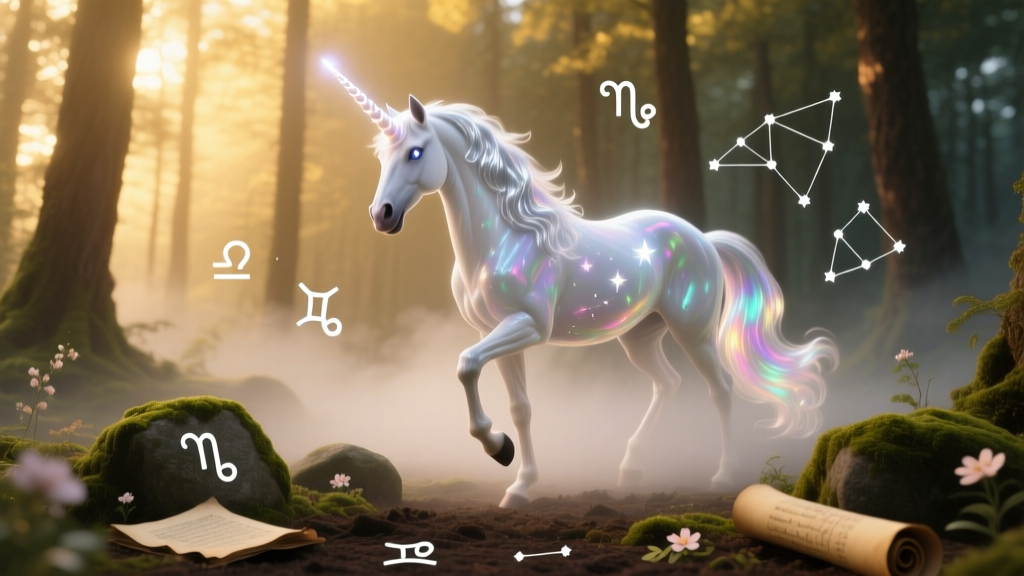
Addressing the Query: Are Unicorns Real? Are Unicorns Real in History?
When users type "are unicorns real are unicorns real" into search engines, they are often caught between childhood nostalgia, esoteric curiosity, and a genuine desire to separate historical fact from fantasy. From a strictly biological and taxonomic standpoint, the equine creature with a single spiraled horn does not exist in the fossil record or modern zoology. However, dismissing the unicorn purely as a fairy tale ignores a complex web of paleontological misinterpretations, ancient trade monopolies, and deep psychological archetypes. This critical review evaluates the pros and cons of the unicorn phenomenon, separating cryptozoological fiction from the profound mythological and historical realities that birthed the legend.
Pros: The Psychological and Cultural Utility of the Myth
While biologically fictitious, the unicorn holds immense value in human history, psychology, and spiritual traditions. Evaluating the "pros" of the unicorn myth requires looking at its function as a cultural and psychological tool.
- Archetypal Resonance: In Jungian psychology, the unicorn represents the untamable wild, purity, and the integration of the anima. It serves as a powerful symbol for shadow work and the pursuit of the unattainable ideal.
- Heraldic and Economic History: The unicorn is the national animal of Scotland, chosen in the 12th century because it was seen as the natural enemy of the lion (the symbol of England). This mythological rivalry shaped centuries of geopolitical branding.
- Alchemical Symbolism: In medieval alchemy, the unicorn (often depicted alongside a lion) represented the spirit or the volatile principle of mercury, while the lion represented the soul or fixed sulfur. Their union symbolized the coniunctio oppositorum—the merging of opposites to create the Philosopher's Stone.
- Moral Frameworks: Historically, the belief that only a pure maiden could tame a unicorn provided a narrative framework for teaching virtues of innocence, temperance, and moral integrity in medieval bestiaries.
Cons: The Pseudoscience and Cryptozoological Fallacies
The primary "cons" associated with the unicorn arise when metaphor and myth are mistakenly treated as literal biological reality. This confusion has led to historical atrocities and modern misinformation.
- Cryptozoological Grift: Modern internet hoaxes and pseudo-documentaries frequently blur the line between myth and reality, selling fake DNA evidence or misidentifying genetic anomalies (such as roe deer with fused horn buds) as proof of mythical beasts. This degrades public scientific literacy.
- Historical Cruelty and Poaching: The medieval European belief in the medicinal properties of the "alicorn" (unicorn horn) drove the mass slaughter of narwhals. Furthermore, the conflation of unicorns with rhinoceroses contributed to early exotic trade networks that exploited endangered megafauna.
- Esoteric Misinformation: In certain New Age circles, the unicorn is treated as a literal interdimensional entity rather than a psychological archetype. This literalism can distract seekers from the genuine internal work required for spiritual development, replacing introspection with fantasy.
Critical Review: Tracing the Biological and Historical Roots
To understand why humanity collectively hallucinated the unicorn, we must examine the historical artifacts and biological misunderstandings that constructed the myth over millennia.
The Indus Valley Seals and the Aurochs Profile
The earliest visual evidence resembling a unicorn comes from the Indus Valley Civilization (c. 2000 BCE). Steatite seals discovered in Harappa and Mohenjo-Daro depict a powerful, bull-like creature with a single, long horn curving forward. According to the Smithsonian Magazine, historians and archaeologists largely agree that this is a profile view of an aurochs (an extinct, massive wild ox) or a local bovine species. Because the animal is drawn in strict profile, the second horn is hidden directly behind the first. When these seals traveled via trade routes to Mesopotamia and later Greece, the two-dimensional profile was misinterpreted as a literal one-horned beast.
Ctesias, Aristotle, and the Indian Rhinoceros
The first written account of a unicorn in Western literature comes from Ctesias, a Greek physician at the Persian court, around 400 BCE. In his book Indika, he described a wild ass in India that was white, had a red head, blue eyes, and a multi-colored horn on its forehead. Encyclopedia Britannica notes that Ctesias never visited India; he was compiling hearsay from Persian travelers. His description is a garbled, composite account of the Indian Rhinoceros (Rhinoceros unicornis), the Tibetan antelope, and the wild ass. Later scholars, including Aristotle and Pliny the Elder, accepted Ctesias's accounts as zoological fact, cementing the unicorn in early scientific catalogs.
The Narwhal Tusk Monopoly and the Alicorn
The physical "proof" of unicorns in medieval Europe came from the Arctic. Viking traders and Inuit hunters harvested the spiral tusks of the narwhal (Monodon monoceros) and sold them to European nobility as "alicorns." According to the Natural History Museum, these tusks were valued at up to ten times their weight in gold. Queen Elizabeth I was gifted a narwhal tusk valued at £10,000—the equivalent of a grand estate. The spiraled texture of the narwhal tusk permanently altered the artistic depiction of the unicorn, shifting it from the bovine or caprine shapes of antiquity to the elegant, horse-like creature with a spiraled horn we recognize today.
Mythological Archetypes vs. Biological Reality
The table below contrasts the mythological unicorn with the real-world animals and extinct species that likely inspired the legend.
| Feature | Mythological Unicorn | Biological Inspirations (Rhino/Narwhal) | Elasmotherium (Siberian Unicorn) |
|---|---|---|---|
| Taxonomy | Equine/Caprine hybrid (Myth) | Perissodactyla (Rhino) / Cetacea (Narwhal) | Extinct Rhinocerotidae |
| Horn Composition | Keratin, bone, or magical crystal | Keratin (Rhino) / Dentin (Narwhal tusk) | Massive keratinous horn (up to 2m) |
| Temperament | Fierce, untamable, yet pure | Highly territorial, aggressive (Rhino) | Herbivorous grazer, likely docile |
| Historical Era | Timeless / Antiquity to Modern | Pleistocene to Modern Era | Extinct approx. 39,000 years ago |
Furthermore, paleontologists have studied Elasmotherium sibiricum, often dubbed the "Siberian Unicorn." This massive, woolly rhinoceros roamed Eurasia and possessed a single, enormous horn on its forehead. While it went extinct around 39,000 years ago, it coexisted with early modern humans. Oral traditions regarding this terrifying, single-horned megafauna may have survived in Eurasian folklore, eventually bleeding into the broader Indo-European mythos.
Actionable Framework: Utilizing the Unicorn Archetype in Spiritual Practice
For practitioners of esoteric traditions, mythology, and depth psychology, the question of biological reality is secondary to the archetypal utility of the symbol. Here is how to practically apply the unicorn archetype in spiritual and psychological frameworks:
- The Principle of the Monad (Singular Focus): The single horn represents the Monad—the indivisible, singular point of divine will. In meditation, visualize the unicorn's horn not as a weapon, but as an antenna for singular, undivided intention. Use this imagery to combat mental fragmentation during deep work or ritual.
- Shadow Work and the Untamable Wild: The unicorn in medieval lore could only be captured through deception (using a maiden as bait). Psychologically, this represents how the ego cannot force the integration of the higher self or the unconscious. You must approach your deepest, wildest instincts with vulnerability and innocence, rather than aggression and control.
- Alchemical Purification: Legend states the unicorn could purify poisoned water by dipping its horn into the stream. In a practical sense, use this myth as a cognitive behavioral framework: when confronted with "toxic" environments or negative thought loops, visualize the alicorn neutralizing the poison, shifting your nervous system from a sympathetic (fight/flight) state to a parasympathetic (rest/digest) state.
Ultimately, while the flesh-and-blood unicorn of fairy tales does not graze in modern forests, the creature is entirely real as a historical catalyst for trade, a biological misunderstanding of magnificent megafauna, and a permanent fixture in the architecture of the human psyche.