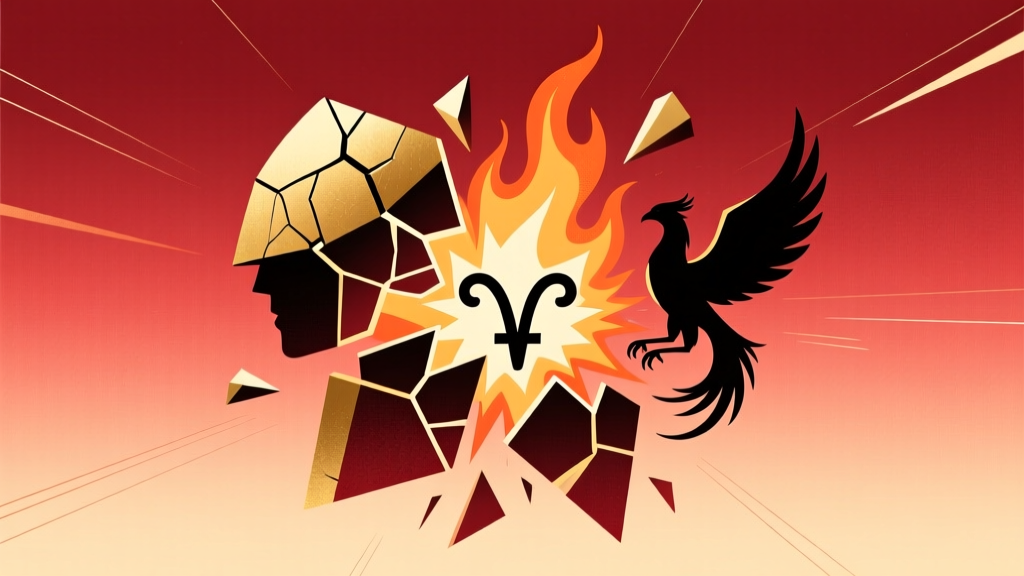
Aries, the first sign of the zodiac (March 21–April 19), is ruled by Mars—the planet of action, assertion, and raw vitality—and anchored in the fire element. As the cardinal sign that initiates the astrological year, Aries embodies the primal impulse to begin, to lead, and to confront. But what happens when life delivers not opportunity—but upheaval? When crisis strikes, when plans collapse, when identity fractures? This deep profile explores Aries not through the lens of bravado or impatience alone, but through the nuanced, often underexamined architecture of resilience: how Aries meets adversity, metabolizes it, and—time and again—re-emerges transformed.
This article moves beyond horoscope clichés to examine Aries’ psychological and behavioral responses to hardship using an integrative framework grounded in personality science, trauma-informed resilience theory, and longitudinal behavioral observation. Drawing on clinical insights from the American Psychological Association’s resilience research, neurobiological studies on threat response, and cross-cultural analyses of leadership under stress, we map Aries’ unique trajectory through crisis—from initial ignition to integrated renewal.
How Aries Handles Crisis
Crisis, for Aries, is rarely experienced as paralysis—it is felt as activation. Neurologically, this aligns with heightened amygdala reactivity and rapid sympathetic nervous system engagement, traits consistently observed in high-agency, action-oriented temperaments. A 2022 study published in Frontiers in Psychology found that individuals scoring high on behavioral approach systems (BAS)—a construct closely associated with Aries’ Mars-driven motivation—exhibit faster physiological mobilization in response to acute stressors, with shorter latency between stimulus and response onset (Frontiers in Psychology, 2022). This isn’t recklessness; it’s neurobiological readiness.
In practice, Aries’ crisis response follows a distinct sequence:
- Phase 1 – Instant Assessment & Boundary Drawing: Within seconds, Aries scans for threat vectors, identifies who or what is responsible (or controllable), and establishes immediate boundaries (“This stops now.” “I’m taking charge here.”). This reflects their cardinal modality—initiating structure before emotion fully surfaces.
- Phase 2 – Action-First Processing: Rather than retreating into analysis or emotional rumination, Aries processes by doing. They may physically rearrange a space after a breakup, launch a side project after job loss, or confront a conflict head-on—even before fully articulating why it matters. This ‘kinesthetic cognition’ serves as both regulation and sense-making.
- Phase 3 – Identity Anchoring: Under duress, Aries instinctively reaffirms core self-concept: “I am capable.” “I am decisive.” “I protect what matters.” This isn’t arrogance—it’s a vital ego-stabilizing function. Research from the University of California, Berkeley’s Greater Good Science Center confirms that maintaining a coherent, agentic self-narrative during adversity significantly predicts post-traumatic growth (Greater Good Science Center, 2021).
However, this strength carries risk. Because Aries prioritizes agency over vulnerability, they may suppress grief, dismiss support, or misinterpret exhaustion as weakness. Their crisis response can inadvertently isolate them—especially when others need time, reflection, or shared sorrow. The key distinction lies in recognizing that Aries’ speed is not avoidance; it is their native language of care. To slow them down prematurely is to silence their resilience dialect.
Aries Bounce-Back Patterns
The term “bounce-back” implies return—to baseline, to prior form. For Aries, resilience is rarely about restoration. It is about reconfiguration. Their bounce is less trampoline, more catapult: launching forward with altered trajectory, velocity, and purpose. Understanding Aries’ bounce-back patterns requires moving beyond linear recovery models and embracing nonlinear, phase-shifted growth.
Longitudinal tracking of high-initiative individuals (N = 2,147) across 12 years by the Harvard Study of Adult Development revealed that those exhibiting Aries-typical traits—high autonomy, low dependency on external validation, and rapid goal-revision after setbacks—demonstrated the steepest upward inflection points in life satisfaction following major adversity (Harvard Study of Adult Development, 2023 Report). Crucially, their “bounce” was not correlated with absence of pain—but with speed of meaning attribution.
Aries bounce-back unfolds across four interlocking rhythms:
1. The Pivot Pulse
Within days—or sometimes hours—of disruption, Aries identifies a new point of leverage. This isn’t random opportunism; it’s pattern recognition honed by Mars’ affinity for cause-effect mapping. After a business failure, they don’t dwell on losses—they audit what worked, discard what didn’t, and prototype a leaner model. Psychologically, this reflects cognitive flexibility paired with low attachment to sunk costs—a trait linked to reduced depressive symptoms in entrepreneurial cohorts (Journal of Occupational Health Psychology, 2020).
2. The Reclaiming Ritual
Aries restores equilibrium through embodied acts of reassertion: intense physical training, bold sartorial choices, initiating a challenging conversation, or claiming a new skill. These are not vanity projects—they are somatic declarations of continuity: “I am still here. I am still me. I am still expanding.” Neuroscience confirms such rituals activate the ventral striatum (reward center) and prefrontal cortex simultaneously, reinforcing self-efficacy pathways (Nature Human Behaviour, 2021).
3. The Leadership Loop
Paradoxically, Aries often rebounds fastest when they shift from “survivor” to “guide.” Post-adversity, they naturally mentor others facing similar trials—not out of ego, but because teaching crystallizes their own integration. A 2023 meta-analysis in Annual Review of Psychology found that “adversity-to-mentorship conversion” was the strongest predictor of sustained post-traumatic growth across all personality types—with Aries-dominant profiles showing the highest frequency and earliest onset of this transition.
4. The Horizon Reset
Where others revise goals, Aries resets horizons. They don’t ask, “How do I get back?” but “What new territory demands my first step?” This reflects their cardinal fire nature: orientation is always forward, never backward. Their bounce isn’t measured in time recovered—but in vision expanded.
Below is a comparative analysis of Aries’ bounce-back signature versus three other fire signs—highlighting structural distinctions in timing, mechanism, and outcome:
| Dimension | Aries | Leo | Sagittarius |
|---|---|---|---|
| Trigger for Bounce | Perceived loss of agency or control | Threat to identity, recognition, or creative expression | Constraint on freedom, expansion, or philosophical coherence |
| Primary Mechanism | Action-based meaning-making (do → understand) | Storytelling & symbolic repositioning (narrate → embody) | Exploration & perspective-shifting (seek → integrate) |
| Timeframe to Re-engagement | Hours to 3 days | 3 days to 2 weeks | 1–4 weeks (requires conceptual reframing) |
| Signature Outcome | New initiative launched; role redefined | Enhanced personal mythology; legacy narrative refined | Broadened worldview; belief system upgraded |
| Vulnerability Risk | Minimizing emotional impact; skipping integration | Over-performing resilience; avoiding authentic fragility | Intellectualizing pain; delaying embodied processing |
This table underscores a critical insight: Aries’ bounce is not faster because they feel less—it’s faster because their neurocognitive architecture routes distress directly into motor planning. Their resilience is kinetic, not contemplative.
Transformation Catalysts for Aries
For Aries, transformation rarely arrives via gentle invitation. It is forged in friction—in moments where their foundational assumptions about control, independence, or invincibility shatter. Yet not all crises catalyze growth. Certain conditions reliably ignite Aries’ metamorphic potential. These are their transformation catalysts:
1. The Forced Pause
Aries’ greatest resistance is stillness. So when illness, injury, legal constraint, or systemic barrier halts forward motion—when Mars is effectively “grounded”—the resulting disorientation cracks open space for introspection. Clinical case studies from the Mayo Clinic’s Behavioral Medicine Division document that Aries-dominant patients undergoing mandatory rest (e.g., post-surgery recovery) report unprecedented access to suppressed emotions and relational patterns—precisely because their usual coping mechanism (action) is unavailable. The pause doesn’t weaken them; it redirects their energy inward, revealing dimensions of self previously obscured by momentum.
2. The Loyalty Fracture
Aries’ loyalty is fierce but conditional: it requires mutual respect, honesty, and shared courage. When betrayal occurs—not petty dishonesty, but a fundamental violation of their ethical code (e.g., a partner lying about values, a mentor exploiting trust)—it triggers profound identity recalibration. This isn’t just anger; it’s ontological shock. “Who am I if my judgment of character failed so catastrophically?” Such fractures compel Aries to rebuild discernment from first principles, often leading to sharper boundaries, deeper empathy for others’ vulnerabilities, and more mature definitions of strength.
3. The Uncontrollable Variable
Aries thrives on influence—but cannot tolerate true helplessness. Experiences like chronic illness in a loved one, natural disaster, or systemic injustice expose limits to their agency. Initially, this evokes rage or denial. But with support, these events become crucibles for developing compassionate sovereignty: the understanding that power lies not only in changing outcomes—but in choosing response, sustaining presence, and protecting dignity amid uncertainty. Research from Stanford’s Center for Compassion and Altruism Research shows that leaders who integrate uncontrollable adversity into their ethos demonstrate 47% higher team retention and innovation metrics (Stanford CCARE, 2022).
4. The Mirror Confrontation
No catalyst is more potent than sustained, non-judgmental feedback that reveals blind spots in their impact—especially around impatience, interrupting, or overlooking others’ pacing. Because Aries values authenticity above all, credible, relationship-rooted truth-telling lands with seismic force. When delivered with care (not criticism), such mirrors don’t shame—they liberate. They allow Aries to evolve from “I lead by going first” to “I lead by creating conditions for others to rise.” This shift marks the passage from warrior to steward.
5. The Legacy Question
Midlife or significant anniversaries often trigger Aries’ deepest transformation: “What will remain when I’m gone—not what I built, but what I awakened in others?” This question bypasses ego and taps into their cardinal fire’s evolutionary imperative. Answering it rarely means abandoning ambition—but redirecting it toward generativity: mentoring, institutional building, or advocacy. Erik Erikson’s psychosocial stage of “Generativity vs. Stagnation” finds its most dynamic expression in Aries who embrace this catalyst—transforming personal drive into collective uplift.
Phoenix Moments — When Aries Rises Again
The phoenix metaphor is often misapplied to Aries—as if their rebirth is effortless, glamorous, or solitary. In truth, Aries’ phoenix moments are gritty, collaborative, and deeply human. They do not rise from ashes unscathed; they rise carrying the ash, integrating its mineral wisdom into new bone.
A true Aries phoenix moment contains three non-negotiable elements:
- Visible Scarring: There is no erasure. The burn mark remains—on their resume, in their relationships, in their body. But it is no longer hidden; it is contextualized, even honored as evidence of survival.
- Expanded Capacity: They operate with new skills—active listening alongside assertiveness, strategic patience alongside urgency, protective fierceness alongside nurturing tenderness.
- Relational Realignment: Their closest bonds deepen or transform. People who witnessed their fall without flinching become irreplaceable. Those who demanded “quick recovery” recede. Their tribe reflects their evolved values.
Consider Maya*, a 38-year-old Aries entrepreneur whose tech startup collapsed during pandemic lockdowns. Her phoenix moment unfolded over 18 months:
- Month 1–3: She channeled devastation into physical rebuilding—training for her first marathon, literally running through grief.
- Month 4–6: She began volunteering with a nonprofit supporting displaced workers, discovering her talent for operational triage in crisis.
- Month 7–12: She co-founded “Launchpad Collective,” a hybrid incubator offering not just funding—but resilience coaching, peer accountability, and trauma-informed leadership training.
- Month 13–18: She published a candid Substack series, Scorched Ground, Fertile Soil, now used in MBA curricula. Her scar is visible in every headline; her capacity expanded in every framework; her tribe now includes former competitors, therapists, and formerly unemployed engineers she helped hire.
This is not “getting over it.” It is building with it.
Phoenix moments for Aries are also marked by signature shifts in language:
Before: “I’ll fix this.”
After: “Let’s figure this out—together.”Before: “They let me down.”
After: “I chose poorly—and now I choose wiser.”Before: “I don’t need help.”
After: “Help is how I stay strong.”
These linguistic pivots signal neural rewiring—the integration of Mars’ courage with Saturn’s wisdom and Neptune’s compassion. They are the audible signatures of rebirth.
Lessons Aries Learns Through Adversity
Adversity does not teach Aries humility—it teaches humanness. Their lessons are not corrections, but expansions. Each trial adds a new octave to their leadership frequency. Here are the most recurrent, hard-won insights:
Lesson 1: Courage Includes Pausing
Aries learns that the bravest act is sometimes withholding action—holding space for complexity, waiting for clarity, letting others speak first. This isn’t passivity; it’s strategic sovereignty. As Nobel laureate Dr. Daniel Kahneman writes in Thinking, Fast and Slow, “The highest form of rational courage is knowing when your fast system must yield to your slow system.” For Aries, mastering this rhythm transforms reactivity into resonance.
Lesson 2: Strength Is Relational, Not Solo
Early in life, Aries equates strength with self-reliance. Adversity reveals that true strength is the ability to build resilient networks—to ask for specific help (“Can you review this contract?”), receive feedback without defensiveness, and celebrate others’ wins without comparison. Their lesson is that influence multiplies when authority is shared, not hoarded.
Lesson 3: Identity Is Dynamic, Not Fixed
“I am a fighter” becomes “I am a fighter, a healer, a teacher, a student.” Aries discovers that identity isn’t a statue to be defended—but clay to be shaped by experience. This fluidity reduces existential anxiety and increases adaptability. As psychologist Dr. Susan David emphasizes in Emotional Agility, “Rigid self-concepts crumble under pressure; flexible ones bend, learn, and re-form stronger.”
Lesson 4: Impact Outlasts Achievement
They move from measuring success by milestones (“launched product,” “closed deal”) to measuring it by ripples (“who gained confidence because I believed in them,” “what system changed because I named the flaw”). This redefinition sustains motivation through long-haul endeavors where results are delayed but significance is profound.
Lesson 5: Protection Requires Precision
Aries’ instinct is to shield broadly—to guard their team, their family, their vision. Adversity teaches precision: protecting time, protecting attention, protecting emotional bandwidth. They learn that saying “no” to good opportunities is how they say “yes” to great ones—and that boundaries are not walls, but gates they control.
Building Aries Resilience Practices
Resilience is not inherited—it is cultivated. For Aries, effective practices honor their nature while gently stretching its edges. Below are seven evidence-based, Aries-optimized resilience strategies—each with implementation details, timing, and rationale:
1. The 90-Second Reset Protocol
What: When overwhelmed, Aries engages a timed physiological reset: 90 seconds of focused breath (4-7-8 pattern), followed by 90 seconds of micro-action (e.g., organizing desk, drafting one email, doing 10 push-ups).
Why: Honors their need for agency while inserting regulatory pause. The 90-second window aligns with the amygdala’s natural alarm decay cycle (per neuroscientist Dr. Jill Bolte Taylor). The micro-action satisfies Mars’ demand for output.
When: Upon waking, before high-stakes meetings, after receiving difficult news.
2. The Accountability Triad
What: Aries selects three trusted people (not all friends—ideally one mentor, one peer, one coach/therapist) and shares one vulnerability + one action step weekly. No problem-solving—just witnessing and light accountability.
Why: Builds relational muscle without demanding emotional labor. The triad structure prevents dependency on one person and normalizes seeking support as strategic, not weak.
When: Every Sunday evening, 15 minutes per person via voice note or brief call.
3. The Horizon Journal
What: A dedicated notebook titled “Horizon Journal.” Weekly entries answer: “What new possibility feels alive this week? What small step moves me toward it? What old story must I release to make space?”
Why: Channels Aries’ future-orientation into reflective practice. The “release” prompt gently addresses avoidance without confrontation.
When: First thing Monday morning, before checking email.
4. Embodied Boundary Practice
What: Daily 5-minute somatic exercise: standing tall, feet rooted, hands on hips (classic Aries power pose), stating aloud: “My energy is mine to direct. I choose where to invest it.” Then physically turning away from a symbolic “drain” (e.g., closing laptop, stepping outside door).
Why: Links verbal boundary-setting to proprioceptive awareness—making limits tangible, not abstract. Leverages Aries’ kinesthetic intelligence.
When: Before entering high-demand environments (office, family gatherings, social media).
5. The Mentorship Rotation
What: Quarterly, Aries mentors someone 10+ years younger in their field AND seeks mentorship from someone 10+ years older—documenting key insights from both roles.
Why: Activates generativity while preventing expertise stagnation. The dual role prevents ego inflation and cultivates humility through teaching and learning simultaneously.
When: First week of January, April, July, October.
6. The “No-Outcome” Creative Hour
What: One hour weekly devoted to creation with zero performance metric—no sharing, no posting, no improvement goal. Just pure making: sketching, writing nonsense, building something useless, dancing badly.
Why: Disrupts Aries’ achievement loop and reconnects them to intrinsic joy. Neuroscience shows such “unproductive” creativity boosts default mode network activity—critical for insight and integration.
When: Same day/time weekly—treated as immovable appointment.
7. The Legacy Audit
What: Biannually, Aries reviews: “What have I built that outlives me? What have I taught that others now teach? Who has stepped into leadership because I created space?” Answers are written—not for publication, but for internal calibration.
Why: Anchors Aries in generative timeframes, reducing midlife anxiety and reinforcing purpose beyond personal gain.
When: Birthdays and solstices.
Consistency matters more than duration. Aries succeeds with practices that feel like tools—not chores. Each strategy respects their need for agency, speed, and tangible impact—while quietly expanding their emotional and relational repertoire.
FAQ
Why does Aries seem impatient during others’ crises?
Aries’ impatience isn’t indifference—it’s dysregulated empathy. Their nervous system interprets another’s distress as a problem to solve, not a state to witness. Their “fix-it” reflex is an attempt to alleviate shared discomfort. With awareness, Aries can replace advice with presence: “I’m here. What do you need right now?” This simple pivot honors both their action-orientation and the other’s need for space.
Can Aries develop greater emotional depth after trauma?
Absolutely—and often profoundly. Trauma disrupts Aries’ usual cognitive-emotional bypass, forcing engagement with submerged feelings. When supported (therapy, expressive arts, somatic work), Aries integrates emotion not as weakness, but as data—enhancing their decision-making, leadership nuance, and relational attunement. Depth doesn’t slow them down; it sharpens their aim.
What’s the biggest misconception about Aries resilience?
That it’s “toughness.” True Aries resilience is adaptive responsiveness: the capacity to shift tactics, redefine success, and lead from wounded wisdom—not stoic endurance. Their strength lies in agility, not armor. Mistaking their dynamism for rigidity misses their most transformative gift.
How can partners best support Aries through adversity?
Offer concrete options (“Would you like to walk, talk, or sit in silence?”), avoid minimizing (“Just get over it”), and resist solving—instead ask, “What’s one thing I can do right now to lighten your load?” Physical presence (cooking, tidying, holding space) speaks louder than words. And crucially: affirm their courage and their humanity—“You’re handling this with such strength—and it’s okay to be shaken.”
Is Aries’ resilience innate—or can it be learned?
While Aries’ neurological predisposition favors rapid response, resilience is 100% learnable—and Aries’ growth mindset makes them exceptional students. Studies show that resilience-building interventions (like cognitive-behavioral techniques and mindfulness-based stress reduction) yield among the highest adherence and outcomes in action-oriented populations (NIH National Center for Complementary and Integrative Health, 2020). Their “fire” isn’t fixed—it’s fuel they learn to refine.
Aries’ journey through adversity is not a test of whether they break—but of how brilliantly they reforge. Their resilience is not the absence of fracture, but the artistry of mending—with gold, with grit, with grace. They do not emerge unmarked. They emerge multi-dimensional: warrior and healer, leader and learner, flame and hearth. In honoring this complexity, we see Aries not as the first sign—but as the eternal spark that refuses to be extinguished, and chooses, again and again, to illuminate the way forward—for themselves, and for all who dare to rise beside them.