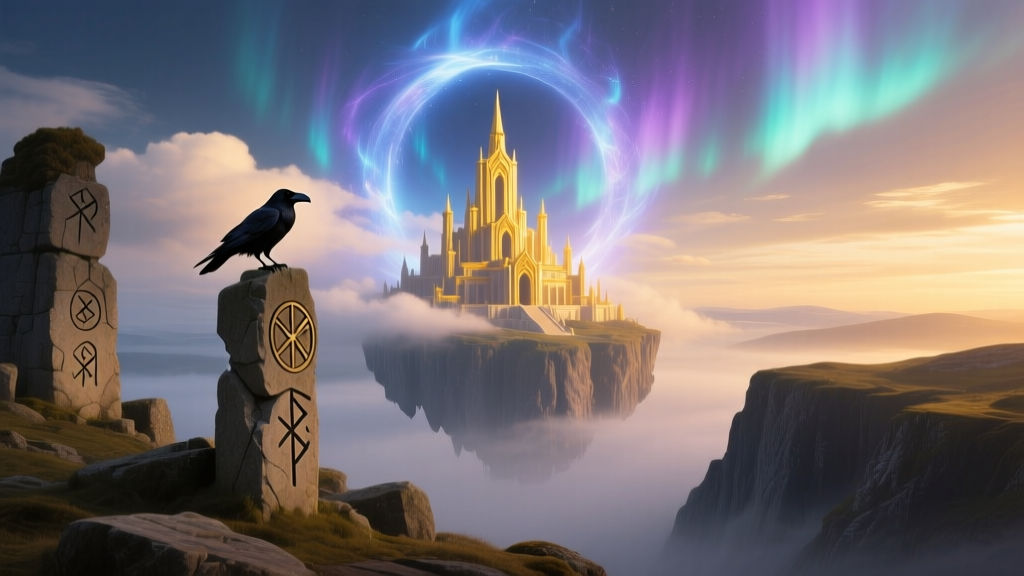
In Norse mythology, Asgard (Old Norse: Ásgarðr) serves as the primary stronghold for the Aesir, the principal tribe of deities. However, modern pop culture adaptations have heavily distorted the original Eddic texts, replacing complex cosmological frameworks with simplified tropes. To understand the genuine spiritual and mythological significance of this realm, we must strip away centuries of reinterpretation and modern cinematic fiction. By examining the original Old Norse sources, we can separate historical fact from modern fantasy regarding Asgard and its inhabitants. This guide addresses the most frequent questions and dismantles widespread misconceptions, relying strictly on the Poetic Edda and Snorri Sturluson’s Prose Edda to reconstruct the authentic Norse worldview.
The True Cosmology: Mapping the Nine Realms
A common error in modern interpretations is the assumption that the Norse cosmos operates on a strictly vertical, tiered hierarchy similar to Dante’s Divine Comedy. In reality, the Nine Realms are organized around Yggdrasil, the immense cosmic ash tree. Asgard is situated at the highest branches, but this 'height' is conceptual and spiritual rather than purely physical. The Poetic Edda describes the realms as being connected by intricate roots and pathways, not stacked like plates.
The Bifrost, often depicted merely as a magical bridge, is described in the Grímnismál as a burning rainbow bridge that requires constant maintenance and defense. Heimdallr, its guardian, resides in Himinbjörg (Heaven's Cliffs) at the edge of the bridge, specifically positioned to prevent the Jötnar (giants) from crossing into the divine realm. This highlights a crucial aspect of Norse theology: the realms are in a state of perpetual tension, and the divine order requires active, martial defense against chaotic forces.
Asgard vs. Valhalla: Clearing Up the Afterlife Confusion
Perhaps the most pervasive misconception is the conflation of Asgard with Valhalla, or the belief that Valhalla is the sole Norse afterlife. Valhalla (The Hall of the Slain) is merely one specific hall located within or adjacent to the broader complex of the divine realm. Furthermore, it is not a universal paradise for the 'good.'
Norse afterlife geography is highly compartmentalized and largely non-moral. According to Snorri Sturluson’s Prose Edda, Odin claims only half of those who die in battle for Valhalla. The other half are chosen by the Vanir goddess Freyja to reside in Fólkvangr, her specific domain and hall (Sessrúmnir), which is also located within the broader boundaries of the realm. Meanwhile, those who die of old age, sickness, or non-martial causes generally travel to Helheim, a subterranean realm ruled by the goddess Hel. Therefore, the divine realm is not a monolithic 'heaven' for human souls; it is primarily the sovereign territory of the gods, with specific halls designated for specific subsets of the honored dead.
The Divine Architecture: Beyond the Golden Halls
Pop culture often reduces the divine realm to a single golden city. The Grímnismál provides a highly specific architectural survey of the realm, detailing distinct estates owned by different deities:
- Gladsheim: The primary meeting hall of the Aesir, featuring thirteen seats for the gods and a high seat for Odin.
- Valaskjálf: Odin’s secondary residence, roofed with silver, which houses the throne Hliðskjálf. From this throne, Odin can observe all Nine Realms simultaneously.
- Breiðablik: The hall of Baldr, described as the most beautiful of all halls. The text explicitly notes that 'nothing unclean' can exist within its boundaries, making it a space of absolute purity.
- Þrúðheimr (Thrudheim): The vast domain of Thor, which contains his colossal hall, Bilskirnir. The Grímnismál specifies that Bilskirnir contains exactly 540 rooms, making it the largest single structure in the cosmos.
The Wall of Asgard: A Monument to Deception
The physical boundaries of the realm are defined by an impenetrable wall, but its origin story is frequently overlooked. The gods did not build the wall themselves. Following the Aesir-Vanir war, an unnamed giant (often called the Hrimthurs) offered to build an impregnable fortress wall in exchange for the sun, the moon, and the goddess Freyja. The gods agreed, believing the task impossible within the stipulated three seasons.
However, the giant’s stallion, Svaðilfari, performed the labor of two. Realizing they were about to lose the wager, the gods coerced Loki into sabotaging the effort. Loki transformed into a mare, lured Svaðilfari away, and the giant failed the deadline. Enraged, the giant revealed his true chaotic nature, prompting Thor to shatter his skull with Mjölnir. This myth underscores a vital theological point: the security of the divine realm is built upon broken oaths, deception, and the exploitation of chaotic forces, reflecting the morally ambiguous nature of the Aesir.
Pop Culture vs. Eddic Reality: A Misconception Matrix
To clarify the distinctions between modern entertainment and historical mythology, review the following comparative analysis:
| Common Misconception | Eddic Reality & Mythological Context |
|---|---|
| The realm is the Norse 'Heaven.' | It is a sovereign territory for deities, not a default moral afterlife for righteous humans. Most humans go to Helheim. |
| Odin rules as an absolute monarch. | The Aesir operate more like an aristocratic council. Gods like Thor, Freyja, and Njordr possess autonomous domains and distinct authority. |
| The realm is destroyed completely in Ragnarok. | While heavily damaged by Surtr's fire and submerged in the sea, the hall Gimli survives, and a new generation of gods and humans repopulate it. |
| Humans can freely visit via the Bifrost. | The Bifrost is heavily guarded by Heimdallr specifically to keep humans and giants out. Mortal access is generally restricted to shamans practicing seiðr. |
Euhemerism: Did the Vikings Believe Asgard Was a Physical City?
A frequent question among students of mythology is whether the Vikings viewed this realm as a literal geographic location on Earth. This confusion largely stems from Snorri Sturluson’s prologue to the Prose Edda. Writing in the 13th century, long after Iceland’s conversion to Christianity, Snorri employed euhemerism—the practice of interpreting mythological gods as historical human kings.
Snorri attempted to trace the lineage of the Aesir back to the city of Troy in Asia (specifically a region he called Asaland). He posited that Odin was a powerful mortal king who migrated northward to Scandinavia, where he was eventually deified by the local populations. Modern historians and the National Museum of Denmark agree that this was a literary device used by Snorri to preserve pagan poetry within a Christian framework without being accused of heresy. During the actual Viking Age (c. 793–1066 AD), pagan Norse people viewed the realm as a parallel, spiritual dimension intimately connected to Midgard (the human realm) through Yggdrasil, not a historical city in the Middle East.
Frequently Asked Questions About Asgard
How did mortals interact with the divine realm?
Physical travel was considered impossible for ordinary humans. However, spiritual practitioners, particularly völur (seeresses) and those skilled in seiðr (shamanic magic), could project their consciousness or enter trance states to communicate with the Aesir. Additionally, the gods frequently crossed the Bifrost in disguise to walk among humans in Midgard.
What language was spoken in the divine realm?
The Eddas do not specify a distinct 'divine language.' The gods are depicted speaking Old Norse, the same language as the humans who composed the myths. However, the runes—a system of writing and magical sigils—are said to have been discovered by Odin while he hung on Yggdrasil, bridging the gap between divine wisdom and mortal comprehension.
Are the Vanir gods also residents of Asgard?
Yes. Following the Aesir-Vanir war, a hostage exchange was enacted to secure peace. The Vanir deities Njordr, Freyr, and Freyja relocated to the divine realm. Njordr resides in Nóatún, Freyr in Álfheimr (which he was given as a tooth-gift, though it is often categorized among the upper realms), and Freyja in Fólkvangr. This integration demonstrates that the realm is a political coalition of two distinct divine tribes, not an exclusive club for the Aesir.
What happens to the realm after Ragnarok?
The eschatological event of Ragnarok results in the submersion of the primary divine halls into the sea. However, the cosmos is cyclical, not terminal. The Völuspá prophesies the emergence of a new, purified earth. The hall Gimli, described as more beautiful than the sun and roofed with gold, survives the cataclysm. It is here that the surviving gods, including Baldr and Höðr, alongside righteous humans, will establish a new, harmonious society, free from the deceit and bloodshed that characterized the old order.