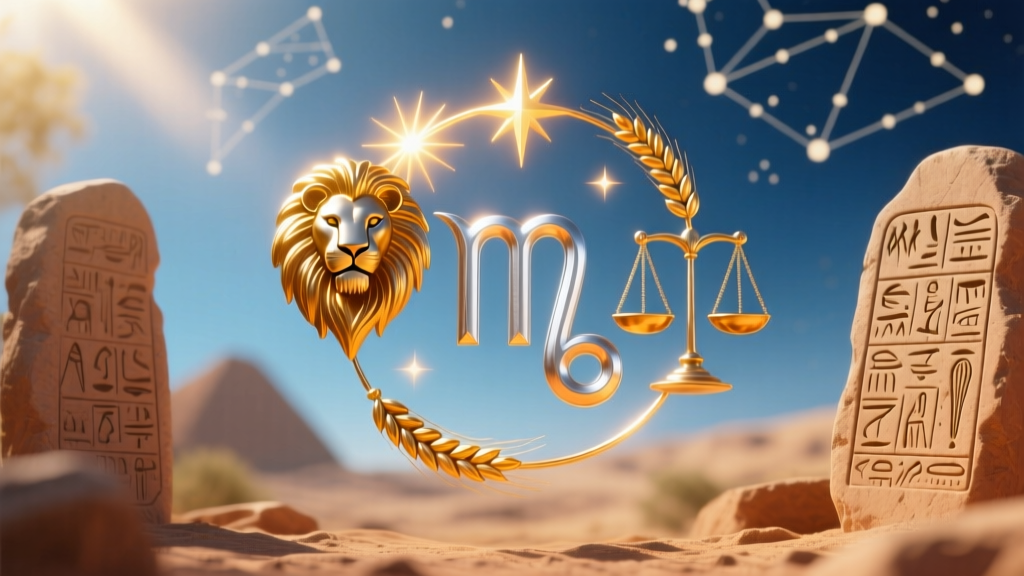
The august 23rd zodiac marks one of the most historically complex thresholds in astrological calendars. Falling on the traditional boundary between Leo and Virgo, this date represents the Sun’s ingress into the tropical sign of the Maiden. However, the history of this specific celestial coordinate reveals a layered evolution of agricultural timekeeping, Babylonian star lore, and Hellenistic mythological synthesis. To understand the spiritual blueprint of those born on this day, we must bypass modern pop-astrology tropes and examine the ancient ephemerides, the precession of the equinoxes, and the shifting archetypes that defined late August in antiquity.
The Babylonian 'Furrow' and the Star Spica
Long before the Greeks assigned the Maiden archetype to this sector of the ecliptic, Babylonian astronomers mapped the late August sky through an agricultural lens. According to the MUL.APIN star catalogues, compiled around 1000 BCE, the constellation we now call Virgo was known as absin, meaning 'The Furrow'. This celestial furrow was intrinsically linked to the goddess Shala, a deity of grain and agriculture, often depicted holding an ear of corn.
The anchor of this ancient constellation was the star Spica (Alpha Virginis), a blue giant star whose name literally translates to 'ear of grain' in Latin. For ancient Mesopotamian farmers, the heliacal rising and setting of Spica served as a critical celestial clock. When the Sun approached the sector of the Furrow in late August, it signaled the imminent end of the summer harvest in the Northern Hemisphere. Therefore, the original astrological essence of the August 23 timeframe was not about purity or modesty—as later Roman and Victorian interpretations would suggest—but about the intense, pragmatic labor of harvesting, resource calculation, and preparing for winter scarcity.
Hellenistic Synthesis: Demeter, Astraea, and the Harvest
When Babylonian astrology was absorbed by Hellenistic scholars in Alexandria around the 3rd century BCE, the 'Furrow' underwent a mythological metamorphosis. The Greeks mapped their own pantheon onto the Mesopotamian star data, transforming the agricultural Furrow into the figure of the Maiden. This archetype was a composite of three distinct goddesses:
- Demeter (Ceres): The goddess of the harvest, reflecting the original Babylonian focus on grain and the changing of the seasons.
- Persephone: Demeter’s daughter, whose descent into the Underworld mirrored the planting of seeds in the dark earth during the autumn months that followed the August harvest.
- Astraea: The goddess of justice and innocence. According to Hesiod and later Ovid, Astraea lived among humans during the Golden Age but fled to the heavens in disgust during the Bronze and Iron Ages, becoming the constellation Virgo and holding the scales of justice (which later became the separate constellation Libra).
This synthesis created a dual nature for the late August zodiac: the practical, earth-bound labor of Demeter combined with the idealistic, analytical, and sometimes unforgiving moral code of Astraea. This duality remains the core psychological friction for modern August 23 natives.
The Tropical vs. Sidereal Divide on August 23
To accurately analyze the history of the August 23 zodiac, one must address the astronomical reality of the precession of the equinoxes. In the Tropical zodiac system, which is based on the Earth's seasonal relationship to the Sun, August 23 marks 0 degrees of Virgo. However, due to a 26,000-year axial wobble, the Tropical signs have drifted approximately 24 degrees away from their original background constellations.
Astronomically, on August 23, the Sun is physically transiting the constellation of Leo, specifically passing near the stars of the Lion's hindquarters. In the Sidereal zodiac system (used in Vedic astrology), the Sun does not enter the sign of Virgo until mid-September. This astronomical fact provides a massive historical context for the so-called 'Leo-Virgo cusp.' The blending of Leonine solar fire and Mercurial earth analysis often attributed to August 23 natives is not just a modern astrological invention; it is a reflection of the fact that the Tropical sign of Virgo currently overlaps the physical, observable constellation of Leo in the night sky.
Deconstructing the 'Cusp of Exposure'
Modern Sun-sign astrology frequently labels August 23 as the 'Cusp of Exposure,' suggesting a personality that merges Leo's performative confidence with Virgo's meticulous critique. From a traditional Hellenistic perspective, however, cusps did not exist as blended zones. According to Claudius Ptolemy and later traditional astrologers, the ecliptic was divided by hard mathematical boundaries. A planet was either at 29 degrees of Leo or 0 degrees of Virgo.
What was historically significant about August 23 was the ingress. The exact moment the Sun crossed 0 degrees Tropical Virgo was a paramount event in mundane astrology. Astrologers cast ingress charts to predict the economic stability, agricultural yield, and political fate of nations for the coming six months. Thus, the historical weight of August 23 is tied to systemic analysis, economic forecasting, and the transition from the creative, individualistic output of Leo to the systemic, administrative organization of Virgo.
Evolution of the Late August Archetype
| Era | Designation | Ruling Deity / Myth | Primary Symbolism & Focus |
|---|---|---|---|
| Babylonian (c. 1000 BCE) | AB.SIN (The Furrow) | Shala (Grain Goddess) | Agricultural labor, harvest timing, survival. |
| Hellenistic (c. 200 BCE) | Parthenos (The Maiden) | Demeter / Astraea | Justice, seasonal cycles, purity, moral law. |
| Roman (c. 100 CE) | Virgo / Ceres | Ceres / Erigone | Civic duty, wine/harvest festivals, modesty. |
| Modern Tropical (20th C.) | Leo-Virgo Cusp | Mercury / Sun Co-rulership | Analytical exposition, perfectionism, service. |
Fixed Star Astrology and the August 23 Native
According to Britannica's astronomical records, the constellation Virgo is the second-largest constellation in the sky, making it a massive backdrop for late summer. For those born on August 23, historical fixed star astrology offers specific nuances. Depending on the exact degree and time of birth, the Sun may align with the fixed star Denebola (the tail of the Lion) or approach Zavijava (Beta Virginis).
Denebola historically carries a reputation for nobility, public recognition, and a sudden, decisive end to cycles. Zavijava is associated with Mercurial traits: speed, intellect, and the breaking down of complex systems. The historical transition between these stars mirrors the psychological mandate of the August 23 native: to take the grand, overarching vision of the Lion and systematically dismantle it into workable, Mercurial components.
Actionable Historical Shadow Work for August 23
Understanding the deep history of your zodiac placement provides concrete frameworks for personal development and shadow work. August 23 natives can utilize the following historical archetypes for psychological integration:
- The Shala Protocol (Resource Audit): Reconnect with the Babylonian 'Furrow' by conducting a late-August resource audit. Historically, this time was about securing winter survival. Modern application: ruthlessly audit your finances, energy expenditures, and time commitments, discarding what will not sustain you through the end of the year.
- Astraea’s Scales (Justice vs. Perfectionism): The shadow side of Astraea is the retreat from a flawed world into isolated cynicism. Combat this by engaging in local, systemic civic action rather than demanding impossible moral purity from individuals.
- Sidereal Reconciliation: Meditate on the physical constellation of Leo currently occupying your Tropical Virgo space. Acknowledge that your drive for perfection (Virgo) is ultimately fueled by a deeply personal, creative ego (Leo) that demands your unique expression be of service to the collective.