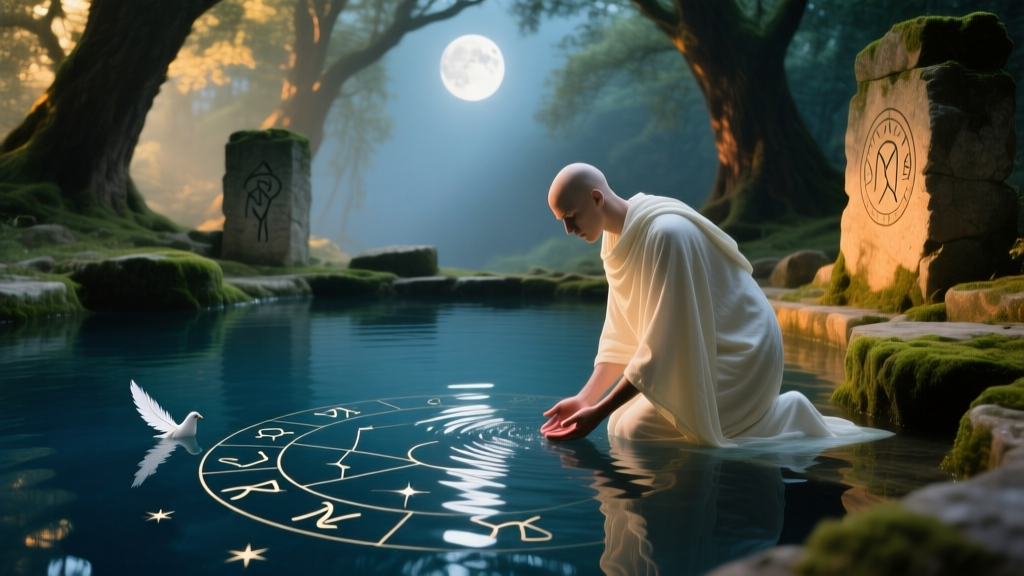
The term baptism is frequently reduced to a singular religious sacrament, yet its spiritual, mythological, and psychological roots extend deep into human antiquity. As a core archetype of purification and initiation, baptism represents a universal threshold crossing. For spiritual seekers and students of esoteric traditions, understanding the true mechanics of this ritual requires stripping away centuries of dogmatic overlay. This guide addresses the most common misconceptions about baptism, explores its cross-cultural origins, and analyzes its function as a catalyst for ego-death and psychological rebirth.
The Esoteric and Mythological Roots of Baptism
Long before the 1st century CE, water immersion was a foundational technology of the sacred. The Greek word baptizein simply means 'to dip' or 'to plunge.' In the ancient Mediterranean, ancient mystery cults utilized ritual immersion to simulate a descent into the underworld and a subsequent resurrection. The cult of Isis in Hellenistic Egypt required initiates to undergo sacred washing to cleanse the soul before encountering the divine mysteries.
Similarly, the Mandaeans of southern Mesopotamia practiced frequent masbuta (immersion in flowing water) as a means of maintaining spiritual equilibrium and connecting with the World of Light. In Second Temple Judaism, the mikveh (ritual bath) was essential for transitioning between states of ritual impurity (tumah) and purity (tohorah). John the Baptist adapted this existing framework, transforming a repetitive purity law into a singular, eschatological initiation. According to historical analyses of baptismal practices, John’s innovation was linking the physical plunge to an imminent cosmic shift, effectively bridging the mythological and the psychological.
5 Common Misconceptions About Baptism Debunked
1. Baptism is an exclusively Christian invention.
Water purification is a ubiquitous anthropological phenomenon. The Essenes at Qumran practiced daily immersions, and the Eleusinian Mysteries utilized sea-bathing (halade mystai) as a preliminary purification rite centuries prior to the Christian era.
2. The water possesses inherent magical properties.
Esoteric traditions view the water as a conduit or a mirror for the subconscious, not a magical solvent. The efficacy of the ritual relies on the intentionality of the initiate and the collective egregore of the community, rather than the physical H2O molecules themselves.
3. Infant baptism was the original apostolic standard.
Historical consensus indicates that early Christian initiation was primarily adult-focused, requiring a rigorous period of catechesis (learning) and fasting. Infant baptism became normative later, largely influenced by the Augustinian doctrine of original sin and high infant mortality rates in the late Roman Empire.
4. Baptism guarantees permanent spiritual elevation.
In spiritual psychology, initiation is merely the opening of a door. It does not bypass the necessity of ongoing shadow work, integration, and ethical living. The 'rebirth' is a potentiality, not an automatic permanent state.
5. It is purely a physical or historical event.
From a mythological perspective, baptism is a recurring psychological event. Every time an individual sheds an outdated ego-identity and embraces a new paradigm of consciousness, they are undergoing a micro-baptism.
Water Purification Rituals: A Cross-Cultural Comparison
To understand the archetype, we must observe how different esoteric and religious systems operationalize water immersion. The following table contrasts the mechanics and spiritual objectives of these rites.
| Tradition | Ritual Name | Esoteric Purpose | Element Focus |
|---|---|---|---|
| Christianity | Baptism | Ego-death, initiation into the body of Christ | Water & Spirit |
| Judaism | Mikveh | Transitioning from ritual impurity to purity | Living Water |
| Shinto | Misogi | Cleansing of spiritual defilement (kegare) | Waterfall/River |
| Hinduism | Snana | Purification of karma before temple entry | Sacred Rivers |
| Mandaeism | Masbuta | Reconnecting the soul with the World of Light | Flowing Water |
The Jungian Archetype: Death, the Womb, and Rebirth
Carl Jung identified water as the ultimate symbol of the unconscious mind. To be submerged in water is to return to the primordial womb, a state of undifferentiated potential. In his exploration of analytical psychology and symbols, Jung noted that the ego must temporarily dissolve (die) in the unconscious to be reborn with greater integration.
Therefore, baptism is an enacted myth of the hero’s journey. The descent into the water mirrors the katabasis (descent into the underworld) of figures like Inanna, Osiris, and Dionysus. The emergence from the water represents the dawn of a new solar consciousness. When spiritual seekers view baptism through this Jungian lens, it ceases to be a rigid dogma and becomes a dynamic map for individuation.
Integrating the Baptismal Archetype into Personal Practice
You do not need to belong to an orthodox religion to utilize the spiritual mechanics of water immersion. Here is a practical framework for integrating the baptismal archetype into your personal spiritual routine:
- Intentional Submersion: When bathing or swimming, visualize the water as a liminal space. Set a specific intention to release a limiting belief or outdated ego-attachment before entering the water.
- The Breath Hold (Katabasis): Safely hold your breath underwater for a few moments. Use this physical sensation of suspension to mimic the 'death' of the conscious, thinking mind. Surrender to the silence of the unconscious.
- The Emergence (Anabasis):strong> As you break the surface and take your first breath, consciously declare a new psychological paradigm. This physical gasp of air anchors the psychological rebirth into the nervous system.
Frequently Asked Questions (FAQ)
What is the difference between baptism and christening?
While often used interchangeably in casual conversation, 'christening' specifically refers to the naming ceremony of an infant, which usually occurs concurrently with infant baptism in Western traditions. Baptism is the broader sacrament of initiation and water immersion, applicable to individuals of any age and carrying deeper esoteric weight regarding spiritual death and rebirth.
Can a person be baptized more than once?
In orthodox Christian theology, baptism leaves an indelible spiritual mark, meaning it cannot be repeated. However, in esoteric and mystical traditions, the experience of baptismal rebirth is cyclical. Spiritual practitioners often undergo multiple 'baptisms of fire' or profound ego-deaths throughout their lives as they ascend through different stages of consciousness and shed deeper layers of the shadow self.
How does baptism relate to the astrological water element?
The astrological water signs (Cancer, Scorpio, Pisces) govern emotion, the subconscious, and spiritual dissolution. Baptism aligns deeply with the Plutonian/Scorpionic archetype of death and regeneration, and the Neptunian/Piscean archetype of merging with the divine source. The ritual physically enacts the dissolution of ego boundaries inherent to the higher octaves of the water element.
Is baptism by water the only valid form?
Historically and esoterically, no. Many mystical traditions recognize 'baptism by fire' (spiritual awakening through intense trial or kundalini arousal) and 'baptism by blood' (martyrdom or profound physical sacrifice). In Christian mysticism, the 'baptism of desire' is also recognized, wherein the sincere spiritual longing of the heart fulfills the archetype without the physical presence of water.