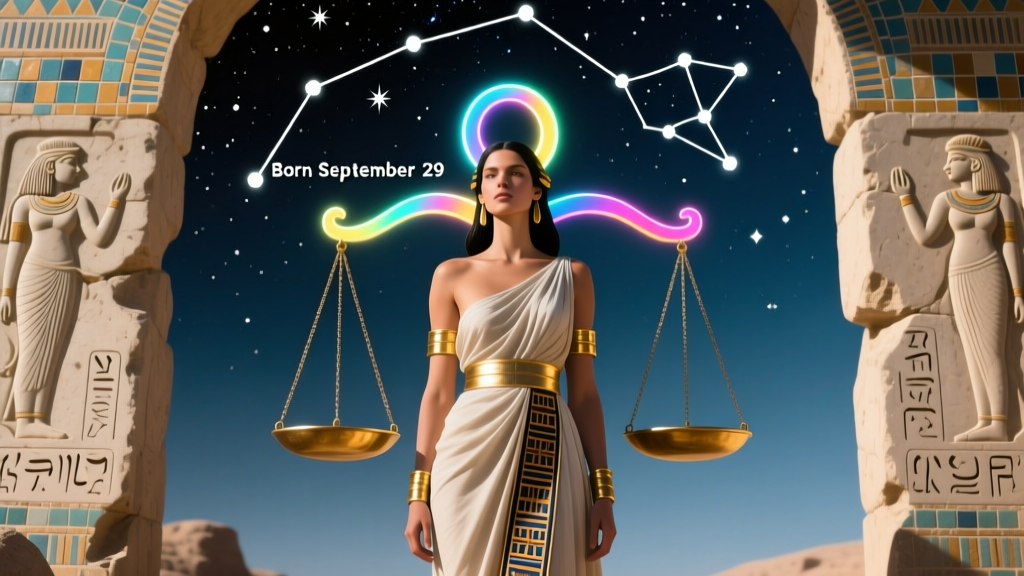
Individuals researching the born September 29 zodiac sign are investigating the seventh astrological sector: Libra. Ruled by Venus and symbolized by the Scales, this cardinal air sign occupies the exact celestial longitude of the autumnal equinox. To understand the psychological, spiritual, and behavioral profile of a September 29 native, we must bypass modern pop-astrology tropes. Instead, we must examine the millennia-old historical, astronomical, and mythological frameworks that forged this archetype. The evolution of this constellation from a predatory appendage to an instrument of cosmic justice provides profound insights into the innate drive for equilibrium found in those born under this degree.
The Babylonian Roots of the Born September 29 Zodiac Sign
Long before the Greeks personified the zodiac, Mesopotamian astronomers mapped the ecliptic. In the foundational Babylonian star catalog known as the MUL.APIN (compiled circa 1000 BCE), the stars we now recognize as Libra were not an independent sign. According to the Open Richly Annotated Cuneiform Corpus (Oracc), this region was designated as zibānītu, meaning 'The Claws of the Scorpion.'
The two brightest stars in this sector retain this ancient anatomical association in their modern Arabic names: Zubenelgenubi (the southern claw) and Zubeneschamali (the northern claw). For the Babylonians, the scorpion was a symbol of the god Ishhara and the darker, transformative forces of nature. However, the 'claws' specifically were associated with the concept of kittu (divine truth) and the weighing of grain during the harvest season, which coincided with the autumnal equinox.
Therefore, the historical DNA of the born September 29 zodiac sign is dualistic. It possesses the latent, defensive intensity of the Scorpion, tempered by the agricultural necessity of measurement, fairness, and equitable distribution. This explains the modern Libran paradox: a deeply diplomatic exterior that can snap with startling, scorpionic precision when boundaries are violated or injustice is perceived.
Hellenistic Astrology and the Myth of Astraea
As Babylonian astronomy was absorbed by Hellenistic scholars following the conquests of Alexander the Great, the constellation underwent a radical mythological rebranding. The Greeks detached the claws from the Scorpion and formally established Zygos (The Scales).
This shift was heavily influenced by the myth of Astraea, the virgin goddess of innocence and purity, and her mother Themis, the Titaness of divine law and order. According to ancient poetic traditions, such as those recorded in Aratus's 3rd-century BCE didactic poem Phaenomena, Astraea lived among humans during the Golden Age, dispensing justice and maintaining harmony. As humanity descended into the Bronze and Iron Ages—becoming increasingly violent and corrupt—Astraea fled the earth in despair, ascending to the heavens to become the constellation Virgo. She placed her scales of justice directly beside her in the sky, forming Libra.
This mythological origin story is critical for understanding the September 29 personality profile. Natives of this degree are historically imprinted with the 'Astraean complex': a profound, sometimes melancholic yearning for an idealized, just society, coupled with a deep sensitivity to the moral decay and disharmony of their immediate environments.
Evolution of Libra: From Scorpion Claws to Cosmic Scales
The transition of this zodiacal sector reflects broader shifts in human civilization, moving from agrarian survival to codified law and philosophical inquiry.
| Era | Culture | Constellation Name | Symbolic Meaning & Function |
|---|---|---|---|
| c. 1000 BCE | Babylonian | Zibānītu | Claws of the Scorpion; Agricultural weighing of harvest grain. |
| c. 300 BCE | Hellenistic | Chelai / Zygos | Transitional phase; The Claws morphing into the Scales of Justice. |
| 1st Century CE | Roman | Libra | The Scales; Codified law, the autumnal equinox, and civic balance. |
| 8th Century CE | Islamic | Al-Mizan | The Balance; Cosmic equilibrium, philosophical synthesis, and optics. |
The Historical Rulership of Venus in Antiquity
Modern astrologers universally assign Venus as the ruling planet of Libra. However, this rulership is not an arbitrary aesthetic choice; it is rooted in the mathematical and philosophical frameworks of classical antiquity.
In his seminal 2nd-century CE text, the Tetrabiblos, Claudius Ptolemy codified the planetary rulerships based on the geometry of the solar year. As documented in the Perseus Digital Library's translation of the Tetrabiblos, Ptolemy assigned the Sun and Moon to the summer signs (Leo and Cancer) due to their proximity to the solstice. The remaining planets were assigned to signs based on their orbital speed and distance from the Sun.
Venus, being the temperate, harmonizing planet closest to the Sun, was assigned to the signs that flanked the solar and lunar domiciles. Taurus received Venus as a nocturnal, earthy domicile, while Libra received Venus as a diurnal, airy domicile. Furthermore, Libra marks the autumnal equinox—the precise moment when day and night are of equal length. Ptolemy argued that this celestial equilibrium required a planetary ruler capable of synthesizing opposites, mediating extremes, and fostering social cohesion. Venus, representing philia (affinity and mutual attraction), was the only planetary archetype equipped to govern the cosmic scales.
Applying Ancient Libran Wisdom to Modern Life
Understanding the historical and mythological origins of the born September 29 zodiac sign provides actionable frameworks for personal development, conflict resolution, and spiritual grounding. Rather than relying on vague horoscopes, natives can leverage their ancient archetypal heritage through the following specific practices.
The Shamash Protocol for Decision-Making
Drawing from the Babylonian association of the scales with Shamash (the god of truth and justice), September 29 natives must structure their decision-making processes around objective data rather than emotional reactivity. When facing a complex career or relational crossroads, utilize a literal 'weighing' mechanism. Write down the empirical facts of both options on opposing sides of a ledger. Strip away assumptions, anxieties, and projected outcomes. The historical Libran mind excels at synthesizing binary data into a tertiary, balanced solution, but only when the inputs are rigorously factual.
Astraea's Retreat: Strategic Boundary Setting
The myth of Astraea fleeing a corrupt humanity is often misinterpreted as cowardice. In reality, it represents the ultimate act of energetic preservation. Individuals born on this date are highly permeable to environmental dissonance and interpersonal toxicity. You must implement 'Astraea's Retreat' as a scheduled, non-negotiable practice. This involves creating a physical and psychological sanctuary—a space devoid of digital noise, interpersonal demands, and aesthetic clutter—where the nervous system can recalibrate to its baseline equilibrium. When an environment becomes fundamentally unjust or chaotic, strategic withdrawal is not a failure; it is a mythological imperative.
Venusian Synthesis in Conflict Mediation
Because Venus rules Libra as a diurnal, air sign, the native's superpower lies in intellectual diplomacy and aesthetic mediation. In professional or familial disputes, avoid the trap of passive appeasement (a modern distortion of Libran energy). Instead, apply Venusian Synthesis: identify the core, unspoken value driving each opposing party. Frame the compromise not as a concession, but as a collaborative design project. By elevating the aesthetic and structural harmony of the proposed solution, you bypass ego-driven resistance and align the conflicting parties with a shared vision of balance.
For further historical context on how ancient civilizations mapped these constellations, the Britannica archive on the Libra constellation offers an excellent overview of the astronomical transitions from the classical era to modern observational astronomy. By anchoring your identity in these deep historical currents, the September 29 native transforms from a passive recipient of daily horoscopes into an active steward of cosmic equilibrium.