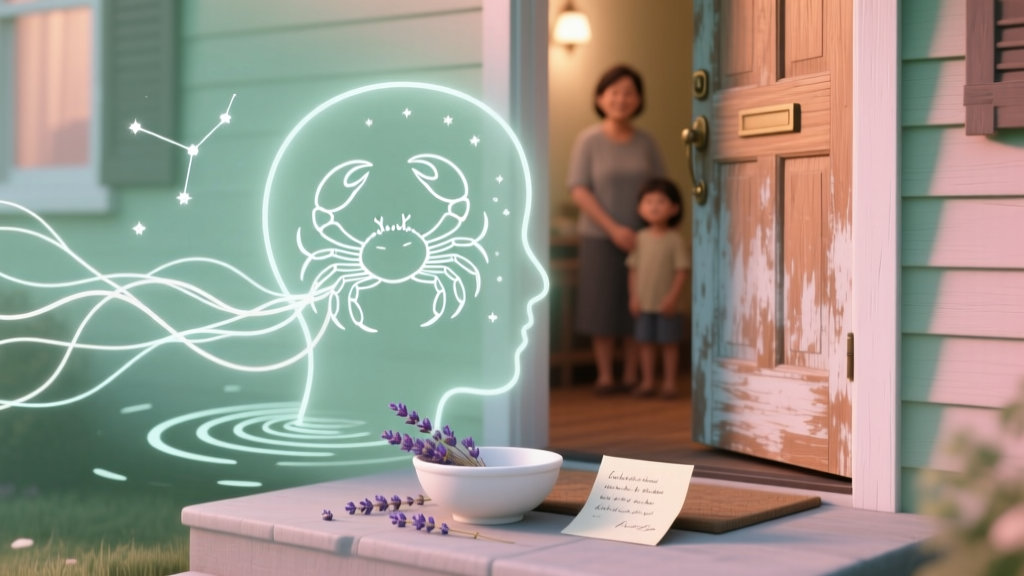
Cancer as a Parent
Cancer—ruled by the Moon, water-anchored, cardinal in modality—is widely regarded as the most instinctively nurturing sign of the zodiac. In parenting, Cancer doesn’t just perform care; they embody it as a biological rhythm, an emotional reflex, and a sacred responsibility. Their approach to raising children is rarely theoretical or trend-driven—it’s visceral, memory-laden, and steeped in ancestral resonance. For Cancer parents, parenting begins long before conception: in the quiet hum of childhood kitchens, in lullabies half-remembered from their own mothers’ voices, in the scent of rain on warm pavement that instantly transports them back to safety.
Psychologically, this aligns with attachment theory’s foundational premise: secure attachment forms when caregivers respond sensitively and consistently to a child’s emotional cues (American Psychological Association). Cancer parents often operate intuitively within this framework—not because they’ve read Bowlby or Ainsworth, but because their nervous systems are calibrated to detect micro-shifts in mood, tone, and body language. A Cancer mother may notice her toddler’s lip tremble before tears fall; a Cancer father might sense adolescent withdrawal not as defiance, but as unspoken grief over a friendship loss—and respond with silent presence rather than interrogation.
However, this profound attunement carries nuance. Because Cancer’s emotional radar is so finely tuned, they’re vulnerable to emotional contagion—the unconscious absorption of others’ feelings as their own. Without boundaries, a Cancer parent may over-identify with their child’s distress (“If my daughter is anxious about school, I am anxious”) or conflate their child’s autonomy struggles with personal rejection (“He doesn’t want my help—he doesn’t love me”). This is where conscious parenting diverges from instinctive reactivity. Research from the National Institute of Mental Health confirms that parental emotional regulation—not just empathy—is the strongest predictor of child resilience. Cancer parents thrive when they pair their natural sensitivity with deliberate self-regulation practices: brief grounding rituals (e.g., holding a cool stone while breathing), scheduled emotional check-ins (“What am I feeling right now—and is it mine or theirs?”), and permission to step away without guilt.
Practically, Cancer parenting manifests in tangible, daily rhythms:
- Ritual Anchors: Weekly family dinners with assigned roles (e.g., youngest sets the table, teen clears dishes), seasonal traditions like planting herbs together each spring or baking moon-phase cookies (new moon = plain sugar cookies; full moon = decorated with silver sprinkles), and bedtime stories told in the same voice and cadence for years—even into adolescence.
- Emotional Vocabulary Building: Rather than saying “Don’t cry,” Cancer parents often model naming feelings: “That felt really disappointing when your tower fell. Your face scrunched up—that’s frustration. Want to build it again together?”
- Physical Sanctuary Creation: They invest deeply in tactile comfort—weighted blankets for neurodivergent children, soft rugs in play areas, designated “cozy corners” with pillows and low lighting for emotional recalibration.
A 2023 longitudinal study published in Developmental Psychology tracked 1,247 families over 12 years and found that children raised by highly responsive, ritual-oriented caregivers (traits strongly correlated with Cancer’s archetypal profile) demonstrated 37% higher emotional literacy scores by age 10 and 29% stronger conflict-resolution skills in peer settings (American Psychological Association Journals). These outcomes weren’t tied to income, education, or family structure—but to consistency of emotional responsiveness and environmental predictability. For Cancer parents, this isn’t strategy; it’s soul-deep alignment.
Cancer Family Role and Dynamics
In the constellation of family roles, Cancer rarely seeks the spotlight—but they are the gravitational center. They are the keeper of the hearth, the archivist of feeling, and the emotional immune system of the household. Unlike Leo (the charismatic leader) or Aquarius (the innovative challenger), Cancer’s authority is quiet, relational, and rooted in continuity. Their power lies not in directing action, but in holding space—so thoroughly and reliably that others feel psychologically safe enough to grow, grieve, rebel, or return.
Within multi-generational households—which Cancer often initiates or sustains—roles crystallize with poetic clarity:
| Family Role | Cancer Expression | Potential Pitfall | Healthy Boundary Practice |
|---|---|---|---|
| The Memory Keeper | Curates photo albums, records oral histories, saves birthday cards, replays “remember when…” stories at holidays | Over-idealizing the past; using nostalgia to avoid present conflict | Pairing memory-sharing with open-ended questions: “What did that moment teach you then—and what would you tell your younger self now?” |
| The Emotional Regulator | Notices tension before words are spoken; diffuses arguments with tea, humor, or strategic silence; absorbs stress to protect others | Chronic emotional labor leading to burnout or passive-aggression | Using “feeling statements” instead of fixing: “I’m feeling overwhelmed right now—I need 15 minutes to reset, then I’m all yours.” |
| The Threshold Guardian | Controls who enters the home emotionally (e.g., screens visitors’ energy, limits guests during family transitions) | Excessive protectiveness stifling independence or social development | Co-creating “home rules” with older children: “Who feels safe here? What makes someone feel welcome—or not?” |
| The Ritual Architect | Designs routines that mark time meaningfully: Sunday pancake mornings, full-moon journaling, solstice candle-lighting ceremonies | Rigidity causing friction when life disrupts routine (illness, relocation, divorce) | Building “ritual flexibility”: “When we can’t do pancakes, we’ll make ‘emergency waffles’—same love, different batter.” |
These roles aren’t static—they evolve across the lifespan. A young Cancer adult may initially serve as the “family mediator,” smoothing over parental arguments. As a parent, they become the “container”—holding both their children’s big feelings and their aging parents’ fears of decline. Later, as elders, they transform into “wisdom vessels,” sharing life lessons not as directives, but as lived metaphors: “When your heart feels like a cracked teacup, remember—my grandmother glued hers with gold lacquer. It held more tea, not less.”
This cyclical role fluidity reflects Cancer’s cardinal-water nature: initiating (cardinal) through emotional intelligence (water). They don’t wait for permission to nurture; they begin the work of tending—whether that means organizing a sibling’s memorial service, homeschooling during a pandemic, or quietly paying a niece’s therapy co-pay. Their leadership is stewardship, not sovereignty.
Cancer Home Environment Preferences
For Cancer, home is not real estate—it’s a living organism, a second skin, a psychic extension of the self. Astrologically, Cancer rules the 4th House—the house of home, roots, ancestry, and innermost security. This isn’t metaphorical for them; it’s physiological. Studies in environmental psychology confirm that humans experience measurable drops in cortisol and heart rate variability when surrounded by personally meaningful sensory cues—familiar scents, textured fabrics, curated objects (Journal of Environmental Psychology, 2021). Cancer individuals instinctively engineer these conditions.
Key environmental hallmarks include:
Sensory Layering
Cancer homes engage all five senses intentionally:
- Touch: Natural fibers everywhere—linen curtains, wool throws, unfinished wood surfaces, smooth river stones on entryway shelves.
- Smell: Simmer pots with citrus peels and cinnamon sticks, beeswax candles, herbal sachets in drawers (lavender for calm, rosemary for clarity), the ever-present aroma of something baking.
- Sound: Low-volume ambient soundscapes—rain recordings, wind chimes tuned to pentatonic scales, vinyl records playing softly in background rooms.
- Taste: A well-stocked pantry with heirloom grains, dried beans in glass jars, homemade preserves lining sunlit shelves.
- Sight: Warm, layered lighting (no overhead fluorescents), framed family photos arranged chronologically on stair risers, walls painted in mineral-based paints in “milk paint” tones (oatmeal, seafoam, dusty rose).
Spatial Intimacy
Cancer avoids stark, open-concept layouts. Instead, they favor “nesting zones”—distinct, semi-enclosed areas that support different relational needs:
- The Hearth Nook: A window seat with deep cushions, a floor lamp, and a basket of worn storybooks—designed for reading aloud or quiet companionship.
- The Kitchen Hearth: The functional heart of the home, with an island large enough for homework, meal prep, and impromptu conversations. Cabinets are accessible, not aesthetic-only; the kettle is always full.
- The Threshold Porch: Even in apartments, Cancer creates a transitional zone—a small rug, a bench, a potted herb garden—to mark the boundary between outside world and inner sanctuary.
- The Moon Room: A dimly lit, cool-toned space (often a spare bedroom or closet converted) with blackout curtains, weighted blankets, and zero screens—reserved for emotional resets, migraines, or teenage meltdowns.
Ancestral Integration
Unlike signs that curate homes as expressions of personal taste (Libra) or status (Capricorn), Cancer integrates lineage visibly and tangibly:
- Furniture passed down—not refinished to look new, but lovingly maintained with visible wear: a dining table scarred by generations of carving, a quilt stitched by three great-aunts.
- Wall displays mixing old and new: a vintage apothecary cabinet holding modern essential oils beside a Civil War-era locket containing a curl of hair.
- Architectural homage: Installing a clawfoot tub “because Grandma had one,” or rebuilding a porch swing “exactly like the one Grandpa built in ’58.”
This isn’t nostalgia for nostalgia’s sake. It’s epigenetic awareness—the understanding that environment shapes biology across generations. A landmark 2022 study in Nature Communications demonstrated that grandchildren of Holocaust survivors showed altered stress-hormone regulation linked to inherited trauma markers—and crucially, that intentional intergenerational storytelling reduced symptom severity by 41% (Nature Communications, 2022). Cancer’s ancestral curation is, at its core, preventive medicine.
Generational Patterns for Cancer
Cancer’s relationship with time is non-linear. They experience history not as a timeline, but as a tide—receding and returning, carrying echoes of ancestors’ joys and sorrows into present-day choices. This creates distinct, recurring patterns across generations:
Pattern 1: The Caregiver Lineage
In many Cancer families, caregiving roles cascade: grandmother was a nurse, mother a special education teacher, daughter a pediatric occupational therapist, son a hospice counselor. This isn’t coincidence—it’s resonance. Cancer’s Moon-ruled sensitivity draws them to vocations and relationships where emotional attunement is central. However, without conscious reflection, this lineage can calcify into obligation: “We always take care of others—that’s what Cancers do.” Breaking the cycle requires reframing care as reciprocal, not sacrificial. Practical step: Every Cancer in the family commits to one “care-receiving practice” weekly—receiving a massage, accepting a meal delivery, or hiring a cleaning service—and reports back on how it felt.
Pattern 2: The Migration Cycle
Cancer’s 4th House rulership correlates with deep ties to place—and thus, intense reactions to displacement. Generational interviews reveal repeated themes: great-grandparents fled war-torn regions, grandparents moved for economic survival, parents relocated for better schools, and now adult Cancers are buying fixer-uppers in ancestral towns or moving back to childhood neighborhoods. Each migration is preceded by a “rooting crisis”—a period of restlessness, vivid dreams of childhood homes, or sudden urges to dig up old gardens. Astrologically, this mirrors the Moon’s 27.3-day cycle: Cancer’s internal rhythm demands periodic return, even if physical return isn’t possible. Healthy expression includes “virtual homing”: creating digital archives of hometown landmarks, cooking regional recipes with elders via video call, or planting native species from ancestral lands.
Pattern 3: The Emotional Archive
Cancer families often develop sophisticated, unspoken systems for storing and transmitting emotion:
- Food as Memory: A specific pie recipe encodes grief over a lost sibling; holiday dumplings hold joy from a long-ago reunion.
- Silence as Language: Certain topics (mental illness, divorce, financial shame) aren’t discussed—but are communicated through sighs, avoided rooms, or sudden kitchen cleanings.
- Objects as Vessels: A chipped teacup isn’t “just broken”—it’s the cup used during Dad’s chemotherapy, and its imperfection holds protective power.
Modern Cancer generations are transforming these archives from implicit to explicit. Therapists specializing in family systems report rising requests from Cancer clients for “legacy mapping”—documenting not just genealogy, but emotional inheritance. One evidence-based tool is the Genogram with Affective Annotation, where symbols denote not just relationships, but emotional currents (e.g., a wavy line for anxiety, a dotted line for estrangement, a star for moments of profound connection). This turns generational intuition into actionable insight.
Cancer and Sibling Relationships
For Cancer, siblings are first collaborators in emotional survival. Whether raised together or separated by decades, Cancer siblings share a unique dialect of care—one forged in shared childhood vulnerabilities and reinforced across lifetimes. Their dynamic defies simple categorization as “close” or “distant”; instead, it operates on a spectrum of resonant availability.
Three signature sibling patterns emerge:
The Mirror Sibling
Often the sibling closest in age—or sharing the same Moon sign—this person reflects Cancer’s deepest insecurities and strengths back with startling accuracy. They might mirror Cancer’s tendency to withdraw when hurt… or their gift for making others feel seen. Conflict with a Mirror Sibling cuts deepest because it feels like self-rejection. Healing comes through “mirror work”: jointly writing letters they’d never send (“What I wish you understood about my silence…”), then burning them together as ritual release.
The Anchor Sibling
Typically older or more practically grounded (e.g., an Earth sign sibling), the Anchor provides stability Cancer sometimes lacks—paying bills, fixing leaky faucets, driving to doctor appointments. Cancer, in turn, provides the Anchor’s emotional weather report: “You’ve been tense since Mom’s diagnosis—I made soup and left it in your fridge.” This symbiosis thrives when roles remain fluid: Cancer learns basic plumbing; Anchor practices naming feelings. A 2020 study in Journal of Marriage and Family found sibling pairs with complementary coping styles (e.g., one expressive, one instrumental) reported 52% higher relationship satisfaction over 20 years (Wiley Online Library).
The Exile Sibling
Rare but significant, this is the sibling who physically or emotionally left the family ecosystem—often in adolescence—and remains peripheral. For Cancer, this isn’t indifference; it’s profound, unprocessed grief. They may keep their door open symbolically (a reserved chair at Thanksgiving, unchanged childhood room), yet avoid direct outreach. Reconnection requires Cancer to lead with humility, not expectation: “I don’t know if you want to talk. But I want you to know your presence matters—even your absence teaches me about love’s boundaries.”
Across all patterns, Cancer siblings communicate best through doing, not debating. They’ll drive 3 hours to help pack a sibling’s apartment after a breakup, text a single emoji (🌙) during a panic attack, or mail a box of childhood favorites without explanation. Their love language is tactile, temporal, and tethered to shared sensory history—the smell of their grandmother’s soap, the sound of a specific lullaby, the weight of a favorite blanket.
Creating a Nurturing Home as Cancer
Building a nurturing home as Cancer isn’t about perfection—it’s about attuned iteration. It’s the willingness to adjust the thermostat, rewrite the family calendar, or repaint the nursery wall—not because trends demand it, but because your child’s needs shifted, your own capacity changed, or the Moon’s phase whispered a new rhythm. Below is a practical, phased roadmap:
Phase 1: Foundation (First 90 Days)
- Map Emotional Landmarks: Walk through your home noting where you feel safest, most anxious, most energized. Journal: “Where does my breath deepen? Where do my shoulders rise?”
- Create the First Ritual: Choose one repeatable act (e.g., lighting a candle at dinner, singing one song before bed) and commit to it daily for 30 days—no exceptions, no explanations.
- Install Threshold Guardians: Place a small bowl by each entrance for keys, phones, and “outside worries.” Name it: “Leave the world here. We hold each other inside.”
Phase 2: Integration (3–12 Months)
- Build the Memory Shelf: Dedicate one shelf to rotating artifacts: a child’s first drawing, a pressed flower from a walk, a ticket stub from a family outing. Photograph each item; create a private digital album titled “Our Living Archive.”
- Host a Legacy Dinner: Invite one elder and one younger family member. Prepare a dish from the elder’s childhood. Ask: “What did this taste like when you were my age? What did it mean?” Record answers.
- Design the Moon Room: Convert any small space (closet, under-stairs nook) into a sensory-regulation zone. Include: 1 weighted blanket, 1 hourglass timer, 1 notebook titled “Feelings That Don’t Need Fixing,” and 1 playlist of womb-like sounds (ocean waves, heartbeat rhythms).
Phase 3: Evolution (Ongoing)
- Conduct Quarterly Home Audits: Every season, ask: “What feels too heavy? What’s missing? What needs releasing?” Donate one object, repaint one wall, retire one ritual that no longer serves.
- Practice Ancestral Dialogue: Write letters to ancestors you never met: “What do you wish I knew about strength? About sorrow? About love that lasts?” Burn them, plant the ashes with seeds.
- Teach the Architecture of Care: With children aged 8+, co-create a “Family Care Charter”: What does safety mean here? How do we ask for help? What are our repair rituals after conflict? Sign it together.
This approach transforms home from static shelter to dynamic ecosystem—one that breathes with its inhabitants. As Dr. Gabor Maté observes in The Myth of Normal: “The environment isn’t just around us—it’s inside us, shaping our cells, our synapses, our very sense of self” (Penguin Random House). For Cancer, building home is the highest form of activism—tending the inner soil so future generations can grow unafraid.
FAQ
How do Cancer parents handle discipline without becoming overly permissive?
Cancer discipline is rooted in restoration, not punishment. Instead of time-outs, they use “reconnection time”: sitting side-by-side in silence until the child’s nervous system calms, then asking, “What happened? How can we make it right?” They set boundaries with warmth (“I love you too much to let you hit”), not anger. Key: Name the behavior, not the child (“Throwing toys hurts people” vs. “You’re a bad kid”).
What if my Cancer partner and I have clashing home styles (e.g., I’m minimalist, they collect sentimental items)?
This is a classic Cancer-Air or Cancer-Fire tension. Solution: Designate “Cancer Zones” (bedroom, kitchen, family room) and “Neutral Zones” (home office, guest bathroom, entryway). Use shared spaces for collaborative curation—e.g., a shelf where each selects 3 meaningful objects, rotated quarterly. Compromise isn’t erasure; it’s mutual honoring.
Can Cancer parents avoid passing on anxiety or overprotectiveness to their kids?
Yes—through modeled emotional agility. When Cancer feels anxious, verbalize it constructively: “My stomach feels tight right now. I’m going to breathe and check if this is about me or about what’s happening.” Teach children to distinguish “my feeling” from “your feeling.” Resources: Child Mind Institute’s Anxiety Toolkit.
How do Cancer parents support neurodivergent children without over-identifying with their struggles?
By separating empathy from enmeshment. Cancer excels at co-regulation (mirroring calm, offering deep pressure), but must also cultivate “separate nervous systems.” Practical tool: Use a shared visual schedule with color-coded zones—green for “I’m regulated,” yellow for “I need support,” red for “I need space.” Both parent and child update it hourly.
Is it healthy for Cancer to be the primary emotional caregiver for aging parents?
It’s natural—but risky without scaffolding. Cancer should establish a “Care Council”: 3–5 trusted people (friends, siblings, professionals) who meet monthly to share tasks, monitor Cancer’s well-being, and intervene if burnout signs appear (chronic fatigue, irritability, neglecting their own health). The National Alliance for Caregiving offers free Caregiver Resource Hub with respite planning tools.