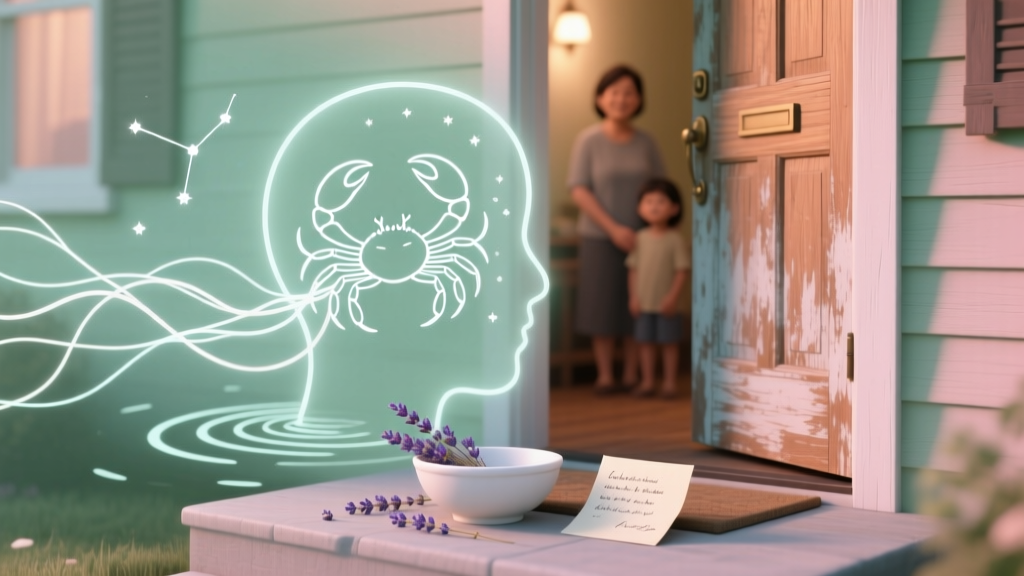
Cancer — the fourth sign of the zodiac, ruled by the Moon and anchored in the water element — is universally recognized as astrology’s archetypal caregiver. Born between June 21 and July 22, Cancers carry an innate, almost biological attunement to emotional safety, familial belonging, and domestic sanctity. In the realm of parenting, family roles, home environment, and intergenerational transmission, Cancer doesn’t just participate — it embodies the emotional infrastructure of family life. This deep profile explores Cancer not as a caricature of ‘the overprotective mom’ or ‘the sentimental dad,’ but as a psychologically rich, behaviorally nuanced, and culturally resonant family archetype — grounded in both astrological tradition and modern developmental science.
Cancer as a Parent
Cancer parents operate from what psychologists call a secure base orientation — a term coined by attachment theorist John Bowlby and expanded by Mary Ainsworth in her landmark Strange Situation studies. For Cancer, parenting isn’t primarily about discipline, achievement, or even instruction; it’s about holding space. Their instinct is to sense unspoken needs before they’re voiced — a child’s clenched jaw before tears, the slight hesitation before entering a new classroom, the quiet withdrawal after a peer conflict. This sensitivity isn’t mystical; it’s neurobiologically reinforced. Research published in Frontiers in Psychology confirms that individuals high in trait empathy — particularly affective empathy (feeling what others feel) — show heightened activation in the insula and anterior cingulate cortex, brain regions associated with emotional resonance and bodily awareness. Cancers consistently score above average on validated empathy scales, especially in caregiving contexts.
Practically, this translates into highly responsive parenting. A Cancer parent doesn’t wait for a toddler to cry to offer comfort — they notice the subtle shift in breathing, the downward tilt of the shoulders, and intervene preemptively. They remember not just birthdays, but the exact date a child lost their first tooth, the name of their kindergarten teacher’s parakeet, and how many times a teen rehearsed a speech before presenting it. This memory isn’t performative; it’s relational scaffolding. Each recalled detail reinforces the child’s sense of being known and held.
However, Cancer’s strength — emotional attunement — can become a vulnerability when boundaries blur. Because Cancers absorb emotional atmospheres like sponges, they may inadvertently mirror or internalize their child’s anxiety, sadness, or frustration — mistaking it for their own. This can lead to over-identification (“I feel so bad that she’s struggling with math — it’s like I’m failing her”) or overcompensation (“I’ll stay up until 2 a.m. helping rewrite her essay because her stress is my stress”). Healthy Cancer parenting requires conscious boundary maintenance — distinguishing between compassionate witnessing and emotional fusion.
Actionable advice for Cancer parents:
- Implement the “3-Minute Pause” ritual: Before responding to a child’s big emotion (tantrum, meltdown, tearful confession), take three slow breaths while placing a hand over your heart. Ask: Is this feeling mine — or am I holding space for theirs? This micro-practice interrupts automatic absorption and restores agency.
- Create a “Feeling Weather Report” board: Use a whiteboard in the kitchen where each family member draws a simple weather symbol (sun, cloud, storm, rainbow) to represent their emotional state each morning. Cancers naturally track these shifts — this makes the tracking visible, collaborative, and de-escalates the pressure to diagnose or fix every mood.
- Designate “Non-Rescue Hours”: Block two 90-minute windows per week (e.g., Tuesday 4–5:30 p.m. and Saturday 10–11:30 a.m.) where you intentionally do not intervene in sibling disputes, homework struggles, or minor frustrations. Let natural consequences and self-advocacy emerge — with gentle debriefing afterward.
Crucially, Cancer parents benefit immensely from external support structures. Because their energy flows outward through care, they rarely refill inward without deliberate input. The American Psychological Association emphasizes that parental well-being is not self-indulgence but foundational to child development. Cancers should treat therapy, peer support groups (like those offered by Postpartum Support International), or even consistent creative time (cooking, journaling, gardening) as non-negotiable family infrastructure — not luxuries.
Cancer Family Role and Dynamics
In the family ecosystem, Cancer rarely seeks the spotlight — yet functions as its gravitational center. Think of Cancer not as the CEO of the household, but as its chief emotional operating system: constantly calibrating temperature, monitoring bandwidth, rerouting stress, and maintaining continuity. Their role is seldom formalized (they rarely hold titles like “Head of Household” or “Family Scheduler”), but their influence is omnipresent — like oxygen.
Cancer’s family role manifests most powerfully through ritual stewardship. They are the keepers of traditions: the ones who ensure the same cinnamon rolls are baked for Christmas morning, who re-read the same bedtime story for three years straight, who preserve faded Polaroids in acid-free albums and narrate the stories behind each one. These rituals aren’t about nostalgia alone; they serve vital developmental functions. According to research from the University of Minnesota’s Institute on Community Integration, family rituals strengthen identity formation, buffer against trauma, and improve adolescent resilience — especially during periods of transition like divorce or relocation. Cancers intuitively understand this: their rituals are emotional immunizations.
Within blended or multi-generational families, Cancer often becomes the bridge builder. They don’t force harmony, but create conditions where connection can organically occur — arranging seating so estranged siblings sit beside each other at Thanksgiving, initiating “story circles” where elders share childhood memories, or quietly slipping a favorite snack into a stepchild’s lunchbox with no fanfare. Their diplomacy is soft but structural: less about negotiating terms, more about adjusting atmospheric pressure.
A defining dynamic in Cancer-led families is emotional reciprocity asymmetry. Cancers give generously, expecting little in return — but they do expect acknowledgment. Not praise, not grand gestures — just a glance of gratitude, a remembered detail repeated back, a willingness to listen when they are overwhelmed. When this reciprocity goes unmet long-term, resentment builds silently — not as anger, but as withdrawal, fatigue, or somatic symptoms (headaches, digestive issues, insomnia). This is why Cancer’s family role requires conscious calibration: teaching children early how to receive care with grace, and modeling how to ask for support without shame.
The following table outlines common Cancer family role expressions across life stages:
| Life Stage | Primary Family Role Expression | Potential Pitfall | Healthy Counterbalance |
|---|---|---|---|
| New Parent (0–3 yrs) | Instinctive, hyper-vigilant nurturer; creates intense physical and emotional cocoon | Identity fusion with infant; difficulty separating needs | Structured “separation practice”: 15-min daily solo walks, baby-wearing only 3x/day, joining a parent group where sharing focuses on self, not just baby |
| Parent of School-Age Children | Homework anchor & emotional translator; decodes social cues, mediates conflicts, preserves routines | Over-managing peer relationships; rescuing from natural social consequences | “Social Lab” framework: designate one low-stakes weekly activity (e.g., library story hour) where child navigates interactions independently; debrief with open questions only |
| Parent of Teens | Safe harbor during identity exploration; holds space for contradictions without judgment | Suppressing own needs to avoid “rocking the boat”; enabling avoidance of responsibility | Clear “non-negotiable + negotiable” agreements: e.g., “Curfew is non-negotiable; choice of weekend job is negotiable.” Paired with weekly 20-min “Adult-to-Adult” chats (no parenting agenda) |
| Grandparent / Elder | Living archive & emotional compass; shares values through storytelling, not lecturing | Over-identifying with grandchildren’s struggles; undermining parents’ authority | “Three-Question Rule” before offering advice: 1. Was I asked? 2. Is this about my need to fix? 3. Does this honor the parents’ leadership? |
Cancer Home Environment Preferences
For Cancer, the home is never merely shelter — it is the first body. Just as skin regulates temperature, filters stimuli, and signals danger, the Cancer home performs parallel functions: it modulates emotional input, protects against overwhelm, and communicates safety (or threat) instantly upon entry. This isn’t aesthetic preference; it’s neurobiological necessity. Environmental psychology research from the Journal of Environmental Psychology demonstrates that spaces perceived as “warm,” “enclosed,” and “personally meaningful” significantly lower cortisol levels and increase vagal tone — physiological markers of calm and connection. Cancer homes are unconsciously engineered for precisely this effect.
Key environmental hallmarks include:
- Tactile Dominance: Texture is paramount. Think chunky knit throws, velvet cushions, woven rugs, smooth ceramic mugs, wooden spoons worn silky by decades of use. Cancers seek materials that invite touch and signal care through wear — not perfection.
- Layered Lighting: Harsh overhead lights are avoided. Instead, pools of warm light emanate from table lamps, string lights wrapped around banisters, salt lamps glowing softly in corners. This mimics circadian rhythms and creates “light zones” — distinct areas for different emotional states (e.g., bright light for meals, dim amber for winding down).
- Sensory Anchors: Specific, consistent scents (vanilla, lavender, old books, simmering broth), familiar sounds (a ticking clock, rain on the roof, a particular playlist), and even taste cues (a jar of homemade jam always on the counter) function as neurological anchors — instantly signaling “you are safe here.”
- Memory Architecture: Walls aren’t blank — they’re curated timelines. Not just framed photos, but ticket stubs from first concerts, pressed flowers from childhood gardens, handwritten recipes taped to the fridge, school projects laminated and hung. The home tells a continuous, evolving story — and Cancer is its chief archivist.
Crucially, Cancer homes prioritize functional warmth over stylistic trends. A mid-century modern sofa might be covered in a crocheted afghan. A sleek smart thermostat is paired with a kettle perpetually on the stove. Technology serves comfort, not control: speakers play lullabies, not podcasts; apps track medication refills, not step counts. The goal isn’t efficiency — it’s embodied ease.
For Cancer parents designing or renovating, practical considerations include:
- Kitchen as Heart: Prioritize counter space for communal cooking, a sturdy table that seats everyone (even if it means folding leaves), and accessible storage for children’s baking tools. The kitchen isn’t for entertaining — it’s for co-regulation. Studies show shared meal preparation reduces family conflict and increases adolescent well-being (Journal of the American Academy of Child & Adolescent Psychiatry).
- Threshold Design: Create intentional entryways. A bench with baskets for shoes, hooks at child height, a small dish for keys — all reduce the “transition shock” of coming home. Add a sensory cue: a bowl of citrus-scented soap, a smooth river stone to hold, or a framed photo of the family smiling.
- Sanctuary Zones: Designate at least one “low-stimulus” room or corner — no screens, minimal decor, soft lighting, comfortable seating. Label it explicitly: “This is where we breathe.” Teach children to recognize when they (or others) need to retreat there.
When Cancer’s home environment is disrupted — by move, divorce, or loss — the impact is profound and somatic. They may experience disorientation, appetite changes, or sleep fragmentation not as “stress” but as a literal destabilization of their nervous system’s primary regulatory site. Recovery requires rebuilding sensory anchors deliberately: unpacking favorite mugs first, hanging one key photo immediately, lighting a signature candle on day one.
Generational Patterns for Cancer
Cancer’s relationship with lineage is unique among the zodiac: they don’t just inherit family patterns — they curate them. While other signs might rebel against or replicate ancestral models, Cancer acts as a selective editor, preserving emotional DNA while discarding toxic mutations. This manifests in powerful generational loops — both healing and repeating.
A well-documented pattern is the “Nurturance Amplification Loop.” A Cancer raised by emotionally unavailable parents often develops hyper-developed caregiving skills — becoming the “little parent” at age 8, soothing siblings, managing household logistics. As an adult, they may over-correct by providing overwhelming nurture to their own children — sometimes smothering, sometimes brilliantly attuned. The loop breaks only when the Cancer consciously identifies which aspects of their childhood care were life-giving (e.g., consistent bedtime stories) versus deficit-based (e.g., suppressing their own needs to keep peace).
Conversely, Cancers raised in highly expressive, emotionally saturated families may develop a “Boundary Fortress” response. Having grown up drowning in unprocessed feelings, they build strong walls — sometimes appearing detached or overly pragmatic. Yet beneath the surface, the Cancer’s longing for emotional safety remains. This generation often pioneers new models: integrating therapy into family life, teaching children emotion vocabulary early, or using structured tools (like mood charts) to make feelings discussable without overwhelm.
Technology has introduced a fascinating new layer. Gen Z and Millennial Cancers are leveraging digital tools to sustain generational connection in unprecedented ways: creating private family Instagram accounts for photo archives, using shared Google Docs for recipe collections annotated with voice notes from grandparents, or hosting monthly Zoom “Story Circles” where elders share oral histories. This isn’t abandoning tradition — it’s evolving the archive.
Breaking harmful generational cycles requires specific Cancer-centered strategies:
- The “Ancestor Interview” Practice: Record interviews with elders focusing not on facts, but on emotional landscapes: “What made your grandmother feel safest as a child?” “When did your father first learn to ask for help?” This reframes history as emotional inheritance, not just biography.
- Genogram Mapping: Work with a family therapist to create a visual genogram — a family tree that maps relationships, traumas, alliances, and cutoffs across 3+ generations. Cancers excel at seeing these patterns; mapping makes them actionable.
- “Tradition Audit” Ritual: Annually, review family traditions with this lens: Does this ritual foster connection or obligation? Does it honor our values or just inertia? What would make it feel alive again? Then, co-create one new ritual with children — something small, sensory, and repeatable (e.g., “First Rain of Spring Tea Ceremony”).
Research from the Harvard Study of Adult Development — the longest-running study on happiness — affirms that strong, warm family relationships across generations are the single strongest predictor of long-term health and life satisfaction. Cancers, by nature, are built to cultivate exactly this. Their generational work isn’t about perfection — it’s about intentional continuity.
Cancer and Sibling Relationships
Within sibling constellations, Cancer often occupies the “Emotional Center” role — regardless of birth order. They may not be the oldest, but they’re the first to notice when a younger sibling is withdrawn, the one who mediates fights between middle children, or the confidante older siblings seek during crises. This isn’t chosen; it’s activated by their lunar sensitivity to relational tides.
Key dynamics include:
- The Memory Keeper: Cancers retain sibling-specific histories — not just events, but emotional subtexts. They remember how their brother’s voice cracked when he got his first bike, or how their sister’s laugh changed after her first heartbreak. This makes them unparalleled advocates — but also vulnerable to carrying unresolved sibling pain.
- The Loyalty Anchor: Cancers form fierce, protective bonds with siblings — especially those perceived as vulnerable. They’ll defend a sibling’s choices passionately, sometimes blinding themselves to genuine concerns. Healthy loyalty requires discernment: “Am I protecting my sibling, or protecting myself from the discomfort of their struggle?”
- The Unspoken Mediator: Rather than confronting conflict head-on, Cancer siblings often use indirect strategies: leaving supportive notes, cooking a favorite meal for the aggrieved party, or inviting both siblings for a walk where conversation unfolds organically. This works beautifully with emotionally intelligent siblings — but can frustrate those needing direct dialogue.
Challenges arise when Cancer’s desire for harmony clashes with necessary boundaries. A Cancer may tolerate a sibling’s chronic unreliability (canceling plans last-minute, borrowing money without repayment) out of fear of rupture — until resentment calcifies into cold distance. Healing requires reframing loyalty: true loyalty includes honesty, not just endurance.
Practical steps for Cancer siblings:
- Initiate “Sibling Check-Ins”: Schedule quarterly 90-minute calls with one sibling focused solely on their current emotional landscape — no problem-solving, no advice, just listening. Rotate partners each quarter.
- Create a Shared Digital Archive: Start a private Google Drive folder titled “Our Story So Far” — upload childhood photos, scanned letters, voice memos of shared memories. Let it grow organically. This satisfies Cancer’s archival impulse while creating neutral, joyful touchpoints.
- Practice “Loyalty with Clarity”: When setting a boundary (e.g., “I can’t lend money, but I’ll help you budget”), pair it with emotional validation: “I know this is disappointing, and I love you deeply. My ‘no’ comes from wanting our relationship to be sustainable.”
For Cancer parents raising multiple children, understanding sibling dynamics is crucial. Avoid labeling (“You’re the peacemaker,” “She’s the sensitive one”) — it traps children in roles. Instead, highlight fluid strengths: “I saw how gently you helped your brother tie his shoes today,” or “Your sister really lit up when you asked about her art project.” This honors Cancer’s intuitive perception while freeing children from fixed identities.
Creating a Nurturing Home as Cancer
Building a nurturing home as Cancer isn’t about achieving Pinterest-perfect aesthetics — it’s about cultivating relational infrastructure. It’s the difference between a house with beautiful furniture and a home where the furniture bears the gentle indentations of shared life. Here’s how to translate Cancer’s innate gifts into tangible, sustainable practices:
1. Design for Emotional Flow, Not Just Function
Map your home’s “emotional topography.” Identify zones by feeling-state:
- The Harbor (Bedrooms): Prioritize darkness, silence, and temperature control. Use blackout curtains, white noise machines, and weighted blankets. Place a small dish of sea salt or a smooth stone on nightstands — tactile anchors for grounding.
- The Hearth (Kitchen/Dining): Ensure seating encourages face-to-face interaction (avoid bar stools facing away). Keep a “connection basket” on the table: notepads, colored pencils, a deck of conversation-starting cards (“What made you smile today?”).
- The Garden (Outdoor Space): Even a fire escape or balcony can become a sanctuary. Grow one edible herb (mint, basil) — caring for living things teaches gentle responsibility. Hang wind chimes tuned to calming frequencies (C major scale).
2. Ritualize Reconnection
Cancer thrives on rhythm. Implement micro-rituals that require under 5 minutes but signal deep presence:
- Morning Light Touch: Before phones are checked, place a hand on each family member’s shoulder or back for 3 seconds — a silent “I see you, I’m here.”
- Transition Chime: Ring a small bell when switching activities (e.g., after homework, before dinner). Everyone pauses, takes one breath, and names one thing they’re carrying into the next moment.
- Gratitude Vessel: A decorative jar where family members drop handwritten notes of appreciation (for actions, not traits: “Thanks for refilling the dog’s water bowl” vs. “You’re helpful”). Read aloud weekly.
3. Normalize Emotional Labor
Teach children that care work is skilled, valuable, and shared. Create a rotating “Care Council” chart listing tasks like:
- “Mood Monitor” (notices energy shifts in family, suggests adjustments)
- “Comfort Coordinator” (chooses music, prepares tea, finds blankets)
- “Memory Keeper” (takes photos, writes captions, updates family timeline)
- “Sanctuary Steward” (maintains the low-stimulus zone — fluffs pillows, replaces candles)
Rotate weekly. This validates Cancer’s natural talents while distributing the load — preventing burnout and modeling collective responsibility.
4. Embrace “Good Enough” Nurturing
Perfectionism is Cancer’s shadow. Remind yourself: A slightly burnt casserole served with love nourishes more than a flawless meal served with tension. A forgotten permission slip matters less than the hug that says, “I’m so glad you’re my kid.”
Use the “Cancer Compass” decision tool: When overwhelmed, ask three questions:
- Does this action directly protect emotional safety? (Yes = Do it. No = Pause.)
- Will this matter in 5 years? (If no, release it.)
- What would I tell my dearest friend in this situation? (Then do that — for yourself.)
This grounds Cancer’s intuition in compassionate pragmatism — transforming guilt into grace.
FAQ
How do Cancer parents handle discipline without losing their nurturing nature?
Cancer discipline is rooted in relational repair, not punishment. They focus on restoring connection first (“I see you’re really upset — let’s sit together”), then clarifying expectations (“In our family, we use kind words even when angry”), and finally co-creating solutions (“What helps you calm down when you feel that way?”). Time-ins — sitting quietly together — are far more effective than time-outs. Consistency matters more than severity: a calm, predictable “We don’t throw toys. Let’s put them away and try again” carries more weight than an angry outburst. The goal isn’t obedience — it’s building the child’s internal compass.
Are Cancer parents more likely to have “helicopter” tendencies?
Yes — but with nuance. Cancer’s vigilance stems from genuine threat assessment, not control. They anticipate real risks (a toddler near stairs, a teen driving in rain) and intervene proactively. The “helicopter” label arises when their protective instincts override the child’s developing autonomy. The antidote isn’t less care — it’s structured scaffolding: gradually releasing responsibility while maintaining emotional availability (e.g., “You’ll navigate the bus route this week; I’ll meet you at the stop for the first three days, then call to check in”).
How can a Cancer parent avoid emotional burnout?
Burnout occurs when Cancer gives from an empty well. Prevention requires treating self-care as sacred infrastructure — not indulgence. Non-negotiables include: 1) Daily 20-minute “sensory reset” (walk barefoot on grass, soak hands in warm water with lavender oil, listen to ocean waves), 2) Quarterly “Emotional Inventory” (journaling: “What am I carrying that isn’t mine? What do I need to release?”), and 3) A trusted “Anchor Person” — one friend/family member who knows Cancer’s language and can say, “You’re running on fumes. Go rest. I’ve got this.”
Do Cancer parents favor one child over another?
Cancer doesn’t favor based on personality — but they resonate more strongly with children whose emotional wavelengths match theirs (e.g., another Cancer, Pisces, or Scorpio). This isn’t bias — it’s energetic ease. The risk lies in unintentionally overlooking children who express needs differently (e.g., a logical Virgo child who says “I’m fine” when overwhelmed). Counter this by scheduling regular 1:1 time with each child using their preferred language: for a verbal child, ask open-ended questions; for a tactile child, bake together; for a visual child, create a collage of “things that make me feel safe.”
How does a Cancer’s Moon sign modify their parenting style?
The Moon sign reveals the *how* of Cancer’s emotional expression. A Cancer Sun with a Capricorn Moon parents with quiet, steady reliability — structure feels like love. With a Gemini Moon, they communicate affection through playful banter and intellectual curiosity. A Leo Moon Cancer expresses love dramatically — through performances, celebrations, and visible pride. A Scorpio Moon Cancer loves with fierce, transformative intensity — diving deep into their child’s psyche. Understanding your Moon sign helps refine your natural gifts: it’s not about changing your Cancer core, but honoring its unique instrumentation.
Cancer’s legacy in family life is profound: they teach us that home is not a place on a map, but a frequency we learn to hold within ourselves and extend to others. They prove that the deepest strength isn’t invulnerability — it’s the courage to remain tender in a world that often rewards armor. By honoring their intuitive wisdom, setting conscious boundaries, and trusting their innate capacity to nurture without losing themselves, Cancer parents don’t just raise children — they cultivate sanctuaries where humanity learns, again and again, how to feel safe enough to become.