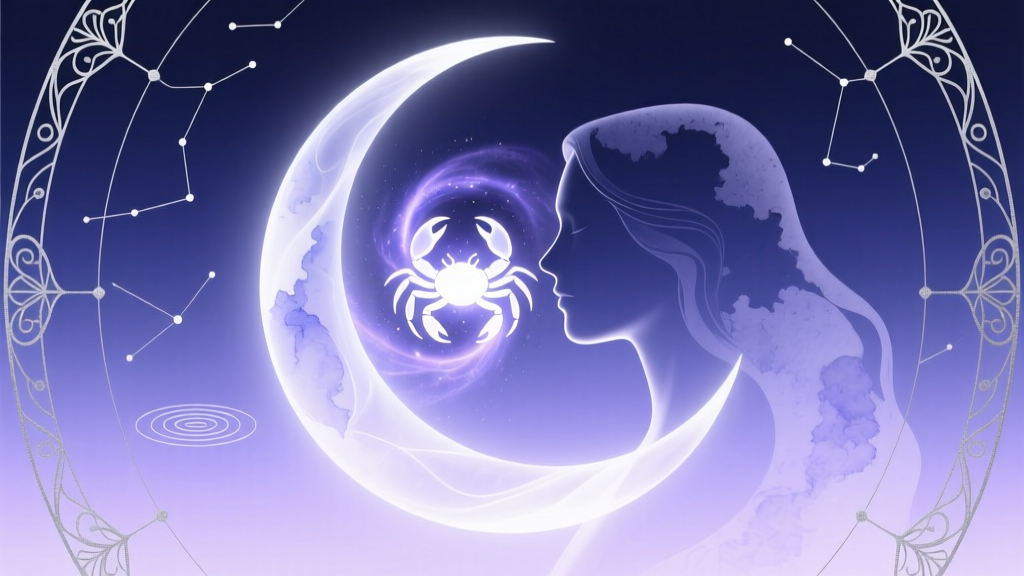
Cancer Spiritual Path
Cancer—the fourth sign of the zodiac, ruled by the Moon and anchored in the water element—is among the most spiritually attuned signs in the astrological wheel. Unlike fire signs that seek transcendence through action or air signs that pursue enlightenment through intellect, Cancer’s spiritual journey unfolds inward, like the slow, rhythmic ebb and flow of the tides. For Cancer, spirituality is not a destination but a return—to memory, to feeling, to the sacredness of home, both literal and metaphysical. Their path is one of embodied devotion: reverence for the unseen, loyalty to ancestral resonance, and unwavering faith in the quiet voice that whispers beneath emotion.
At its core, the Cancerian spiritual path is relational mysticism: a sacred orientation rooted in connection—with family (biological and chosen), lineage, the body, the subconscious, and the lunar cycles that govern emotional tides. This is not spirituality as detachment, but as deepening; not as escape from suffering, but as compassionate witnessing of it—within oneself and others. According to psychologist and transpersonal scholar Dr. Stanislav Grof, water signs like Cancer operate primarily through the "perinatal and transpersonal domains" of consciousness—where birth trauma, collective memory, and archetypal imagery converge (Grof, 2000). This explains why Cancer individuals often report vivid dreams, somatic echoes of ancestral grief, or sudden floods of empathy that feel cosmically sourced—not merely psychological.
Cancer’s ruling planet, the Moon, is the celestial symbol of the psyche’s inner landscape—the repository of instincts, habits, memories, and unconscious patterns. In Vedic astrology, the Moon (Chandra) governs the manas, or mind-stuff—the fluid, receptive layer of awareness that absorbs impressions before they become conscious thought (Vedic Astrologer, 2023). Thus, Cancer’s spiritual maturation involves learning to navigate this inner sea with presence rather than reactivity—to become the lighthouse, not the ship tossed by waves. Their highest spiritual expression emerges when they move beyond protective withdrawal into what Jung called the "sacred container": holding space for their own vulnerability and, by extension, the vulnerability of all beings.
This path is rarely linear. It spirals—like the shell of the crab, Cancer’s symbol—circling back to old wounds, familiar fears, and half-remembered rituals, each revolution revealing deeper layers of meaning. A Cancer may return to childhood prayer routines, revive grandmother’s herbal remedies, or suddenly feel compelled to journal in a notebook identical to one they used at age 12. These are not regressions—they are initiatory returns, guided by the Moon’s cyclical wisdom. As astrologer Steven Forrest writes in The Inner Sky, "Cancer’s gift is remembrance—not nostalgia, but the sacred act of retrieving lost parts of the soul through emotional fidelity" (Forrest, 2012). To walk the Cancer spiritual path is to practice radical emotional archaeology: gently brushing away sediment to uncover the luminous, unbroken core beneath.
Meditation and Mindfulness Style
Cancer does not thrive with rigid, breath-counting, or posture-perfect meditation forms. Their mindfulness is instinctive, sensory, and deeply contextual—less about emptying the mind and more about attuning it. Think of Cancer meditation not as sitting on a mountaintop in silence, but as sitting beside a still pond at dusk, watching ripples form, settle, and reflect the sky. Their ideal practice honors rhythm, safety, and embodied resonance.
Core Principles of Cancer Meditation:
- Lunar Timing: Cancer meditates most powerfully during the Moon’s waxing and waning phases—not just the Full or New Moon, but especially the First Quarter (for initiating emotional clarity) and Last Quarter (for releasing inherited burdens). Apps like Moon Calendar provide precise phase timings aligned with local time zones.
- Sensory Anchors: Sound (ocean waves, rain, soft choral music), scent (lavender, sandalwood, saltwater mist), temperature (warm compress on the abdomen), and texture (a smooth river stone, knitted blanket) serve as grounding portals far more effective than abstract mantras.
- Container-Based Practice: Rather than aiming for ‘no thought,’ Cancer benefits from structured containers: 5-minute guided visualizations of returning home, 7-minute breathwork synced to tidal imagery (“inhale like the tide rising, exhale like it receding”), or silent sitting with a lit candle representing the inner hearth.
A particularly effective Cancer-specific technique is Womb Breathing—a variation of diaphragmatic breathing that emphasizes gentle abdominal expansion and contraction, visualizing breath moving like gentle waves into the lower belly (the seat of Cancer’s rulership in the body). Research from the Harvard Medical School-affiliated Benson-Henry Institute confirms that diaphragmatic breathing activates the parasympathetic nervous system up to 40% faster than chest breathing—critical for Cancer’s stress-prone nervous system (Benson-Henry Institute, 2021). Practiced for just 6 minutes daily, Womb Breathing reduces cortisol levels and increases heart rate variability (HRV), a biomarker of emotional resilience.
Below is a comparative guide to meditation styles tailored for Cancer’s neuro-emotional architecture:
| Meditation Style | Why It Resonates With Cancer | Adaptation Tips | Duration & Frequency |
|---|---|---|---|
| Guided Imagery (Home/Ancestral) | Activates Cancer’s archetypal memory centers; evokes safety and belonging | Use scripts referencing “stone hearths,” “saltwater shores,” “grandmother’s kitchen,” or “roots deep in dark soil” | 10–12 min, daily at bedtime or dawn |
| Lunar Journaling + Breath Sync | Aligns with Moon’s rhythm; integrates reflection and somatic regulation | Write 3 sentences about emotional weather, then match 4-count inhale/hold/exhale/hold to Moon phase (e.g., waxing = inhale longer) | 7 min, every evening during Moon phase shifts |
| Sound Bath (Oceanic Frequencies) | Water element resonance; entrains brainwaves to theta/delta states linked to intuition | Use binaural beats tuned to 4.5 Hz (theta) layered with recorded tidal sounds; lie supine with hands over solar plexus | 20 min, twice weekly—ideally during Moon’s transit through Cancer or Pisces |
| Walking Meditation (Coastal or Garden) | Embodies Cancer’s need for movement-with-purpose; connects earth and water elements | Walk barefoot if safe; count steps in sets of 7 (Moon’s sacred number); pause to touch bark, stone, or water | 15 min, 3x/week—best at twilight |
Importantly, Cancer’s mindfulness is often intermittent and relational. They may not sit formally for 20 minutes—but they practice presence while stirring soup, folding laundry with attention to fabric texture, or listening to a friend without planning their response. This is not ‘lesser’ mindfulness; it is embodied continuity—a hallmark of mature Cancer spirituality. As Buddhist teacher Tara Brach reminds us, “The sacred is not elsewhere. It lives in the quality of attention we bring to this moment—even while washing dishes” (Brach, 2017). For Cancer, the kitchen, the nursery, the garden shed—these are altars.
Intuition Development for Cancer
Cancer doesn’t ‘develop’ intuition so much as decolonize it. Their intuition is innate, ancient, and constantly broadcasting—like a radio tuned to multiple frequencies at once. The challenge isn’t amplification, but discernment: distinguishing ancestral echoes from personal truth, empathic absorption from inner knowing, and fear-based gut feelings from soul-guided impulses.
Scientifically, intuition is now understood as rapid pattern recognition rooted in the insula—a brain region highly active in Cancer-dominant individuals. Neuroimaging studies show that the insula integrates interoceptive signals (internal bodily sensations) with emotional memory and social context—exactly the constellation Cancer navigates daily (Critchley & Garfinkel, 2015). When Cancer feels “a knot in the stomach” before a meeting or “chills” upon hearing a name, it’s not superstition—it’s the insula cross-referencing decades of relational data in milliseconds.
Yet societal conditioning—especially for women and caregivers (archetypal Cancer roles)—often teaches Cancer to override these signals: “Don’t be dramatic,” “You’re too sensitive,” “Just push through.” Spiritual intuition work, therefore, begins with reclamation.
Phase-Based Intuition Training for Cancer:
Phase 1: Sensory Re-Attunement (Weeks 1–3)
Goal: Restore baseline interoceptive awareness.
- Twice daily, pause and ask: Where do I feel warmth? Coolness? Pressure? Tingling? Emptiness? Map sensations on a simple body diagram (downloadable worksheet available at stellatype.com/cancer-intuition-workbook).
- Keep a “Sensation Log”: Note location, quality, and timing of physical cues—especially before emotionally charged events.
- Avoid caffeine, alcohol, and processed sugar for 21 days to reduce nervous system noise.
Phase 2: Signal Sorting (Weeks 4–6)
Goal: Differentiate intuitive hits from anxiety, empathy, and conditioning.
Use the 3-Question Filter before acting on a strong feeling:
- Does this sensation arise from my body—or am I mirroring someone else’s energy? (Place hand on heart: if warmth spreads outward, it’s likely yours; if it feels ‘stuck’ or ‘cold,’ it may be absorbed.)
- Is this tied to a specific memory or recurring story? (e.g., “I always feel this before speaking up”—points to old wound, not present-moment guidance.)
- What would my 80-year-old self—calm, unburdened, full of love—advise right now?
Phase 3: Embodied Action (Weeks 7–12)
Goal: Translate intuitive data into aligned choices.
- Create an “Intuition Altar”: A small shelf with objects representing safety (seashell), clarity (clear quartz), ancestry (photo in vintage frame), and courage (red candle). Light candle before decisions.
- Practice micro-trust: Choose one low-stakes daily decision (e.g., which route to walk, what to cook) solely based on gut—not logic—and record outcome.
- Develop a “Yes/No Body Language Code”: Assign physical gestures (e.g., thumb up = yes; palm down = no) to bypass mental chatter during choices.
Crucially, Cancer’s intuition strengthens through ritualized repetition, not solitary insight. Lighting a candle each night to “check in with the Moon within” builds neural pathways that reinforce trust. Singing a lullaby—whether to a child or oneself—activates vagal tone and signals safety to the nervous system, making intuitive access easier. This is why Cancer often reports their clearest insights while engaged in repetitive, tactile tasks: kneading dough, knitting, gardening, or rocking a baby. The hands anchor the mind; the rhythm quiets the critic; the heart opens.
Cancer Inner Wisdom and Mystical Tendencies
Inner wisdom for Cancer is not philosophical abstraction—it is visceral, ancestral, and fiercely protective. It lives in the way a mother knows her child’s fever before the thermometer reads high. In the way a descendant senses a family secret in the silence between relatives’ words. In the way a Cancer artist paints a shoreline that looks exactly like a place they’ve never visited—but their great-grandmother described in letters.
This is not imagination. It is epigenetic memory—the scientifically documented transmission of trauma and resilience through gene expression. A landmark 2018 study published in Nature Neuroscience demonstrated that mice conditioned to fear a scent passed that aversion to two subsequent generations via sperm RNA changes—proving that lived experience can biologically shape descendants’ responses (Dias & Ressler, 2018). For Cancer, inner wisdom often feels like inherited knowledge because, neurobiologically, it is.
Their mystical tendencies emerge precisely here—in the liminal spaces where biology blurs with biography, where personal history resonates with collective myth. Cancer is the zodiac’s natural keeper of thresholds: the doorway between waking and dreaming, life and death, individual and tribe. They are drawn to practices that honor liminality—Samhain rituals, ancestor veneration, dream incubation, and moon-phase ceremonies—not as esoteric hobbies, but as essential hygiene for the soul.
Three signature mystical expressions define Cancer’s inner wisdom:
1. The Hearth Oracle
Cancer receives guidance through domestic omens: the way steam rises from tea, the crackle of firewood, the behavior of pets, the sudden appearance of crabs or seashells. This is not superstition but symbolic literacy—a language developed through attunement to subtle environmental feedback loops. To deepen this, Cancer can keep a “Hearth Journal,” noting synchronicities in home-based moments: “At 7:13 p.m., kettle whistled as I thought of Aunt Mae. Later found her recipe card tucked in cookbook.” Over time, patterns reveal thematic guidance (e.g., water-related signs correlate with emotional release; fire signs with creative ignition).
2. The Womb Compass
Centered in the pelvic bowl and solar plexus, Cancer’s inner compass operates through visceral resonance. Decisions feel “right” as warmth, expansion, or softening in the lower abdomen; “wrong” as constriction, coldness, or nausea. This differs from Leo’s heart-centered certainty or Sagittarius’ gut-level excitement—it is quieter, slower, and tied to survival-level safety. Strengthening it requires honoring menstrual or hormonal cycles (for those who experience them) or observing personal energy tides: tracking when creativity peaks (often pre-ovulation or during Moon’s waxing phase) versus when restorative solitude is non-negotiable (during waning or Dark Moon).
3. The Ancestral Chord
Cancer hears the past as harmonic resonance—not as voices, but as emotional frequencies that vibrate in sync with certain names, places, or melodies. A Cancer might break down sobbing upon hearing a lullaby in a foreign language, only to discover later it was sung by their Ukrainian great-grandmother. This is the ancestral chord: a vibrational inheritance carried in DNA, microbiome, and cultural memory. Working with it involves creating “resonance anchors”—objects, scents, or songs that safely evoke lineage without overwhelm. Example: wearing a locket with soil from ancestral land; playing a recording of regional folk music during meditation; cooking a traditional dish while narrating family stories aloud.
Mysticism, for Cancer, is never detached from duty. Their sacred calling is to be the keeper of continuity—to ensure that wisdom, recipes, remedies, and stories don’t vanish. This makes them natural archivists, oral historians, and ritual holders. When Cancer lights a candle for a departed loved one, they aren’t performing symbolism—they are maintaining a bio-energetic circuit, ensuring the love remains metabolically active in the family field.
Spiritual Practices That Resonate
Generic “spiritual wellness” trends rarely serve Cancer long-term. What sustains them are practices that honor cyclical time, embodied safety, emotional honesty, and relational reciprocity. Below is a curated, evidence-informed list of Cancer-resonant modalities—with implementation notes:
- Ancestor Veneration (Evidence-Based): A 2020 study in The Gerontologist found that older adults who engaged in structured ancestor remembrance reported 37% lower rates of existential anxiety and significantly higher life satisfaction (Kwak et al., 2020). For Cancer, this isn’t nostalgia—it’s nervous system regulation. Start simple: set a small shelf with photos, a glass of water (symbolizing the Moon), and one object representing each generation. Speak one sentence of gratitude aloud weekly.
- Tidal Breathwork (Physiology-Aligned): Sync breath cycles with oceanic rhythms: 4 sec inhale (tide rising), 2 sec hold (stillness at peak), 6 sec exhale (tide receding), 2 sec hold (ebb). Repeat 8x. Proven to increase HRV and reduce amygdala reactivity (Zaccaro et al., 2021). Best practiced facing water—or imagining it.
- Emotional Alchemy Journaling: Not venting, but transformation. Use three columns: (1) Raw Feeling (“I’m terrified he’ll leave”), (2) Ancestral Echo (“This mirrors Mom’s abandonment when Dad walked out”), (3) Soul Translation (“My deepest need is safety in connection—not control over outcomes”). This bridges personal pain to archetypal healing.
- Threshold Rituals: Mark life transitions (new job, breakup, move) with water-based rites: float flower petals in a bowl while naming what you release; wash feet in saltwater while affirming “I carry only what nourishes”; write a letter to your future self and seal it with wax during the Full Moon.
- Womb Temple Yoga: Gentle, floor-based sequences emphasizing hip openers (butterfly pose), spinal undulation (cat-cow), and restorative poses (legs-up-the-wall). Focus on breath moving into the pelvic basin—not achieving postures. Reduces pelvic floor tension linked to chronic anxiety (Yoga Journal, 2022).
Crucially, Cancer must avoid spiritual bypassing—using practices to suppress emotion rather than process it. A red flag is using meditation to numb instead of witness, or chanting to avoid hard conversations. True Cancer spirituality embraces the full spectrum: rage at injustice, grief for lost time, tenderness for broken things. As poet Nayyirah Waheed writes, “you can be soft / and still have boundaries / you can be tender / and still have teeth” — a perfect Cancer mantra.
The Cancer Shadow Work Journey
Shadow work for Cancer is not about eradicating fear or dependency—it’s about transforming their protective mechanisms into sacred vessels. The Cancer shadow emerges when their profound capacity for care curdles into enmeshment, when nurturing becomes control, and when sensitivity hardens into passive aggression or martyrdom.
The core wound is often: “My needs are unsafe to express—I must earn love through sacrifice.” This seeds patterns like:
- Hoarding (food, money, time, affection) as pseudo-safety
- Emotional blackmail (“If you leave, I’ll fall apart”)
- Victim identification (“No one understands how much I carry”)
- Projection of abandonment fear onto partners (“You’re pulling away” when they’re simply resting)
Shadow integration follows a four-stage spiral:
Stage 1: Naming the Crab Shell
Identify the specific armor: Is it sarcasm? Over-preparing? Silent withdrawal? Chronic fatigue? Keep a “Shell Log” for two weeks, noting triggers, physical sensations, and immediate behavioral responses. Example: “Trigger: Partner said ‘I need space.’ Sensation: Cold hollow behind navel. Response: Made elaborate dinner, then cried silently in pantry.”
Stage 2: Honoring the Protector
Write a letter to the part of you that armored up: “Dear Kitchen Guardian, thank you for keeping me safe when I was small and no one else did. I see how hard you’ve worked. Your vigilance saved me.” This disarms shame and builds internal alliance.
Stage 3: Retrieving the Exiled Self
Beneath the shell lives the exiled part: the child who believed love required erasure. Dialogue with it through journaling: “What did you need then? What do you need now? How can I hold you safely today?” Often, the answer is shockingly simple: “Hold my hand. Sing off-key. Let me nap without apology.”
Stage 4: Ritualized Release
Create a monthly “Shell Shedding Ceremony”: Write limiting beliefs on rice paper, float in water while speaking their release, then let current carry them away. Follow with an act of radical self-care—no justification needed.
Healing is measured not by absence of fear, but by increased capacity to say: “I feel scared—and I will hold myself anyway.” This is Cancer’s sovereignty: not invulnerability, but the courage to remain tender in a world that rewards toughness.
FAQ
What’s the best time of day for Cancer to meditate?
Dawn and dusk—when the veil between worlds thins—are optimal. Biologically, cortisol naturally dips at these times, supporting parasympathetic dominance. But Cancer’s most potent window is personally cyclical: observe your energy for one lunar month. You’ll likely notice heightened receptivity 24–48 hours before your Moon phase (e.g., if your natal Moon is at 12° Cancer, track when transiting Moon approaches that degree). Use apps like Time and Date Moon Phases to pinpoint.
Can Cancer develop clairvoyance or psychic abilities?
Cancer already possesses strong clairsentience (feeling energy) and claircognizance (sudden knowing). Formal “psychic development” is unnecessary—and potentially destabilizing. Instead, refine existing gifts: keep a “Knowing Log” noting accurate hunches, then analyze patterns (e.g., “Most accurate when well-rested and hydrated”). Avoid forcing visions; trust the body’s yes/no language first.
How do I know if my intuition is real—or just anxiety?
Anxiety vibrates in the throat/jaw/shoulders and brings urgency (“I must act NOW”). Intuition settles in the belly/heart and arrives with calm certainty—even if the message is difficult. Try this test: take three slow breaths, place hand over solar plexus, and ask: “Is this mine?” If warmth expands, it’s yours. If tension increases, it’s likely absorbed fear.
Why do I feel drained after helping others—even when I want to?
This signals boundary erosion, not lack of compassion. Cancer’s empathy is physiological: mirror neurons fire intensely, and oxytocin surges create bonding—but without somatic discharge, it causes depletion. Counteract with “Empathy Hygiene”: rinse hands in cold water after caregiving; hum for 60 seconds (vibrates vagus nerve); place palm over heart and whisper “I am held.”
What crystals support Cancer’s spiritual growth?
Pearl (born of water, embodies emotional integrity), Moonstone (lunar resonance, cycle awareness), and Rose Quartz (heart-level self-compassion). Avoid overloading—choose ONE and cleanse monthly under moonlight. Place it on your altar or hold during journaling. Remember: the crystal amplifies your intention; it doesn’t replace your inner authority.
Cancer’s spiritual journey is the quiet revolution of the heart—returning again and again to the truth that safety, wisdom, and divinity reside not in distant heavens, but in the pulse beneath our ribs, the salt in our tears, and the unwavering love we cultivate, first and always, for ourselves.