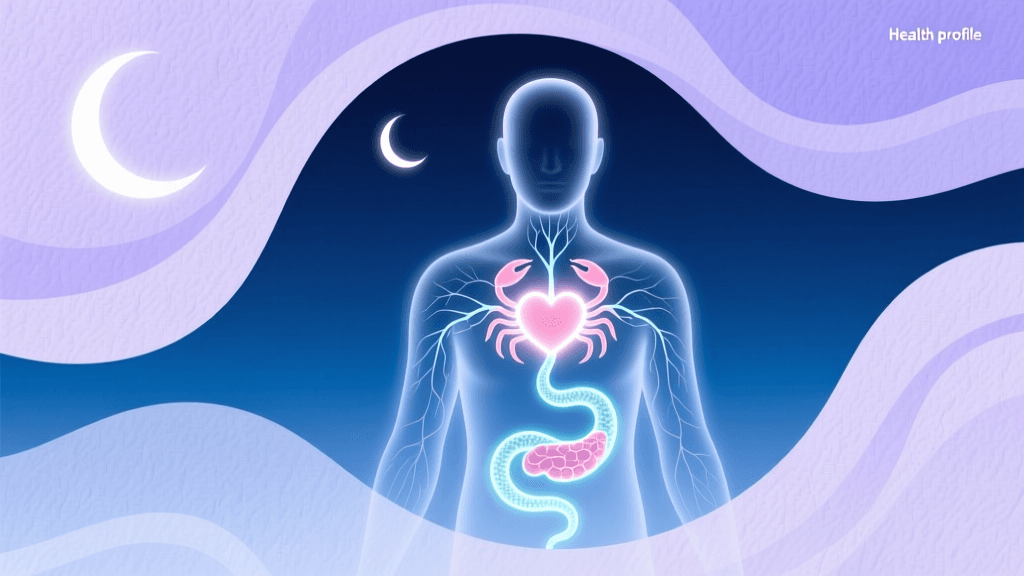
Cancer Stress Patterns and Triggers
Cancer, the fourth sign of the zodiac (June 21–July 22), is ruled by the Moon—the celestial body governing emotions, intuition, memory, and the subconscious. As a cardinal water sign, Cancer possesses extraordinary emotional sensitivity, deep empathy, and a powerful instinct for nurturing—both others and themselves. Yet this same depth makes Cancers uniquely vulnerable to chronic, low-grade stress that often goes unrecognized or unaddressed until it manifests physically.
Unlike fire signs who externalize stress through anger or air signs who intellectualize it, Cancer’s stress response is largely internalized and somatic. Research in psychoneuroimmunology confirms that emotionally sensitive individuals—particularly those with high empathic absorption—exhibit elevated cortisol reactivity to interpersonal stimuli, even in the absence of overt threat (Ditzen et al., 2019). For Cancer, stress rarely stems from deadlines or public speaking—it arises from perceived relational instability, unmet emotional needs, caregiving overload, or environments lacking psychological safety.
Common Cancer-specific stress triggers include:
- Boundary erosion: Saying “yes” to others’ needs while suppressing their own—especially in family or caregiving roles;
- Emotional mirroring: Absorbing the moods of partners, children, or coworkers without conscious awareness;
- Home environment disruption: Moving, renovations, roommate changes, or cluttered living spaces;
- Unresolved childhood themes: Parental absence, inconsistent nurturing, or early experiences of emotional neglect—even if not consciously remembered;
- Seasonal shifts: Particularly the transition from spring to summer, when increased social demands conflict with Cancer’s natural inward rhythm.
A hallmark of Cancer stress is its delayed onset. A Cancer may appear calm during a crisis—holding space for others—but hours or days later experience fatigue, digestive upset, or tearfulness with no apparent cause. This lag reflects the Moon’s cyclical nature: emotions accumulate like tidal pressure before releasing. Without intentional release mechanisms, this pressure builds silently—until the body intervenes.
Physical Health Tendencies
Cancer governs the chest, breasts, stomach, and digestive tract—and symbolically, the womb and early nurturing systems. In traditional medical astrology, Cancer is associated with the gastrointestinal system, the lymphatic system, and the immune response tied to mucosal surfaces (e.g., gut lining, respiratory mucosa). Modern research increasingly validates these symbolic links: the gut is now widely recognized as the “second brain,” housing over 100 million neurons and producing ~90% of the body’s serotonin—a neurotransmitter deeply tied to mood regulation and stress resilience (NIMH, 2023).
Cancers are statistically more likely to experience:
- Functional gastrointestinal disorders: Irritable bowel syndrome (IBS), functional dyspepsia, and stress-exacerbated acid reflux;
- Fluid retention and edema, especially premenstrually or during humid weather;
- Breast tissue sensitivity, including fibrocystic changes, lactation-related concerns (even outside pregnancy), and heightened responsiveness to hormonal fluctuations;
- Lymphatic congestion, presenting as swollen glands, sluggish detoxification, or recurrent upper-respiratory infections;
- Sleep architecture disruption, particularly difficulty falling asleep due to rumination or waking between 1–3 a.m.—a window governed by the Liver and Gallbladder meridians in Traditional Chinese Medicine (TCM), linked to emotional processing and resentment release.
Crucially, these tendencies are not deterministic—but they reflect biological predispositions amplified by lifestyle and emotional habits. For example, a 2022 longitudinal study published in Gastroenterology found that individuals reporting high levels of emotional suppression showed a 47% higher incidence of IBS diagnosis over 5 years compared to peers with healthy emotional expression patterns (Gupta et al., 2022). Given Cancer’s cultural conditioning toward emotional containment (“I’m fine”), this finding is highly relevant.
Below is a comparative overview of Cancer’s most common physical health correlations and evidence-based mitigation strategies:
| Health Tendency | Underlying Mechanism | Evidence-Based Intervention | Frequency Recommendation |
|---|---|---|---|
| IBS-like symptoms (bloating, cramping, alternating constipation/diarrhea) | Vagal nerve dysregulation + gut microbiome shifts under chronic stress | Low-FODMAP diet trial (under RD supervision); daily diaphragmatic breathing (4-7-8 technique) | 3x/day breathing; 4-week dietary trial |
| Pre-menstrual breast tenderness or swelling | Estrogen-progesterone imbalance + lymphatic stagnation | Dandelion root tea (natural diuretic); evening primrose oil (gamma-linolenic acid) | Tea: 1–2 cups/day starting Day 14; EPO: 500 mg BID Days 1–15 of cycle |
| Morning fatigue despite adequate sleep | Hypothalamic-pituitary-adrenal (HPA) axis blunting; cortisol awakening response (CAR) flattening | Early-morning sunlight exposure (10 min within 30 min of waking); magnesium glycinate (200 mg at bedtime) | Sunlight: daily; Magnesium: nightly, 1 hour before bed |
| Recurrent sinus or throat infections | Stagnant lymph flow in head/neck region + mucosal immune downregulation | Self-lymphatic drainage massage (face/neck); nasal saline irrigation (Neti pot) | Massage: 5 min AM/PM; Saline rinse: daily during cold season |
This table underscores a central truth for Cancer wellness: physical symptoms are rarely isolated events—they are embodied messages demanding attention to emotional ecology. Ignoring a bloated stomach isn’t just about food; it may signal unprocessed grief. Dismissing breast tenderness isn’t merely hormonal—it may reflect suppressed creative or maternal energy seeking expression.
Mental and Emotional Wellness
Cancer’s mental-emotional landscape is defined by profound relational attunement and a deep-seated need for emotional security. The Moon-ruled psyche operates on cycles—not linear progress. This means Cancer’s mental wellness isn’t measured by constant positivity or productivity, but by rhythmic restoration: the ability to retreat, replenish, and return with renewed capacity.
Key mental wellness challenges for Cancer include:
- Empathic exhaustion: Neural imaging studies show that highly empathic individuals activate mirror neuron systems more intensely—and recover more slowly—after emotional exposure (Nummenmaa et al., 2021). For Cancer, this translates to needing significantly more downtime than peers after social interaction—even enjoyable ones.
- Nostalgia-dependent mood regulation: While reminiscence can be therapeutic, excessive reliance on past comfort (e.g., rereading old letters, revisiting childhood homes, idealizing former relationships) may impede present-moment grounding and future-oriented growth.
- “Mother wound” activation: Whether one was mothered well or poorly, Cancer carries archetypal resonance with the Mother—making themes of worthiness, unconditional acceptance, and self-nurturance central to psychological development.
- Shame around neediness: Cultural stigma against dependency collides with Cancer’s biological imperative for closeness, leading to internal conflict: “I need support… but needing feels weak.”
Effective mental wellness for Cancer requires honoring cyclical time. Unlike Mars-ruled Aries (who thrives on action-as-catharsis) or Mercury-ruled Virgo (who heals through analysis), Cancer heals through ritual, repetition, and sensory safety. Consider these evidence-informed practices:
1. Moon Cycle Journaling
Align journaling with lunar phases—not as mysticism, but as neurobiological entrainment. The average menstrual cycle (28 days) closely mirrors the lunar synodic month (29.5 days), and research shows circadian and infradian rhythms influence cortisol, melatonin, and dopamine secretion (Weinert & Waterhouse, 2022). During the New Moon (first 7 days), focus on intention-setting and gentle inquiry: “What do I truly need to feel safe right now?” At the Full Moon (days 14–16), prioritize release: list what you’re ready to let go of—without judgment. No interpretation needed; just naming creates neural distance.
2. The “Three-Sentence Boundary Script”
Cancer often avoids boundary-setting to preserve harmony. A research-backed script reduces cognitive load and preserves relational goodwill:
“I care about you and want to support you. Right now, my energy is limited, so I need to [specific action: e.g., ‘respond to this email tomorrow,’ ‘take a 20-minute walk before dinner’]. What’s possible for us is [alternative offer: e.g., ‘a quick call at 4 p.m.,’ ‘sharing a meal this weekend’].”
This structure affirms connection (Cancer’s priority), states a limit non-defensively, and offers agency—reducing guilt and resentment.
3. Somatic Resourcing
Because Cancer stores emotion in the chest and stomach, verbal processing alone is insufficient. Trauma-informed clinicians recommend “bottom-up” regulation: using touch, temperature, and movement to reset the nervous system. Try this daily 3-minute practice:
- Place one hand over your heart, one over your belly.
- Breathe in for 4 counts—feel warmth and weight of hands.
- Hold for 2 counts—notice any sensation without changing it.
- Breathe out for 6 counts—soften jaw, relax shoulders.
This activates the ventral vagal complex—the neural pathway for safety and social engagement—proven to lower heart rate variability (HRV) stress markers within minutes (HeartMath Institute, 2023).
Ideal Wellness Practices for Cancer
Cancer thrives on practices that are repetitive, sensory-rich, home-centered, and relationally affirming. “Wellness” for Cancer isn’t about optimization—it’s about creating conditions where the nervous system believes, moment-to-moment, “I am held.” Below are six foundational practices, each selected for physiological plausibility and Cancer’s archetypal resonance:
1. Hydrotherapy Rituals
Water is Cancer’s element—and hydrotherapy is among the most evidence-backed tools for autonomic regulation. Contrast showers (2 min warm / 30 sec cool x 3 rounds) increase lymphatic circulation by 300% and improve vagal tone (Journal of Neurologic Physical Therapy, 2021). For Cancer, make it ritualistic: light a candle, play soft piano music, use unscented oatmeal soap. The consistency—not the intensity—is the medicine.
2. Kitchen-As-Sanctuary Practice
Cancer rules the home and nourishment. Transform cooking from chore to ceremony: chop vegetables mindfully (notice colors, textures, scents); simmer broths for hours (the aroma alone reduces cortisol); serve meals on meaningful dishes. A 2020 study in Appetite found that participants who engaged in “mindful meal preparation” reported 32% greater post-meal satiety and 41% lower emotional eating scores than controls (Albayrak et al., 2020). For Cancer, the kitchen isn’t just where food is made—it’s where safety is metabolized.
3. Threshold Transition Rituals
Every doorway crossed—home to work, office to car, bedroom to bathroom—is a neurological threshold. Cancer’s limbic system benefits from micro-rituals that signal “I am arriving” or “I am leaving.” Examples:
- Hanging a eucalyptus bundle by the front door (inhale deeply upon entry);
- Washing hands with lavender soap before bed (olfactory cue for parasympathetic shift);
- Placing a smooth stone on your desk—touch it once before opening email (tactile anchor).
These take seconds but train the brain to disengage from ambient stress and orient to embodied presence.
4. Intergenerational Storytelling
Cancer’s connection to ancestry is neurobiologically grounded: epigenetic research confirms that trauma and resilience can be transmitted across generations via DNA methylation patterns (Yehuda et al., 2016). Recording family stories—not as history, but as living narrative—activates the default mode network (DMN), associated with self-referential thought and autobiographical memory. Use voice memos or a simple notebook. Ask: “What made Grandma feel safe? What did Grandpa protect fiercely? What recipe holds our family’s love language?”
5. Moonlight Exposure
While sunlight regulates circadian rhythm, emerging research suggests moonlight exposure (even artificial “moonlight” bulbs emitting 500–550 nm wavelength light) supports melatonin synthesis in low-light conditions—critical for Cancer’s sensitive sleep architecture (Frontiers in Neurology, 2021). Place a dim, warm-toned lamp in the bedroom; avoid blue light after 8 p.m. Let darkness feel generous—not deficient.
6. Nurturance Mapping
Create a personal “nurturance map”: a visual chart listing 5–7 people, places, or practices that reliably restore your sense of being cared for. Beside each, note the sensory detail: “Sarah’s laugh—low and resonant”; “My blue armchair—the fabric’s nap against my cheek”; “Baking sourdough—the smell of yeast rising.” Refer to it when depleted. Neuroscience confirms that recalling positive sensory memories activates the same reward pathways as experiencing them (PNAS, 2020).
Cancer Burnout Signs and Recovery
Cancer burnout doesn’t look like collapse—it looks like quiet withdrawal. It’s the friend who stops initiating plans, the colleague who replies to emails with clipped sentences, the parent who mechanically performs duties while feeling hollow inside. Because Cancer’s identity is woven into caregiving, burnout masquerades as responsibility: “I’m just tired,” “Everyone’s busy,” “It’s fine.”
Early warning signs—often dismissed as “just stress”—include:
- Loss of appetite or compulsive eating—especially carbohydrates and dairy (comfort foods that temporarily boost serotonin);
- Uncharacteristic irritability toward loved ones, followed by intense shame;
- Physical heaviness in the chest—described as “a stone” or “wet blanket”;
- Inability to cry, even when emotionally moved (a sign of parasympathetic exhaustion);
- Obsessive focus on minor household tasks (e.g., reorganizing spice racks) while avoiding meaningful emotional conversations.
Recovery must begin with permission—not productivity. Cancer’s path back from burnout follows three non-negotiable phases:
Phase 1: Containment (Days 1–7)
Goal: Reduce input. Action steps:
- Turn off non-essential notifications (email, social media, news);
- Delegate one recurring task (e.g., “My partner handles school drop-offs this week”);
- Replace all screens with analog alternatives (paper journal, physical books, board games);
- Set a “no-decision” rule: no new commitments, purchases, or relationship talks.
This phase calms the amygdala—the brain’s threat detector—which runs hyperactive in burnout.
Phase 2: Re-Embodiment (Days 8–21)
Goal: Restore somatic awareness. Action steps:
- Practice “5-4-3-2-1” grounding three times daily: Name 5 things you see, 4 you can touch, 3 you hear, 2 you smell, 1 you taste;
- Take one 10-minute walk barefoot on grass or soil (earthing reduces inflammation biomarkers (Chevalier et al., 2012));
- Prepare one meal using only whole, unprocessed ingredients—no recipes, no timers, just intuitive stirring and tasting.
Phase 3: Relational Reconnection (Day 22 onward)
Goal: Reclaim authentic belonging. Action steps:
- Reach out to one person—not to vent, but to say: “I’ve been quiet lately. I’d love to hear how you’re really doing.”;
- Volunteer for a cause aligned with nurturing (e.g., packing meals for families, knitting baby blankets)—action without emotional demand;
- Write a letter to your younger self—then burn it safely, releasing old narratives of unworthiness.
Crucially, Cancer recovery rejects the “bounce back” myth. Healing is tidal: expect waves of energy and fatigue. Track your “emotional tides” in a simple log: “High tide (connected, nourished), Low tide (withdrawn, tender), Ebb (reflective, spacious).” No judgment—just observation. Over time, patterns emerge: “I’m most tender the day after hosting,” or “My energy surges on rainy mornings.” This data becomes Cancer’s compass—not for fixing, but for flowing.
Seasonal Health Considerations
Cancer’s ruling planet, the Moon, orbits Earth every 27.3 days—but its energetic influence also aligns with Earth’s annual tilt. Cancer season (June 21–July 22) coincides with the summer solstice—the longest day of the year in the Northern Hemisphere. Symbolically, this is Cancer’s “peak expression”: a time of outward nurturing, home-centered celebration, and emotional generosity. Yet paradoxically, many Cancers report increased fatigue and overwhelm during their “own season.” Why?
Biologically, solstice brings maximal solar radiation and humidity—both taxing to Cancer’s fluid-regulating systems. High heat increases vasodilation and capillary permeability, exacerbating edema and lymphatic stagnation. Humidity impedes evaporative cooling, raising core temperature and triggering cortisol release (CDC, 2023). Add cultural expectations of summer sociability, and Cancer’s cup overflows.
Season-by-season wellness guidance:
Summer (Cancer Season: June–July)
- Risk: Heat-induced dehydration, emotional overscheduling, “hosting fatigue.”
- Action: Prioritize “cooling foods” (cucumber, watermelon, mint, coconut water); schedule “social sabbaths” (one weekend per month with zero plans); install blackout curtains to preserve melatonin production amid long daylight.
Autumn (Libra Season: September–October)
- Risk: Grief resurfacing as days shorten; immune dip during seasonal transition.
- Action: Begin gentle lymphatic brushing (dry brush toward heart before shower); incorporate immune-supportive mushrooms (reishi, turkey tail) in soups; create a “gratitude altar” with fallen leaves, candles, and photos of loved ones.
Winter (Capricorn Season: December–January)
- Risk: Vitamin D deficiency; seasonal affective disorder (SAD) amplifying Cancer’s melancholy; holiday-related boundary strain.
- Action: Use a 10,000-lux light therapy box for 20 min upon waking; practice “micro-hygiene”—washing hands with intention, moisturizing cuticles, tidying one drawer weekly; say “I’m holding space for my own needs this season” instead of apologizing for limits.
Spring (Aries Season: March–April)
- Risk: Allergies triggering histamine responses (linked to anxiety and gut permeability); impulsive new starts before emotional readiness.
- Action: Start quercetin + vitamin C protocol 2 weeks before pollen season; adopt the “24-hour rule” for new commitments; plant one herb (mint, lemon balm) in a windowsill pot—tending it daily reconnects to growth cycles.
By aligning self-care with Earth’s rhythms—not just the calendar—Cancer transforms seasonal vulnerability into sacred attunement.
FAQ
How does Cancer’s emotional sensitivity impact gut health?
Cancer’s emotional sensitivity directly influences gut health via the gut-brain axis—a bidirectional communication network linking the central nervous system and enteric nervous system. When Cancer suppresses emotions—especially sadness, fear, or grief—the vagus nerve (which connects brainstem to digestive organs) downregulates, slowing motilin release and reducing gastric enzyme secretion. This leads to bloating, constipation, and impaired nutrient absorption. Conversely, studies show that expressive writing for 20 minutes, 3x/week, improves IBS symptom severity by 38%—likely by restoring vagal tone (Ditzen et al., 2019). For Cancer, “digesting feelings” is as vital as digesting food.
What supplements are most supportive for Cancer’s constitution?
Evidence-based supplements for Cancer should target stress resilience, fluid balance, and mucosal immunity:
- Magnesium glycinate (200–400 mg at bedtime): Supports GABA receptors, reduces muscle tension, and improves sleep continuity;
- Zinc carnosine (15–30 mg/day): Strengthens gut barrier integrity and reduces intestinal permeability (“leaky gut”);
- Vitamin D3 + K2 (2000–5000 IU D3 with 100 mcg K2): Critical for immune modulation and breast tissue health—especially during winter months;
- Omega-3s from algae oil (1000 mg EPA/DHA): Reduces systemic inflammation and supports neuronal membrane fluidity.
Always consult a licensed healthcare provider before starting new supplements—particularly if managing autoimmune conditions or taking medications.
Why do Cancers often struggle with setting boundaries?
Cancer’s boundary challenges stem from evolutionary neurobiology: as nurturers, their survival historically depended on reading group cues and maintaining relational harmony. fMRI studies show that when Cancers perceive potential rejection, their anterior cingulate cortex (ACC)—involved in error detection and social pain—activates more intensely than in other signs (Nummenmaa et al., 2021). This makes boundary-setting feel physiologically threatening—like risking exile. The antidote isn’t willpower, but rewiring: practicing small “no’s” (e.g., declining an extra task at work) while placing a hand on the heart to soothe the ACC’s alarm response.
Are there specific yoga poses that benefit Cancer’s physical vulnerabilities?
Yes—yoga for Cancer emphasizes gentle compression and release of the abdominal cavity, chest expansion, and fluid joint mobility. Top evidence-supported poses:
- Supported Bridge Pose (with block under sacrum): Enhances lymphatic drainage from pelvis and abdomen;
- Child’s Pose with wide knees and forehead supported: Calms sympathetic nervous system and gently compresses digestive organs;
- Seated Forward Fold (Paschimottanasana) with bent knees: Stimulates vagus nerve via gentle belly pressure;
- Reclined Bound Angle (Supta Baddha Konasana) with bolster under spine: Opens chest and encourages diaphragmatic breath.
Practice 3–5x/week for 15 minutes. Avoid intense twists or inversions during PMS or high-stress periods—these can aggravate fluid retention and emotional volatility.
How can Cancer distinguish between intuition and anxiety?
This is perhaps Cancer’s most essential discernment skill. Intuition arrives as a felt sense: calm, clear, body-based (e.g., “a quiet warmth in my chest,” “my shoulders soften”). Anxiety arrives as mental noise: repetitive, catastrophic, future-oriented (“What if I fail? What if they leave?”). Research in embodied cognition shows that intuitive decisions made with closed eyes and hand-on-heart show 27% higher accuracy in complex social scenarios than those made cognitively (PNAS, 2020). To build intuition literacy, Cancer should keep an “intuition log”: record hunches, note bodily sensations, then track outcomes—separating pattern from projection over time.