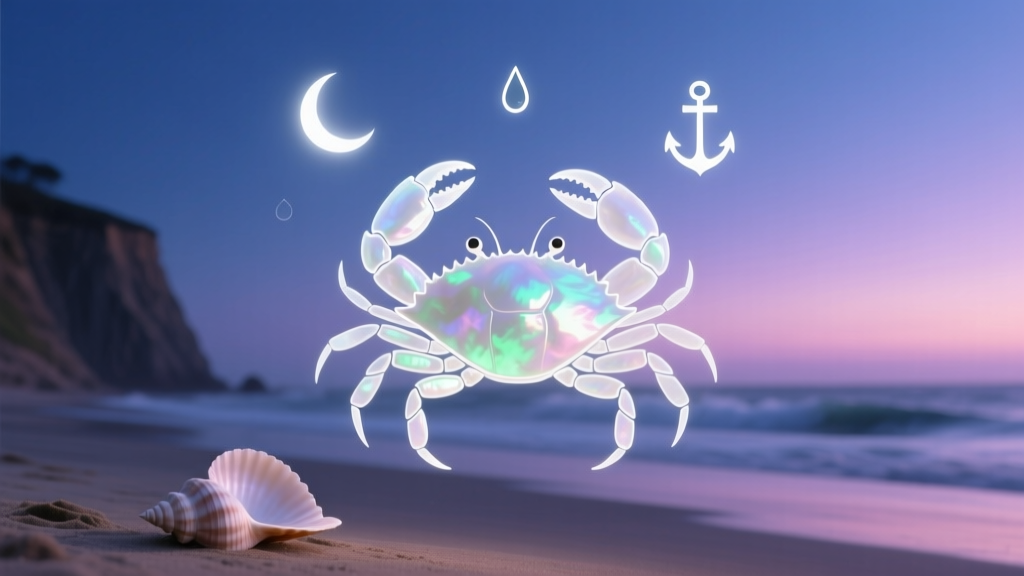
The cancer zodiac archetype, spanning from June 21 to July 22, is frequently reduced to pop-astrology caricatures of weeping sentimentality and passive fragility. As the fourth sign of the zodiac and the first cardinal water sign, Cancer operates as the astrological initiator of emotional security. Ruled by the Moon, this sign governs the subconscious, ancestral lineage, and the psychological foundation we build for ourselves. To understand the true mechanics of this placement, we must dismantle prevalent myths and examine the structural realities of the Crab's astrological blueprint. This requires moving beyond superficial horoscopes into the realm of psychological and evolutionary astrology.
The Reality of the Cancer Zodiac: Beyond the Stereotypes
Pop culture often misinterprets the protective shell of the Crab as a symbol of weakness or an inability to face the world. In reality, the shell represents rigorous boundary-setting and psychological fortification. Because Cancer is a cardinal sign—sharing this initiatory modality with Aries, Libra, and Capricorn—individuals with prominent Cancer placements are architects of their emotional environments. They do not passively receive emotional dynamics; they actively construct and enforce them.
Misconception 1: Cancers Are Exclusively 'Weak' or 'Overly Sensitive'
Sensitivity in astrology is not a deficit; it is a high-fidelity data-gathering mechanism. The cancer zodiac processes micro-expressions, tonal shifts, and environmental atmospherics that air and fire signs often overlook. According to psychological astrology frameworks outlined by researchers at Astrology.com, this hyper-vigilance is an evolutionary survival trait. The perceived 'weakness' is actually a highly tuned empathic radar. When overwhelmed, the Crab's defense mechanism is not necessarily tears; it is often a calculated, impenetrable emotional withdrawal or sharp, defensive sarcasm designed to protect their vulnerable core.
Misconception 2: They Hold Grudges Out of Spite
The idea that Cancers are vindictive grudge-holders ignores the sign's neurological and astrological relationship with memory. Ruled by the Moon, which governs the unconscious mind and past conditioning, Cancers possess an eidetic emotional memory. They do not hold grudges to punish others; they retain the somatic memory of how a specific interaction disrupted their emotional equilibrium. Forgiveness requires them to consciously decouple the historical memory from the present trigger, a process that requires deliberate cognitive reframing rather than mere passage of time.
Cancer Zodiac in the Natal Chart: Beyond the Sun Sign
When discussing the cancer zodiac, most people refer exclusively to the Sun sign. However, the archetype manifests differently depending on the personal planet involved. A Moon in Cancer is in its domicile (home), meaning the emotional nature is pure, unfiltered, and deeply tied to the physical body and maternal lineage. Conversely, Mars in Cancer is in its fall, creating a complex dynamic where the drive for action (Mars) is filtered through the need for emotional security (Cancer). This often results in passive-aggressive behavior or immense protective aggression when their family is threatened. Understanding these planetary distinctions is vital for accurate chart interpretation, a concept heavily explored in advanced synastry studies at The Mountain Astrologer.
Cancer Zodiac Compatibility FAQs: Synastry and Elemental Dynamics
Mainstream horoscopes reduce compatibility to basic Sun sign matching. True synastry evaluates elemental trines, sextiles, and squares. The cancer zodiac thrives in environments where emotional reciprocity is structurally guaranteed. Below is a breakdown of elemental dynamics when Cancer interacts with other modalities.
| Elemental Pairing | Aspect | Dynamic & Friction Points | Long-Term Viability |
|---|---|---|---|
| Water + Earth (Taurus, Virgo, Capricorn) | Trine (120°) | Earth provides the physical container for Water's emotional depth. Friction arises if Earth becomes too rigid or dismissive of intuitive leaps. | High (Foundational Stability) |
| Water + Water (Cancer, Scorpio, Pisces) | Conjunction (0°) | Profound unspoken understanding. The primary risk is emotional enmeshment and the lack of an objective, grounding third party to resolve disputes. | Medium-High (Requires Boundaries) |
| Water + Air (Gemini, Libra, Aquarius) | Square (90°) / Inconjunct (150°) | Air intellectualizes what Water feels. Cancer may perceive Air as emotionally detached; Air may view Cancer as irrational or overly demanding. | Low-Medium (High Maintenance) |
| Water + Fire (Aries, Leo, Sagittarius) | Quincunx / Opposition | Fire's blunt, forward-moving energy can boil Water or cause it to evaporate. However, Fire can help Cancer break out of depressive ruts through sheer momentum. | Medium (Polarizing but Transformative) |
Frequently Asked Questions About the Cancer Zodiac
How does the Moon's phase affect a Cancer's mood?
Because the Moon is the ruling planet of Cancer, individuals with heavy Cancer placements are highly susceptible to lunar cycles. During the New Moon, they may experience a drop in physical vitality and an urge to isolate and incubate. During the Full Moon, emotional tension peaks, often manifesting as heightened anxiety or sudden clarity regarding domestic and familial issues. Tracking the lunar cycle using ephemeris tools at Astro-Seek is a practical tool for Cancers to anticipate and manage their energy output.
Are all Cancers naturally nurturing and maternal?
No. This is a projection of the archetypal 'Mother' associated with the fourth house. A Cancer's expression of nurturing depends heavily on their entire natal chart. For instance, a Cancer Sun with a Mars in Aries conjunction will express care through fierce protection and proactive problem-solving rather than soft, maternal coddling. Conversely, a Cancer with a prominent Uranus placement may reject traditional domesticity entirely, expressing their nurturing nature through community activism or unconventional chosen families.
What is the difference between a June Cancer and a July Cancer?
This distinction lies in the decans and the Sun's exact degree, calculated via the Chaldean order. June Cancers (roughly June 21 - July 2) fall in the first decan, co-ruled by the Moon, making them the most quintessential, emotionally transparent Cancers. July Cancers often fall into the second decan (co-ruled by Pluto/Scorpio) or third decan (co-ruled by Neptune/Pisces). A second-decan July Cancer will exhibit more intense, investigative, and secretive traits, while a third-decan July Cancer will lean heavily into mysticism, artistic expression, and boundary dissolution.
Actionable Guidance: Navigating Conflict with a Cancer Zodiac
When engaging in conflict resolution with a cancer zodiac individual, standard logical debate tactics will fail. You must address the emotional subtext. Implement the following framework:
- Validate the Subtext First: Before presenting your logical counter-argument, explicitly acknowledge their emotional experience. Use phrases like, 'I can see why my action made you feel unsupported,' rather than, 'You are overreacting.' This disarms the cardinal water defense mechanism.
- Avoid the 'Sideways' Approach: Cancers, like the Crab, often approach issues indirectly when they feel unsafe. If they are using passive-aggression or changing the subject, do not force a direct confrontation. Create a low-stakes environment (e.g., walking side-by-side rather than sitting face-to-face) to encourage them to drop their defensive shell.
- Anchor in Historical Precedent: Cancers respect consistency and historical data. When apologizing or proposing a new boundary, reference past instances where you successfully navigated a similar issue. This builds the psychological safety required for them to engage in the present dispute without fearing abandonment.
Understanding the cancer zodiac requires moving past superficial tropes and engaging with the complex, cardinal-water mechanics that drive their behavior. By respecting their need for emotional architecture and recognizing their formidable protective instincts, you can build deeply resilient, transformative bonds with the Crab.