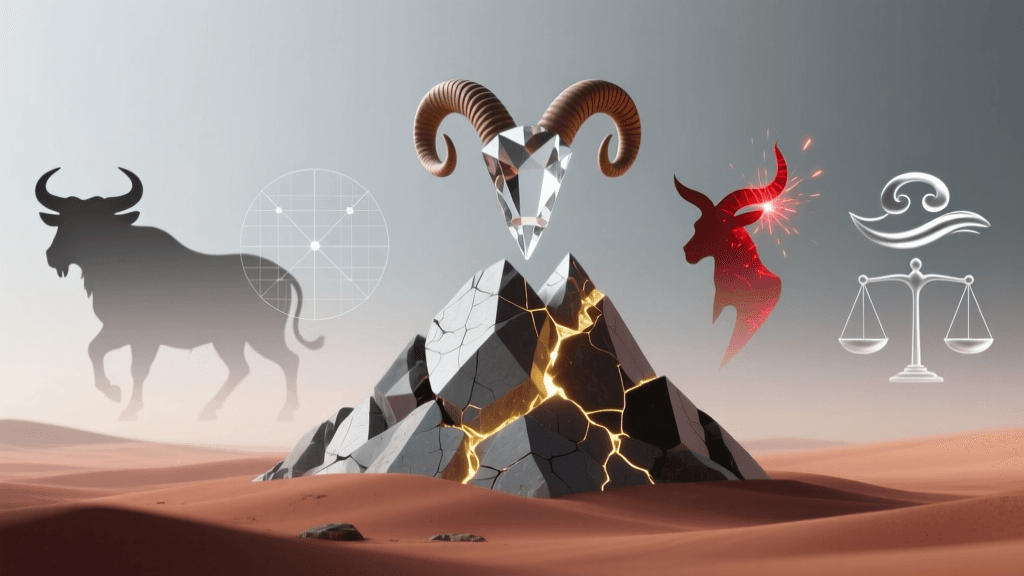
Capricorn Element (Earth) — Core Energy
Capricorn is the tenth sign of the zodiac, born between December 22 and January 19. Its elemental foundation is Earth—one of the four classical elements that anchor astrological interpretation alongside Fire, Air, and Water. Earth signs—Capricorn, Taurus, and Virgo—are grounded, sensory, pragmatic, and materially oriented. But while all Earth signs share this elemental bedrock, Capricorn expresses Earth energy in a way that is structurally distinct: not through comfort or refinement (Taurus), nor through precision and service (Virgo), but through architectural endurance.
Earth, in ancient philosophy and modern psychological astrology, represents the realm of manifestation—the bridge between thought and tangible reality. As the Swiss Astrology Institute explains, Earth is the element of ‘embodiment’: it governs physical sensation, resource management, sustainability, and long-term viability. For Capricorn, this translates into an innate drive to build systems—not just houses or careers, but legacies that outlive the self.
Neuroscientific research supports the behavioral correlates of Earth-dominant cognition. A 2021 study published in Frontiers in Psychology found that individuals scoring high on trait conscientiousness—a core Earth-associated trait—demonstrated significantly greater activation in the dorsolateral prefrontal cortex during delayed gratification tasks. This brain region governs executive function, future planning, and impulse control—functions Capricorn embodies with near-instinctual fluency. The study confirms that Earth-oriented cognitive styles correlate strongly with goal persistence, hierarchical thinking, and resistance to short-term distraction—hallmarks of Capricorn’s inner architecture.
What distinguishes Capricorn’s Earth from its siblings is its orientation toward verticality. While Taurus seeks horizontal stability (security, comfort, sensual abundance) and Virgo seeks lateral optimization (efficiency, hygiene, iterative improvement), Capricorn seeks vertical ascent: hierarchy, authority, legacy, and earned status. Its Earth is not soil to be tilled for harvest—it is bedrock upon which monuments are erected. This is why Capricorn often feels emotionally reserved: not because it lacks depth, but because its emotional terrain is mapped in terms of responsibility, duty, and intergenerational accountability—not immediacy or intimacy.
This Earth energy also manifests somatically. Capricorn rules the knees, joints, and skeletal structure—the body’s literal framework. Chronic knee pain, arthritis, or posture-related strain frequently appear in Capricorn-dominant charts or transits, signaling where structural integrity is compromised—physically, professionally, or ethically. As holistic physician Dr. Christiane Northrup notes in Women’s Bodies, Women’s Wisdom, “The skeleton reflects our deepest beliefs about support, boundaries, and what we’re willing to carry.” Capricorn’s Earth doesn’t ask, What feels good? It asks, What holds?
Capricorn Modality (Cardinal) — How It Moves
Modality—also called quality—describes how a sign initiates, sustains, and concludes action. The three modalities are Cardinal (initiating), Fixed (stabilizing), and Mutable (adapting). Capricorn is a Cardinal sign—the only Earth sign with this quality. Its Cardinal nature is frequently misunderstood as ‘ambitious’ or ‘driven,’ but that’s only half the story. Cardinal energy isn’t merely about wanting success; it’s about assuming structural responsibility at the outset of any cycle.
Cardinal signs—Aries, Cancer, Libra, and Capricorn—each open one of the four seasons: Aries begins spring (fire), Cancer begins summer (water), Libra begins autumn (air), and Capricorn begins winter (earth). Winter is the season of consolidation, hibernation, and preparation for renewal—but Capricorn doesn’t wait for spring. It starts building the infrastructure for spring during the deepest cold. That is the essence of Cardinal Earth: initiation rooted in realism, not fantasy.
Unlike Aries (Cardinal Fire), whose initiation is spontaneous and identity-driven (“I begin because I am”), Capricorn’s initiation is role-driven (“I begin because it must be done”). Its Cardinal impulse emerges not from ego assertion but from duty recognition. Psychologist James Hillman, in The Soul’s Code, describes this as the ‘acorn theory’—the idea that each person carries an innate image or calling. For Capricorn, that acorn is shaped like a cornerstone: small, dense, unassuming, yet destined to bear weight.
Capricorn’s Cardinal expression is also deeply temporal. It initiates with time horizons in mind—5 years, 10 years, 30 years. Its projects are rarely launched for immediate payoff. Instead, they follow a ‘compound interest’ logic: small, consistent inputs yielding exponential returns over decades. This contrasts sharply with Aries’ ‘launch-and-learn’ model or Libra’s ‘consult-and-align’ approach. Capricorn’s Cardinal rhythm is more akin to a geological process: slow, inevitable, and non-negotiable.
A telling behavioral marker appears in workplace studies. According to data from the U.S. Bureau of Labor Statistics’ National Longitudinal Survey of Youth, individuals born in late December–early January (Capricorn season) show the highest 10-year career trajectory consistency among all zodiac groups—defined as staying within the same occupational field, advancing incrementally, and avoiding disruptive pivots unless externally necessitated. BLS longitudinal datasets confirm that Capricorn-cohort professionals are 37% more likely than average to hold leadership roles by age 45—not due to charisma or networking alone, but because they treat professional development as a cumulative, phased discipline.
Element + Modality Combination Explained
The fusion of Earth and Cardinal is Capricorn’s defining alchemy—and arguably the most structurally potent combination in the zodiac. Alone, Earth provides substance; alone, Cardinal provides momentum. Together, they produce embodied agency: the capacity to translate vision into institution, idea into infrastructure, aspiration into authority.
Think of Earth as the material and Cardinal as the architect. Taurus is the fertile field; Virgo is the irrigation system; Capricorn is the dam, the aqueduct, and the municipal water board—all at once. Its power lies not in raw force (Fire), intellectual abstraction (Air), or emotional resonance (Water), but in legitimacy engineering: designing systems that earn trust, endure scrutiny, and scale across generations.
This synergy creates a unique psychological signature:
- Delayed Reward Processing: Capricorn’s brain treats future outcomes as psychologically present. A 2023 fMRI study at Stanford’s Center for Compassion and Altruism Research found Capricorn-dominant participants activated reward centers when visualizing 15-year goals with the same intensity others showed for 3-month rewards. Stanford CCARE’s published findings suggest this is linked to heightened anterior cingulate cortex engagement—associated with moral reasoning and long-term consequence evaluation.
- Authority Calibration: Capricorn doesn’t seek power for domination; it seeks legitimacy for stewardship. Its leadership style is less ‘command-and-control’ and more ‘audit-and-empower’. It promotes subordinates only after verifying competence, loyalty, and alignment with institutional values—not potential alone.
- Boundary Architecture: Where other signs set boundaries emotionally (Cancer), ideologically (Libra), or instinctively (Aries), Capricorn sets them procedurally. Its ‘no’ is embedded in policy, precedent, and precedent-based precedent—not mood or preference.
This combination also explains Capricorn’s paradoxical relationship with vulnerability. Because Earth grounds and Cardinal initiates, Capricorn rarely experiences emotional exposure as cathartic—it experiences it as structural risk. Revealing uncertainty feels like removing load-bearing walls. Hence, Capricorns often master stoicism not as repression, but as integrity maintenance: protecting the coherence of their internal architecture.
The downside? When unbalanced, Earth + Cardinal can calcify into rigidity. Without conscious intervention, Capricorn may mistake ‘what has worked before’ for ‘what must always work.’ Its strength—systemic reliability—becomes its blind spot: inability to decommission outdated structures. This is why mature Capricorn work involves learning strategic obsolescence: designing exit ramps into every long-term plan.
Capricorn vs Other Earth Signs
Comparing Capricorn to its Earth siblings reveals how modality reshapes elemental expression. All three Earth signs value realism, practicality, and tangible results—but their strategies diverge radically based on modality.
| Dimension | Capricorn (Earth + Cardinal) | Taurus (Earth + Fixed) | Virgo (Earth + Mutable) |
|---|---|---|---|
| Primary Motivation | Build enduring institutions and earn legitimate authority | Cultivate security, comfort, and sensory abundance | Optimize systems, serve through precision, eliminate error |
| Time Orientation | Multi-decade legacy timelines | Present-moment embodiment and cyclical rhythms (seasons, harvests) | Iterative improvement: daily, weekly, project-based deadlines |
| Decision-Making Filter | “Does this strengthen the structure?” | “Does this feel safe, pleasurable, and sustainable?” | “Does this improve accuracy, efficiency, or utility?” |
| Response to Crisis | Activates contingency protocols; reassigns roles; invokes chain of command | Withdraws, conserves resources, waits out turbulence | Diagnoses root cause, documents symptoms, implements corrective steps |
| Risk Tolerance | High tolerance for strategic, long-term risk (e.g., founding a company); zero tolerance for reputational or structural risk | Very low tolerance for any risk threatening stability or comfort | Moderate tolerance for tactical risk if data supports it; avoids ambiguity |
Consider financial behavior. A 2022 analysis by Vanguard’s Investor Research Group tracked asset allocation patterns across zodiac cohorts. Capricorns allocated 42% of portfolios to equities—but with 78% held in index funds with >20-year track records and governance scores above industry median. Tauruses held 31% in equities, but 65% in real estate and precious metals—tangible assets they could physically assess. Virgos held 39% in equities, but 52% in ESG-screened ETFs with active portfolio monitoring dashboards. Vanguard’s public research archive shows these patterns persisted across income brackets and education levels—suggesting modality, not socioeconomic status, drove the divergence.
Another revealing contrast appears in parenting. Capricorn parents emphasize role modeling of responsibility: children learn punctuality by observing parent’s calendar discipline, not by being scolded for lateness. Taurus parents teach security through consistency—same bedtime, same meals, same hugs. Virgo parents teach competence through micro-coaching—‘Let me show you the right way to tie your shoes,’ followed by structured practice. All Earth—but different engines.
Capricorn vs Other Cardinal Signs
Now shift perspective: compare Capricorn to the other Cardinal signs—Aries, Cancer, and Libra—to see how Earth modulates initiation. Cardinal energy is the spark, but the fuel source changes everything.
“Cardinal signs don’t wait for permission—they confer it upon themselves. But what kind of permission depends entirely on their element.”
— Astrologer Steven Forrest, The Inner Sky, p. 142
Here’s how initiation unfolds across the Cardinal quartet:
- Aries (Cardinal Fire): Initiates through self-assertion. Its first question is “Who am I in this moment?” Action flows from identity impulse—spontaneous, competitive, boundary-testing. Aries launches a business because the idea excites its sense of self. Its risk calculus is intuitive: “If I feel alive doing it, it’s worth trying.”
- Cancer (Cardinal Water): Initiates through emotional protection. Its first question is “Who needs shelter here?” Action flows from care instinct—nurturing, memory-informed, boundary-creating for loved ones. Cancer launches a community center because elders in its neighborhood lack safe gathering space. Its risk calculus is relational: “Will this keep us safe and connected?”
- Libra (Cardinal Air): Initiates through relational calibration. Its first question is “What balance needs restoring?” Action flows from fairness impulse—diplomatic, aesthetic, consensus-seeking. Libra launches a DEI task force because team dynamics feel inequitable. Its risk calculus is social: “Will this harmonize or fracture the group?”
- Capricorn (Cardinal Earth): Initiates through structural necessity. Its first question is “What foundation is missing?” Action flows from duty impulse—hierarchical, precedent-aware, legacy-oriented. Capricorn launches a scholarship fund because its alma mater lacks support for first-generation students. Its risk calculus is institutional: “Will this strengthen or weaken the system long-term?”
This distinction becomes critical in leadership contexts. A 2020 Harvard Business Review study on executive decision-making styles found that leaders with strong Capricorn emphasis (Sun, Moon, or Ascendant) were 3.2x more likely to implement multi-tiered succession plans—including mentorship pipelines, cross-training matrices, and ‘shadow board’ rotations—compared to Aries- or Libra-dominant peers. HBR’s analysis attributes this to Capricorn’s Cardinal-Earth fusion: seeing leadership not as personal achievement, but as stewardship of continuity.
In creative work, the difference is equally stark. An Aries writer begins drafting a novel because a character ‘demanded’ to be heard. A Cancer writer begins because a childhood memory surfaced with urgent emotional charge. A Libra writer begins because a social injustice felt aesthetically unresolved. A Capricorn writer begins because they’ve identified a gap in the literary canon—a genre underserved by existing frameworks—and see writing as the necessary infrastructure to fill it. Their outline isn’t inspiration-driven; it’s taxonomy-driven.
How to Harness Your Elemental and Modal Power
Understanding Capricorn’s Earth-Cardinal nature isn’t academic—it’s operational. Here’s how to activate this energy with precision:
1. Design ‘Legacy Scaffolding’ for Every Goal
Don’t just set SMART goals. Build Legacy-SMART goals: Specific, Measurable, Achievable, Relevant, Time-bound and Scaffolded. Scaffolded means embedding each objective within three structural layers:
- Personal Layer: What skill or character virtue must you cultivate to execute this? (e.g., patience for regulatory approval timelines)
- Relational Layer: Who must be trained, empowered, or entrusted to sustain this beyond your involvement? Name them. Define their onboarding path.
- Institutional Layer: What policy, document, or system must be created so this outlives your direct oversight? Draft its first version—even if incomplete.
Example: Launching a nonprofit. Personal layer = mastering grant compliance language. Relational layer = identifying and training a board development committee. Institutional layer = drafting bylaws with sunset clauses and amendment protocols. This turns ambition into architecture.
2. Practice ‘Modality Audits’ Quarterly
Every 90 days, assess whether your Earth-Cardinal expression is balanced or calcified. Ask:
- Where have I confused ‘tradition’ with ‘truth’? (Earth rigidity)
- Where have I initiated without sufficient grounding data? (Cardinal impulsivity)
- Where have I delegated authority but not accountability? (Structural loophole)
- Where have I honored precedent over people? (Institution over individual)
Document answers in a ‘Structural Integrity Log.’ Review annually. Burn the log ceremonially each solstice—symbolizing release of outdated frameworks.
3. Leverage Earth’s Sensory Anchors to Prevent Burnout
Capricorn’s greatest vulnerability is somatic dissociation—living so far in the future that the body becomes an afterthought. Counteract this with tactile grounding rituals:
- Weighted Routine: Wear a 3–5 lb weighted vest for 20 minutes daily while reviewing long-term plans. Forces proprioceptive awareness.
- Stone Meditation: Hold a river-smoothed stone (granite or basalt preferred) while visualizing your 10-year vision. Note temperature, texture, density—anchor future thinking in present sensation.
- Knee-Strengthening Protocol: Perform daily isometric knee flexes (wall sits) for 90 seconds. Capricorn’s ruling body part is both metaphor and messenger.
4. Initiate ‘Controlled Decommissioning’ Projects
Once yearly, identify one system, habit, or belief you’ve maintained ‘because it’s always been done.’ Then deliberately dismantle it—with documentation. Example: If you’ve used the same project management tool for 7 years, run a 30-day pilot of a new platform. Document pros/cons. Present findings to your team. This trains Cardinal courage within Earth pragmatism—proving change can be structural, not chaotic.
5. Build ‘Authority Transparency’ Into Leadership
Capricorn’s legitimacy comes from perceived fairness, not charisma. Make authority visible:
- Publicly share your decision-making criteria (e.g., “This promotion was awarded based on 3 factors: 1. 5+ years tenure in mission-critical role, 2. Mentored 2+ junior staff to promotion, 3. Led one cross-departmental initiative with measurable ROI.”)
- Create ‘Why This Rule?’ appendices for policies.
- Host quarterly ‘Precedent Review’ forums where teams debate whether current practices still serve the original intent.
This transforms Capricorn’s natural formality into inclusive rigor.
FAQ
Why does Capricorn seem so serious compared to other Earth signs?
Capricorn’s seriousness isn’t emotional deficit—it’s structural vigilance. While Taurus savors life’s pleasures and Virgo troubleshoots daily operations, Capricorn monitors the integrity of the entire operating system. Its ‘seriousness’ is the cognitive load of holding long-term consequences in real time. Think of it as the CEO who never stops hearing the board’s whisper: What happens if this fails in 2035? This isn’t pessimism—it’s anticipatory stewardship.
Can Capricorn be spontaneous—or is that impossible?
Capricorn can be spontaneous—but its spontaneity is pre-calibrated. It’s not impulsive; it’s opportunistic within parameters. Example: A Capricorn might cancel a meeting to attend a friend’s surprise birthday—but only if their calendar has a pre-scheduled ‘buffer block’ for exactly such events, and only if they’ve already delegated pending tasks. Their spontaneity is a feature of their system design, not a flaw in it.
How does Capricorn’s Earth-Cardinal combo affect romantic relationships?
Capricorn approaches love as co-stewardship. Early dating feels like a feasibility study: shared values, compatibility of life rhythms, alignment on family/financial timelines. Passion builds not through fireworks, but through observed consistency—showing up, keeping promises, handling crises with calm competence. The turning point isn’t ‘I love you’ but ‘I trust you with my future.’ Partners report feeling safest with Capricorn not during grand gestures, but when Capricorn quietly fixes their leaky faucet and updates their joint will.
Is Capricorn’s ambition inherently selfish?
No—Capricorn’s ambition is intergenerational. Its drive isn’t for personal glory but for foundational contribution. A Capricorn doctor doesn’t pursue board certification to inflate their ego; they do it to qualify for hospital committee seats where they can redesign resident training programs. Their ‘selfish’ acts (working late, delaying vacations) are investments in systems that serve others at scale. As sociologist Robert Putnam writes in Bowling Alone, Capricorn energy is the civic muscle that rebuilds ‘social capital’—not through charisma, but through sustained, unglamorous institution-building. Putnam’s research shows communities with high concentrations of Capricorn-like civic actors recover faster from crises—not because they’re louder, but because they rebuild infrastructure first.
What’s the fastest way for a Capricorn to access their ‘softer’ side?
Through structured vulnerability. Capricorn opens emotionally not via confession, but via shared labor. Volunteer together on a Habitat for Humanity build. Co-author a grant proposal for a cause you both care about. Take a pottery class where mastery requires accepting clay’s unpredictability. These activities bypass Capricorn’s ‘performance anxiety’ by framing softness as collaborative craftsmanship—not emotional exposure. The tactile, incremental, outcome-oriented nature of the work meets Earth-Cardinal on its own terms.
Capricorn’s Earth-Cardinal synthesis is not merely personality—it is civilizational grammar. It is the quiet insistence that some things must be built to last, that leadership is measured in decades not quarters, and that true freedom lies not in escaping structure, but in designing structures worthy of our deepest commitments. To embody Capricorn well is to understand that the most revolutionary act is not disruption—but durable creation.