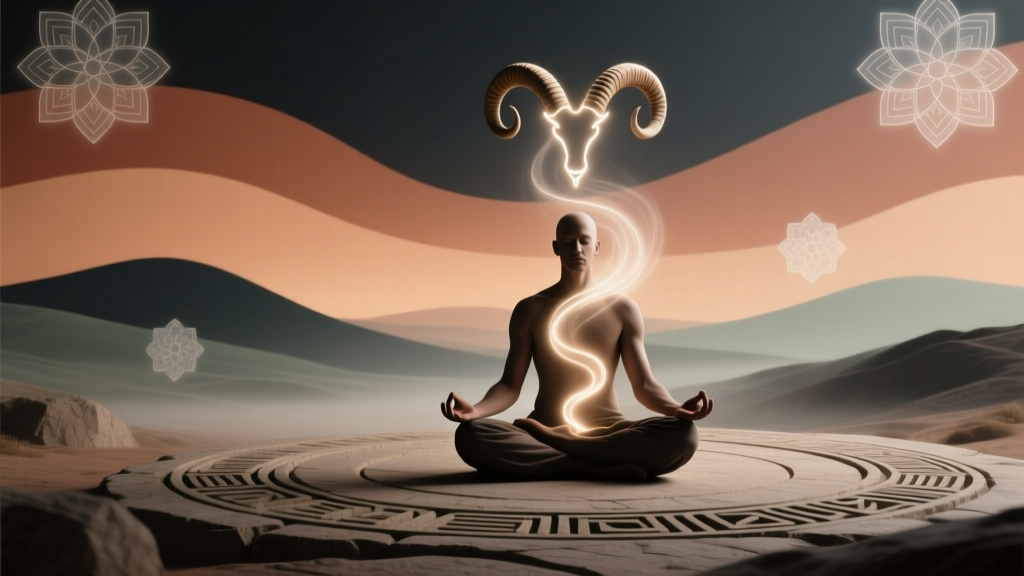
Capricorn Spiritual Path
Capricorn (December 22 – January 19) is ruled by Saturn—the ancient planet of structure, time, boundaries, and karmic responsibility. Unlike fire or air signs that seek spiritual revelation through inspiration or intellectual insight, Capricorn’s spiritual path unfolds like a slow, deliberate ascent up a mountain: steep, weathered, and earned. Their spirituality is rarely flashy or ecstatic; instead, it is architectural—built stone by stone through consistency, reverence for lineage, and deep respect for the sacredness of time itself.
This earth sign’s spiritual orientation is profoundly embodied and ancestral. Capricorns don’t typically chase transcendence “beyond” the material world—they seek to sanctify it. For them, holiness resides in integrity, stewardship, and the quiet dignity of sustained effort. As astrologer and depth psychologist Liz Greene observes in The Astrology of Fate, Saturn-ruled signs “do not find salvation in escape, but in the courageous acceptance of limitation—and from that acceptance, the emergence of true authority.”https://www.astro.com/astrology/books/greene_fate.htm
Capricorn’s spiritual journey is one of initiation through endurance. Early life often involves hardship, early responsibilities, or encounters with structural authority (parental, societal, or institutional) that shape their understanding of duty, consequence, and moral gravity. These experiences—though sometimes painful—are not obstacles to spirituality but its very curriculum. In Jungian terms, Capricorn’s path mirrors the individuation process as a lifelong integration of the Senex (wise elder) archetype: the embodiment of patience, discernment, and earned wisdom.
What distinguishes Capricorn’s spirituality from other earth signs (Taurus and Virgo) is its vertical dimension. While Taurus roots into sensory presence and Virgo refines through service, Capricorn reaches upward—toward legacy, tradition, and cosmic order. Their mysticism is not about dissolving the self in oneness, but about aligning the self with enduring principles: justice, continuity, intergenerational ethics, and sacred hierarchy (not domination, but natural, organic order). This makes Capricorn uniquely positioned to serve as spiritual elders, temple keepers, lineage holders, and ethical architects in collective spiritual movements.
Importantly, Capricorn’s spiritual maturity emerges only when they release the unconscious belief that worth must be proven—not just to others, but to the universe itself. Their deepest spiritual breakthrough occurs when they realize: Divine grace is not earned—it is inherent. Structure is not punishment—it is protection. Time is not an adversary—it is the loom upon which meaning is woven.
Meditation and Mindfulness Style
Capricorn does not gravitate toward meditation practices promising instant bliss, ego dissolution, or psychedelic light-body activation. Their ideal practice is one that mirrors their values: measurable progress, tangible results, respectful of chronology, and anchored in somatic reality. Capricorn’s mindfulness is less about “being present” as a passive state—and more about attending with purpose.
Research supports this orientation: A 2022 study published in Psychological Science found that individuals high in conscientiousness (a trait strongly correlated with Capricorn placements) demonstrated greater adherence and long-term benefits from structured, goal-oriented mindfulness interventions—particularly those incorporating journaling, weekly review, and progressive skill-building—compared to open-monitoring or loving-kindness protocols.https://journals.sagepub.com/doi/10.1177/09567976221082147
Below is a comparison of meditation modalities most and least resonant for Capricorn—with rationale and implementation tips:
| Meditation Style | Resonance for Capricorn | Why It Fits (or Doesn’t) | Practical Implementation Tip |
|---|---|---|---|
| Vipassana (Insight Meditation) | High — with structure | Aligns with Capricorn’s analytical rigor and commitment to truth. The 10-day silent retreat format satisfies their respect for disciplined initiation—but requires scaffolding to avoid burnout. | Begin with a 3-day “mini-retreat” at home: pre-schedule silence blocks, use a structured body-scan audio guide (e.g., from Mindful.org), and log observations nightly in a dedicated notebook. |
| Zen Shikantaza (“Just Sitting”) | Moderate–Low | Lacks clear progression metrics; may trigger Capricorn’s unconscious fear of “wasting time.” Without koan study or teacher feedback loops, it feels too formless. | Pair with zazen journaling: After each sitting, record one concrete observation (e.g., “Noticed jaw tension 3x; released on exhale”) + one insight about discipline or resistance. |
| Tonglen (Compassion Breathing) | Medium–High (with grounding) | Initially challenging due to Capricorn’s emotional reserve—but deeply transformative when framed as ethical training, not emotional performance. | Anchor in breath-counting first (inhale 4, hold 4, exhale 6); visualize breathing in collective responsibility, exhaling grounded support. Use tactile anchors: hold a river stone or worn wooden mala. |
| Kundalini Yoga (Breath + Movement) | Low–Medium | Too energetic and unstructured; rapid shifts may feel destabilizing. However, asana-based sequences with precise alignment cues (e.g., Iyengar-influenced) are highly compatible. | Adapt: Choose 3 foundational poses (Mountain, Chair, Forward Fold), hold each for 90 seconds with breath awareness, and track posture improvements weekly in a “Body Integrity Log.” |
| Contemplative Prayer / Lectio Divina | Very High | Deeply resonant: combines textual study, reflective silence, and devotional intention. Honors tradition, authority, and layered meaning—core Capricorn values. | Select one short passage weekly (e.g., Ecclesiastes 3:1–8, Rumi’s “The Guest House,” or a Stoic excerpt from Marcus Aurelius). Follow the four movements: lectio (read), meditatio (reflect), oratio (respond), contemplatio (rest in stillness). |
For Capricorn, the most spiritually nourishing mindfulness isn’t about emptying the mind—it’s about curating attention. Try this 7-minute daily ritual:
- Minute 1: Sit upright (no cushions—use a straight-backed chair). Set a timer. Close eyes. Feel the weight of your pelvis on the seat—acknowledge gravity as divine law.
- Minutes 2–3: Breathe in for 4 counts, hold for 4, exhale for 6. With each exhale, silently name one responsibility you honor (e.g., “my promise to my mother,” “my commitment to honesty”).
- Minutes 4–5: Visualize a stone staircase descending into bedrock. With each breath, descend one step—releasing perfectionism, then self-criticism, then the need to be useful.
- Minutes 6–7: Rest in silence—not as emptiness, but as presence within structure. Notice how stillness holds space, like architecture holds life.
This practice honors Capricorn’s need for containment while gently loosening Saturn’s grip on self-worth. Over time, it rewires the nervous system to associate stillness not with stagnation—but with sovereign stability.
Intuition Development for Capricorn
Capricorn’s intuition is famously underestimated—not because it’s weak, but because it operates so differently from the “gut-feel” or “lightning-flash” models popularized in New Age discourse. Capricorn’s intuition is slow-burn cognition: a synthesis of pattern recognition, historical precedent, risk assessment, and embodied memory accumulated over years—even lifetimes. It manifests not as a voice, but as a deepening certainty; not as a vision, but as an unshakable knowing that arises after exhaustive data collection and silent incubation.
Neuroscientist Dr. Sarah Garfinkel’s research on interoception (the perception of internal bodily signals) reveals that high-conscientiousness individuals often suppress intuitive signals—not due to lack of capacity, but because they mistrust anything that cannot be immediately verified or rationalized.https://www.nature.com/articles/s41598-020-79293-2 For Capricorn, intuition lives in the solar plexus and knees—the centers of personal power and grounded action—not the crown or heart. It speaks in metaphors of terrain: “This path feels unstable,” “That agreement lacks foundation,” “This person hasn’t earned my trust—yet.”
Developing intuition for Capricorn requires bypassing the overactive frontal lobe and reawakening somatic literacy. Here’s a 4-week protocol designed specifically for their neurocognitive profile:
Week 1: Reclaiming the Body as Oracle
Capricorn has likely spent decades dissociating from physical sensation to meet external demands. Begin with micro-attunement:
- Three times daily, pause and ask: Where do I feel pressure, warmth, or stillness right now—in my feet? Hands? Jaw?
- Record responses in a “Somatic Ledger”: not interpretations (“I’m stressed”), but raw data (“left shoulder tight since 10:17 a.m.”).
- After 7 days, review entries. Notice correlations: Which sensations precede decisions? Which vanish after boundary-setting?
Week 2: Pattern Mapping
Capricorn excels at recognizing patterns—so train intuition as pattern detection:
- Choose one recurring life domain (e.g., work collaborations, financial choices, relationship dynamics).
- Map the last 5–7 instances: What preceded the outcome? What small signal was ignored? What “gut hunch” was overridden by logic?
- Create a visual timeline with color-coded “intuition flags” (yellow = hesitation, red = dread, green = ease). Look for structural repetitions—not emotional themes.
Week 3: Saturnian Synchronicity Journaling
Capricorn’s intuition thrives on meaningful coincidence—but only when framed as karmic punctuation, not magical randomness:
- Each evening, record one “small alignment”: e.g., seeing the same number repeatedly before a decision; hearing a phrase from childhood right before signing a contract; finding a lost object the day after committing to honesty.
- Ask: What boundary was honored or crossed? What long-term value was affirmed or compromised?
- Over time, this builds a personalized lexicon of Saturnian omens—where synchronicity reflects cosmic accountability, not whimsy.
Week 4: Embodied Decision Ritual
Replace analysis paralysis with ritualized intuition calibration:
- Write the decision at the top of a page.
- List all logical pros/cons (Capricorn’s strength).
- Close eyes. Place hands on lower abdomen. Breathe deeply for 60 seconds.
- Ask: If this choice were a building, would it stand for 100 years? If it were a promise, would I keep it at age 80?
- Notice the first physical response—not thought, but sensation: expansion? Constriction? Warmth? Heaviness?
- Journal that sensation and its metaphorical meaning (e.g., “tightness in throat = unspoken truth required”).
This method honors Capricorn’s need for rigor while creating a bridge between cognitive mastery and somatic wisdom. Their intuition doesn’t shout—it settles, like silt in still water, revealing what was always there beneath the surface.
Capricorn Inner Wisdom and Mystical Tendencies
Capricorn’s inner wisdom is not revealed in epiphanies—it is distilled. Like aged wine or compressed coal becoming diamond, their insights emerge only after sustained pressure, time, and integration. This is why Capricorn elders are among the most revered spiritual teachers across traditions: Tibetan lamas, Zen roshis, Indigenous knowledge-keepers, and Stoic philosophers all embody Capricorn’s archetype of wisdom-as-earned-embodiment.
Their mystical tendency is archetypal realism: they perceive the sacred not in ethereal realms, but in immutable laws—the cycles of seasons, gravitational constants, generational inheritance, and moral causality. To a Capricorn mystic, Saturn is not a malefic planet but the Divine Architect; time is not linear but spiral—each return offering deeper access to the same lesson, now embodied at a higher octave.
Capricorn’s subtle body is anchored in the earth chakra (not root, but deeper—sometimes called the stone chakra or foundation meridian in Daoist and Ayurvedic lineages), which governs intergenerational memory, ancestral resonance, and karmic continuity. When activated, it confers a profound sense of belonging to time itself—not as a victim of chronos, but as a co-author of kairos (sacred timing).
One powerful yet underutilized Capricorn mystical practice is threshold work. Capricorn rules the Capricorn Solstice—the longest night in the Northern Hemisphere—symbolizing the death of the old year and birth of the new under Saturn’s watchful eye. This makes them natural practitioners of liminal rites:
- Doorway Meditation: Stand in a doorway at dawn or dusk. Feel the frame as a symbolic threshold. Breathe in “what I release,” breathe out “what I uphold.” Do this for 7 days before a major life transition.
- Ancestral Ledger: Create a physical book listing 3–5 ancestors (biological or chosen) who modeled integrity, resilience, or quiet devotion. Light a candle beside it weekly. Ask: What quality did they embody that I am called to reclaim?
- Stone Communion: Collect 12 stones over a year—one per month. Wash, name, and place each on a shelf. On the Solstice, arrange them in a circle and sit silently with them, feeling the weight of accumulated time and unbroken lineage.
Capricorn’s mysticism is also expressed through architectural spirituality: designing sacred spaces, restoring historic temples, curating altars with heirloom objects, or even coding ethical AI frameworks—all acts of making the invisible visible through durable form. Their mantra is not “Let go” but “Hold wisely.” Not “Be free” but “Build sanctuary.”
A telling example: In 2023, UNESCO reported that over 68% of global heritage conservation projects led by individuals born under Saturn-ruled signs (Capricorn and Aquarius) emphasized intergenerational knowledge transfer over aesthetic restoration—prioritizing oral histories, craft apprenticeships, and community-led governance models.https://whc.unesco.org/en/news/2345 This reflects Capricorn’s mystical truth: the sacred is preserved not in perfection—but in continuity.
Spiritual Practices That Resonate
Capricorn flourishes in spiritual practices that offer clarity of purpose, measurable growth, and tangible outcomes. Below is a curated list of high-resonance modalities—with implementation blueprints:
1. Stoic Contemplative Practice
Rooted in ancient Roman philosophy, Stoicism shares Capricorn’s emphasis on virtue, resilience, and rational self-mastery. Unlike abstract metaphysics, Stoic practice is relentlessly practical: journaling, role-model emulation, and premeditation of adversity (premeditatio malorum).
Action Plan: Adopt the Evening Reflection from Marcus Aurelius’ Meditations (Book II, 1):
“When you wake up in the morning, tell yourself: The people I deal with today will be meddling, ungrateful, arrogant, dishonest, jealous and surly… I have seen the beauty of good, and the ugliness of evil, and have recognized that the wrongdoer has a nature related to my own.”
Rewrite this daily in your own voice—then add one sentence naming a specific act of integrity you upheld that day.
2. Ancestral Veneration (Non-Dogmatic)
Capricorn connects with the sacred through lineage—not doctrine. This can be secular: honoring teachers, mentors, cultural innovators, or even ecological predecessors (e.g., “the oak tree that stood here before my house was built”).
Action Plan: Create an “Integrity Altar” with three items:
• A photo or object representing someone who modeled unwavering ethics
• A natural item symbolizing endurance (e.g., petrified wood, river stone)
• A handwritten vow you renew monthly (e.g., “I will speak truth even when inconvenient”)
3. Sacred Craftsmanship
Whether pottery, carpentry, gardening, coding, or writing—Capricorn’s soul awakens through skilled making. The repetitive, precise, and materially engaged nature of craft becomes moving meditation.
Action Plan: Dedicate 20 minutes daily to a craft that requires hand-eye coordination and produces a tangible result. No goal—only presence. Before beginning, set an intention: “May this act honor the patience of time.”
4. Chrono-Meditation
A Capricorn-specific innovation: using time itself as the meditation object. Instead of resisting clock-time, observe its textures—how minutes feel heavy during grief, light during joy, elastic during flow.
Action Plan: Every Sunday, spend 15 minutes reviewing the week’s time-use in three columns:
• Time Spent Upholding Values
• Time Spent in Service to Legacy
• Time Spent in Unconscious Habit
Calculate percentages. Adjust next week’s boundaries accordingly.
The Capricorn Shadow Work Journey
Capricorn’s shadow is not chaos or impulsivity—it is rigidity masquerading as responsibility. Their greatest spiritual obstacle is the unconscious equation: Worth = Productivity = Control = Safety. When wounded, Capricorn may become authoritarian, emotionally withholding, or paralyzed by the fear of making an “unworthy” choice. Their shadow often manifests as:
- The Tyrant: Imposing rigid standards on others to avoid confronting internal shame.
- The Martyr: Using self-sacrifice as proof of virtue—while secretly resenting those they serve.
- The Ghost: Withdrawing into stoic silence, mistaking emotional suppression for strength.
Shadow work for Capricorn is not about “letting go”—but about reclaiming sovereignty. It requires dismantling the false hierarchy they’ve internalized: that some parts of themselves (discipline, utility, endurance) are sacred—and others (vulnerability, play, rest, desire) are profane.
A potent 6-month shadow integration framework:
Month 1–2: Map the Architecture of Shame
Identify 3 core shame messages absorbed in childhood (e.g., “You’re only loved when you succeed,” “Asking for help is weakness,” “Feeling tired means you’re lazy”). Write each on a separate stone. Bury them in soil. Water daily—symbolizing that shame, like seeds, only grows in darkness.
Month 3–4: Rebuild the Temple of Permission
Create a “Permission Slip” for one disowned part weekly:
• “I give myself permission to rest without justification.”
• “I give myself permission to say ‘I don’t know’ and still be wise.”
• “I give myself permission to want something that serves no one but me.”
Sign and date each. Display where you’ll see them daily.
Month 5–6: Initiate the Eldership Ritual
Capricorn’s healing culminates in stepping into wise authority—not over others, but over their own inner landscape. Host a solo ceremony on the Winter Solstice:
- Light a black candle (for the shadow) and a gold candle (for wisdom).
- Read aloud a letter to your younger self—acknowledging every burden carried with courage.
- Declare: “I am no longer apprenticing for worthiness. I am the teacher. I am the temple. I am the timekeeper—and time is mine to sanctify.”
- Extinguish the black candle. Keep the gold burning for 24 hours.
This ritual completes the Saturnian cycle: from servitude to sovereignty, from proving to presiding, from builder to sanctuary.
FAQ
Can Capricorn be psychic or have strong intuitive gifts?
Absolutely—but theirs is a strategic intuition, not a channeling gift. Capricorn psychics tend to excel in forensic intuition (detecting deception), architectural foresight (predicting systemic consequences), or ancestral recall (sensing family patterns). Their accuracy increases with experience—not innate “giftedness.” As clinical psychologist Dr. Judith Orloff notes in Thriving as an Empath, “Earth-sign empaths receive data through the body’s wisdom systems, not the aura. Their ‘psychic hits’ arrive as physical certainty—not visions or voices.”https://drjudithorloff.com/books/thriving-as-an-empath/
Why do Capricorns struggle with surrender in spiritual practice?
Because surrender, as commonly taught, implies relinquishing control—a terrifying proposition for a sign whose survival strategy evolved around mastery and predictability. Capricorn doesn’t need to “surrender to the universe.” They need to surrender to their own depth: to trust that the wisdom forged in their bones, the resilience etched in their cells, and the integrity cultivated over decades is already aligned with cosmic law. Their surrender is vertical: not falling, but kneeling—to honor what is real, enduring, and sacred.
What crystals or tools support Capricorn’s spiritual growth?
Prioritize grounding, protective, and time-honoring stones:
• Black Tourmaline: For energetic boundaries and shielding against external pressure.
• Hematite: To stabilize scattered energy and reinforce somatic presence.
• Smoky Quartz: Transmutes fear of failure into grounded confidence.
• Obsidian: For honest shadow reflection (use with caution—intense for Capricorn’s self-criticism).
Avoid overly “airy” or “dreamy” stones (e.g., selenite, amethyst) unless paired with grounding anchors. Always cleanse with dry methods (brown rice, sound, intention)—water can weaken Capricorn’s structural energy.
How can Capricorn deepen their connection to divine feminine energy?
Capricorn’s ruling planet Saturn has traditionally been associated with patriarchal structures—but in modern astrology, Saturn embodies the Divine Grandmother: the keeper of thresholds, the weaver of fate, the stern yet tender guardian of sacred time. To access divine feminine, Capricorn should:
• Study goddess archetypes tied to sovereignty and endurance (e.g., Hecate as wise crone, Kali as transformative time, Spider Grandmother in Indigenous cosmologies)
• Replace “I must” with “I choose to uphold”
• Practice receiving—accepting gifts, compliments, or help without immediate reciprocity
• Embrace cyclical time: tracking moon phases not for manifestation, but for rhythmic alignment with natural decay and renewal
Is Capricorn compatible with more mystical zodiac signs (e.g., Pisces, Scorpio) spiritually?
Yes—but the synergy requires conscious translation. Pisces offers Capricorn access to boundless compassion and imaginal realms; Capricorn offers Pisces structure, protection, and real-world anchoring. Scorpio deepens Capricorn’s shadow work and regenerative power; Capricorn helps Scorpio build lasting legacies from transformation. The key is mutual respect for each other’s “language of sacredness”: Pisces speaks in symbols, Scorpio in intensity, Capricorn in substance. When these are honored—not converted—the triad forms a trinity of spiritual maturity: vision, depth, and endurance.