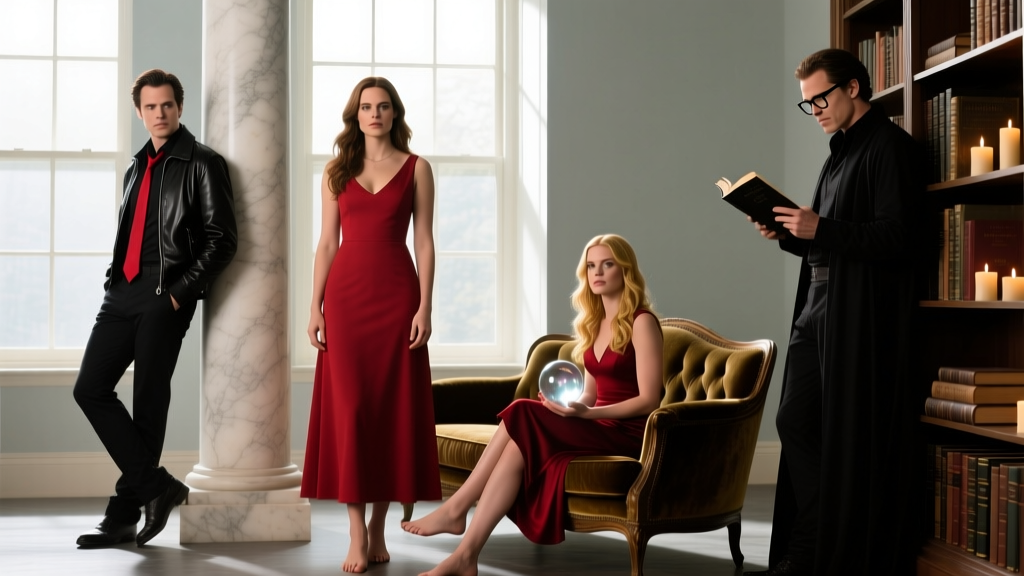
When analyzing the cultural impact of early 2010s supernatural television, the success of casting the vampire diaries stands as a masterclass in archetypal alignment. Beyond superficial chemistry, the selection of Nina Dobrev, Paul Wesley, and Ian Somerhalder tapped directly into Jungian psychology and ancient mythological frameworks. For students of personality typology and esoteric symbolism, Mystic Falls offers a rich landscape for character analysis. This explainer breaks down the psychological and mythological mechanics that made the central trio so compelling.
The Jungian Shadow and the Doppelgänger Myth
At the core of the narrative is the doppelgänger myth, a concept deeply rooted in Germanic folklore and later adapted by psychoanalyst Carl Jung. The doppelgänger represents the 'Shadow'—the unconscious, repressed, and often darker aspects of the personality. Elena Gilbert and Katherine Pierce are not merely physical twins; they are psychological inverses. Elena operates from a place of conscious morality and social cohesion, while Katherine embodies the uninhibited, survival-driven Shadow. According to Carl Jung's theory of the collective unconscious, integrating the Shadow is essential for individuation. The series forces Elena to repeatedly confront Katherine, mirroring the psychological journey of acknowledging one's own capacity for selfishness and manipulation.
Deconstructing the Salvatore Brothers: Apollo vs. Dionysus
Friedrich Nietzsche’s philosophical dichotomy of the Apollonian and Dionysian provides a precise lens for understanding the Salvatore brothers. Stefan represents the Apollonian ideal: order, restraint, logic, and the burden of moral duty. Damon embodies the Dionysian spirit: chaos, intoxication, passion, and the rejection of societal boundaries. Stefan’s reliance on the daylight ring as a symbol of his desire to walk among humans and maintain a facade of normalcy contrasts sharply with Damon’s initial rejection of such constraints. Furthermore, Stefan’s 'Ripper' alter-ego represents the catastrophic collapse of Apollonian order when the repressed Dionysian urges are starved for too long. This psychological pendulum swing provides a more nuanced portrayal of addiction and recovery than standard supernatural fare.
Archetypal and Personality Matrix
| Character | Actor | Mythological Archetype | MBTI Alignment | Core Enneagram |
|---|---|---|---|---|
| Elena Gilbert | Nina Dobrev | The Compassionate Anchor | INFJ | Type 9 (Peacemaker) |
| Stefan Salvatore | Paul Wesley | The Stoic Guardian | ISFJ | Type 1 (Reformer) |
| Damon Salvatore | Ian Somerhalder | The Byronic Rebel | ESTP | Type 8 (Challenger) |
Stefan Salvatore (Paul Wesley): The ISFJ Guardian
Stefan aligns with the ISFJ (Introverted, Sensing, Feeling, Judging) personality type. His dominant cognitive function, Introverted Sensing (Si), manifests in his deep attachment to the past, his meticulous diary-keeping, and his rigid moral code. Si-users rely on historical precedent and internal bodily sensations, which explains Stefan's intense struggle with his 'Ripper' persona—a state where his repressed sensory desires violently override his conscious control. His auxiliary Extroverted Feeling (Fe) drives his need to protect others and maintain harmony, often at the expense of his own well-being.
Damon Salvatore (Ian Somerhalder): The ESTP Rebel
Damon is a textbook ESTP (Extroverted, Sensing, Thinking, Perceiving), heavily influenced by Extroverted Sensing (Se). Se dominance results in a hyper-awareness of the immediate physical environment, leading to impulsivity, physical dominance, and a hedonistic approach to eternity. Damon’s auxiliary Introverted Thinking (Ti) allows him to rationalize his cruel actions with detached, pragmatic logic. He perfectly encapsulates the classic Byronic hero: brooding, deeply flawed, rebellious, yet possessing a hidden moral compass that occasionally surfaces through his tertiary Extroverted Feeling (Fe).
Elena Gilbert (Nina Dobrev): The INFJ Anchor
Elena’s psychological profile aligns with the INFJ (Introverted, Intuitive, Feeling, Judging) type. Her dominant Introverted Intuition (Ni) gives her a profound understanding of the underlying motives of those around her, allowing her to see the 'good' in Damon when others only see a monster. Her auxiliary Extroverted Feeling (Fe) makes her highly empathetic but also prone to absorbing the emotional trauma of Mystic Falls. The burden of the INFJ is the constant tension between their idealistic vision of how people should be and the harsh reality of their actions.
Enneagram Core Motivations and Tritypes
Beyond cognitive functions, the Enneagram system illuminates the core fears driving the trio. Stefan operates as an Enneagram Type 1 (The Reformer) with a heavy 9 wing (1w9). His core fear is being corrupt or evil, which manifests in his obsessive tracking of his blood consumption and his rigid moral boundaries. Damon aligns with the Type 8 (The Challenger), but his tritype (874) reveals a deep-seated fear of being controlled or deprived, masked by a hedonistic pursuit of intensity. Elena’s Enneagram Type 9 (The Peacemaker) core fear is fragmentation and loss of connection. Her journey from a passive 9 to an integrated 3 (The Achiever) maps her transition from a grieving teenager to an active participant in her own supernatural destiny.
Astrological Resonances in the Ensemble
The esoteric alignments extend beyond personality typology into astrological archetypes, mirroring the elemental natures of the characters and the actors who portrayed them.
- Ian Somerhalder (Sagittarius Sun): Sagittarius is a mutable fire sign ruled by Jupiter, associated with restlessness, philosophical seeking, and a tendency toward excess. This perfectly maps onto Damon’s reckless immortality and his constant search for meaning amidst the chaos.
- Paul Wesley (Cancer Sun): Cancer is a cardinal water sign ruled by the Moon, deeply tied to lineage, memory, and the concept of 'home.' Stefan’s entire existence revolves around the Salvatore boarding house (his emotional anchor) and his complex, often toxic loyalty to his family lineage.
- Nina Dobrev (Capricorn Sun): Capricorn is a cardinal earth sign ruled by Saturn, representing duty, structure, and the carrying of heavy burdens. Elena is the pragmatic anchor of the group, constantly forced to mature and take on the karmic debts of the supernatural world around her.
Why Casting The Vampire Diaries Succeeded Through Archetypes
The enduring legacy of casting the vampire diaries lies in its commitment to psychological realism within a supernatural framework. When actors embody the cognitive function stacks and mythological archetypes of their characters, the audience experiences a subconscious recognition. The love triangle is not merely a romantic trope; it is a psychological battleground where the viewer's own Apollonian and Dionysian desires are projected onto the screen. The casting directors successfully identified actors whose natural energetic signatures could sustain these heavy archetypal loads over multiple seasons.
Actionable Framework for Character Analysis
For writers, psychologists, and media analysts, the Mystic Falls ensemble provides a replicable framework for character development and narrative analysis:
- Map the Shadow: Ensure every protagonist has a clearly defined psychological opposite (e.g., Elena vs. Katherine) to externalize internal conflicts and force character growth.
- Align Cognitive Functions: Do not just assign an MBTI label; write scenes that specifically challenge the character's dominant and inferior cognitive functions to create realistic psychological stress.
- Track Integration/Disintegration Lines: Use Enneagram growth and stress paths to dictate character arcs. A stressed Type 1 (Stefan) disintegrates to Type 4 (moody, irrational), while an integrated Type 8 (Damon) moves toward Type 2 (altruistic, protective).
- Utilize Elemental Contrast: Cast and write opposing characters with contrasting astrological or elemental energies (Fire/Water, Earth/Air) to create natural, unforced friction in dialogue and decision-making.
- Anchor the Myth: Ground supernatural elements in established folklore (the doppelgänger, the siren, the original) to tap into the collective unconscious and give the narrative timeless resonance.
Analyzing media through the intersecting lenses of personality psychology, astrology, and mythology reveals why certain narratives achieve immortality. The psychological architecture of Mystic Falls remains a definitive case study in archetypal storytelling and the profound impact of intentional casting.