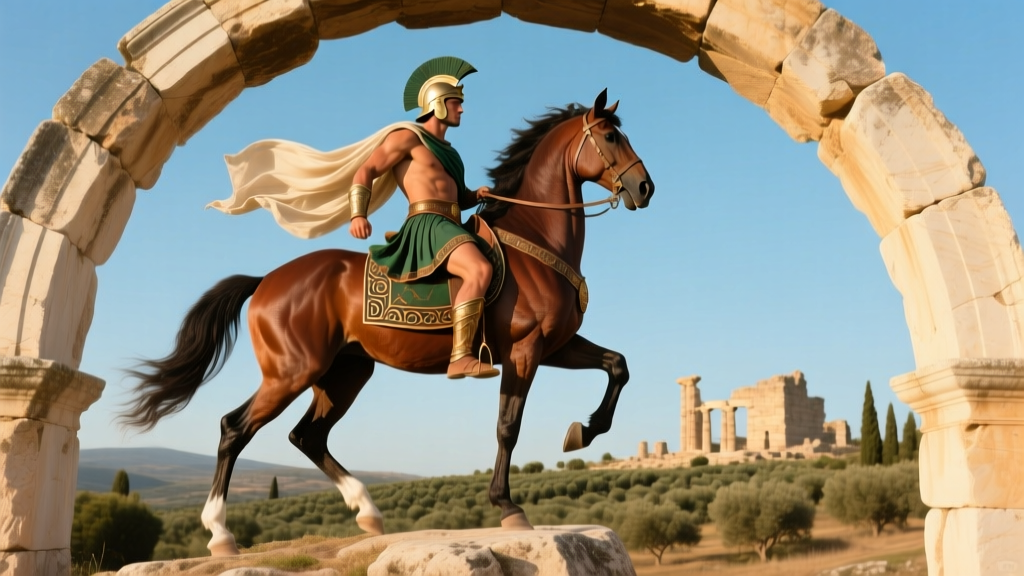
The hybrid creature, half-human and half-horse, stands as one of the most recognizable liminal beings in classical mythology. While modern fantasy often reduces them to tavern-brawlers or noble woodland guardians, the historical origin of the centaur reveals a complex intersection of ancient anthropology, cross-cultural misunderstanding, and evolving artistic typology. Far from mere monsters, these figures served as vital sociological markers for the ancient Greeks, defining the boundaries between civilization and barbarism, humanity and the untamed natural world. Understanding their genesis requires examining both the linguistic roots of the Greek peninsula and the geopolitical realities of the ancient Mediterranean.
The Etymology and Earliest Depictions of the Centaur
The linguistic roots of the word kentauros remain a subject of intense debate among classical philologists. A popular ancient folk etymology, championed by early mythographers, suggests the word derives from ken (to pierce or kill) and tauros (bull), translating to 'bull-killer.' This theory aligns with myths of the centaurs' rustic, hunting lifestyles in the mountainous regions of Thessaly. However, modern linguists often point to Mycenaean Greek Linear B tablets, which feature the term ke-ta-u-ro. This suggests the word may predate the Greek language entirely, potentially stemming from a Pre-Greek substrate language or an Indo-European root associated with a specific Thracian or steppe tribe that early Greeks encountered.
The earliest visual evidence of the centaur appears during the Greek Geometric period (c. 900–700 BCE). Small terracotta and bronze figurines from this era depict the creature not as a seamless hybrid, but as a human male whose lower back is awkwardly fused to the hindquarters of a horse. These early models, cataloged extensively in the British Museum Collection, highlight a culture attempting to conceptualize a creature that defied natural taxonomy, relying on additive anatomy rather than organic integration.
The Nomadic Horseman Theory: Historical Catalyst for the Myth
The most widely accepted anthropological explanation for the centaur myth centers on the early Greek encounters with mounted nomadic warriors. During the late Bronze Age and early Iron Age, Greek tribes expanding into the Thessalian plains likely clashed with steppe nomads, such as the Scythians or Cimmerians, or indigenous Thracian cavalry. To a culture where horseback riding was not yet a standardized military practice, the visual silhouette of a skilled rider moving in perfect synchronization with their mount would appear as a single, terrifying beast.
This phenomenon of cross-cultural misidentification is well-documented in later historical contexts. When the Spanish conquistadors arrived in the Americas in the 16th century, Aztec and Inca accounts initially described the mounted soldiers as singular, multi-limbed deities or monsters. Similarly, the Greek historian Herodotus noted the profound psychological impact of Scythian cavalry on non-riding populations. The mythological 'Centauromachy'—the legendary battle between the Lapiths (representing indigenous, civilized Thessalians) and the centaurs (representing the encroaching, untamed nomadic cavalry)—is widely interpreted by modern historians as an allegorical memory of these violent territorial skirmishes over the fertile grazing lands of Thessaly.
Chiron vs. The Savage Herd: The Duality of Centaur Mythology
Greek mythology rarely deals in absolutes, and the centaur is defined by a stark dichotomy. The vast majority of centaurs, particularly those dwelling on Mount Pholoe, were depicted as slaves to their base animal instincts. They were notoriously prone to drunkenness, violence, and unbridled lust, serving as narrative foils to Greek ideals of sophrosyne (self-control and moderation). The wedding of Pirithous, where intoxicated centaurs attempted to abduct the Lapith women, remains the quintessential myth illustrating the danger of surrendering to primal urges.
Chiron stands as the ultimate exception to this rule. Unlike the feral herd, which was said to be born from the union of Ixion and a cloud shaped like Hera, Chiron was the son of the Titan Cronus and the Oceanid nymph Philyra. Cronus had taken the form of a horse to hide from his wife Rhea, resulting in Chiron's hybrid physiology. Chiron was immortal, deeply wise, and served as the premier tutor to Greek heroes, including Achilles, Heracles, Jason, and Asclepius. His eventual death—sacrificing his immortality to free Prometheus from his eagle-torment after being accidentally poisoned by Heracles' Hydra-blood arrows—cements him as a martyr of civilization and intellect, elevating the centaur archetype beyond mere savagery. Researchers analyzing these dual narratives can find comprehensive primary source translations via the Theoi Project.
Taxonomy of Centaur Types in Classical Art
For art historians and classical archaeologists, tracking the evolution of the centaur requires a rigid typological framework. In 1923, classical scholar Paul V. C. Baur established a definitive classification system that remains the standard for cataloging centaur iconography in antiquity.
| Classification | Anatomical Structure | Predominant Era | Notable Examples |
|---|---|---|---|
| Class A | Human torso attached at the waist to the hindquarters of a horse. The horse retains its full equine neck and head, often pointing backward or downward. | Geometric to Early Archaic (900–600 BCE) | Geometric bronze figurines; early Corinthian pottery. |
| Class B | Human torso emerging directly from the horse's neck/chest, replacing the equine head and neck. This creates a seamless, upright posture. | Classical Period (480–323 BCE) | Parthenon metopes; Temple of Zeus at Olympia pediments. |
| Class C | Human torso featuring equine forelegs instead of human arms, or incorporating wings. Often blended with satyr-like facial features. | Hellenistic and Etruscan (323 BCE onwards) | Hellenistic marble sarcophagi; Etruscan bronze mirrors. |
Astronomical and Astrological Legacy
The cultural footprint of the centaur extends into the cosmos. The constellation Centaurus, cataloged by Ptolemy in the 2nd century CE, is one of the largest in the southern sky and contains Alpha Centauri, the closest star system to Earth. In Greek lore, this constellation is often identified with Chiron, placed in the heavens by Zeus as an honor for his sacrifice.
Conversely, the zodiac sign Sagittarius is frequently conflated with Chiron in modern astrology. However, classical texts and the Perseus Digital Library indicate that the Archer constellation more accurately represents Crotus, a satyr-like figure and son of Pan, or a generic Babylonian archery deity (Nergal/Pabilsag) that the Greeks later Hellenized into a centaur form. Recognizing this distinction is crucial for accurate astrological and astronomical historical analysis.
Identifying Centaur Motifs in Antiquity: A Curator's Framework
When analyzing classical artifacts in museum settings or academic archives, identifying the specific era of a centaur depiction requires observing anatomical proportions, facial expressions, and contextual motifs. Use the following diagnostic framework to date and categorize centaur iconography:
- Geometric Period (900–700 BCE): Look for extreme abstraction. The human and horse halves are often reduced to cylindrical shapes with stick-like limbs. Class A anatomy dominates. The figures are usually beardless and lack distinct emotional expressions.
- Archaic Period (700–480 BCE): Characterized by rigid, frontal poses and the 'Archaic smile.' Centaurs are heavily bearded, often depicted in black-figure pottery engaging in combat with Heracles or Theseus. The transition from Class A to early Class B begins here, though the equine neck often remains awkwardly attached to the human spine.
- Classical Period (480–323 BCE): The zenith of Class B anatomy. The focus shifts to the Centauromachy. The critical diagnostic marker is the contrast in ethos and pathos: Lapith warriors display calm, idealized restraint (ethos), while centaurs exhibit contorted, agonizing facial expressions and chaotic, twisted limbs (pathos). Muscle tension and dynamic foreshortening are paramount.
- Hellenistic Period (323–31 BCE): Artistic boundaries expand to show centaurs in domestic or familial settings. Look for marble groups depicting elderly, bearded centaurs teaching youths, or centaurs interacting with nymphs and Eros. The emotional realism is heightened, and Class C anatomical variations (including wings or satyr-like snub noses) become prevalent.
By applying this typological and historical framework, scholars and enthusiasts can move beyond superficial interpretations of the centaur, recognizing them instead as profound reflections of ancient Greece's evolving understanding of humanity, nature, and the civilizations beyond their borders.