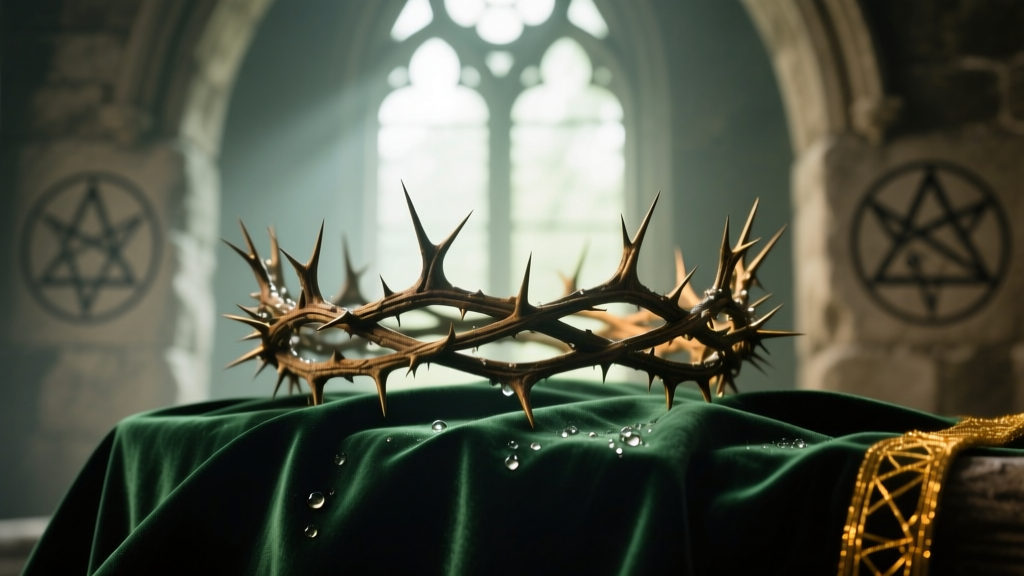
Beyond the biblical narrative of the Passion, the crown of thorns operates as one of the most potent archetypal symbols in esoteric spirituality, mythological psychology, and occult anatomy. It represents the agonizing intersection of divine consciousness and earthly limitation. For spiritual seekers, astrologers, and students of the esoteric arts, understanding this symbol requires moving past literalist interpretations. We must examine it through the lens of alchemical transmutation, karmic astrology, and the energetic mapping of the human body. Historically documented by relics and botanical studies, the physical crown was designed to mock. Yet, in the realm of depth psychology and mystical traditions, the mockery is recontextualized as the ultimate initiation. The piercing of the head is not merely an act of torture; it is a profound metaphysical cipher detailing how the ego must be breached for higher consciousness to descend.
The Archetypal Duality of the Crown of Thorns
The power of this symbol lies in its inherent paradox. A crown is the ultimate Solar symbol, representing sovereignty, the divine right of kings, and the Sahasrara (Crown Chakra) at the apex of the human energetic system. Thorns, conversely, are Saturnian. They represent restriction, karma, earthly defense mechanisms, and the harsh realities of the material plane. When woven together, they illustrate the inescapable burden of incarnating a divine spark into a dense, physical vessel.
This duality is mirrored in the natural world. While historical debates persist over whether the relic was crafted from Ziziphus spina-christi (the jujube tree) or other local flora, the plant most commonly associated with the archetype today is Euphorbia milii. According to the botanical profile of Euphorbia milii, these sharp, defensive spikes evolved as a survival mechanism to deter herbivores in harsh, arid environments. Esoterically, this mirrors the human ego's defense mechanisms. The ego generates psychological "thorns"—cynicism, fear, attachment, and dogma—to protect its fragile sense of self from the harsh, dissolving realities of spiritual awakening.
Esoteric Anatomy and the Piercing of the Veil
In esoteric anatomy, the head is the seat of the mental body and the gateway to the divine. The placement of the thorns specifically targets the cranium, symbolizing the necessary breaking of the ego-mind. In yogic and tantric traditions, the ascent of Kundalini energy culminates at the Sahasrara chakra. Mystics and advanced practitioners frequently report intense physical sensations at the crown of the head during peak states of samadhi or spiritual awakening—described as immense pressure, burning, or a literal "piercing" sensation.
The crown of thorns serves as an allegory for this physiological and energetic phenomenon. The pain of the thorns is the friction of the lower mind resisting the influx of higher, unmediated cosmic light. As documented in The Catholic Encyclopedia, the historical veneration of the relic focused on the physical bloodshed, but occultists view the blood as the vital life force (Prana/Chi) being released from the head center to sanctify the lower chakras, effectively grounding divine consciousness into the physical body.
The Number 33 and the Ascent of Consciousness
The esoteric weight of the crown is deeply intertwined with the number 33. The human spine contains 33 vertebrae, through which the serpent force must ascend to reach the crown. The mythic Christ figure lived 33 years, marking the completion of the physical cycle and the initiation into the spiritual. In numerology, 33 is a Master Number representing spiritual mastery, compassion, and the burden of the avatar. The crown of thorns is the final, agonizing test at the 33rd degree of spiritual initiation, where the initiate must surrender their individual will to the cosmic will.
Alchemical Transmutation: Suffering as the Nigredo
In the Hermetic and alchemical traditions, the events of the Passion are mapped to the stages of the Magnum Opus (The Great Work). The crown of thorns is intrinsically linked to the Nigredo (the blackening) and Calcinatio (the burning away of impurities). It represents the deliberate application of psychological and spiritual pressure to burn away the dross of the false self.
| Passion Symbol | Alchemical Stage | Psychological Meaning | Esoteric Function |
|---|---|---|---|
| Crown of Thorns | Nigredo / Calcinatio | Ego death, confronting the shadow, mental anguish | Breaching the mental body to allow the descent of higher light |
| The Scourging | Separatio | Stripping away false identities and societal conditioning | Purifying the astral/emotional body of accumulated karma |
| The Crucifixion | Coagulatio / Fixatio | The ultimate surrender, grounding the spirit into matter | Anchoring the transmuted consciousness into the physical plane |
| The Blood and Water | Rubedo / Solutio | Integration, compassion, and the flow of universal love | The release of vital life force to heal the collective unconscious |
The alchemist understands that without the agonizing pressure of the thorns, the base metals of the human psyche cannot be forced into the crucible of transformation. Suffering, in this context, is not a punishment from a wrathful deity, but a precise, mechanical necessity for spiritual evolution.
Astrological Correlations: Saturn, the Sun, and the Ram
Astrologically, the head and the skull are ruled by Aries, the Ram. The imagery of horns and thorns is deeply connected to the Arian archetype of the warrior and the pioneer who must push through dense underbrush. However, the act of placing a restrictive, painful crown upon the head is a profound mythological depiction of a harsh Saturn-Sun aspect.
The Sun rules the ego, the divine identity, and the crown chakra. Saturn rules restriction, karma, time, and thorns. When Saturn squares or opposes the Sun in a natal chart, the individual experiences the heavy burden of karmic reality pressing down on their divine spark. This transit forces a spiritual maturation that cannot be achieved through ease. The mythological narrative of the crown of thorns is the ultimate Saturn-Sun synastry: the Lord of Karma (Saturn) humiliating and restricting the Solar Hero (the Sun), forcing the hero to realize that true sovereignty is found not in earthly dominance, but in spiritual surrender and karmic acceptance.
Integrating the Archetype: Shadow Work and Meditation
Understanding the esoteric meaning of the crown of thorns is only the first step. To derive genuine spiritual utility from this archetype, practitioners must integrate it into their active shadow work and meditative routines. Here is a concrete framework for working with this energy:
- Identifying Ego-Thorns (Shadow Work): Audit your psychological defenses. What cynical beliefs, rigid dogmas, or defensive reactions are you using to protect your ego from the vulnerability of spiritual growth? Journaling these "thorns" is the first step in the Calcinatio process.
- Saturnian Meditation (Sitting with Discomfort): Dedicate 15 minutes daily to sitting in absolute silence without seeking dopamine hits or mental distractions. When the mind rebels and creates "thorns" of irritation or boredom, observe the friction without reacting. This builds the spiritual endurance required for higher states of consciousness.
- Crown Chakra Visualization: During meditation, visualize the Sahasrara chakra not as a peaceful lotus, but as a dense thicket of thorns. With each exhale, visualize the thorns retracting as you release a specific earthly attachment. With each inhale, allow pure, unmediated white light to enter the newly opened space at the crown of your head.
By engaging with the crown of thorns as a living, breathing archetype rather than a static historical artifact, spiritual seekers can harness its transformative power. It stands as an eternal reminder that the path to the highest spiritual sovereignty is paved with the willing surrender of the ego's most fiercely guarded illusions.