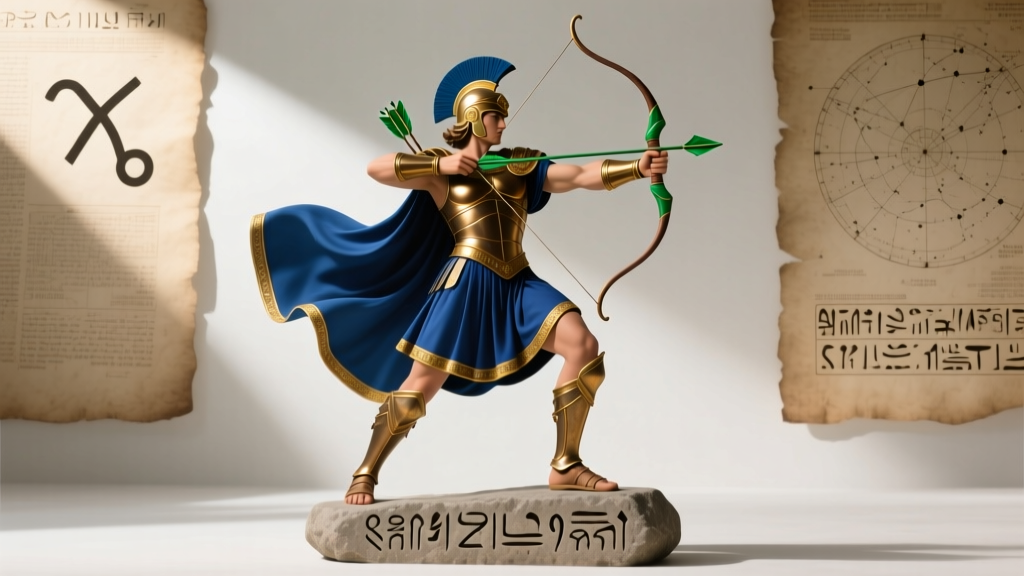
The Ancient Roots of the Zodiac for December 9
Individuals born under the zodiac for December 9 fall squarely within the second decan of Sagittarius. This specific astrological coordinate—approximately 16 to 17 degrees of the mutable fire sign—carries a distinct historical lineage that predates Hellenistic astrology by millennia. To understand the psychological and spiritual blueprint of this birthdate, we must trace its origins from the ziggurats of Mesopotamia to the astronomical schools of Alexandria. Far from modern pop-astrology tropes, the ancient architects of this system mapped the December sky with rigorous mathematical precision and deep mythological resonance.
Pabilsag and the MUL.APIN: The Mesopotamian Archer
The Greeks did not invent the archer constellation; they inherited and adapted it. In the MUL.APIN, a comprehensive Babylonian astronomical compendium compiled around 1000 BCE, the constellation we now call Sagittarius was known as Pabilsag. Pabilsag was a tutelary deity of the ancient city of Isin, later syncretized with Ninurta, the Mesopotamian god of hunting, agriculture, and war. According to Britannica's astronomical records on Sagittarius, the Babylonian depiction differed radically from the familiar Greco-Roman centaur. Pabilsag was illustrated with a human head, the body of a satyr, and the barbed tail of a scorpion.
For those studying the historical archetype of the December 9 birthdate, this Babylonian root explains the sign's intrinsic duality. The human head represents the pursuit of higher philosophy, law, and divine wisdom, while the beast body and scorpion tail symbolize primal, instinctual drives and a connection to the earth's hidden, subterranean mysteries. This tension between the civilized intellect and the wild instinct is a hallmark of the mid-Sagittarius personality.
Astronomical Alignment: The Galactic Center
Ancient astronomers recognized that the constellation of the Archer points directly toward the center of the Milky Way galaxy. Modern astrophysics identifies this region as Sagittarius A*, a supermassive black hole surrounded by dense star clusters and cosmic dust. In ancient Babylonian and later Mayan cosmology, this dark, dense band of the sky was viewed as the "Dark Rift" or the womb of the galaxy—a portal between the physical realm and the underworld. The Sun's transit through this region in early December historically marked a time of spiritual descent, introspection, and the gathering of hidden knowledge before the rebirth of the Winter Solstice.
The Chaldean Decans: Pinpointing the December 9 Archetype
To understand the precise energetic signature of December 9, we must examine the decan system. Originating in ancient Egypt, the sky was divided into 36 ten-degree segments to track the heliacal rising of specific stars for timekeeping and agricultural planning. Hellenistic astrologers later integrated this Egyptian framework with the Chaldean planetary ruler system, assigning a sub-ruler to each ten-degree slice of the zodiac.
December 9 falls into the second decan of Sagittarius (10° to 20°). While the overarching sign is ruled by Jupiter (expansion, philosophy, and travel), the second decan is sub-ruled by Mars (action, aggression, and pioneering courage). This Mars sub-rulership fundamentally alters the expression of the Sagittarian archetype, shifting it from a passive philosopher to an active crusader.
| Decan Segment | Approximate Dates | Planetary Sub-Ruler | Historical Archetype |
|---|---|---|---|
| First (0°–10°) | Nov 22 – Dec 1 | Jupiter | The Philosopher / Lawgiver |
| Second (10°–20°) | Dec 2 – Dec 11 | Mars | The Warrior-Scholar (Includes Dec 9) |
| Third (20°–30°) | Dec 12 – Dec 21 | Sun | The Sovereign Visionary |
The Mars influence grants the December 9 native a highly kinetic, competitive, and physically robust energy. Historically, this decan was associated with the mobilization of armies and the defense of philosophical or religious ideals. It is the placement of the theologian who is willing to debate, the explorer who endures physical hardship for discovery, and the advocate who fights fiercely for justice.
Hellenistic Syncretism: Crotus, Chiron, and the Muses
When Greek astronomers formalized the zodiac, a debate emerged regarding the exact mythological identity of the Archer. Modern astrology often conflates Sagittarius with Chiron, the wise centaur who tutored heroes like Achilles and Heracles. However, classical scholars such as Eratosthenes, as noted in records concerning Eratosthenes and Hellenistic star mapping, explicitly identified the constellation Sagittarius as Crotus, not Chiron. (Chiron was assigned to the separate constellation Centaurus).
Crotus was a satyr—the son of the wild god Pan and Eupheme, the nurse of the Muses. Unlike the purely martial centaurs, Crotus was a creature of the forest who possessed a deep reverence for the arts. He is credited in Greek myth with inventing the bow and arrow, as well as the rhythmic clapping that accompanied musical performances. Because he lived on Mount Helicon with the Muses, Crotus embodied the synthesis of wilderness survival, physical prowess, and high artistic inspiration. Zeus placed him in the stars at the request of the Muses, cementing his legacy as a patron of creative and physical mastery.
Practical Application: Harnessing the Crotus Archetype
Understanding the historical distinction between Chiron and Crotus provides a highly specific framework for individuals born on December 9 to optimize their natural talents. The Crotus archetype demands a synthesis of physical exertion and creative expression.
- Channel the Mars Sub-Rulership: The December 9 native requires rigorous physical outlets to process their Mars-ruled energy. Sedentary intellectual pursuits will lead to frustration. Combine cognitive tasks with physical movement, such as walking debates, outdoor field research, or martial arts.
- Engage the Crotus Arts: Because Crotus invented rhythmic percussion and the bow, this birthdate responds exceptionally well to disciplines requiring hand-eye coordination and rhythm. Archery, playing percussion instruments, woodworking, and kinetic sculpture are historically aligned with this decan's neuro-muscular wiring.
- Navigate the Dark Rift: Acknowledge the psychological pull toward the esoteric and the hidden. The December 9 native possesses a natural aptitude for researching taboo subjects, occult histories, and deep psychology. Dedicate specific hours to unstructured research into fringe sciences or ancient mythologies to satisfy the soul's proximity to the Galactic Center.
Legacy of the Winter Archer
The zodiac for December 9 is not merely a collection of personality traits; it is a historical artifact. It encapsulates the Babylonian reverence for the hunter-god Pabilsag, the Egyptian mathematical division of the stars, and the Greek celebration of Crotus the satyr-artist. Born precisely two weeks before the Winter Solstice, this astrological coordinate represents the final, fierce mobilization of fire energy before the dark of winter. By anchoring their modern lives in these ancient, well-documented origins, December 9 individuals can transcend superficial horoscopes and step into the legacy of the warrior-scholar and the cosmic archer.