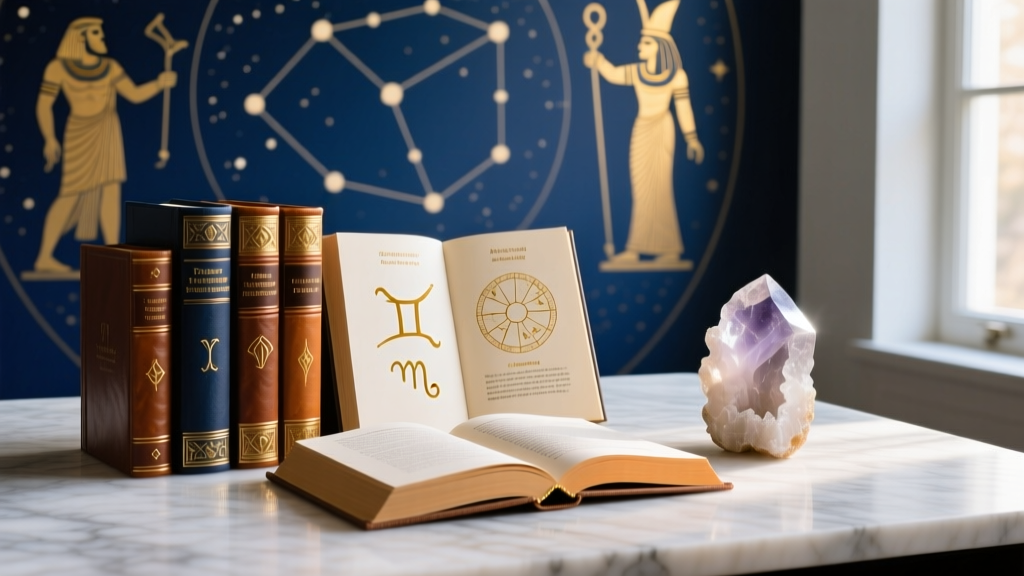
When conducting archetypal research or tracing planetary correspondences, a comprehensive dictionary mythology reference serves as a foundational tool. Rather than reading monolithic epics cover-to-cover, scholars, astrologers, and writers rely on these lexicons to isolate specific deities, motifs, and regional variants. However, not all mythological dictionaries are created equal. Some prioritize rapid fact-checking over nuanced cultural context, while others suffer from heavy Hellenocentric bias. This critical review examines the pros, cons, and structural limitations of using a dictionary mythology format, providing a framework to select the right reference for esoteric, literary, and historical research.
The Utility of a Dictionary Mythology in Archetypal Research
For practitioners of psychological astrology, Jungian analysis, and comparative esotericism, mythological dictionaries function as rapid-deployment archetype databases. When an astrologer identifies a prominent Venus-Pluto synastry aspect, they may seek mythological parallels to ground the psychological dynamics. A well-structured lexicon allows the researcher to bypass the exhaustive Homeric Hymns and immediately access the core motifs of deities like Eris, Persephone, or Inanna.
Furthermore, these references standardize nomenclature. The transliteration of ancient languages is notoriously inconsistent; a single deity might appear as Hephaistos, Hephaestus, or Vulcan depending on the era and origin of the text. A high-quality mythological dictionary establishes a primary lemma (the headword) and cross-references the variants, ensuring that researchers do not miss critical data due to linguistic drift or interpretatio graeca (the ancient Roman habit of equating foreign gods with their own pantheon).
Critical Review: Categorizing Mythological Lexicons
To accurately assess the pros and cons of these resources, we must first segment the market into three distinct categories. The efficacy of a dictionary mythology resource depends entirely on its intended editorial mandate.
1. Academic and University Press Lexicons
Resources like the Oxford Research Encyclopedia of Classical Studies represent the gold standard for historical accuracy. Entries are authored by credentialed classicists and archaeologists. They prioritize primary source citations (e.g., referencing specific lines in Hesiod’s Theogony) and actively debunk Victorian-era mythological misconceptions.
2. Public Domain and Historical Dictionaries
Texts such as John Lemprière’s Bibliotheca Classica (1788) or Thomas Bulfinch’s Age of Fable (1855) are widely available and heavily referenced in older literary criticism. While they offer beautiful, romanticized prose, they are riddled with outdated syncretism and lack modern archaeological context, often blending distinct regional myths into a single, homogenized narrative.
3. Digital and Crowdsourced Databases
Platforms like the Theoi Greek Mythology Project or Encyclopedia Mythica offer unparalleled searchability and hyperlinking. They excel at mapping genealogical trees and providing direct translations of fragmentary texts, though they occasionally lack the rigorous peer-review process of academic print publications.
| Resource Type | Primary Examples | Core Strengths | Critical Limitations | Ideal User Profile |
|---|---|---|---|---|
| Academic Print | Oxford Classical Dictionary | Rigorous peer review, precise etymology, primary source citations | Expensive, dense, slow publication cycles | Historians, Academics, Serious Researchers |
| Historical / Public Domain | Bulfinch’s Mythology, Lemprière | Evocative prose, focus on literary influence, free access | Hellenocentric bias, outdated syncretism, lacks archaeological context | Poets, Classic Literature Students |
| Digital Databases | Theoi Project, Pantheon.org | Instant searchability, genealogical mapping, fragment translations | Variable editorial oversight, fragmented narrative reading experience | Astrologers, Novelists, Worldbuilders |
Pros: Why Researchers Rely on Dictionary Formats
The primary advantage of the dictionary format is motif isolation. In comparative mythology, researchers track specific themes—such as the Axis Mundi (world tree), the Katabasis (descent into the underworld), or the Divine Twin motif. A narrative anthology requires reading hundreds of pages to find these threads. A specialized mythological dictionary indexes these motifs directly, allowing a researcher to compare the Sumerian descent of Inanna with the Japanese myth of Izanagi in Yomi within minutes.
Another significant benefit is genealogical clarity. Ancient pantheons are defined by complex, often contradictory familial relationships. High-quality dictionaries provide standardized family trees at the end of major entries, clarifying the difference between the various figures named 'Zeus' or 'Heracles' across different cult centers (e.g., Zeus Lykaios vs. Zeus Olympios).
Cons: The Reductionism of Lexicon Formats
The most severe limitation of any dictionary mythology resource is narrative fragmentation. Myths were not originally encyclopedic data points; they were performative, ritualistic, and deeply embedded in seasonal cycles. When a dictionary reduces the myth of Tammuz/Dumuzi to a 300-word summary of an "underworld descent," it strips away the vital context of the Mesopotamian Akitu festival and the agricultural grief rituals that gave the myth its psychological weight.
Additionally, many mainstream dictionaries suffer from geographical and temporal bias. Older and mid-tier dictionaries disproportionately allocate page space to Greek, Roman, and Norse pantheons, while reducing complex Afro-Asiatic, Mesoamerican, or Polynesian mythological systems to brief, homogenized entries. This creates a skewed archetypal framework for astrologers and psychologists who rely on these texts to understand universal human motifs.
Navigating Translation and Etymological Drift
A persistent issue in mythological lexicons is the handling of syncretism. When the Ptolemaic dynasty created Serapis (a synthesis of Osiris and Apis, blended with Hellenistic traits), older dictionaries often struggled to categorize the deity, forcing a binary Greek/Egyptian classification. Modern researchers must be wary of dictionaries that enforce rigid boundaries on deities whose worship was inherently fluid and syncretic across the ancient Mediterranean.
Actionable Framework: Selecting the Right Reference
To extract genuine value from a dictionary mythology resource, align your selection with your specific operational needs:
- For Astrologers and Esotericists: Prioritize digital databases like Theoi or specialized esoteric dictionaries (e.g., A Dictionary of Angels by Gustav Davidson). You require rapid access to planetary correspondences, elemental associations, and iconographic symbols rather than deep historical historiography.
- For Novelists and Worldbuilders: Utilize historical public domain texts like Bulfinch for tonal inspiration and narrative flow, but cross-reference names and cultural details with modern academic databases to avoid perpetuating outdated stereotypes.
- For Academics and Depth Psychologists: Invest in university press lexicons. The inclusion of primary source citations (e.g., referencing specific Orphic fragments or Ugaritic tablets) is non-negotiable for serious archetypal analysis and ensures your foundational data is historically verifiable.
Ultimately, a dictionary is a map, not the territory. It provides the coordinates for archetypal exploration, but the researcher must still engage with the primary source texts to understand the true resonance of the myth.