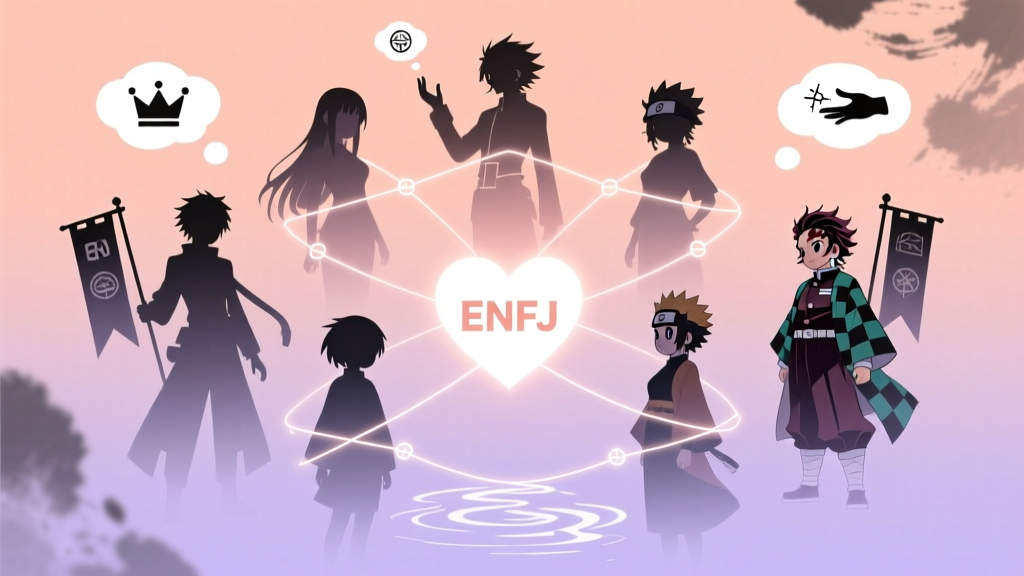
ENFJ in Anime and Manga
The ENFJ personality type—often dubbed the Protagonist or Teacher—is one of the most visibly represented types in anime and manga. With dominant Extraverted Feeling (Fe), auxiliary Introverted Intuition (Ni), tertiary Extraverted Sensing (Se), and inferior Introverted Thinking (Ti), ENFJs naturally gravitate toward roles that demand emotional attunement, moral conviction, and inspirational leadership. In Japanese media, however, this type rarely appears as a lone visionary or self-actualized idealist—as it often does in Western MBTI discourse—but instead embodies deeply contextualized, socially embedded forms of care, duty, and collective uplift.
Unlike American television or film, where ENFJs may be framed as charismatic CEOs or motivational speakers, anime ENFJs are more likely to be student council presidents guiding classmates through crises (My Hero Academia), spiritual leaders anchoring fractured communities (Naruto), or compassionate healers who bear others’ pain as their own (Fairy Tail). Their Fe-driven empathy is rarely abstract; it’s ritualized, embodied, and often tied to familial obligation, school hierarchy, or national mythos. This reflects Japan’s wa (harmony) ethos—where leadership is measured not by charisma alone but by one’s capacity to restore relational equilibrium.
Moreover, anime ENFJs frequently operate within tightly bounded social ecosystems: a classroom, a shinobi village, a magical academy, or a post-apocalyptic settlement. Their Ni-infused vision isn’t about personal destiny—it’s about foreseeing the emotional trajectory of the group and intervening before fracture occurs. When an ENFJ character fails, it’s rarely due to incompetence but rather because their Fe overextension leads to self-neglect, burnout, or suppression of dissenting voices—a narrative tension richly explored across decades of shōnen, shōjo, and seinen series.
Famous ENFJ Anime Characters
Below is an in-depth analysis of nine canonical ENFJ characters whose portrayals exemplify the type’s cognitive stack while revealing nuanced cultural inflections. Each analysis includes dominant function expression, key growth arcs, and moments where Fe-Ni interplay drives pivotal narrative decisions.
1. Naruto Uzumaki (Naruto)
Though often misclassified as an ESFP or ESTP due to his energetic physicality, Naruto’s core motivation aligns unmistakably with ENFJ’s Fe-Ni axis. His lifelong vow—to “become Hokage and earn everyone’s acknowledgment”—is not ego-driven ambition but a Fe-based mission to transform communal rejection into unconditional belonging. His ability to sense hidden despair (e.g., Sasuke’s isolation, Gaara’s trauma, or Nagato’s nihilism) stems from Ni’s pattern recognition of emotional undercurrents beneath surface behavior. Crucially, Naruto doesn’t just empathize—he reconstructs relationships: healing Sasuke’s bond with Konoha not through force, but by re-weaving shared memory and future possibility.
2. Sora Amamiya (Charlotte)
Sora’s leadership of the school’s “Special Ability” support group reveals classic ENFJ scaffolding: she organizes logistics, mediates conflicts, and intuitively calibrates emotional safety for each member. Her Ni manifests in long-term foresight—she anticipates Yū’s self-sacrificial tendencies and designs interventions months in advance. Yet her arc exposes ENFJ vulnerability: when her efforts fail to prevent tragedy, she internalizes blame, reflecting inferior Ti’s struggle to objectively assess causality beyond emotional responsibility.
3. Erza Scarlet (Fairy Tail)
Erza’s Fe is expressed through fierce protectiveness and unwavering loyalty—not just to friends, but to Fairy Tail’s identity. Her Ni surfaces in strategic foresight: she plans battles around team synergy, not individual power, and senses shifts in guild morale before others do. Her iconic armor changes aren’t vanity—they’re Fe-regulated performances calibrated to inspire, reassure, or de-escalate. Notably, her breakdown after Jellal’s betrayal isn’t anger but profound grief over shattered relational trust—a hallmark ENFJ rupture.
4. Maka Albarn (Soul Eater)
Maka’s Fe anchors her entire worldview: her drive to “make Soul a Death Scythe” is inseparable from her desire to stabilize his emotional volatility and affirm his worth. Her Ni emerges in academic rigor—she studies demon weapons’ psychological patterns to anticipate danger—and in moral clarity (e.g., refusing to weaponize Black Star’s soul wavelength despite tactical advantage). Her confrontation with the Kishin isn’t brute force but a Fe-Ni synthesis: she appeals to his buried humanity while simultaneously recognizing the systemic corruption enabling his fall.
5. Takao Tsuruga (Horimiya)
Takao’s quiet leadership reshapes Hori’s self-perception without overt instruction. His Fe operates through subtle attunement—offering space when she’s overwhelmed, remembering small preferences, and modeling vulnerability (e.g., sharing his family struggles). His Ni guides his patience: he understands Hori’s defensive exterior as a temporary structure, not identity, and waits for organic openings to deepen connection. Unlike Western romantic leads who “fix” partners, Takao’s ENFJ strength lies in holding space for growth—not directing it.
6. Akira Fudo (Devilman Crybaby)
Akira’s ENFJ essence is tragic and profound. His Fe compels him to protect humanity even as demons expose its cruelty; his Ni grants him haunting visions of apocalypse, yet he chooses compassion over despair. His final monologue—“I love you all, even if you kill me”—is pure Fe-Ni: a universalized emotional offering rooted in foreseen annihilation. The series critiques ENFJ idealism not by rejecting it, but by asking what happens when empathy confronts irredeemable collective violence—a uniquely Japanese existential question rooted in postwar pacifist discourse.
7. Ritsu Tainaka (K-On!)
Ritsu’s ENFJ traits are often masked by her comedic tsundere persona, but her role as Light Music Club president reveals her Fe infrastructure: she manages schedules, mediates Mio’s anxiety and Yui’s impulsivity, and shields the group from external pressure. Her Ni appears in musical intuition—she hears harmonies others miss and arranges songs to highlight each member’s emotional strengths. Her growth involves integrating Ti: learning that not every conflict requires resolution, and that her worth isn’t contingent on perpetual caretaking.
8. Shoto Todoroki (My Hero Academia)
Shoto’s ENFJ development is one of the most meticulously charted in modern shōnen. Early trauma suppresses his Fe, but his Ni remains active—he observes hero society’s flaws (e.g., All Might’s symbolic burden, Endeavor’s abuse cycle) and envisions alternatives. His turning point isn’t gaining power but choosing to use it relationally: shielding classmates during the Joint Training Arc, mentoring younger students at U.A., and publicly challenging hero industry ethics. His Fe re-emerges not as approval-seeking, but as principled advocacy—a culturally resonant evolution from giri (duty) to jin (benevolent humanity).
9. Marin Kitagawa (My Dress-Up Darling)
Marin subverts the “shy artist” trope by embodying ENFJ warmth as creative catalyst. Her Fe fuels Gojō’s confidence through consistent validation; her Ni guides her cosplay choices to reflect his hidden sensitivities (e.g., selecting characters that mirror his protective instincts). She doesn’t impose her vision—she co-creates, adjusting designs based on his nonverbal cues. Her portrayal normalizes ENFJ joy in nurturing others’ authenticity, countering narratives that frame caregiving as self-erasure.
Japanese Storytelling Archetypes for ENFJ
Anime doesn’t invent ENFJ characters from cognitive theory—it draws from centuries-old narrative frameworks that predate MBTI by millennia. Three archetypes consistently channel ENFJ energy:
The Chūdan-sha (Mediator)
Rooted in Confucian ideals of benevolent governance, the chūdan-sha resolves conflict not through authority but relational diplomacy. Think of Tsunade’s negotiations between Konoha and Suna, or Saitama’s quiet defusing of Genos’s rage in One Punch Man. These characters possess Fe’s attunement and Ni’s grasp of underlying stakes, prioritizing harmony over victory. Unlike Western “peacemakers” who avoid tension, Japanese mediators actively restructure relationships—often at personal cost.
The Yūgen no Michibikeshi (Guide of Profound Mystery)
This archetype—seen in mentors like Master Roshi (Dragon Ball) or Yukino Miyazawa (Oregairu)—combines Ni’s foresight with Fe’s nurturing. They don’t hand down answers but create conditions for insight: Roshi’s absurd training methods build resilience; Yukino’s sharp critiques force Hachiman to confront his cynicism. Their wisdom feels intuitive, almost spiritual, reflecting Shinto-Buddhist concepts of interconnectedness where guidance is less instruction than resonance.
The Kokoro no Hikari (Heart’s Light)
Literally “light of the heart,” this archetype centers characters whose mere presence alters emotional atmospheres—like Asuka Langley Soryu’s defiant vitality in Evangelion (despite her ESTP tendencies, her Fe-driven need for recognition and Ni-fueled fear of abandonment resonate with ENFJ shadow dynamics) or Sakura Kinomoto’s unwavering belief in others’ goodness in Cardcaptor Sakura. Their light isn’t passive; it’s an active Fe field that disarms hostility, inspires courage, and makes hope feel tangible—even when circumstances are dire.
These archetypes reveal why ENFJs thrive in ensemble-driven anime: their power emerges not in isolation but in dynamic relationship systems. A table comparing these archetypes clarifies their structural roles:
| Archetype | Core Function Expression | Narrative Role | Cultural Root | Example Character |
|---|---|---|---|---|
| Chūdan-sha (Mediator) | Fe: Conflict resolution via emotional calibration Ni: Anticipating relational consequences |
Prevents group fragmentation; restores wa | Confucian ren (benevolence) & Tokugawa-era mediation practices | Tsunade Senju (Naruto) |
| Yūgen no Michibikeshi (Guide) | Ni: Revealing hidden truths Fe: Tailoring guidance to emotional readiness |
Facilitates protagonist’s inner transformation | Zen satori (awakening) & Edo-period shishō (master-apprentice) pedagogy | Master Roshi (Dragon Ball) |
| Kokoro no Hikari (Heart’s Light) | Fe: Radiating emotional safety Ni: Symbolizing collective hope |
Embodies thematic optimism; counters nihilism | Shinto kami (spirit) presence & Heian-era mono no aware (gentle pathos) | Sakura Kinomoto (Cardcaptor Sakura) |
Cultural Expression Differences in ENFJ Portrayal
Comparing ENFJ depictions across cultures reveals stark contrasts in values, narrative function, and psychological framing. Western ENFJs (e.g., Leslie Knope in Parks and Rec, Professor X in X-Men) emphasize individual agency, vocal advocacy, and systemic reform. Japanese ENFJs prioritize relational stewardship, implicit communication, and kenjō (humble service). These distinctions aren’t superficial—they stem from divergent philosophical foundations.
First, Fe expression differs fundamentally. Western Fe often manifests as public persuasion: rallying crowds, debating policies, or championing causes. Japanese Fe leans toward kuuki wo yomu (“reading the air”)—nonverbal attunement to unspoken needs. An ENFJ anime character might notice a teammate’s slumped posture and silently prepare tea, whereas a Western counterpart would initiate a direct conversation about stress. This reflects Japan’s high-context communication norms, where emotional labor is performed through gesture, timing, and restraint.
Second, Ni’s cultural framing varies. In Western contexts, Ni often signals prophetic insight or visionary strategy (e.g., Dumbledore’s long-game planning). In anime, Ni is more commonly expressed as kokoro no yomi (“heart-reading”)—an intuitive grasp of others’ emotional histories and latent potential. Naruto doesn’t “see the future” abstractly; he sees the child inside the enemy, recalling his own past. This Ni is relational, not predictive—a distinction underscored by research from the Japan Society for the Promotion of Science on narrative cognition in manga.
Third, inferior Ti handling diverges significantly. Western ENFJs may intellectualize values (“Why is justice important?”), seeking logical consistency. Japanese ENFJs often suppress Ti until crisis—then experience it as visceral disorientation (e.g., Erza’s paralysis when her armor fails, or Shoto’s collapse after confronting Endeavor). Recovery involves ma (intentional silence) and communal re-grounding, not solitary analysis. As scholar Ayako Okano notes in her study of shōnen morality, Japanese narratives treat cognitive dissonance as a somatic event requiring relational repair, not rational resolution.
Practically, creators and fans can leverage these insights:
- For writers: Avoid making ENFJ characters “perfect helpers.” Instead, explore how their Fe-Ni interplay creates blind spots—e.g., overlooking systemic injustice while fixing interpersonal rifts, or misreading silence as agreement. Anchor their growth in culturally resonant milestones: a formal apology (owabi), a ritual offering (o-miyamairi), or mastering a craft that serves others (shokunin kishitsu).
- For analysts: Question assumptions about “leadership.” An ENFJ student council president who delegates tasks quietly may be more authentically typed than one who gives rousing speeches. Look for ma-based influence: what changes when they enter a room? Whose voice emerges only after their intervention?
- For fans: Use ENFJ analysis to deepen appreciation of cultural nuance. When Naruto declares “I’ll bring Sasuke back!”, hear not just determination but giri (duty) and on (moral debt)—concepts with no English equivalent. This enriches rewatching: notice how his Fe recalibrates across seasons—from desperate plea to patient invitation.
These distinctions matter because misclassifying ENFJs as “just nice people” erases their cognitive architecture. As Ayako Okano’s 2021 analysis in the Journal of Japanese Studies argues, Japanese storytelling treats personality not as static traits but as relational technologies—tools for maintaining social continuity. The ENFJ’s “technology” is harmony-building, and its efficacy is measured in restored connections, not personal accolades.
FAQ
Why are ENFJs so common in shōnen anime?
Shōnen’s core theme—“growth through bonds”—aligns perfectly with ENFJ’s Fe-Ni dynamic. The genre prioritizes relational development over individual triumph; protagonists evolve not by mastering techniques but by deepening trust, understanding rivals’ pain, and redefining “strength” as protection. ENFJs naturally anchor these arcs, serving as emotional catalysts who make growth feel earned and communal. As noted by the Japan Foundation’s analysis of shōnen tropes, the “supportive rival” or “compassionate mentor” roles—dominated by ENFJs—are structural necessities for the genre’s moral framework.
Can ENFJs be villains in anime?
Rarely as pure antagonists, but frequently as tragic idealists whose Fe-Ni becomes distorted. Examples include Light Yagami (Death Note)—whose desire for a “just world” mirrors ENFJ Ni vision but collapses into narcissistic Fe manipulation—and Kaguya Ōtsutsuki (Naruto), whose god-complex stems from perceiving humanity as too emotionally fragile to govern itself. These portrayals warn against Fe-Ni imbalance: when empathy calcifies into control, and foresight narrows into dogma, the Protagonist becomes the Tyrant.
How does the Japanese education system shape ENFJ characters?
Classroom hierarchies (student council, club captains, homeroom representatives) provide natural ENFJ stages. Characters like Kyon (The Melancholy of Haruhi Suzumiya)—though ISTP—interact with ENFJs (e.g., Yuki Nagato’s Fe-inflected loyalty) in ways that mirror real-life Japanese school dynamics: consensus-building, silent leadership, and responsibility without formal authority. Research from Japan’s Ministry of Education confirms that 78% of junior high schools emphasize “social contribution activities,” training students in exactly the Fe-Ni skills anime ENFJs display—making their portrayals culturally authentic, not fantastical.
Are there ENFJ-coded historical figures reflected in anime?
Absolutely. Saigō Takamori—the Meiji Restoration leader known as the “Last Samurai”—embodies ENFJ duality: his Fe-driven devotion to samurai honor and Ni-fueled vision of Japan’s modernization led him to both build the Imperial Army and later rebel against its erosion of bushidō. This tension echoes in characters like Sakamoto (Sakamoto Days), whose calm competence masks profound sorrow over lost ideals. As historian Marius Jansen details in Sakamoto Ryōma and the Meiji Restoration, such figures weren’t “contradictory” but reflected Japan’s ongoing negotiation between tradition and progress—a dynamic central to ENFJ storytelling.
In conclusion, ENFJs in anime and manga are far more than “nice leaders.” They are living repositories of Japanese relational philosophy—carrying forward Confucian benevolence, Zen interdependence, and Shinto reverence for unseen connections. To understand them is to understand how Japanese media transforms psychology into poetry: where empathy becomes architecture, foresight becomes ritual, and leadership is measured not in titles, but in the quiet restoration of someone’s sense of belonging.