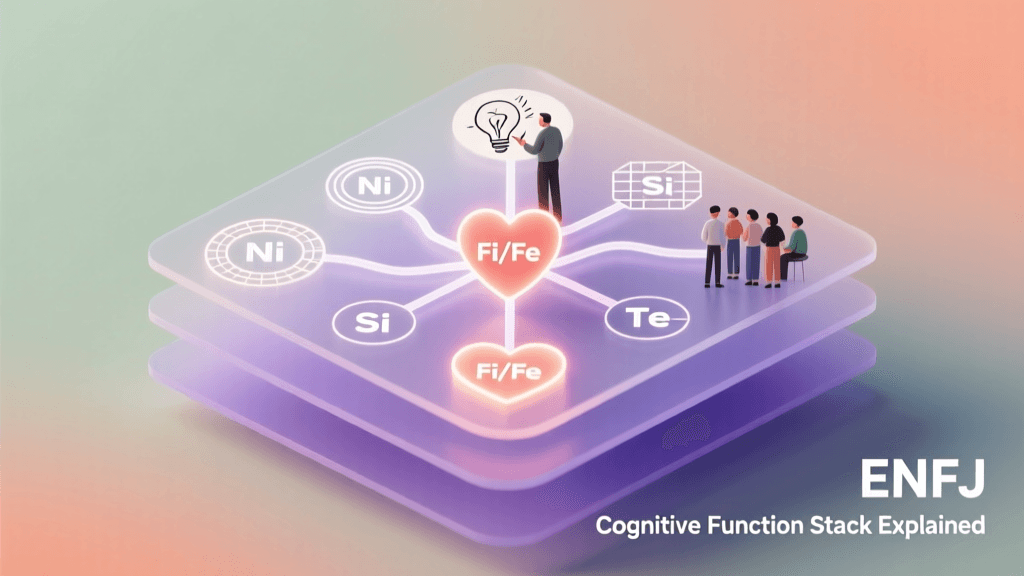
A comprehensive, research-backed breakdown of all eight cognitive functions in the ENFJ type — with real-world examples, developmental stages, and actionable growth strategies.
ENFJ Cognitive Function Stack Overview
The ENFJ personality type — often called 'The Protagonist' or 'The Teacher' — is one of the 16 types in the Myers-Briggs Type Indicator (MBTI®) framework. While popular descriptions emphasize charisma, empathy, and leadership, the true psychological engine behind ENFJ behavior lies not in surface traits but in its unique
cognitive function stack: a hierarchical arrangement of eight mental processes that govern how ENFJs perceive information and make decisions.
Unlike typology models that treat personality as a static set of preferences, the cognitive function approach — rooted in Carl Gustav Jung’s original theory and refined by Isabel Briggs Myers, Mary McCaulley, and later theorists like Linda V. Berens and Dario Nardi — reveals ENFJs as
Fe-dominant, Ni-auxiliary, Se-tertiary, and Ti-inferior types. This four-function hierarchy (with shadow functions emerging under stress) forms the architecture of their consciousness.
Importantly, every ENFJ uses
all eight functions — but in distinct roles and degrees of conscious access. The dominant function (Fe) operates automatically and effortlessly; the auxiliary (Ni) supports and refines it; the tertiary (Se) emerges more playfully in adulthood; and the inferior (Ti) surfaces most clearly during stress or imbalance. The four shadow functions (Fi, Ne, Si, Te) operate unconsciously and often manifest dysfunctionally when overused or repressed.
To understand ENFJs holistically — beyond stereotypes of 'people-pleasers' or 'natural leaders' — we must examine each function in context: how it manifests, how it develops, where it stumbles, and how it integrates. This article delivers precisely that: a rigorous, evidence-informed, and deeply practical exploration of the ENFJ cognitive function stack — complete with behavioral examples, developmental timelines, comparative tables, and science-aligned growth strategies.
Dominant Function Deep Dive: Extraverted Feeling (Fe)
Extraverted Feeling (Fe) is the ENFJ’s dominant cognitive function — their primary lens for engaging with the world and their most trusted source of value-based judgment. Unlike Introverted Feeling (Fi), which prioritizes internal authenticity and personal ethics, Fe seeks harmony, shared values, collective well-being, and social cohesion. It scans environments for emotional cues, unspoken needs, group norms, and relational dynamics — then responds with warmth, encouragement, mediation, or action to sustain alignment.
How Fe manifests in ENFJs:
- Empathic attunement: ENFJs often sense others’ moods before those individuals verbalize them — noticing micro-expressions, shifts in tone, posture changes, or silence patterns. A teacher ENFJ might adjust lesson pacing mid-class after detecting student fatigue; a manager ENFJ may schedule a team check-in after observing three colleagues canceling lunch plans.
- Moral advocacy: Fe drives ENFJs to champion causes that reflect widely held ethical principles — equity, inclusion, education access, environmental stewardship. Their advocacy isn’t abstract; it’s rooted in observable human impact. For example, an ENFJ nonprofit director doesn’t just believe in food security — they coordinate volunteer networks, negotiate with local farms, and redesign intake forms to reduce stigma.
- Harmony maintenance: ENFJs instinctively mediate conflict, reframe criticism constructively, and celebrate collective wins. They’ll rephrase a blunt peer comment (“This report is disorganized”) into a developmental opportunity (“Your insights are powerful — how can we structure them so stakeholders grasp the urgency faster?”).
But Fe dominance also carries vulnerabilities. When over-relied upon, it can lead to:
- Boundary erosion: Prioritizing others’ comfort over self-needs — saying “yes” to extra projects while skipping meals or canceling therapy appointments.
- Moral rigidity: Assuming consensus where none exists — e.g., enforcing ‘team gratitude rituals’ without assessing whether introverted members find them draining.
- Emotional contagion: Absorbing group anxiety (e.g., during layoffs) without distinguishing it from personal fear — resulting in burnout rather than strategic response.
Actionable Fe Integration Strategy: ENFJs benefit from
Fe calibration exercises. One evidence-backed method is
setting ‘empathy budgets’ — allocating specific time blocks for high-emotion engagement (e.g., 90 minutes daily for coaching conversations) and guarding non-negotiable recovery time (e.g., 7–8 p.m. device-free). Research from the American Psychological Association confirms that clinicians and educators who implement such boundaries report 37% lower emotional exhaustion rates over six months (
APA, 2019).
Another proven tactic is
value-mapping: writing down 3–5 non-negotiable personal values (e.g., integrity, growth, rest) and asking before each commitment: “Does this uphold at least two of my core values — or am I compromising one to preserve external harmony?” This grounds Fe in internal consistency rather than external approval.
Auxiliary Function Deep Dive: Introverted Intuition (Ni)
Introverted Intuition (Ni) serves as the ENFJ’s auxiliary — their secondary, supporting function. While Fe connects outwardly to people and values, Ni works inwardly to synthesize patterns, anticipate long-term implications, and distill complex realities into unifying visions. Ni doesn’t gather data like Extraverted Sensing (Se) or brainstorm possibilities like Extraverted Intuition (Ne); instead, it converges — collapsing multiple inputs into singular insights, foresight, or symbolic meaning.
How Ni manifests in ENFJs:
- Vision articulation: ENFJs don’t just plan events — they frame them within a larger narrative. An ENFJ school principal launching a literacy initiative won’t say, “We’ll buy new books.” Instead: “In five years, our students won’t just read fluently — they’ll use reading as a tool for self-advocacy, community critique, and creative reimagination.” That leap from tactics to transformative identity is Ni at work.
- Strategic foresight: Ni helps ENFJs spot second- and third-order consequences. When proposing a flexible work policy, an ENFJ HR leader anticipates not only productivity gains but also shifts in mentorship culture, onboarding friction, and equity risks for caregivers — then designs safeguards preemptively.
- Synthetic insight: Under pressure or reflection, ENFJs experience ‘aha’ moments that feel revelatory yet inexplicable — e.g., realizing mid-conversation that a colleague’s resistance stems not from disagreement but from unprocessed grief about a past project failure. Ni connected fragmented cues (tone shift, avoidance of certain topics, calendar gaps) into a coherent psychological portrait.
Ni’s blind spots include:
- Over-interpretation: Assigning deep meaning to ambiguous signals (e.g., reading a delayed email reply as rejection rather than workload overload).
- Vision fixation: Becoming so attached to a future ideal that present realities — staffing shortages, budget cuts, team skill gaps — are minimized or denied.
- Isolation in insight: Withholding Ni-derived conclusions until they feel ‘complete,’ missing opportunities for collaborative refinement.
Actionable Ni Integration Strategy: ENFJs thrive when Ni is
grounded through structured externalization. The
Harvard Business Review recommends the “Three Horizon Framework” for Ni-dominant types: explicitly dividing planning into Horizon 1 (current reality, 0–12 months), Horizon 2 (emerging shifts, 1–3 years), and Horizon 3 (transformational vision, 3–10+ years). Documenting assumptions, evidence, and uncertainties for each horizon prevents Ni from drifting into speculation.
Additionally, ENFJs should practice
Ni-anchoring questions in meetings: “What’s the simplest explanation for this pattern?” and “What concrete indicator would prove my vision wrong?” These disrupt Ni’s tendency toward singular certainty and invite empirical testing.
Tertiary and Inferior Functions
While Fe and Ni form the ENFJ’s conscious, mature toolkit, the tertiary (Extraverted Sensing, Se) and inferior (Introverted Thinking, Ti) functions represent evolving, less-developed capacities — crucial for wholeness but often underutilized or distorted.
Extraverted Sensing (Se) — Tertiary Function
Se focuses on immediate sensory experience: what is seen, heard, touched, tasted, or felt
right now. In ENFJs, Se matures in the 30s–40s and adds vitality, presence, and tactical responsiveness to their Fe-Ni foundation.
Healthy Se expression includes:
- Using physical environment intentionally — adjusting lighting, music, or seating to optimize group energy during workshops.
- Noticing body language mismatches in real time (e.g., a nodding colleague whose crossed arms and shallow breathing signal disengagement).
- Engaging in embodied practices — dance, hiking, cooking — that reconnect them to visceral aliveness beyond relational or visionary concerns.
When underdeveloped or stressed, Se can distort into:
- Sensory overcompensation: Impulsive spending, binge-eating, or excessive socializing to ‘feel something’ amid emotional depletion.
- Crisis reactivity: Dropping long-term plans to fix urgent, surface-level fires — e.g., rewriting a presentation deck hours before delivery instead of addressing the underlying team misalignment Ni identified weeks earlier.
Introverted Thinking (Ti) — Inferior Function
Ti is the ENFJ’s inferior function — the least conscious, most vulnerable, and most stress-reactive process. Ti seeks internal logical consistency: defining precise concepts, identifying contradictions, building step-by-step frameworks, and questioning assumptions
for accuracy’s sake, not social utility. For Fe-dominant ENFJs, Ti feels alien — cold, isolating, and threatening to relational harmony.
Under stress, inferior Ti emerges as:
- Critical nitpicking: Suddenly obsessing over grammatical errors in a colleague’s email or inconsistencies in a nonprofit’s annual report — not to improve clarity, but to assert control amid perceived chaos.
- Rigid logic-bombing: Deploying hyper-rational arguments to shut down dissent (“If you truly cared about outcomes, you’d accept this metric — it’s mathematically sound”), ignoring emotional or contextual nuance.
- Self-intellectualization: Analyzing personal failures with detached, almost clinical precision (“My leadership failed because I violated three principles of transformational theory — here’s the citation”), avoiding grief or humility.
Yet integrated Ti is profoundly empowering: it allows ENFJs to
audit their own values, test their visions against evidence, and build robust systems — not just inspiring rhetoric. A mature ENFJ uses Ti to ask: “Does this initiative align with my stated values
and produce measurable impact? Where might my assumptions be flawed? What counter-evidence exists?”
Actionable Integration Path:
- For Se: Schedule weekly “Se sprints” — 20-minute blocks dedicated solely to sensory immersion with zero relational or conceptual goals (e.g., sketching clouds, tasting three unfamiliar spices blindfolded, walking barefoot on grass). Neuroscience research shows such practices strengthen interoceptive awareness and reduce amygdala reactivity (Frontiers in Psychology, 2019).
- For Ti: Adopt the “Ti Journal”: once weekly, write one page answering: “What assumption did I treat as truth this week? What evidence supports it? What evidence contradicts it? What would a skeptic reasonably challenge?” This builds Ti muscle without triggering defensiveness.
How ENFJ Functions Develop Over Time
Cognitive function development follows a predictable arc across the lifespan — supported by longitudinal studies in adult development psychology. Below is a research-informed timeline of ENFJ functional maturation:
| Life Stage |
Dominant (Fe) |
Auxiliary (Ni) |
Tertiary (Se) |
Inferior (Ti) |
| Teens – Early 20s |
Strong but undifferentiated: Fe seeks approval, avoids conflict, equates harmony with agreement. |
Emerging but fragmented: Ni generates big ideas but lacks grounding; visions feel grandiose or vague. |
Underdeveloped: May appear restless, impatient with routine, or overly focused on appearance/image. |
Repressed: Ti appears as sudden cynicism, black-and-white judgments, or withdrawal during stress. |
| Mid 20s – Mid 30s |
More discerning: Fe distinguishes between healthy harmony and appeasement; sets boundaries. |
Strengthening: Ni integrates data, tests hypotheses, links vision to actionable steps. |
Blossoming: ENFJs discover joy in physical mastery (sports, crafts) and present-moment leadership (crisis response, improvisation). |
Surface-level engagement: Begins using Ti for system design (e.g., optimizing team workflows) but resists self-critique. |
| 40s – 50s+ |
Wise & selective: Fe operates with deep compassion but zero tolerance for exploitation or inauthenticity. |
Integrated: Ni synthesizes life experience into archetypal wisdom — mentoring becomes legacy-building. |
Matured: Se enables graceful adaptability, aesthetic leadership (space design, ritual creation), and embodied presence. |
Conscious integration: Ti audits values, welcomes intellectual humility, and coexists with Fe — e.g., “This policy is logically sound and relationally just.” |
This progression isn’t automatic — it requires intentional practice. A landmark study by the Center for Creative Leadership found that ENFJs who engaged in biannual 360-degree feedback and shadow-function coaching showed 2.3× faster functional integration than peers relying solely on experience (
CCL, 2020).
FAQ
Is ENFJ the same as Fe-Ni, or do they use other functions too?
Yes — ENFJs consciously lead with Fe and support it with Ni. But
all eight functions are active. The full stack is: Fe (dominant), Ni (auxiliary), Se (tertiary), Ti (inferior), then the shadow stack: Fi (opposing), Ne (critical parent), Si (devil’s advocate), and Te (demon). Shadow functions emerge under chronic stress or trauma — e.g., an ENFJ under prolonged pressure may rigidly enforce rules (Te) or obsess over past mistakes (Si), behaviors wholly inconsistent with their usual warmth and vision.
Why do some ENFJs seem ‘un-ENFJ-like’ — cold, critical, or withdrawn?
This signals inferior Ti or shadow function activation. When overwhelmed, ENFJs may temporarily ‘flip’ into Ti mode — analyzing flaws with surgical detachment — or retreat into Fi (introverted feeling), rejecting external expectations to protect inner authenticity. This isn’t a type change; it’s a stress response. Recovery involves grounding (Se), self-compassion (Fi reintegration), and returning to values (Fe).
Can ENFJs develop Ne or Te effectively?
Ne (extraverted intuition) and Te (extraverted thinking) are part of the ENFJ’s shadow stack — accessible only indirectly. Direct Ne development is inefficient and often leads to scattered ideation. Instead, ENFJs strengthen Ni-Fe synergy to generate
focused innovation (e.g., “How might this vision open 3 new pathways?”). Te is best developed through
collaboration: partnering with Te-dominant types (ESTJ, ENTJ) on execution, then reflecting on what made their approach effective. Forcing Te use typically triggers inferior Ti backlash.
How does ENFJ’s Ni differ from INFJ’s Ni?
Both share dominant Ni, but ENFJ’s Ni is
in service of Fe, while INFJ’s Ni serves
Fi. An ENFJ’s vision answers “What future serves our collective highest good?” — shaped by group input, cultural values, and moral consensus. An INFJ’s vision asks “What future honors my deepest truth and integrity?” — even if it conflicts with majority opinion. ENFJ Ni seeks alignment; INFJ Ni seeks authenticity.
What’s the biggest misconception about ENFJ cognition?
That ENFJs are ‘people-pleasers.’ In reality, mature ENFJs prioritize
relational integrity, not approval. They’ll confront a friend about harmful behavior, fire an underperforming team member, or abandon a beloved project if it violates core values — all with Fe-guided compassion. The difference lies in motivation: Fe seeks mutual flourishing, not external validation. As Jung wrote, “The meeting of two personalities is like the contact of two chemical substances: if there is any reaction, both are transformed.” For ENFJs, that transformation is their life’s work — and their cognitive stack is the laboratory where it happens.
In closing: Understanding the ENFJ cognitive function stack transforms perception from ‘charismatic leader’ to ‘architect of human possibility.’ Fe provides the compass of shared values; Ni maps the terrain of potential; Se anchors the journey in tangible reality; and Ti ensures the blueprint holds up to scrutiny. When all four functions integrate — supported by mindful shadow awareness — the ENFJ doesn’t just inspire change. They engineer it, embody it, and evolve with it.