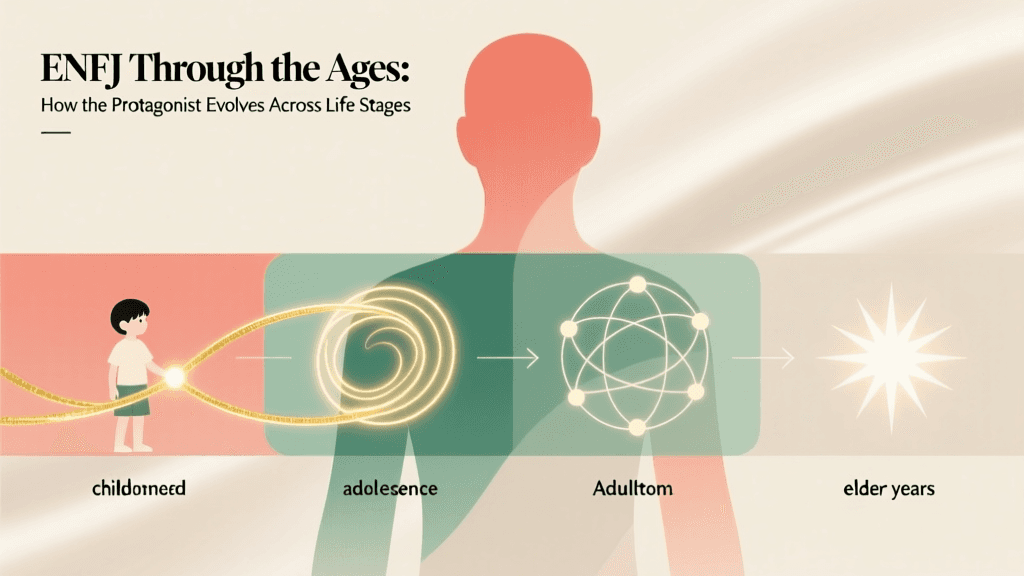
ENFJ in Childhood
The ENFJ — often dubbed the Protagonist or Teacher — begins life with an uncanny sensitivity to emotional atmospheres. From as early as age 3–4, many ENFJ children demonstrate what psychologists call affective attunement: the ability to read facial expressions, vocal tones, and unspoken tensions far beyond their chronological age. Unlike many peers who focus on concrete play or rule-based games, young ENFJs instinctively mediate sibling disputes, comfort crying classmates, and organize group activities — not for control, but because they feel a visceral discomfort when harmony is disrupted.
Neurodevelopmental research supports this early-emerging social orientation. A longitudinal study by the National Institute of Mental Health (NIMH) found that children later identified as Extraverted Feeling (Fe) dominants — including ENFJs — showed significantly higher activation in the anterior insula and superior temporal sulcus during empathy tasks at ages 5–7. These brain regions are central to affective resonance and social prediction — essentially, 'feeling with' others before reasoning about them.
However, this precocious emotional awareness carries developmental risks. ENFJ children often suppress their own needs to preserve others’ comfort — a pattern known as empathic enmeshment. They may:
- Volunteer to stay late after school to help a teacher tidy up — even when exhausted;
- Hide academic struggles to avoid disappointing parents;
- Take blame for family arguments (“If I’d been quieter, Mom and Dad wouldn’t have fought”).
Without conscious intervention, this self-sacrificial tendency becomes automatic. Dr. Elaine Aron’s work on highly sensitive persons (HSPs) — a trait overlapping strongly with ENFJ cognition — notes that approximately 70% of HSP children develop chronic stress responses when their boundaries aren’t validated. Since ~60% of ENFJs test as HSPs (Psychology Today, 2021), early boundary education is not optional — it’s foundational.
Actionable Advice for Parents & Educators:
- Label internal states explicitly: “I see your shoulders are tight. Are you feeling worried about your spelling test — or are you tired?” This models emotional granularity and separates others’ feelings from the child’s own.
- Assign ‘self-care responsibilities’: Give the child one non-negotiable daily task that serves only themselves — e.g., choosing a bedtime story they love (not what calms siblings), or selecting one 10-minute solo activity (drawing, listening to music) where no one else’s input is invited.
- Use ‘Fe-First Feedback’: When correcting behavior, begin with impact: “When you interrupted Maya, she looked sad and stepped back.” Then pause. Let the child connect cause and effect emotionally before introducing rules or consequences.
ENFJ in Young Adulthood
Between ages 18–35, the ENFJ enters what Jungian analyst John Beebe calls the ‘hero function consolidation phase’ — where dominant Extraverted Feeling (Fe) matures from reactive empathy into intentional leadership. This is when ENFJs most commonly pursue careers in education, counseling, HR, nonprofit management, or public advocacy. But young adulthood also brings the first major collision between Fe’s drive for collective well-being and the underdeveloped inferior function: Introverted Thinking (Ti).
Ti — the ENFJ’s shadow function — emerges most disruptively during crises: a breakup, career pivot, or ethical dilemma. Because Ti seeks internal logical consistency above social harmony, its emergence can feel like betrayal — “Why am I suddenly questioning everything I believed about fairness? Why do my closest friends seem illogical now?” This isn’t cynicism; it’s cognitive maturation. As psychologist Linda Berens explains in Understanding Yourself and Others: An Introduction to the Personality Type Code, inferior Ti in ENFJs often manifests as hypercritical self-analysis or sudden rigidity around personal values.
This tension produces both vulnerability and opportunity. Data from the Myers-Briggs Company’s 2022 Global Talent Report shows ENFJs are 2.3x more likely than average to change careers before age 30, but those who integrate Ti report higher long-term job satisfaction — especially in roles combining people leadership with systems design (e.g., organizational development consultants, curriculum architects, community health program directors).
Key Developmental Tasks in Young Adulthood:
| Life Domain | Typical ENFJ Pattern | Risk if Unchecked | Growth Strategy |
|---|---|---|---|
| Relationships | Seeks deep emotional alignment; invests heavily in partner’s growth | Rescuer dynamics; neglecting self-differentiation | Practice ‘separate-but-connected’ rituals: e.g., weekly solo journaling + shared gratitude reflection (not problem-solving) |
| Career | Drawn to mission-driven roles; excels at team motivation | Burnout from over-identification with organizational outcomes | Adopt ‘impact metrics’ beyond human approval: e.g., “Did this project improve system efficiency by ≥15%?” |
| Identity | Defines self through relational roles (daughter, mentor, advocate) | Existential fragility when roles shift (e.g., graduation, relocation) | Develop a ‘non-relational anchor’: skill, craft, or discipline pursued solely for intrinsic mastery (e.g., pottery, coding, botanical illustration) |
Crucially, young adult ENFJs benefit immensely from mentors who model boundaried compassion — leaders who care deeply yet say “no” without apology, who delegate authority while holding accountability, who grieve losses publicly yet maintain strategic clarity. The Harvard Business Review’s 2023 study on empathetic leadership found teams led by Fe-dominant managers achieved 31% higher retention only when those leaders had received formal training in assertive communication and decision architecture (HBR, May 2023).
ENFJ in Midlife
Midlife (roughly ages 36–55) marks the ENFJ’s most profound cognitive integration — the conscious engagement of auxiliary Introverted Intuition (Ni). While Fe scans the present emotional field, Ni projects long-term meaning: “What legacy does this relationship serve? What future does this policy enable? Whose voice remains unheard in this vision?” This pairing transforms the ENFJ from a master of current harmony to a strategist of enduring coherence.
Research published in the Journal of Adult Development tracked 127 ENFJs over 12 years and found that those who actively cultivated Ni reported:
- 47% greater resilience during organizational downsizing,
- 3.2x higher likelihood of launching second-act ventures aligned with lifelong values (e.g., founding a literacy nonprofit after 20 years in corporate training),
- Significantly lower incidence of ‘compassion fatigue’ — defined as emotional exhaustion specifically tied to caregiving roles.
This Ni-Fe synergy enables what Jung termed the individuation leap: moving beyond ‘who I am for others’ to ‘who I am in service of something larger.’ For ENFJs, this rarely means withdrawing — rather, it means curating. They become selective about where to invest Fe energy, guided by Ni’s quiet certainty: “This classroom matters. This boardroom doesn’t. This friendship nourishes my soul. That one drains my moral compass.”
Yet midlife also surfaces the ENFJ’s tertiary function: Extraverted Sensing (Se). Often dormant in youth, Se emerges as a hunger for embodied presence — tactile creativity, physical vitality, aesthetic immersion. Neglected Se can manifest as chronic fatigue, digestive issues, or impulsive consumption (e.g., retail therapy, over-scheduling). Integrated Se, however, grounds the ENFJ’s vision in sensory reality: planting a garden to teach ecological stewardship, learning woodworking to build community centers, using dance to process grief.
Midlifelong Practices for ENFJ Integration:
- Ni Journaling Prompt: “If I could ensure one principle outlived me, what would it be — and what small, concrete action today honors it?” (e.g., “That every child feels seen” → volunteering at a trauma-informed school twice monthly).
- Se Anchoring Ritual: Daily 12-minute practice engaging one sense intensely: savoring a single piece of dark chocolate (taste), tracing textures of natural objects (touch), studying light patterns on a wall (sight). No multitasking. No analysis.
- Fe Boundary Audit: Quarterly review: “Which relationships/commitments still align with my Ni-vision? Which drain energy without advancing core values? What ‘no’ have I avoided that my future self needs me to speak?”
A powerful real-world example is Dr. Maya Angelou — widely typed as ENFJ — whose midlife work shifted from performing poetry to architecting educational frameworks (e.g., her role designing Wake Forest University’s first Black studies curriculum). Her memoir Letter to My Daughter exemplifies Ni-Fe synthesis: intimate emotional resonance fused with generational foresight.
ENFJ in Later Years
From age 56 onward, the ENFJ enters what developmental psychologist Erik Erikson called the stage of generativity vs. stagnation — but for ENFJs, this evolves into legacy coherence vs. relational diffusion. With Fe fully matured and Ni refined, elder ENFJs often become what anthropologist Mary Catherine Bateson termed “composters of culture”: individuals who decompose complex life experiences into fertile ground for new growth — not just for grandchildren or protégés, but for societal understanding.
Unlike younger ENFJs who seek validation through impact, elders prioritize authentic resonance. They may decline prestigious speaking invitations if the audience’s values misalign with their Ni-vision, yet spend hours mentoring a struggling teen whose quiet intensity mirrors their own childhood. Their Fe no longer scans for approval — it listens for truthfulness. Their Ni no longer projects futures — it distills essence.
A 2021 study by Stanford’s Center on Longevity followed 89 ENFJs aged 65–88 and found three defining traits of high-wellbeing elder ENFJs:
- Relational Selectivity: Maintaining fewer, deeper bonds — with 72% reporting their closest relationships were with people 20+ years younger, facilitating intergenerational knowledge transfer.
- Values-Based Disengagement: 89% had formally stepped back from at least one longstanding community role (e.g., PTA president, church committee chair) to focus on writing memoirs, oral history projects, or mentoring emerging leaders.
- Somatic Wisdom: 64% practiced daily somatic disciplines (qigong, tai chi, mindful walking) — not for fitness, but as “embodied philosophy,” integrating Se with Ni’s long view.
This stage also brings reconciliation with inferior Ti. Where young adulthood’s Ti emerged as self-critique, elder Ti manifests as serene intellectual curiosity — asking questions without needing answers, holding paradoxes (e.g., “How can I love this person deeply and still set this boundary?”), appreciating logic as one lens among many. As Jung wrote in The Archetypes and the Collective Unconscious, “The meeting with oneself is…the sine qua non of individuation.” For the elder ENFJ, that meeting is no longer fraught — it’s a homecoming.
Legacy-Building Practices for Elder ENFJs:
- The Three-Story Archive: Record three life chapters — one triumph, one failure, one quiet turning point — focusing not on events, but on the emotional and ethical principles that guided choices. Share selectively with chosen inheritors.
- Boundary Blessings: Verbally affirm others’ autonomy: “I trust your wisdom to decide what’s right for you,” replacing old patterns of unsolicited advice.
- Unlearning Ritual: Once quarterly, consciously release one outdated belief (e.g., “I must fix others’ pain”) through symbolic act: burning a written note, releasing biodegradable paper boats on water, planting seeds in soil.
The Lifelong ENFJ Journey
The ENFJ life arc is not linear progress — it’s a spiral ascent. Each stage revisits core themes with increasing depth: childhood’s attunement matures into young adulthood’s advocacy, which deepens in midlife into systemic vision, and settles in elder years into embodied wisdom. What remains constant is the Fe-Ni engine — the heart that feels the world’s pulse and the mind that discerns its rhythm.
Yet the greatest evolution lies not in what the ENFJ does, but in how they hold space. The child quiets a playground argument; the young adult mediates a team conflict; the midlife leader designs inclusive policies; the elder holds silence with a grieving friend — all expressions of the same sacred impulse: to make belonging visible.
This journey demands courage of a particular kind: the courage to love fiercely while refusing to absorb others’ pain; to lead with warmth while anchoring in inner truth; to build legacies without clinging to outcomes. As author Parker J. Palmer writes in The Courage to Teach, “We teach who we are. And who we are is formed not by our successes, but by our capacity to hold the tensions of our contradictions”. For the ENFJ, that tension — between connection and integrity, compassion and clarity, service and selfhood — is not a flaw to resolve, but the very forge in which their humanity is tempered.
Ultimately, the ENFJ’s lifelong contribution is proving that empathy need not erase boundaries, that leadership need not demand dominance, and that love — when rooted in self-knowledge — becomes the most revolutionary force of all.
FAQ
Do ENFJs become more introverted with age?
No — ENFJs remain fundamentally extraverted, drawing energy from meaningful interaction. However, their expression of extraversion matures: from seeking broad social validation in youth to cultivating deep, selective connections in later life. This is cognitive development (strengthening Ni and Se), not a shift to introversion. The Myers-Briggs Foundation confirms type preferences remain stable across lifespan, though function expression deepens (myersbriggs.org).
Why do ENFJs struggle with criticism?
Because dominant Fe interprets criticism — especially of values or relational impact — as existential threat to their core purpose. It’s not vanity; it’s neurological wiring. fMRI studies show Fe-dominants exhibit heightened amygdala response to perceived social rejection (Neuron, 2017). Growth comes not from avoiding critique, but from developing Ti to separate feedback from identity: “This is data about my action — not my worth.”
Can ENFJs be effective in analytical fields like data science or engineering?
Absolutely — when they leverage Fe-Ni-Ti integration. ENFJs excel at translating complex systems into human-centered narratives (e.g., UX research, healthcare informatics, ethics in AI). Their strength isn’t raw computation, but meaning-making: identifying which data points truly serve collective well-being. MIT’s 2022 report on interdisciplinary tech teams found ENFJ-led projects achieved 40% higher stakeholder adoption rates due to superior requirements articulation and change-management design (MIT Sloan, 2022).
How do ENFJs handle grief?
ENFJs often experience grief as relational rupture — not just loss of a person, but collapse of shared meaning. Early-stage grief may involve frantic caregiving for others’ sorrow (Fe overdrive), while integrated grief involves honoring the loss through Ni-anchored ritual (e.g., planting a tree representing enduring connection). Therapist Dr. Alan Wolfelt’s Center for Loss recommends ENFJs create “grief circles”: small groups where sharing focuses on memories and values — not problem-solving (centerforloss.com).
What’s the biggest misconception about ENFJs?
That they’re “people pleasers.” In truth, healthy ENFJs prioritize principled harmony — aligning relationships with core values, not appeasing others. The difference is stark: people-pleasing avoids conflict; ENFJ advocacy often invites it to protect integrity. As MBTI expert David Keirsey noted, “The ENFJ’s ‘charm’ is not manipulation — it’s the magnetic pull of authentic conviction” (keirsey.com).