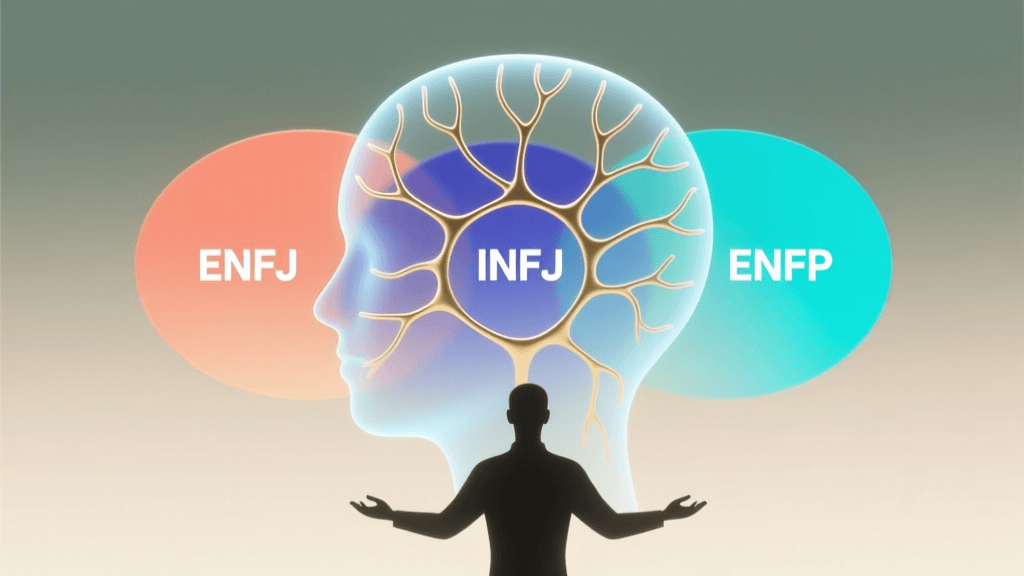
The ENFJ personality type — often dubbed the Protagonist or Teacher — stands out in the MBTI landscape for its magnetic warmth, intuitive leadership, and unwavering commitment to human potential. Yet despite its visibility in pop culture and leadership discourse, ENFJ is one of the most commonly misidentified types — particularly among self-typers, coaches, and even certified practitioners. Why? Because its dominant function, Extraverted Feeling (Fe), operates so seamlessly in social harmony that it can easily be mistaken for the inward-focused Fe of INFJ or the spontaneous, idea-driven energy of ENFP.
This article cuts through the noise. Grounded in Jungian cognitive function theory, validated by decades of MBTI research, and enriched with behavioral markers from clinical observation and personality science, we’ll clarify exactly where ENFJ diverges from its closest lookalikes — not through vague stereotypes, but through observable patterns, cognitive priorities, and decision-making mechanics. Whether you’re a counselor verifying a client’s type, a writer analyzing a character, or someone re-evaluating your own result after years of doubt, this guide delivers actionable clarity.
Common ENFJ Mistypes
ENFJs are estimated to comprise just 2–3% of the general population — making them statistically rare, yet disproportionately represented in leadership roles, education, counseling, and activism. Their rarity contributes to misidentification: when people encounter someone who’s empathetic, organized, inspiring, and socially attuned, they often default to ‘ENFJ’ — even when the underlying cognitive stack tells a different story.
But more insidiously, ENFJs are routinely confused with two other types: INFJ (the Advocate) and ENFP (the Campaigner). These three types share two letters — E/N/F — and all value authenticity, growth, and connection. Yet their core motivations, information-processing hierarchies, and stress responses differ profoundly. Let’s unpack why.
Why the confusion happens:
- Shared values, divergent functions: All three types prioritize harmony, meaning, and human development — but they arrive there via different mental pathways. ENFJ leads with Fe, INFJ with Ni, and ENFP with Ne. That single difference in dominant function reshapes everything — from how they gather data to how they make decisions and respond under pressure.
- Surface-level similarity: An ENFJ organizing a community fundraiser, an INFJ quietly mentoring a struggling student, and an ENFP launching a viral social justice campaign may all appear ‘idealistic’ and ‘people-oriented.’ Without examining how each processes information and directs energy, observers conflate intention with mechanism.
- Test-based ambiguity: Many online MBTI assessments (especially free ones) rely heavily on self-reported preferences for Extraversion/Introversion and Thinking/Feeling — without probing cognitive function order. Since ENFJ and INFJ both score high on Fe and Ni-related items (e.g., ‘I notice subtle shifts in group mood’ or ‘I have strong hunches about people’s futures’), respondents often land in the wrong quadrant.
- Cultural bias toward ‘feeling’ types: In wellness-adjacent spaces, ‘Feeling’ is often equated with emotional intelligence — leading to over-attribution of Fe-dominance. But Fe isn’t just empathy; it’s active social calibration: adjusting behavior in real time to maintain collective cohesion, uphold shared values, and mobilize groups toward common goals.
Crucially, mistyping isn’t merely academic — it has real consequences. An ENFJ told they’re an INFJ may suppress their natural drive to organize, lead, and intervene — retreating into passive insight instead of catalytic action. An INFJ labeled ENFJ may overextend socially, burn out from unmanaged Fe demands, and neglect their essential need for Ni-reflection. Accurate typing is foundational to sustainable growth.
ENFJ vs INFJ — Key Differences
ENFJ and INFJ are perhaps the most frequent pair of mistypes — so much so that some typologists refer to them as ‘mirror types.’ Both are idealistic, deeply compassionate, and future-oriented. But their cognitive stacks are inversions of each other:
| Cognitive Function | ENFJ | INFJ |
|---|---|---|
| Dominant | Extraverted Feeling (Fe) | Introverted Intuition (Ni) |
| Auxiliary | Introverted Intuition (Ni) | Extraverted Feeling (Fe) |
| Tertiary | Extraverted Sensing (Se) | Introverted Thinking (Ti) |
| Inferior | Introverted Thinking (Ti) | Extraverted Sensing (Se) |
This inversion explains nearly every behavioral distinction. Let’s break it down with concrete, observable criteria.
1. Energy Direction & Social Engagement
ENFJ: Gains energy from facilitating group dynamics. Will initiate conversations, mediate conflicts, and proactively shape social environments — not just to connect, but to align people around shared purpose. Their Fe is outwardly directive: “How can I help this team succeed?” “What does this group need right now to feel seen and motivated?”
INFJ: Engages socially with deep selectivity and intentionality. While equally attuned to others’ emotions, their Ni filters interactions through internal frameworks: “What is the deeper pattern here?” “What long-term meaning does this relationship hold?” They conserve energy fiercely and often withdraw after sustained social exposure — not due to disinterest, but because Ni requires solitude to synthesize insights.
Actionable test: Observe how each responds to a chaotic group meeting. The ENFJ will likely step in within minutes — clarifying agendas, redirecting tangents, summarizing consensus — while the INFJ may listen intently, take sparse notes, and offer one precise, synthesized observation only after the discussion settles.
2. Decision-Making Priorities
ENFJ: Decisions are evaluated first on interpersonal impact and harmony. Even when advocating for change, they frame it in terms of collective benefit: “This policy uplifts our entire staff” or “This curriculum honors every student’s learning style.” Their Ni auxiliary supports this by spotting long-term implications — but always in service of Fe’s relational imperative.
INFJ: Decisions begin with internal conviction — a ‘knowing’ rooted in Ni’s foresight. They ask: “Does this align with my core vision?” “Is this ethically coherent over time?” Fe is auxiliary, so they consider others’ feelings deeply — but won’t compromise their Ni-informed truth to preserve surface harmony. This can make them appear quietly uncompromising.
Actionable test: Present both with a moral dilemma involving loyalty vs. principle (e.g., discovering a trusted colleague falsified data). The ENFJ will likely focus on repair, accountability, and restoring team trust — possibly advocating for restorative dialogue before consequences. The INFJ may prioritize systemic integrity first, supporting swift, principled action — then using Fe to compassionately communicate the rationale.
3. Stress Responses (The Grip)
Under chronic stress, ENFJs access their inferior Ti — leading to hyper-critical self-analysis, obsessive logic-chopping, and withdrawal into rigid, isolated reasoning (“If I’d just been more logical, this wouldn’t have happened”). They may dismiss emotions — their own and others’ — as ‘irrational.’
INFJs under stress access inferior Se — manifesting as sensory overwhelm, impulsivity, or hyper-focus on physical details (“I can’t stop noticing the flicker of that light” or “I need to clean everything, right now”). They may abandon long-term vision for immediate, tangible control.
This contrast is clinically significant. A stressed ENFJ therapist might suddenly question every therapeutic choice with cold, detached logic; a stressed INFJ teacher might fixate on classroom decor while ignoring students’ emotional cues.
4. Real-World Character Examples
- ENFJ: Leslie Knope (Parks and Recreation) — relentlessly optimistic, institutionally invested, thrives on building teams and public systems. Her vision is realized through coalition-building, mentorship, and civic infrastructure. She doesn’t just see potential — she structures it.
- INFJ: Atticus Finch (To Kill a Mockingbird) — morally anchored, quietly resolute, speaks sparingly but with devastating precision. His influence flows from unwavering inner conviction, not social orchestration. He defends Tom Robinson not to win popularity, but because his Ni-intuition reveals the irreducible truth of injustice.
As The Myers & Briggs Foundation emphasizes, “Type is about how you prefer to perceive and judge information — not what you do or how you appear.” Leslie organizes; Atticus embodies. Both inspire — but through fundamentally different psychological engines.
ENFJ vs ENFP — Key Differences
If ENFJ/INFJ confusion stems from shared Fe-Ni dynamics, ENFJ/ENFP confusion arises from shared Extraverted attitude and Feeling preference — plus overlapping enthusiasm and advocacy. But their dominant functions couldn’t be more opposed: ENFJ leads with Fe; ENFP leads with Extraverted Intuition (Ne). This creates divergent rhythms, priorities, and blind spots.
Here’s their cognitive stack comparison:
| Cognitive Function | ENFJ | ENFP |
|---|---|---|
| Dominant | Extraverted Feeling (Fe) | Extraverted Intuition (Ne) |
| Auxiliary | Introverted Intuition (Ni) | Introverted Feeling (Fi) |
| Tertiary | Extraverted Sensing (Se) | Extraverted Thinking (Te) |
| Inferior | Introverted Thinking (Ti) | Introverted Sensing (Si) |
1. Goal Orientation vs. Possibility Orientation
ENFJ: Is outcome-oriented. They generate visions (via Ni) and then energetically mobilize people to realize them. Their Fe drives them to create structures — timelines, roles, feedback loops — that ensure collective success. They experience satisfaction when a plan is executed and people grow within it.
ENFP: Is process-oriented. They thrive on generating possibilities (Ne), exploring connections, and iterating ideas. Their Fi ensures authenticity — “Does this resonate with who I am?” — but they often resist finalizing plans, fearing closure will stifle emergent potential. They feel most alive in the ‘what if’ phase.
Actionable test: Ask both to plan a community garden. The ENFJ drafts a phased rollout: volunteer sign-ups, soil testing schedule, planting calendar, harvest celebration. The ENFP brainstorms 12 creative themes (‘Meditation Maze,’ ‘Pollinator Paradise,’ ‘Storytelling Succulents’), invites collaborators to co-design, and may pivot entirely when a new idea sparks.
2. Feedback Style & Conflict Approach
ENFJ: Gives feedback with developmental intent — specific, structured, and tied to growth metrics. They’ll say: “Your presentation improved clarity by 40% this month; next, let’s refine your closing call-to-action.” Conflict is addressed swiftly to restore relational flow, often through private, solution-focused dialogue.
ENFP: Gives feedback impressionistically — highlighting resonance, authenticity, and emotional impact. They’ll say: “That part where you paused? It felt so real — like you were speaking straight from your heart.” Conflict is avoided initially (Fi discomfort), but when engaged, it’s values-driven and passionate — less about fixing systems, more about honoring truth.
3. Leadership Style
ENFJ: Is a steward-leader. They nurture talent, assign roles based on strengths, and hold people accountable to shared standards. Think Barack Obama — charismatic yet disciplined, visionary yet procedural, emotionally intelligent yet strategically rigorous.
ENFP: Is a spark-leader. They ignite enthusiasm, connect disparate ideas, and empower others’ autonomy. Think Robin Williams — improvisational, boundary-pushing, deeply empathic but resistant to hierarchical structure. His genius was in catalyzing joy and insight, not managing workflows.
As noted in a 2022 systematic review published in the Journal of Personality and Leadership Studies, “ENFJs consistently correlate with transformational leadership behaviors grounded in role modeling and individualized consideration, whereas ENFPs excel in inspirational motivation but show lower consistency in contingent reward systems.” In plain terms: ENFJs build the ladder; ENFPs paint the sky it reaches toward.
4. Real-World Character Examples
- ENFJ: Steve Rogers / Captain America (Marvel Cinematic Universe) — leads with moral clarity, builds teams, enforces standards, and sacrifices personal desire for collective good. His shield isn’t just a weapon; it’s a symbol of protection, structure, and unwavering principle.
- ENFP: Phoebe Buffay (Friends) — channels boundless creativity, challenges norms playfully, follows her inner compass unapologetically, and resists being ‘managed.’ Her ‘Smelly Cat’ isn’t performance — it’s authentic expression, regardless of audience reaction.
Both champion humanity — but Captain America organizes the Avengers Initiative; Phoebe opens a metaphysical massage parlor called ‘Chakra.’ One systematizes ideals; the other incarnates them spontaneously.
How to Confidently Identify ENFJ
Accurate identification requires moving beyond traits (“charismatic,” “caring”) to examine cognitive hierarchy in action. Here’s a field-tested, step-by-step protocol:
Step 1: Map the Dominant Function in Real Time
Observe how the person processes a group challenge — e.g., low morale in a team. Does their first instinct involve:
- Assessing collective emotional tone and adjusting their communication to stabilize it? → Fe-dominant
- Generating multiple interpretations or ‘what ifs’ about causes? → Ne-dominant
- Withdrawing to reflect on underlying patterns or future implications? → Ni-dominant
ENFJs don’t just notice the mood — they intervene to recalibrate it, often before others articulate the problem.
Step 2: Audit the Auxiliary Function’s Role
Once Fe sets the relational priority, how does Ni support it? Look for:
- Future-oriented scaffolding: Do they anticipate roadblocks and design preventive measures? (“We’ll need cross-training before the merger — let’s start next month.”)
- Pattern recognition in people: Do they spot developmental arcs? (“She’s ready for delegation — her confidence has grown three-fold since Q1.”)
- Strategic patience: Do they tolerate short-term friction for long-term alignment? (“Yes, this feedback session will be tough — but it prevents bigger rifts later.”)
Without Ni, Fe becomes reactive — appeasing rather than guiding. With Ni, Fe becomes architectural.
Step 3: Check for Tertiary Se Engagement
ENFJs use Se not for thrill-seeking (like ESTPs), but for embodied presence and practical grounding. Signs include:
- Using gestures, eye contact, and vocal modulation to amplify emotional messages
- Noticing environmental details that affect group comfort (lighting, seating, timing)
- Introducing hands-on activities in workshops (role-plays, visual mapping, timed exercises)
An ENFJ facilitator doesn’t just talk about empathy — they design a 10-minute paired listening exercise with clear instructions and timekeeping.
Step 4: Assess Inferior Ti Triggers
When stressed or insecure, ENFJs may:
- Over-analyze past decisions with detached logic (“Statistically, my approach had a 73% success rate — why did this fail?”)
- Dismiss emotional appeals as ‘unscientific’
- Isolate to write exhaustive pros/cons lists — then discard them, frustrated
This isn’t their natural state — but recognizing it confirms Ti’s inferior position.
Step 5: Rule Out Lookalikes with Behavioral Anchors
Use this diagnostic checklist:
| Behavioral Anchor | ENFJ | INFJ | ENFP |
|---|---|---|---|
| Initiates group projects? | Yes — with clear roles & timeline | Rarely — prefers to join existing missions | Yes — but resists fixed structure |
| Corrects others’ behavior publicly? | Yes — gently, to uphold standards | No — addresses privately or not at all | No — avoids confrontation unless values violated |
| Keeps detailed records of others’ growth? | Yes — journals, notes, follow-ups | No — remembers symbolic moments, not metrics | No — focuses on present resonance |
| Feels drained by unstructured brainstorming? | Yes — seeks convergence quickly | Yes — needs silence to process | No — thrives in open ideation |
Finally, consult the Center for Applications of Psychological Type (CAPT), which stresses: “Type verification requires observing consistent patterns across contexts — not single instances. A true ENFJ will demonstrate Fe-Ni integration whether teaching, parenting, or leading a protest.”
FAQ
Can an ENFJ be shy or socially anxious?
Yes — but shyness is not synonymous with introversion in MBTI terms. An ENFJ may feel anxious about social performance (fear of failing their Fe duty to harmonize) or carry past wounds that inhibit expression. Their preference remains Extraverted — they recharge by engaging with people’s growth, even if they enter rooms cautiously. As CAPT notes, “Social anxiety reflects emotional experience; Extraversion/Introversion reflects where one directs and renews mental energy.”
Why do so many ENFJs test as INFJ on free online quizzes?
Most free assessments over-rely on Fe-related statements (“I’m sensitive to others’ moods”) and Ni-related items (“I often have hunches about people’s futures”), without distinguishing dominant vs. auxiliary function usage. Since ENFJs use Ni secondarily to support Fe, they endorse Ni items strongly — but lack the INFJ’s primary reliance on Ni for meaning-making. Validated instruments like the MBTI Step II assess function dynamics, not just preferences.
Is ENFJ compatible with INTJ in relationships?
Functionally, yes — with conscious work. ENFJ’s Fe-Ni pairs well with INTJ’s Ni-Te: both value long-term vision and competence. The ENFJ provides relational warmth and developmental scaffolding; the INTJ offers strategic rigor and intellectual depth. Potential friction arises when ENFJ’s Fe seeks affirmation and the INTJ’s Te prioritizes efficiency over emotional processing. Research in Frontiers in Psychology (2020) found that Fe-Ni/Te-Ni pairings report high relationship satisfaction when both partners explicitly negotiate communication styles — especially around conflict and decision speed.
How can an ENFJ avoid burnout?
ENFJ burnout stems from Fe overload — absorbing others’ emotions without boundaries and neglecting Ti integration. Prevention strategies include: (1) Scheduling non-negotiable Ti time (e.g., 20 minutes daily journaling with logic-focused prompts: “What assumptions am I making? What evidence contradicts them?”); (2) Using Se intentionally — walking without headphones, cooking mindfully, practicing breathwork — to ground in the body; and (3) Building ‘Fe buffers’: delegating emotional labor (e.g., assigning a peer to handle post-meeting sentiment checks). As The Myers & Briggs Foundation advises: “Your strength is lifting others — but your sustainability depends on lifting yourself, too.”
Understanding ENFJ isn’t about labeling — it’s about honoring a rare, vital architecture of care: the ability to hold a vision, read a room, and build the bridge between them. When misidentified, that architecture crumbles under mismatched expectations. When accurately seen, it transforms communities, heals divisions, and proves, daily, that idealism and execution aren’t opposites — they’re the twin engines of human progress.