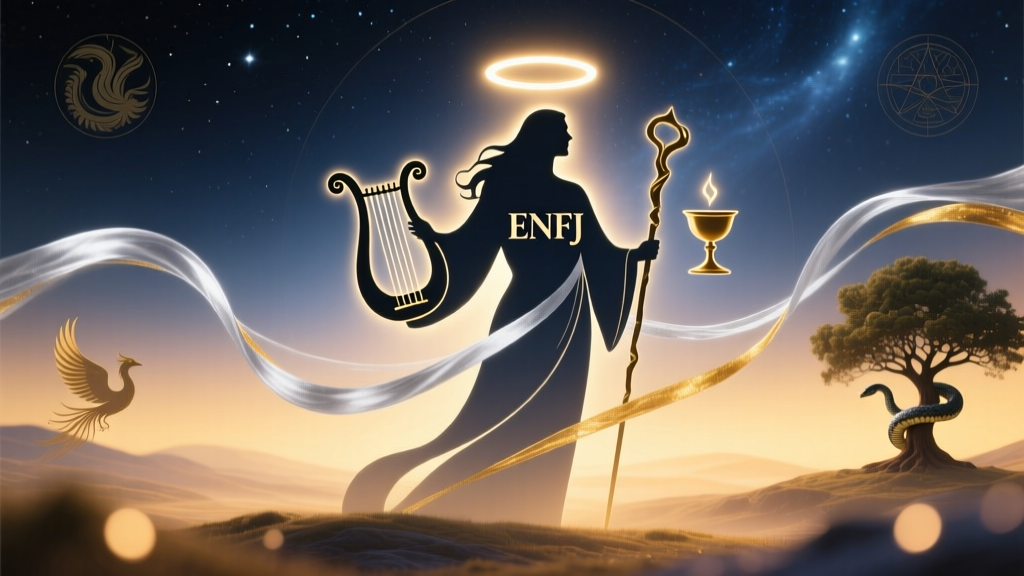
ENFJ in Mythology and Folklore
The ENFJ personality—often dubbed the Protagonist or Teacher—is defined by Extraversion (E), Intuition (N), Feeling (F), and Judging (J). At its core, the ENFJ is driven by a profound desire to inspire, unify, and uplift others. They possess an uncanny ability to read emotional undercurrents, articulate shared values, and mobilize communities toward noble ideals. While modern psychology codified this type in the mid-20th century, its behavioral signature—charismatic leadership grounded in empathy, moral conviction, and future-oriented vision—resonates powerfully across millennia of mythic storytelling.
Mythology does not record MBTI types—but it *does* encode enduring psychological archetypes. Carl Gustav Jung, whose theories underpin the MBTI framework, identified the Hero, Wise Old Man/Woman, Healer, and Mediator as universal patterns emerging from the collective unconscious. The ENFJ embodies a rare confluence of these: the Hero who leads not through brute force but moral authority; the Wise One who mentors with warmth rather than austerity; the Healer who restores harmony, not just bodies; and the Mediator who bridges divine and mortal, tradition and reform, self and society.
Folklore reinforces this pattern. In oral traditions worldwide, figures who gather villagers to rebuild after disaster, negotiate truces between warring clans, or sacrifice personal ambition for communal renewal consistently share ENFJ traits: expressive warmth, persuasive idealism, structured compassion, and a strong internal compass of justice. As scholar Joseph Campbell observed, the monomyth’s ‘Call to Adventure’ often arrives not as a sword or prophecy—but as a plea from the vulnerable, which the ENFJ hears before anyone else.Joseph Campbell Foundation
This article traces the ENFJ archetype across three interwoven domains: classical and indigenous mythology, high fantasy literature, and cross-cultural folklore. We move beyond superficial ‘type matching’ to examine how ENFJ energy functions structurally—how it resolves conflict, initiates transformation, and sustains cultural memory. Crucially, we conclude with pragmatic guidance: how real-world ENFJs can harness these ancient patterns to navigate modern challenges—from burnout in helping professions to leadership in polarized environments.
Famous ENFJ Mythological Figures
Identifying ENFJ figures requires looking past surface roles (e.g., ‘warrior’ or ‘trickster’) and analyzing narrative function, relational dynamics, and motivational drivers. Below are eight mythological figures whose stories, motivations, and symbolic roles align robustly with ENFJ cognitive functions—dominant Extraverted Feeling (Fe), auxiliary Introverted Intuition (Ni), tertiary Extraverted Sensing (Se), and inferior Introverted Thinking (Ti).
| Figure | Culture/Tradition | Core ENFJ Narrative Function | Key Evidence (Mythic Text / Scholarly Analysis) | Fe-Ni Tension Point |
|---|---|---|---|---|
| Apollo | Greek | Divine Harmonizer & Moral Educator | Oracles at Delphi guided city-states via ethical counsel; hymns emphasize harmonia (cosmic order) and paideia (civic education)Center for Hellenic Studies | Struggles with hubris when Fe-driven certainty overrides Ni foresight (e.g., punishing Marsyas for challenging his judgment) |
| Māui | Māori & Polynesian | Compassionate Trickster-Reformer | Steals fire for humanity, slows the sun to lengthen days for laborers—not for glory, but communal welfareTe Ara Encyclopedia of New Zealand | Overextends Se (action) to ‘fix’ systemic injustice, neglecting personal limits until exhaustion or backlash |
| Anansi | Akan (Ghanaian) & Caribbean Folklore | Storyteller-Diplomat & Cultural Preserver | Uses wit and narrative—not force—to resolve disputes, teach ethics, and encode ancestral wisdom in accessible formBritish Museum Learning Resources | Fe desire for consensus leads to over-negotiation, delaying necessary boundaries (e.g., appeasing antagonists too long) |
| Quetzalcoatl | Mesoamerican (Aztec/Toltec) | Peaceful Creator-King & Ethical Reformer | Opposed human sacrifice, promoted arts, agriculture, and priestly learning; exiled for refusing violenceMetropolitan Museum of Art | Ni vision of a just society clashes with Fe need for acceptance—leading to self-exile rather than confrontation |
| Brigid | Celtic/Irish | Triple Goddess of Healing, Poetry & Smithcraft | Syncretized as St. Brigid; her flame symbolizes inspired action rooted in compassion; founded monasteries as centers of learning, healing, and hospitalityIrishCentral | Fe-driven service expands until boundaries dissolve—her ‘eternal flame’ reflects both strength and risk of self-erasure |
| Amaterasu | Shinto (Japanese) | Restorer of Light & Divine Unifier | Withdraws into cave causing cosmic darkness; coaxed out not by force, but by communal joy, dance, and mirror—symbolizing Fe’s power to reintegrate fractured wholenessAsia Society | Ni foresight of harmony’s fragility makes her hypersensitive to discord—triggering withdrawal as protective Fe response |
| Hathor | Egyptian | Maternal Protector & Joy-Bringer | “The Eye of Ra” who transforms wrath into nurturing love; patron of music, dance, fertility, and the afterlife’s joyful rebirthBrooklyn Museum Egyptian Collection | Fe’s drive to soothe can suppress necessary anger—her ‘Eye’ aspect shows Ti inferiority surfacing as sudden, disproportionate rage when boundaries are violated |
| Väinämöinen | Finnish (Kalevala) | Wisdom-Singer & Nation-Builder | Creates land, crafts the Sampo (cosmic mill), and sings adversaries into submission—his voice embodies Fe’s unifying power and Ni’s generative visionFinnish National Library Kalevala Resources | Relies so heavily on harmonious consensus that he hesitates to confront existential threats (e.g., Louhi’s sorcery) until near-collapse |
What unites these figures is not divine portfolio, but *relational architecture*. Each serves as a living conduit between higher principles (justice, light, creativity, community) and embodied human need. Their power lies not in isolation, but in catalyzing collective action: Apollo’s oracles shaped Athenian democracy; Brigid’s monasteries preserved literacy through Dark Ages; Anansi’s tales encoded resistance strategies for enslaved Africans. This is ENFJ essence—power exercised *through* people, not over them.
Crucially, their flaws mirror ENFJ vulnerabilities. When Fe dominates unchecked, they absorb others’ emotions as their own duty—Apollo’s grief over Hyacinthus, Amaterasu’s retreat, Hathor’s rage—all stem from collapsed boundaries. When Ni overreaches, they become dogmatic about their vision (Quetzalcoatl’s absolutist pacifism), mistaking one path for the only moral path. Recognizing these patterns helps modern ENFJs honor their gifts while building resilience.
ENFJ Fantasy Literature Archetypes
Fantasy literature, particularly post-Tolkien high fantasy, crystallizes mythic archetypes into psychologically nuanced characters. ENFJ energy thrives here—not as lone wizards or brooding antiheroes, but as architects of fellowship, healers of broken worlds, and moral anchors in moral ambiguity.
Gandalf the Grey (J.R.R. Tolkien, The Lord of the Rings) exemplifies the ENFJ Mentor archetype at its most potent. His power is never displayed for dominance: he rekindles hope in Frodo (“I wish it need not have happened in my time”), redirects Aragorn’s self-doubt into kingship, and orchestrates the Fellowship—not as commander, but as conductor. His famous line, “All we have to decide is what to do with the time that is given us,” reflects Fe’s focus on agency within relationship and Ni’s grasp of temporal responsibility. Tolkien, a Catholic scholar steeped in medieval hagiography, modeled Gandalf on Christ-like servant-leadership—prioritizing sacrifice (his fall in Moria), empathy (his grief for Théoden), and patient cultivation of potential (Aragorn, Frodo, even Bilbo).Tolkien Gateway
Albus Dumbledore (J.K. Rowling, Harry Potter) presents a more complex, cautionary ENFJ portrait. His Fe drives his lifelong fight against Voldemort’s dehumanizing ideology; his Ni vision foresees Harry’s role and the necessity of sacrificial love. Yet his tragic flaw—keeping critical truths from Harry—reveals ENFJ’s shadow: the belief that protecting others from painful reality is loving, when it actually undermines their autonomy and growth. Rowling explicitly links Dumbledore’s arc to the danger of “love without honesty.” His redemption comes not through grand victory, but through trusting Harry with truth—a hard-won integration of Fe (care) and Ti (integrity).British Library: Harry Potter Essays
Lyra Belacqua (Philip Pullman, His Dark Materials) subverts expectations: a child protagonist embodying ENFJ’s fearless advocacy. Her Fe compels her to protect Roger, to challenge authoritarian theology, and to unite disparate worlds (Mulefa, Gallivespians, witches). Her Ni manifests as intuitive leaps—recognizing Dust’s significance, understanding the subtle language of daemons. Unlike traditional ENFJs, Lyra’s Se is highly developed (climbing, fighting, navigating physical danger), showing how ENFJ energy adapts to context. Her journey teaches that ENFJ leadership isn’t about titles, but about speaking truth to power with unwavering compassion.
Other notable ENFJ-aligned fantasy figures include:
- Elrond (LOTR): The diplomatic host who convenes the Council of Elrond, balancing wisdom, sorrow, and unwavering commitment to hope.
- Kvothe (Patrick Rothfuss, The Name of the Wind): His early years showcase ENFJ charisma, teaching prowess, and desire to heal through knowledge—though his later arc explores the corrosion of Fe when Ni becomes obsessive and Ti inferiority triggers self-sabotage.
- Queen Mab (Merc Fenn Wolfmoor, The Deep & Dark Blue): A trans nonbinary fae queen whose rule centers on radical inclusion, restorative justice, and transforming trauma into communal strength—modern ENFJ ideals made sovereign.
These characters offer ENFJs literary mirrors and practical blueprints. Gandalf teaches strategic patience: true influence grows through listening, asking questions, and empowering others’ agency. Dumbledore warns against compassionate control: withholding truth ‘for their own good’ erodes trust and stunts growth. Lyra models courageous empathy: standing with the marginalized requires not just feeling, but acting—even when scared.
Legendary Heroes, Creatures and ENFJ
Beyond anthropomorphic gods and heroes, ENFJ energy permeates legendary creatures and composite beings whose very nature embodies unifying, healing, or mediating functions.
The Phoenix is perhaps the quintessential ENFJ creature. Its cyclical death-and-rebirth symbolizes the ENFJ’s capacity for renewal—not just personal, but collective. When communities fracture (Fe disruption), the ENFJ doesn’t flee; they initiate the ‘funeral pyre’ of old systems and steward the emergence of something integrated and stronger. Its tears healing wounds reflects Fe’s restorative power; its song inspiring awe and unity mirrors the ENFJ’s ability to articulate shared purpose. In Egyptian lore, the Bennu bird (Phoenix) was linked to Ra and creation—reinforcing the ENFJ’s role as co-creator of social reality.
The Centaur Chiron stands apart from his violent kin. A master healer, teacher, and mentor to Achilles, Asclepius, and Jason, Chiron embodies the ENFJ’s fusion of wisdom (Ni) and compassionate action (Fe). Wounded by a poisoned arrow yet unable to die (immortal), he represents the ENFJ’s paradox: deeply attuned to others’ pain, yet carrying their own unhealed wounds. His eventual sacrifice—trading immortality for Prometheus’s freedom—shows Fe’s ultimate expression: prioritizing collective liberation over personal comfort.
The Rainbow Serpent (Aboriginal Australian) is a creator deity governing water, fertility, and the life force connecting all things. Its rainbow form symbolizes bridging realms (sky/earth, spirit/matter, individual/tribe)—a core ENFJ function. Rituals honoring it emphasize community singing, dance, and shared responsibility for land—direct expressions of Fe’s relational imperative and Ni’s holistic vision. Anthropologist Deborah Bird Rose notes its role as “the law-giver who binds people to country and each other,” highlighting ENFJ’s structural role in sustaining culture.ANU Press: Aboriginal History Journal
The Baku (Japanese Folklore), a dream-eating chimera, offers a subtle ENFJ parallel. It doesn’t destroy nightmares but transforms them—consuming terror to restore peaceful sleep. This mirrors the ENFJ’s therapeutic instinct: not denying pain, but metabolizing it into safety and clarity for others. Its gentle, non-threatening appearance underscores Fe’s preference for approachability over intimidation.
Even seemingly antagonistic figures reveal ENFJ shadows. Loki (Norse) is often typed as ENTP, but his most ENFJ-like moments—mediating between Aesir and giants, crafting solutions to crises (e.g., retrieving Thor’s hammer)—show Fe’s adaptive diplomacy. His downfall stems from Fe’s distortion: craving validation so intensely he engineers chaos to be the indispensable fixer. This warns ENFJs that seeking external affirmation as validation of worth is a perilous path.
Practical Application for Modern ENFJs:
- Ritualize Boundary Setting: Like Amaterasu needing the mirror’s reflection to re-emerge, create physical or temporal ‘mirrors’—a 10-minute journaling ritual after caregiving, a ‘no-meetings’ Friday—to reaffirm your own identity separate from others’ needs.
- Channel Ni into Systems Thinking: Move beyond individual acts of kindness to designing structures. Start a community skill-share network (like Brigid’s monasteries), advocate for policy changes aligned with your values (like Quetzalcoatl’s reforms), or develop mentorship curricula (like Chiron’s teachings).
- Embrace ‘Constructive Dissonance’: Follow Lyra’s example: seek out perspectives that challenge your vision. Join a debate club, read opposing political analyses, or invite candid feedback on your projects. This integrates Ti and prevents Ni-Fe echo chambers.
- Reclaim Rest as Resistance: The Phoenix doesn’t rush rebirth—it rests in the ashes. Schedule mandatory, guilt-free downtime. Use it for sensory grounding (Se): walk barefoot, bake bread, listen to polyphonic choral music—activities that reconnect you to your body and present moment.
FAQ
Can mythological ENFJs be villains or flawed?
Absolutely—and this is vital for healthy self-understanding. ENFJ’s greatest vulnerability is conflating ‘harmony’ with ‘suppression.’ When Fe dominates, they may silence dissent to maintain false peace (e.g., a leader ignoring team burnout to hit quarterly goals). When Ni overreaches, they become ideologically rigid, dismissing alternatives as ‘immoral’ rather than exploring nuance. Mythology shows this: Apollo’s punishment of Niobe for boasting about her children wasn’t justice—it was Fe-driven enforcement of hierarchy. Recognizing these shadows allows ENFJs to lead with integrity, not perfection.
How do ENFJs differ from INFJs in mythic roles?
Both share dominant Fe and auxiliary Ni, but their third functions diverge: ENFJs use Extraverted Sensing (Se), INFJs use Extraverted Thinking (Te). This creates distinct mythic expressions. ENFJs are active harmonizers: Apollo conducting oracles, Gandalf rallying armies, Anansi weaving plots. They engage the physical world to manifest unity. INFJs are visionary interpreters: Hermes as boundary-crossing messenger, Odin sacrificing an eye for cosmic insight, the Oracle of Delphi delivering cryptic prophecies. They prioritize depth of meaning over immediate action. An ENFJ builds the temple; an INFJ deciphers the sacred geometry within it.
Are there ENFJ figures in non-Western folklore I can connect with?
Yes—deeply. Beyond those listed (Māui, Quetzalcoatl, Amaterasu, Rainbow Serpent), consider: Oshun (Yoruba), goddess of rivers, love, and diplomacy, who negotiates peace and heals with honey and song; Sobek (Egyptian), crocodile god who protects but also enforces Ma’at (cosmic order) through decisive action; and Pele (Hawaiian), volcano goddess whose destructive eruptions make way for new life—showcasing ENFJ’s transformative courage. Engaging with these traditions respectfully (via primary sources like Library of Congress Folklore Collections) enriches ENFJ self-concept beyond Eurocentric frameworks.
How can I use ENFJ archetypes if I’m not religious or spiritual?
Archetypes are psychological tools, not theological doctrines. You can engage them secularly: study Apollo’s oracular process as a model for ethical decision-making frameworks; apply Gandalf’s mentoring techniques in your workplace coaching; use Anansi’s storytelling methods to communicate complex ideas accessibly. Psychologist Jordan Peterson emphasizes that myths encode ‘maps of meaning’—practical guides for navigating life’s chaos. Your ENFJ strength lies in translating abstract values (justice, care, growth) into tangible actions that improve real lives. That’s the enduring, human work of the Protagonist—no belief system required.
The ENFJ’s journey, mirrored across Olympus, Valhalla, Te Pō, and Middle-earth, is ultimately one of sacred stewardship: holding space for others’ potential while fiercely guarding their own flame. By studying these archetypes not as distant legends, but as ancestral blueprints, modern ENFJs reclaim a lineage of compassionate leadership—one that heals fractures, ignites possibility, and reminds us that the most powerful magic is always, fundamentally, human connection made visible.