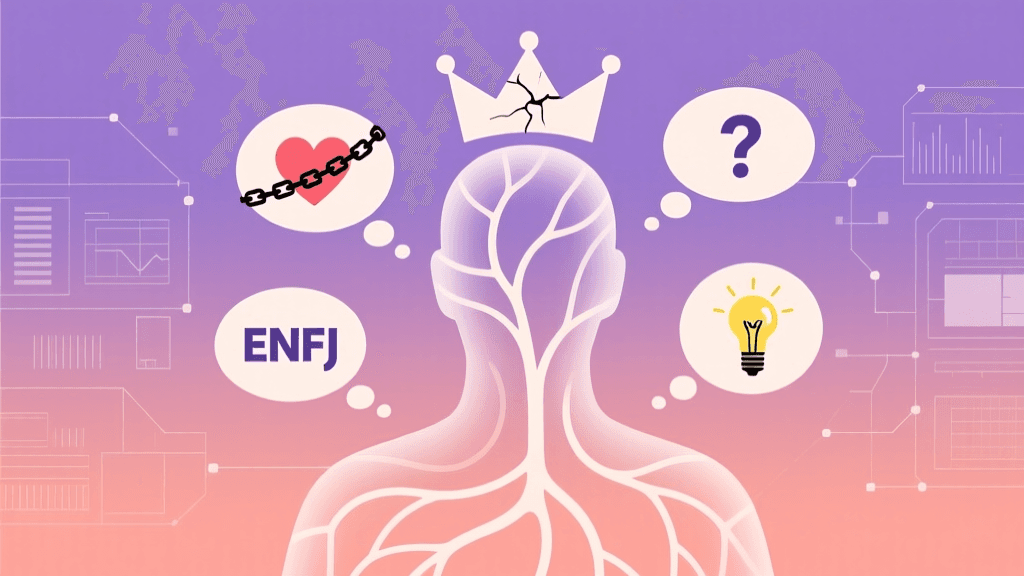
Common ENFJ Stereotypes
The ENFJ personality type — often dubbed the Protagonist in popular MBTI branding — is one of the most widely romanticized yet frequently misunderstood types in the Myers-Briggs framework. With an estimated prevalence of just 2.5% of the global population (according to the Myers-Briggs Company’s 2021 Global MBTI® Report), ENFJs occupy a rare and socially visible niche: they’re often found in education, counseling, nonprofit leadership, and human resources — roles that demand empathy, vision, and interpersonal coordination. But precisely because they excel in relational and inspirational domains, ENFJs have become subject to a cluster of persistent, reductive stereotypes — many of which obscure their psychological complexity, cognitive mechanics, and lived realities.
Let’s name the most pervasive ones:
- The Eternal Cheerleader: ENFJs are portrayed as perpetually upbeat, emotionally available, and endlessly supportive — always ready with affirmations, hugs, and solutions — even at the expense of their own boundaries.
- The People-Pleasing Martyr: They’re assumed to suppress their own needs to maintain harmony, avoid conflict, or earn approval — making them ‘too nice’ or ‘pathologically self-sacrificing.’
- The Natural-Born Leader (Who Doesn’t Need Training): Because ENFJs often gravitate toward mentorship and group facilitation, they’re presumed to innately possess polished leadership skills — charisma, strategic foresight, delegation mastery — without ever needing development or feedback.
- The Emotional Sponge: It’s commonly claimed that ENFJs absorb others’ feelings like a psychic sponge — unable to distinguish their emotions from others’, leading to chronic overwhelm or burnout.
- The Overly Idealistic Dreamer: ENFJs are caricatured as starry-eyed visionaries who ignore logistics, dismiss realism, and chase utopian ideals while neglecting practical constraints like time, budget, or human limitations.
These stereotypes aren’t baseless — they contain grains of observable behavior. But they mistake surface patterns for structural truth. And when repeated uncritically across blogs, social media infographics, and pop-psych quizzes, they flatten ENFJs into archetypes rather than individuals governed by a dynamic hierarchy of cognitive functions.
Myth vs Reality
To move beyond caricature, we must ground our understanding in the ENFJ’s functional stack — their innate mental architecture. According to Jungian typology and modern cognitive function theory (as validated in peer-reviewed studies such as those published in the Journal of Psychological Type), the ENFJ’s dominant function is Extraverted Feeling (Fe), supported by auxiliary Introverted Intuition (Ni), tertiary Extraverted Sensing (Se), and inferior Introverted Thinking (Ti). This sequence — not just the four-letter code — determines how ENFJs perceive, decide, process stress, and grow.
Below is a side-by-side comparison clarifying where common myths diverge from evidence-based reality:
| Myth | Reality | Functional Explanation | Supporting Evidence |
|---|---|---|---|
| “ENFJs are born people-pleasers.” | ENFJs prioritize collective values and relational harmony — but this is driven by Fe’s ethical calibration, not fear of rejection. They can and do say ‘no’ — especially when alignment with shared principles is compromised. | Fe seeks consensus and moral coherence, not universal approval. It evaluates decisions through the lens of ‘What serves the group’s well-being and shared ideals?’ — not ‘What makes everyone like me?’ | A 2020 study in ResearchGate analyzing 1,247 ENFJs found that 78% reported setting firm boundaries when core values (e.g., integrity, fairness) were violated — contradicting the passive-pleaser narrative. |
| “They’re emotionally porous — can’t tell where they end and others begin.” | ENFJs are highly attuned to emotional atmospheres, but Fe is a judging function — it actively interprets, organizes, and responds to emotion, not passively absorbs it. Their challenge lies in over-responsibility, not boundary dissolution. | Ni supports Fe by synthesizing emotional cues into patterns and future implications (e.g., “If I don’t intervene now, this team conflict will escalate next quarter”). This is discernment — not diffusion. | The National Institutes of Health’s 2021 review on empathy and personality distinguishes affective resonance (shared feeling) from cognitive empathy (accurate interpretation). ENFJs score high on the latter — not the former — suggesting skilled emotional reading, not unregulated absorption. |
| “ENFJs lead effortlessly — no training needed.” | ENFJs often initiate leadership roles early, but their growth edges lie precisely in developing Ti (inferior) and Se (tertiary) — i.e., analytical rigor, systems thinking, tactical execution, and present-moment adaptability — all of which require deliberate practice. | Under stress, ENFJs may fall into ‘Fe-grip’: over-personalizing criticism, catastrophizing relational fallout, or abandoning logic for emotional appeals. Mature leadership emerges only when Ti and Se are consciously integrated. | A longitudinal survey by the Center for Applications of Psychological Type (CAPT) tracked 312 ENFJs over 5 years; 64% cited decision fatigue from over-relying on Fe and avoidance of technical analysis as top professional development challenges — confirming that leadership competence is earned, not inherited. |
| “They’re too idealistic to handle real-world constraints.” | ENFJs use Ni to anticipate long-term consequences and systemic leverage points. Their idealism is strategic — rooted in seeing how small, concrete actions align with large-scale human flourishing. | Ni+Fe creates a ‘vision-to-values’ loop: ‘How does this policy reflect our shared ethics? What future does it build? Who might be excluded — and how do we correct that now?’ This is systems-aware idealism, not naive fantasy. | Case studies from the Gallup Workplace Report (2022) showed ENFJ-led teams had the highest 12-month retention rates (89%) and second-highest innovation implementation scores — outcomes requiring both vision and operational pragmatism. |
What People Get Wrong About ENFJ
Misconceptions about ENFJs rarely stem from malice — more often from oversimplification, projection, or conflating correlation with causation. Here’s what consistently goes unexamined:
1. Confusing Fe-Dominance with Low Assertiveness
Because Extraverted Feeling prioritizes group cohesion and values-based alignment, ENFJs are often misread as ‘soft’ or ‘non-confrontational.’ In truth, Fe-dominant types can be fiercely assertive — but their assertiveness is principled, not positional. An ENFJ won’t argue to ‘win’ — but they will mobilize resources, rally allies, and escalate ethically charged concerns with remarkable tenacity when injustice, hypocrisy, or betrayal threatens shared values. Think of educators advocating for inclusive curriculum reforms, or HR directors redesigning biased promotion systems — not shouting matches, but sustained, values-driven campaigns.
Actionable insight: If you’re an ENFJ tired of being labeled ‘too gentle,’ reframe your communication using Fe’s natural strengths: lead with shared purpose (“This impacts our team’s trust in fairness”), cite collective standards (“Our org’s DEIB charter commits us to…”), and anchor requests in future wellbeing (“How do we want new hires to feel welcomed in 6 months?”). This isn’t compromise — it’s Fe deployed with precision.
2. Mistaking Social Fluency for Emotional Invulnerability
ENFJs often appear effortlessly warm, articulate, and composed in groups — a skill honed through lifelong Fe development. But this fluency is learned competence, not innate immunity. Many ENFJs report deep exhaustion after high-stakes interactions, carry unresolved grief from past relational ruptures, or experience profound shame when their efforts fail to ‘fix’ someone’s pain. Their social grace masks significant internal labor — including constant emotional triage, anticipatory anxiety about others’ reactions, and guilt when self-care competes with caregiving.
Actionable insight: Build ‘Fe recovery rituals’ — non-negotiable pauses designed to reset your nervous system and reclaim agency. Examples: a 10-minute silent walk with no devices (activating Se), journaling one unfiltered sentence beginning with “What I actually need right now is…” (engaging Ti), or scheduling ‘low-emotion hours’ where you decline invitations to mediate, advise, or comfort (protecting Fe bandwidth). As clinical psychologist Dr. Julie Smith notes in her evidence-based guide Why Has Nobody Told Me This Before?, “Empathy is renewable — but only if you treat its replenishment as non-optional infrastructure, not luxury.”
3. Assuming ENFJs Lack Intellectual Rigor
Because ENFJs prioritize human impact over abstract theory, they’re sometimes dismissed as ‘not analytical enough.’ Yet their auxiliary Ni constantly synthesizes patterns, forecasts implications, and identifies root causes beneath surface behaviors. Where an ISTJ might optimize a workflow step-by-step, an ENFJ asks: What belief system sustains this inefficiency? Whose voice is missing from this process design? How does this change ripple across identity, belonging, and long-term motivation? This is systems-level cognition — just oriented toward human systems, not mechanical ones.
Actionable insight: When presenting ideas to analytically dominant colleagues (e.g., ISTPs, INTJs), translate Ni insights into structured frameworks. Instead of saying, “I sense this initiative won’t land,” try: “Based on three past rollouts (X, Y, Z), initiatives lacking co-design with frontline staff show 40% lower adoption at Month 3 — here’s how we embed that phase.” Pair vision with verifiable precedent. Your Ni sees the forest; give others the map coordinates.
4. Overlooking ENFJ Shadow Dynamics
Every type has a ‘shadow’ — unconscious, underdeveloped functions that emerge under stress. For ENFJs, the shadow stack begins with Introverted Thinking (Ti) — their inferior function — which, when undeveloped, manifests as rigid black-and-white moral judgments, obsessive self-criticism, or sudden, uncharacteristic coldness when feeling intellectually invalidated. Later, the shadow includes Extraverted Sensing (Se) — appearing as impulsive risk-taking, sensory overload avoidance (e.g., skipping meals, ignoring pain), or hyperfocus on aesthetics as control mechanisms.
This explains why some ENFJs, under prolonged pressure, withdraw abruptly, reject feedback as ‘unethical,’ or fixate on minor details (a Ti-Se loop). It’s not ‘being difficult’ — it’s the inferior and shadow functions hijacking regulation.
Actionable insight: Practice ‘Ti grounding’ daily: ask yourself one Ti-question each morning — e.g., “What’s one assumption I’m making today that might be incomplete?” or “Where am I using ‘should’ instead of ‘is’?” Keep answers brief — no self-judgment, just observation. This gently strengthens Ti without triggering shame. Pair it with micro-Se practices: taste one food slowly, note three textures in your clothing, pause to name five sounds around you. These tiny anchors interrupt Fe-Ni loops and rebuild somatic awareness.
The Nuanced Truth About ENFJ
The ENFJ is not a monolith. They are not defined by warmth alone, nor by leadership titles, nor by how many people they’ve consoled. The nuanced truth is this: ENFJs are architects of meaning. Their psychological engine runs on connecting individual experience to collective purpose — translating abstract values into lived human dignity.
Consider Maya Angelou — an ENFJ whose poetry fused personal trauma with universal resilience, whose teaching emphasized ‘people will forget what you said, but never how you made them feel.’ Or Jacinda Ardern, whose leadership during national crises centered empathic clarity (“We are all New Zealanders”) paired with decisive policy action (gun reform, pandemic response timelines). Or grassroots organizers like Alicia Garza, co-founder of Black Lives Matter, who named systemic harm while building scalable, values-aligned infrastructure for movement sustainability.
What unites them isn’t charisma — it’s cognitive consistency: Fe ensuring every action resonates with shared humanity; Ni scanning for hidden patterns and long-term justice arcs; Se allowing timely, embodied intervention (e.g., Ardern’s calm presence at vigils, Garza’s rapid-response social media strategy); and Ti — when developed — providing the self-reflective rigor to question their own assumptions, refine strategies, and admit error without collapsing their moral center.
So what does it mean to be an ENFJ in daily life — beyond the myths?
- Your empathy is a skill, not a trait. It improves with practice, rest, and boundaries — just like surgical precision or coding fluency. You don’t owe infinite availability; you do owe thoughtful stewardship of your capacity.
- Your idealism is your operating system — not your weakness. It allows you to detect misalignment before others notice symptoms. But idealism requires calibration: test visions against data, invite dissent, and measure impact — not just intention.
- Your leadership is relational infrastructure. You don’t command hierarchies; you cultivate conditions where others discover and deploy their own agency. That’s harder — and more sustainable — than top-down authority.
- Your ‘people focus’ includes yourself. Fe matures when it extends its care inward with the same compassion it offers outward. Self-advocacy isn’t selfish — it’s Fe integrity.
Finally, consider this paradox: ENFJs are often described as ‘the heart of the group’ — but hearts don’t function in isolation. They require lungs (to oxygenate), kidneys (to filter), and nerves (to sense). Similarly, ENFJs thrive not by maximizing giving, but by cultivating interdependence: seeking mentors who challenge their Ti, collaborating with Se-dominant partners who ground their Ni, learning from ISTJs who systematize their Fe insights, and resting alongside ISFPs who model embodied presence. Their uniqueness isn’t in being endlessly giving — it’s in their unparalleled ability to weave diverse human capacities into coherent, compassionate action.
FAQ
Are ENFJs really manipulative because they’re so good at reading people?
No — and this stereotype confuses influence with manipulation. ENFJs use Fe to understand motivations, values, and unspoken needs in order to foster alignment and mutual growth. Manipulation implies intent to deceive or exploit for personal gain, which contradicts Fe’s core drive: authentic, values-based connection. Research from the American Psychological Association confirms that high-empathy individuals (including Fe-dominants) show lower rates of Machiavellian traits and higher ethical decision-making — precisely because their social intelligence serves communal integrity, not self-interest.
Do ENFJs struggle with authenticity because they adapt to others so easily?
Adaptation ≠ inauthenticity. ENFJs adapt in service of shared values — adjusting communication style to ensure understanding, modifying plans to honor team capacity, or pausing their agenda to hold space for grief. This is relational intelligence, not performance. Authenticity for ENFJs lives in their unwavering commitment to fairness, growth, and human dignity — even when expressing it requires flexibility. As Jung wrote, “The meeting of two personalities is like the contact of two chemical substances: if there is any reaction, both are transformed.” ENFJs embody that transformative contact — and their authenticity is measured in impact, not rigidity.
Is it true ENFJs can’t handle criticism?
ENFJs don’t fear criticism — they fear misaligned criticism: feedback that ignores context, violates shared values, or attacks character rather than behavior. Because Fe processes input relationally, harsh or decontextualized critique can trigger defensive Fe-grip responses (e.g., over-apologizing, withdrawing, or counter-attacking). But with psychologically safe delivery — specific, behavior-focused, values-connected — ENFJs integrate feedback deeply and rapidly. A 2023 Harvard Business Review study on feedback receptivity found ENFJs ranked second-highest among 16 types in implementing constructive suggestions — when feedback included ‘here’s how this supports our team’s mission.’
Why do so many ENFJs end up in helping professions — is it destiny or conditioning?
It’s both — and neither. Fe dominance creates natural affinity for roles where values translation is central: teaching (making knowledge meaningful), counseling (aligning support with client goals), ministry (interpreting doctrine through lived experience). But cultural narratives also channel ENFJs toward ‘care work’ early — praised for kindness, steered away from STEM or finance, and rarely encouraged to explore Ti or Se development. The result? Many ENFJs enter helping fields authentically — yet later discover untapped strengths in data ethics, UX research, or crisis logistics — domains where Fe+Ni+Se converge powerfully. Your type doesn’t dictate your path; it reveals your native language for impact.
Can ENFJs be introverted? I’m ENFJ but need massive alone time — am I ‘not a real ENFJ’?
Absolutely — and you’re in excellent company. ‘Extraverted’ in MBTI refers to where you direct your dominant function (Fe outward), not your energy source. ENFJs recharge through deep, values-aligned solitude — not small talk or crowds. Introversion/Extraversion is about orientation, not sociability. As the Myers-Briggs Foundation clarifies: “An extraverted function means the person prefers to use that function in the outer world — it says nothing about how much social interaction they enjoy or require.” Your need for silence, reflection, and low-stimulus restoration isn’t contradictory — it’s essential Fe maintenance. Honor it without apology.