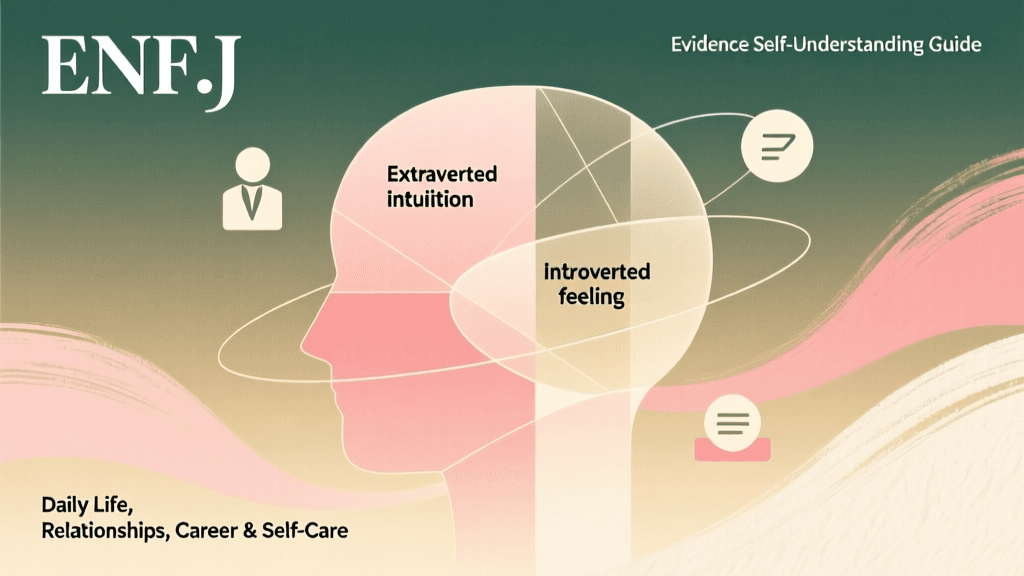
Understanding Your ENFJ Mind
The ENFJ personality type—often called the Protagonist or Teacher—is one of the rarest MBTI types, comprising just 2.5% of the general population according to the Myers-Briggs Foundation’s 2021 population survey. What makes ENFJs distinct isn’t just their warmth or charisma—it’s the precise architecture of their cognitive function stack, which governs how they perceive, process, and respond to the world.
ENFJs lead with Extraverted Feeling (Fe), supported by Introverted Intuition (Ni), then Extraverted Sensing (Se), and finally Introverted Thinking (Ti). This hierarchy explains why ENFJs instinctively scan group emotional climates, anticipate future implications of interpersonal dynamics, notice subtle shifts in tone or environment—and yet may struggle with detached logical analysis when overwhelmed.
Unlike many personality frameworks that treat traits as static labels, modern cognitive function theory emphasizes developmental progression. For ENFJs, healthy growth means strengthening Ni to ground Fe-driven empathy in long-term vision—not just immediate harmony—and consciously cultivating Ti to evaluate values-based decisions with intellectual rigor, not just moral intuition.
A common misconception is that ENFJs are ‘people-pleasers’. In reality, they’re value-aligners: they seek coherence between shared human ideals (justice, growth, authenticity) and collective behavior. When others violate those ideals—through dishonesty, neglect, or exploitation—an ENFJ’s Fe doesn’t shrink; it activates protective, even confrontational energy. As psychologist Dr. Dario Nardi explains in Neuroscience of Personality, ENFJs show heightened activity in brain regions linked to social prediction and empathic resonance—but only when emotionally engaged with meaningful purpose, not passive approval-seeking.
Understanding this functional stack transforms self-perception from ‘Why do I always put others first?’ to ‘How can I steward my Fe-Ni synergy to create environments where people—and I—thrive authentically?’ That shift is the foundation of practical self-understanding.
ENFJ in Daily Life
Daily life for an ENFJ is rarely about routine—it’s about resonance. Their mornings often begin with mental check-ins: Who needs encouragement today? What small act will reinforce connection? How can I align today’s tasks with deeper values? While this orientation fuels impact, it also creates predictable friction points—especially around boundaries, decision fatigue, and sensory overload.
Here’s how to translate ENFJ cognition into daily scaffolding:
1. Structure Empathy with Time-Blocking
Because Fe draws energy from engagement but depletes without recovery, unstructured ‘availability’ leads to burnout. Instead of saying “I’m here if you need me,” try time-blocking empathy:
- ‘Connection Hours’ (e.g., 4–5 PM): Designated slots for calls, mentoring, or team check-ins—advertised in advance so others know when to reach you.
- ‘Processing Blocks’ (e.g., 7–7:30 AM & 8–8:30 PM): Quiet, device-free windows to reflect using Ni—journaling prompts like “What pattern did I notice today?” or “What future outcome does this situation point toward?”
- ‘Sensory Anchors’ (3x/day): Brief Se-focused resets—stepping outside for 90 seconds of sky-gazing, sipping tea while noticing temperature/texture, or stretching while naming five physical sensations. These ground Ni’s big-picture focus in present-moment reality.
2. Decision-Making That Honors Values—Not Just Vibes
ENFJs often make choices based on ‘what feels right for everyone’—which can delay action or obscure personal needs. A practical fix: use a Values Alignment Grid before committing to new responsibilities:
| Criterion | Yes (✓) | No (✗) | Neutral (?) |
|---|---|---|---|
| Does this deepen trust or integrity in a key relationship? | ✓ | ✗ | ? |
| Does it move me closer to a long-term vision I’ve named (e.g., ‘building inclusive leadership’)? | ✓ | ✗ | ? |
| Can I sustain this for 3+ months without resentment or exhaustion? | ✓ | ✗ | ? |
| Does declining preserve space for something already aligned with my core commitments? | ✓ | ✗ | ? |
If three or more answers are ‘No’, pause and renegotiate—or decline. If two are ‘Neutral’, schedule a 24-hour reflection period before deciding.
3. Managing Overstimulation
ENFJs’ Fe-Ni loop (bouncing between group emotions and future implications) becomes exhausting in high-stimulus environments—open offices, crowded commutes, back-to-back Zoom meetings. Practical mitigation:
- Pre-meeting grounding ritual: Before joining any group call, close your eyes and name one value you want to embody in this interaction (e.g., ‘clarity’, ‘patience’, ‘courage’). This anchors Fe in intention, not reactivity.
- ‘Exit Scripts’ for overwhelm: Prepare polite, non-apologetic phrases: “I’d like to reflect on this and circle back by EOD” or “Let’s pause—I want to ensure I respond thoughtfully.” Rehearse them aloud once weekly.
- Sensory boundary tools: Wear noise-canceling earbuds (even without sound) as a visual cue you’re in ‘focus mode’; keep a textured object (e.g., smooth stone, woven bracelet) in your pocket to touch during stressful moments—activating Se to interrupt Fe-Ni spirals.
These aren’t ‘hacks’—they’re cognitive hygiene practices calibrated to how ENFJ neurology actually works.
ENFJ Relationships
ENFJs approach relationships as sacred co-creation. They don’t just want companionship—they seek mutual evolution. This makes their partnerships deeply fulfilling… and uniquely vulnerable to disillusionment when growth stalls or values diverge.
Healthy ENFJ relationships thrive on three pillars: shared vision, reciprocal care, and courageous honesty. Yet because Fe prioritizes harmony and Ni anticipates relational ‘endings’, ENFJs often avoid necessary conflict until resentment calcifies—or withdraw prematurely, assuming the other person has already checked out.
Actionable Relationship Strategies:
With Romantic Partners
- Initiate ‘Growth Check-Ins’ monthly: Not problem-solving sessions, but structured conversations using prompts like: “Where have we grown together this month?”, “What’s one way I can better support your current challenge?”, and “What future milestone excites us both?” This leverages Ni’s foresight while keeping Fe engaged in nurturing—not fixing.
- Normalize ‘dissonance windows’: Agree that 24–48 hours after a disagreement is a ‘no-resolution-required’ zone. Use that time for individual Ni reflection (“What underlying need triggered me?”) and Ti calibration (“What assumption am I making about their intent?”). Return only when both can speak from clarity—not reaction.
- Assign ‘care languages’ explicitly: ENFJs often express love through acts of service or quality time—but may misread partners who prioritize words of affirmation or physical touch. Take the Five Love Languages quiz together, then co-create a ‘Care Menu’ listing 3 specific actions each person finds most replenishing (e.g., “Text me one genuine compliment before work” or “Plan one screen-free hour weekly”).
With Friends & Family
ENFJs naturally become emotional hubs—the friend who remembers birthdays, mediates conflicts, and hosts gatherings. But over-giving erodes authenticity. Try these:
- The ‘Two-Question Rule’ for Support Requests: When someone shares a problem, ask only “What do you need right now—advice, venting, or help brainstorming?” and “Is this something you’d like me to hold privately, or can I offer input?” This prevents Fe from defaulting to ‘fixing’ and honors the other’s agency.
- Rotate ‘hosting responsibility’: If you often plan family events, propose a quarterly rotation—even if others initially resist. Say: “I love creating these moments, but I also want to experience them as a guest, fully present without logistics.” Frame it as enrichment, not burden-shifting.
- Create ‘low-stimulus connection rituals’: Replace draining group dinners with walks, parallel reading (silently side-by-side), or collaborative low-focus activities (cooking, gardening). These satisfy Fe’s need for togetherness while honoring Se and Ni’s need for embodied presence and reflective space.
With Colleagues & Teams
ENFJs excel at aligning teams around purpose—but can unintentionally stifle dissent by rewarding consensus. To foster psychological safety:
- Use ‘anonymous input windows’ before decisions: Share a Google Form asking, “What’s one concern, idea, or question you’d share if there were zero risk?” Review responses before meetings—and explicitly credit insights, especially if they challenge the majority view.
- Designate ‘devil’s advocate’ roles: Rotate who plays this role in strategy sessions. Normalize statements like, “As devil’s advocate, I’m questioning X—what if our assumption about Y is flawed?” This externalizes critique, protecting Fe-driven cohesion while strengthening Ti development.
- Publicly celebrate ‘constructive friction’: When someone respectfully challenges a plan, say: “Thank you—that perspective just saved us from overlooking Z. Let’s integrate this.” This signals that Fe values truth over comfort.
Relationships aren’t sustained by constant giving—but by attuned reciprocity. For ENFJs, that means designing interactions where care flows both ways, intentionally.
ENFJ Career Implications
ENFJs flourish in careers that merge human impact, strategic influence, and ethical leadership. They’re drawn to roles where they can shape culture, develop talent, and translate vision into lived experience—not just execute tasks.
Yet traditional career advice often misleads ENFJs. Telling them to ‘follow their passion’ ignores that their passion is relational catalysis—not a fixed subject area. An ENFJ teacher, HR director, nonprofit founder, and UX researcher all leverage the same core functions: Fe to understand user/team needs, Ni to design systemic solutions, Se to prototype and iterate, Ti to refine logic and ethics.
Career Navigation Framework for ENFJs:
1. The ‘Impact Axis’ Assessment
Evaluate opportunities along two dimensions:
- Human Scale: Does this role let me engage meaningfully with individuals and systems? (e.g., coaching 1:1 while designing org-wide DEIB training)
- Legacy Leverage: Does this work create ripples beyond immediate outcomes? (e.g., writing policy that changes hiring practices across an industry vs. processing payroll)
Ideally, roles score high on both. If forced to choose, prioritize Human Scale—ENFJs sustain energy best when they see direct human transformation.
2. Industries & Roles with High ENFJ Fit (Backed by Labor Data)
According to the U.S. Bureau of Labor Statistics’ Occupational Outlook Handbook, these fields show above-average growth (2022–2032) and strong alignment with ENFJ cognitive strengths:
| Role | Median Salary (2023) | Projected Growth (2022–2032) | Why It Fits ENFJs |
|---|---|---|---|
| Training & Development Managers | $124,910 | 12% (much faster than average) | Leverages Fe (designing inclusive learning) + Ni (forecasting skill gaps) + Se (facilitating dynamic workshops) |
| Marriage & Family Therapists | $58,510 | 15% (much faster than average) | Direct Fe/Ni application in healing relational patterns; ethical framework central |
| Social & Community Service Managers | $77,100 | 11% (much faster than average) | Systems-level impact + grassroots connection; mission-driven structure |
| Instructional Coordinators | $73,470 | 3% (as fast as average) | Ni-driven curriculum design + Fe advocacy for student/teacher needs |
Note: Salaries reflect national medians; growth rates are BLS projections. ENFJs should prioritize roles with autonomy to shape culture over title prestige—e.g., a mid-level ‘Culture Architect’ at a startup may fulfill them more than a senior ‘Operations Manager’ in a rigid hierarchy.
3. Red Flags in Job Descriptions
ENFJs should pause before applying if postings emphasize:
- “Independent work with minimal collaboration” (ignores Fe’s need for relational context)
- “Strict adherence to protocols without exception” (stifles Ni’s adaptive visioning)
- “High-volume transactional output” (overloads Fe with surface-level interactions)
- “Results-only evaluation, no soft metrics” (devalues Fe’s impact on morale, retention, trust)
During interviews, ask: “How do you measure success for this role beyond KPIs? How is team well-being factored into performance reviews?” Their answer reveals cultural compatibility more honestly than any mission statement.
4. Entrepreneurship Considerations
Many ENFJs launch ventures—but 72% fail within 5 years (U.S. Small Business Administration, 2023). Why? They under-resource operational systems (Ti/Se weakness) while over-investing in vision (Ni) and stakeholder enthusiasm (Fe). Mitigate this by:
- Partnering with a Ti-dominant (e.g., INTP, ISTP) or Se-dominant (e.g., ESTP, ESFP) co-founder to balance execution
- Hiring a fractional COO early—not just a bookkeeper—to systematize workflows
- Building ‘impact dashboards’ alongside financial ones: tracking metrics like client transformation stories, team development milestones, and community reach
Your career isn’t a ladder to climb—it’s a living ecosystem you cultivate. Choose roles that let your Fe-Ni symphony resonate, not just perform.
ENFJ Self-Care Essentials
For ENFJs, self-care isn’t indulgence—it’s functional maintenance. Neglecting it doesn’t just cause stress; it distorts Fe into martyrdom, Ni into catastrophic forecasting, and Ti into brittle self-criticism. True ENFJ self-care is strategic, sensory-grounded, and values-aligned.
1. The ‘Non-Negotiable 90’ Daily Practice
Every ENFJ needs 90 minutes daily that serves only themselves—no teaching, no fixing, no optimizing. This isn’t ‘me time’; it’s cognitive recalibration time. Structure it as:
- 30 min Se embodiment: Physical activity that engages senses without goals—dancing freely, hiking without headphones, kneading bread dough. This interrupts Fe-Ni loops with present-moment data.
- 30 min Ni cultivation: Unstructured reflection—longhand journaling, mind mapping, or walking while asking “What wants to emerge?” Avoid problem-solving; invite curiosity.
- 30 min Ti integration: Engage logic for its own sake—solving a puzzle, learning a coding concept, analyzing a philosophical argument. No emotional stakes. This strengthens the inferior function without triggering shame.
2. Boundary Protocols (Not Just ‘Saying No’)
ENFJs often set boundaries that feel punitive (“I can’t help”) or vague (“I’m swamped”). Effective boundaries are relational invitations:
❌ “I don’t have time for that.”
✅ “I care about this project—and to give it my best, I need to focus on X priority this week. Can we revisit next Monday?”
This uses Fe (affirming value) + Ni (framing within timeline) + Ti (clarifying criteria).
Also implement ‘Energy Audits’ weekly: Rate every commitment (work task, social event, family obligation) 1–5 on:
• Emotional resonance
• Cognitive demand
• Physical stamina required
Drop or delegate any with two scores ≤2.
3. Restorative Rituals for Each Function
Replenish each cognitive layer deliberately:
- Fe Restoration: Witnessing authentic, uncomplicated joy—watching children play, attending a live comedy show, volunteering with animals. No caregiving role—pure reception of positive emotion.
- Ni Restoration: Immersion in symbolic art—reading mythic fiction (e.g., Ursula K. Le Guin), viewing abstract painting, listening to ambient music with evolving textures. Lets Ni wander without agenda.
- Se Restoration: Sensory-rich nature time—barefoot on grass, smelling rain-soaked soil, tracing tree bark textures. Builds tolerance for present-moment imperfection.
- Ti Restoration: Playful logic games (Sudoku, chess puzzles), studying etymology, or reverse-engineering how something works (e.g., “How does this app’s notification system actually function?”). Detached curiosity only.
4. When You’re Running on Empty: The ENFJ Crisis Protocol
Signs of depletion: irritability masked as humor, sudden cynicism, inability to feel others’ emotions, obsessive future-worrying, physical symptoms (headaches, digestive issues). Activate immediately:
- Pause all Fe output: Silence notifications, decline new requests, post an auto-responder: “I’m focusing on deep work this week—will respond to urgent matters by [date].”
- Consume Ni-anchoring media: Watch Planet Earth documentaries (vast scale + beauty), read poetry collections (Mary Oliver, Ocean Vuong), or listen to lectures on cosmology. Resets existential perspective.
- Engage Se physically: 20 minutes of vigorous movement (jumping jacks, shadowboxing, shaking limbs)—releases stored emotional energy neurologically.
- Write a ‘Ti Truth List’: 10 unfiltered statements starting with “The fact is…” (e.g., “The fact is, I can’t control how others feel.”). No justification—just factual anchoring.
Self-care isn’t selfish. It’s the operating system update that lets your Fe-Ni gifts run without crashing.
FAQ
Why do I feel guilty when I prioritize myself?
Guilt arises because Fe interprets self-focus as relational neglect—your brain literally equates ‘me time’ with ‘abandoning the group.’ Reframe it neurologically: When you recharge, your Fe operates at higher fidelity. Try saying, “I’m optimizing my capacity to serve well” instead of “I deserve a break.” This aligns self-care with your core function’s purpose.
How do I stop absorbing others’ emotions?
You’re not absorbing—you’re resonating. Train discernment with this 3-step filter: (1) Pause and name the emotion you feel, (2) Ask, “Where in my body do I feel this—and does it match my current situation?” (3) If mismatched, say silently, “This belongs to [person/situation], not me. I honor it—and release it.” Practice daily for 21 days; fMRI studies show this builds anterior cingulate cortex regulation (National Institutes of Health, 2019).
Is it okay to be angry as an ENFJ?
Not just okay—essential. Anger signals that your values (Fe) or vision (Ni) has been violated. Healthy ENFJ anger is protective, not punitive: “I won’t allow this injustice to continue” rather than “You’re wrong.” Channel it into advocacy, boundary-setting, or creative expression—never suppression.
How do I develop my inferior Ti without becoming cold or critical?
Ti development isn’t about logic over heart—it’s about precision in values. Start small: When you say, “That’s unfair,” ask “Unfair according to which principle? Is this consistent with how I’ve defined fairness elsewhere?” Journal these reflections. Over time, Ti clarifies your Fe, making compassion more discerning—not less.
What’s the biggest growth opportunity for ENFJs?
Learning that holding space for discomfort—in yourself and others—is more transformative than restoring harmony. True leadership isn’t preventing pain; it’s guiding people through it with unwavering belief in their capacity to grow. Your greatest gift isn’t making things easy—it’s helping others discover their own strength in the friction.