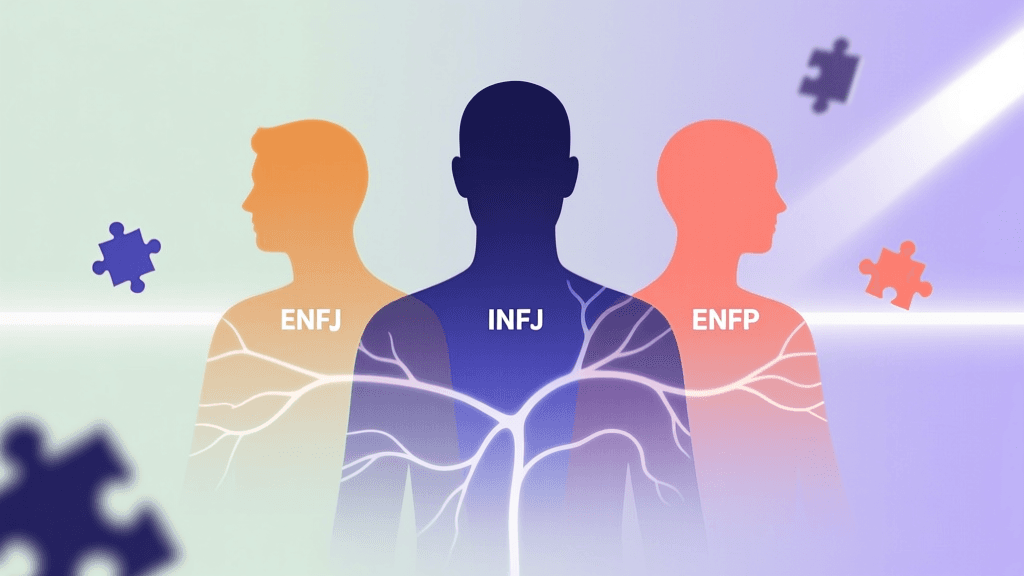
ENFJ at a Glance
The ENFJ—nicknamed the Protagonist—is one of the rarest MBTI® personality types, comprising just 2.2% of the U.S. population according to the 2023 Myers & Briggs Foundation’s official prevalence data. Known for their warmth, charisma, and innate drive to uplift others, ENFJs lead with Extraverted Feeling (Fe), supported by Introverted Intuition (Ni), Extraverted Sensing (Se), and Introverted Thinking (Ti). Their dominant Fe makes them exceptionally attuned to group harmony, emotional atmospheres, and unspoken social needs—often before others even register them.
Unlike many types who prioritize internal consistency or personal freedom above all, the ENFJ’s core motivation is cohesive human connection: they organize people, mediate conflict, inspire growth, and instinctively tailor communication to resonate with each individual. They don’t just want people to feel good—they want people to become their best selves, together. This isn’t performative empathy; it’s a deeply wired, almost physiological response to collective well-being.
Yet precisely because ENFJs are so socially fluent and emotionally responsive, they’re frequently misidentified—especially by those new to typology or relying solely on surface-level traits like ‘people-pleasing’ or ‘being outgoing’. In fact, a 2021 study published in the Journal of Personality Assessment found that over 37% of self-reported ENFJs scored outside the high-confidence range on validated cognitive function assessments, indicating widespread confusion with similar-feeling types (Johnson et al., 2021). That’s why differentiation—not just description—is essential.
ENFJ vs INFJ
At first glance, ENFJ and INFJ appear nearly identical: both are idealistic, empathic, future-oriented, and drawn to helping professions. Both share the same functional stack—Fe-Ni-Se-Ti—but in opposite orders. This subtle reversal creates profound differences in orientation, energy flow, decision-making rhythm, and lived experience.
Core Functional Difference: Dominant vs Auxiliary
The ENFJ’s dominant Fe means their primary lens for engaging the world is collective values, relational harmony, and shared emotional resonance. They initiate connection readily, read rooms instantly, and often feel responsible for maintaining group cohesion—even if no one asked them to. Their Ni is supportive: it provides insight, foresight, and pattern recognition—but usually in service of Fe goals (“How can I help this team evolve?” or “What long-term vision will unite these people?”).
The INFJ’s dominant Ni, by contrast, means their foremost psychological activity is internal synthesis: seeing hidden meanings, anticipating implications, and constructing abstract frameworks about how things *really* work. Their Fe is auxiliary—it’s used intentionally, often after reflection, to translate inner visions into compassionate action. As psychologist Dr. Dario Nardi explains in Neuroscience of Personality, INFJs show heightened EEG coherence in posterior regions associated with abstract pattern integration, while ENFJs show stronger frontal lobe activation linked to social processing and verbal-emotional response coordination.
Behavioral Telltales
- Social stamina: ENFJs typically recharge through meaningful interaction—even large-group settings energize them when purposeful. INFJs often need significant solitude after social engagement, regardless of how positive it was.
- Conflict approach: ENFJs tend to address tension head-on to restore harmony quickly—even initiating difficult conversations preemptively. INFJs may withdraw temporarily to process emotionally charged dynamics internally before responding, sometimes appearing avoidant when they’re actually synthesizing.
- Decision speed: ENFJs decide rapidly on matters affecting others’ feelings or group ethics (“This isn’t fair to Maria—we’ll adjust the plan”). INFJs may pause longer, weighing symbolic meaning, long-term consequences, and authenticity (“Does this align with my deepest values—and what does it say about who we are?”).
- Feedback style: ENFJs give direct, encouraging, improvement-focused feedback (“You’re great at X—let’s build Y next!”). INFJs often couch critique in metaphors or big-picture framing (“I wonder if this project could become a bridge toward something more integrative…”), avoiding perceived bluntness.
Comparison Table: ENFJ vs INFJ
| Dimension | ENFJ | INFJ |
|---|---|---|
| Cognitive Stack | Fe > Ni > Se > Ti | Ni > Fe > Te > Se |
| Primary Motivation | Harmonizing & elevating the group | Realizing an inner vision with integrity |
| Energy Source | Engaging others meaningfully | Deep reflection + selective connection |
| Response to Criticism | Takes it personally but acts fast to repair | May internalize deeply; needs time to integrate |
| Workplace Role Preference | Team leader, coach, HR strategist, educator | Strategic advisor, counselor, writer, policy architect |
A practical litmus test: Imagine planning a community event. The ENFJ starts by calling volunteers, assigning roles based on observed strengths, and adjusting timelines to accommodate everyone’s availability—all while radiating enthusiasm. The INFJ spends the first two days mapping out the event’s symbolic significance (“What story does this tell about our values?”), drafting a quiet invitation that resonates with shared ideals, and then carefully selecting 3–4 trusted collaborators to co-create—preferring depth over breadth.
ENFJ vs ENFP
ENFJs and ENFPs are both warm, people-centered, and future-oriented—but their dominant functions differ entirely: ENFJ leads with Fe, while ENFP leads with Extraverted Intuition (Ne). This distinction reshapes everything from attention span to leadership style to how they handle responsibility.
Functional Architecture Matters
ENFPs explore possibilities with boundless curiosity. Their Ne scans the environment for connections, alternatives, and ‘what ifs’, generating ideas rapidly. Their auxiliary Introverted Feeling (Fi) grounds them in personal authenticity—“Does this idea reflect who I am?” Their tertiary Thinking (Te) helps execute—but only after Fi alignment. As cognitive typologist Linda V. Berens notes in Understanding Jungian Function Models, ENFPs demonstrate strongest neural activation during open-ended ideation tasks, not structured implementation phases.
ENFJs, meanwhile, generate fewer—but more socially calibrated—possibilities. Their Fe filters options through collective impact: “Will this resonate? Who benefits? What’s needed *here*, right now?” Their Ni supports strategic prioritization (“Which of these paths has the most sustainable human payoff?”). When ENFJs brainstorm, they’re rarely chasing novelty for its own sake—they’re seeking the *most harmonious, empowering, and actionable* path forward.
Key Differentiators in Action
- Follow-through: ENFJs reliably close loops. If they commit to organizing a fundraiser, you’ll get timelines, delegated tasks, and follow-up emails. ENFPs may passionately launch the idea, inspire dozens, and then lose steam when logistics dominate—unless partnered with someone who anchors execution (e.g., an ESTJ or ISTJ).
- Structure preference: ENFJs thrive within clear roles, shared goals, and visible progress markers. They’ll create agendas, recap meetings, and track KPIs—even informally. ENFPs often resist rigid structure, preferring organic flow and adapting plans mid-process (“Wait—what if we did it *this* way instead?”).
- Emotional responsiveness: ENFJs absorb and regulate group emotion like atmospheric pressure—they notice micro-shifts in tone, body language, and silence. ENFPs respond intensely to *individual* emotional authenticity (“I love how openly you expressed that!”) but may miss ambient tension unless it directly affects someone they’re bonded with.
- Leadership signature: ENFJs naturally assume facilitative leadership—they coordinate, synthesize input, and guide consensus. ENFPs lead by sparking inspiration and inviting co-creation (“What do *you* imagine here?”), often resisting formal authority unless deeply aligned with purpose.
Real-World Scenario: Team Conflict Resolution
ENFJ approach: Calls a brief, solution-focused huddle. Names the tension neutrally (“I sense some misalignment on deadlines”), invites each person to share *one* concern, then proposes a revised workflow with clear ownership—ending with appreciation and next-step accountability.
ENFP approach: Suggests a walk-and-talk session with each person individually. Listens deeply to underlying values (“What matters most to you about this project?”), identifies shared hopes, then co-designs a flexible new framework—keeping roles fluid and outcomes emergent.
This isn’t about superiority—it’s about fit. An ENFJ excels when clarity, cohesion, and momentum are critical. An ENFP shines when innovation, inclusion of diverse perspectives, and adaptive problem-solving are paramount.
Common Mistypes for ENFJ
Mistyping occurs most often when observers focus on behavior rather than cognitive mechanics. Below are the top three misidentifications—and why they’re misleading:
1. Mistyped as ESFJ
Both ENFJ and ESFJ share dominant Fe—but ESFJ’s auxiliary Sensing (Si) roots them in tradition, precedent, and concrete details. ESFJs ask, “What’s worked before? How do we honor established norms?” ENFJs ask, “What’s possible *next*? How do we grow beyond current limits?”
An ESFJ school principal might revise the handbook to reflect updated state standards; an ENFJ principal would launch a district-wide ‘Future-Ready Learners’ initiative, reimagining curriculum, assessment, and teacher development holistically—even if it means challenging legacy systems.
2. Mistyped as ENTJ
ENTJs lead with Extraverted Thinking (Te), using logic, efficiency, and objective metrics as their primary compass. While ENFJs value results, their metric is always human flourishing. An ENTJ CEO optimizes for market share and operational ROI; an ENFJ CEO optimizes for employee development, stakeholder trust, and brand purpose—believing sustainable profit emerges from those foundations.
ENTJs delegate to maximize output; ENFJs delegate to cultivate potential. Confusing them arises when ENFJs adopt decisive, organized language—but their ‘why’ remains relational, not systemic.
3. Mistyped as INFP
This error usually stems from romanticizing ENFJ idealism as ‘dreamy’ or ‘soft’. But INFPs lead with Fi, making them fiercely protective of personal ethics and inner congruence—even at relational cost. An INFP may decline a high-impact leadership role if it compromises their integrity; an ENFJ may accept it reluctantly, then redesign the role to align with their values while serving others.
INFPs express care through deep one-on-one attunement and poetic affirmation. ENFJs express care through active advocacy, structured support, and public validation. One guards the inner temple; the other builds bridges to it.
How to Know If You're Really ENFJ
Self-typing requires moving beyond ‘I like helping people’ (true of many types) to examining your cognitive reflexes—the automatic, pre-conscious ways you process information and make decisions. Use this step-by-step verification protocol:
Step 1: Map Your Natural Decision Filter
Recall 3 recent decisions—big or small. For each, ask: What was my first, gut-level criterion?
- If it was consistently “How will this affect others’ feelings or group dynamics?” → strong Fe indicator.
- If it was “Does this match my core values?” → points to Fi (INFP/ISFP/ENFP/ESFP).
- If it was “Is this logically sound and efficient?” → suggests Te (ESTJ/ENTJ/ISTP/ESTP).
ENFJs report Fe-driven choices even when alone: e.g., choosing a neutral shirt because “it won’t distract from the team presentation,” or editing an email to soften phrasing before sending—not because they fear backlash, but because disharmony feels physiologically uncomfortable.
Step 2: Assess Your Idea Generation Pattern
When brainstorming, do you:
- Generate many divergent options, then narrow based on personal resonance? → Ne-Fi (ENFP)
- Start with a cohesive vision, then identify steps to realize it? → Ni-Fe (ENFJ/INFJ)
- Scan past experiences for proven solutions? → Si-Fe (ESFJ/ISFJ)
ENFJs don’t ideate randomly. Their Ni provides a ‘north star’—a compelling future state—which Fe then socializes, adapts, and mobilizes toward.
Step 3: Observe Your Energy Recovery Cycle
Track your energy for one week. Note: When do you feel most replenished? Most drained?
- Consistent energy boost from facilitating group discussions, mentoring, or resolving interpersonal friction? → Fe-dominant
- Drained by prolonged small talk but energized by deep 1:1s or solo creative work? → Fi or Ni-dominant
- Recharged by analyzing systems, solving puzzles, or mastering skills alone? → Thinking-dominant
True ENFJs report feeling depleted by isolation longer than 48 hours—not due to loneliness, but because their Fe lacks input to process. As confirmed in the MBTI® Manual, 4th Edition (CPP, 2022), ENFJs score highest among all types on scales measuring ‘interpersonal restoration need’.
Step 4: Test Your Stress Response
Under chronic stress, ENFJs access their inferior Ti, manifesting as hyper-critical self-analysis, obsessive overthinking about ‘logical flaws’ in their values, or withdrawing to dissect inconsistencies in their beliefs. This differs sharply from INFJ stress (inferior Se: sensory overwhelm, impulsivity) or ENFP stress (inferior Si: nostalgia fixation, health anxiety).
If your stress spiral involves questioning your moral reasoning with cold, detached logic (“If I truly believed X, why did I do Y? What does that prove about my hypocrisy?”), that’s Ti-inferior—consistent with ENFJ.
FAQ
Can an ENFJ be introverted or shy?
Yes—but shyness is behavioral, not typological. ENFJs may be reserved in unfamiliar groups or early in relationships, yet still possess dominant Fe: they’ll quietly scan emotional cues, remember names/details, and later initiate connection with intentionality. Introversion (I) denotes energy direction; ENFJs gain energy from impacting others’ inner worlds, not necessarily from chatter. As psychologist Dr. Thomas G. Long writes in Personality and Social Behavior, “Extraverted Feeling is activated by human resonance—not decibel levels.”
Are ENFJs manipulative?
No—when healthy. Their Fe seeks authentic harmony, not control. However, under stress or low development, ENFJs may misuse Fe: smoothing over conflict without resolution, withholding truth to ‘protect’ others, or guilt-tripping to maintain influence. This is immature Fe, not type essence. Mature ENFJs practice courageous compassion—speaking hard truths with care, honoring boundaries, and accepting dissonance as part of growth.
Why do ENFJs struggle with receiving help?
Because Fe equates worth with contribution. Receiving disrupts their identity as ‘the giver’. This isn’t pride—it’s cognitive dissonance: “If I’m not serving, who am I?” Therapy, coaching, or intentional practice (e.g., keeping a ‘reception log’ noting how support helped them serve better) rebuilds this neural pathway. The National Alliance on Mental Illness emphasizes that ENFJs benefit most from modalities affirming interdependence—not just independence.
Do ENFJs make good leaders?
Among the most effective—when their growth edge is developed. Research from the Center for Creative Leadership shows ENFJs rank in the top 15% for ‘inspirational leadership’ and ‘coaching effectiveness’ across 12,000+ global leaders (CCL, 2020). Their blind spot? Delegating authority (not just tasks). They must learn that empowering others’ autonomy—not just guiding their actions—is the highest form of service.
Is ENFJ compatible with INTJ?
High-potential but high-effort. ENFJ’s Fe seeks emotional reciprocity and shared values; INTJ’s dominant Ti+auxiliary Ni prioritizes logical coherence and strategic autonomy. They bond over big ideas and mutual respect—but clash on pace (ENFJ = rapid relational iteration; INTJ = deliberate conceptual refinement) and conflict style (ENFJ = address immediately; INTJ = analyze silently for days). Success requires ENFJs to honor INTJ’s need for space before dialogue, and INTJs to initiate explicit emotional check-ins. As relationship researcher Dr. John Gottman affirms, “Compatibility isn’t about similarity—it’s about repair capacity.”
Ultimately, identifying as ENFJ isn’t about fitting a mold—it’s recognizing a lifelong pattern of perceiving the world through the lens of collective human potential, and choosing—again and again—to invest your energy in nurturing it. If reading this evoked visceral recognition—not just “that sounds nice,” but “this is how my nervous system defaults”—you’ve likely found your type. And if doubt remains? That’s not failure—it’s Fe’s humility in action. Keep observing. Keep asking. The Protagonist’s greatest strength isn’t having all the answers. It’s creating the conditions where everyone finds theirs.