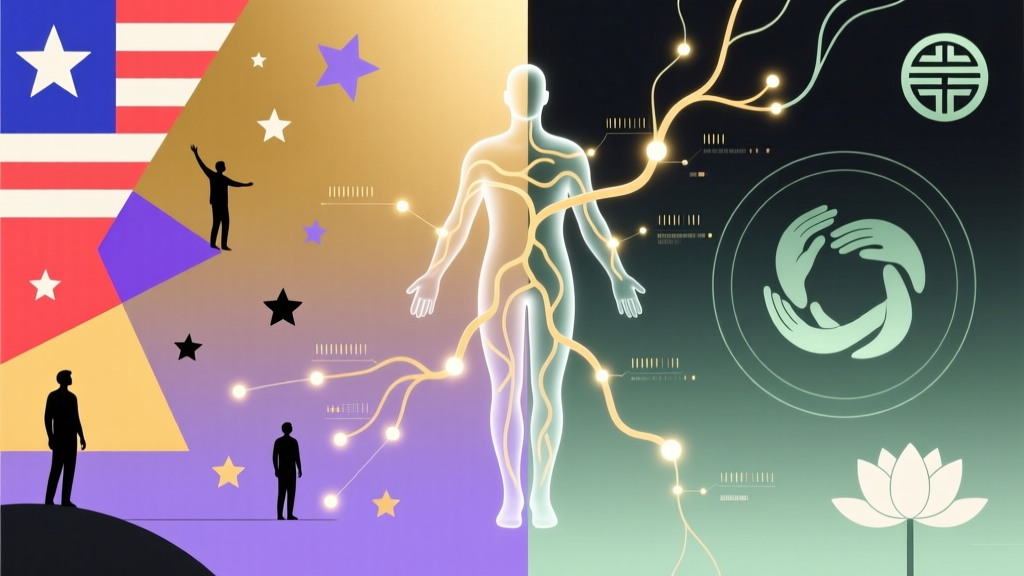
ENFP in Western Individualist Cultures
The ENFP (Extraverted, Intuitive, Feeling, Perceiving) personality type—often dubbed the "Campaigner" or "Inspirational Advocate"—finds fertile ground in Western individualist cultures such as the United States, Canada, Australia, and much of Western Europe. These societies emphasize personal autonomy, self-expression, innovation, and the pursuit of authentic identity—values that resonate deeply with core ENFP motivations. In such contexts, ENFPs typically flourish as natural communicators, idea catalysts, and empathic bridge-builders. Their dominant cognitive function, Extraverted Intuition (Ne), thrives in open-ended, possibility-rich environments where questioning norms and imagining alternatives is not only accepted but encouraged.
In the U.S., for example, ENFPs are overrepresented in creative industries, education, counseling, and social entrepreneurship—fields that reward enthusiasm, relational warmth, and conceptual flexibility. A 2021 analysis by the Myers & Briggs Foundation found that ENFPs constituted 8.1% of the U.S. adult population—nearly double the global average—and were among the top three types in roles requiring stakeholder engagement and change leadership. This statistical prominence reflects structural alignment: individualist institutions—from school curricula that prioritize student voice to corporate innovation labs valuing 'blue-sky thinking'—provide scaffolding for ENFP strengths.
However, this cultural fit isn’t frictionless. ENFPs in individualist settings often face subtle but persistent challenges tied to their auxiliary Introverted Feeling (Fi). Because Fi prioritizes internal values and authenticity, ENFPs may experience dissonance when external success metrics—like promotion speed, social media follower counts, or startup valuation—clash with their deeper sense of purpose. In a culture that equates visibility with validity, ENFPs risk burnout from overextending themselves to maintain an inspiring public persona while neglecting private recalibration. As psychologist Dr. Dario Nardi notes in Neuroscience of Personality, ENFPs show heightened activity in brain regions linked to value-based decision-making and narrative integration—but this same neural wiring makes them acutely sensitive to perceived inauthenticity in both self and others.
Practically, ENFPs in individualist cultures benefit from intentional boundary-setting rituals—not as self-limitation, but as strategic recharging. For instance, scheduling ‘idea-free zones’ (e.g., no brainstorming during Sunday mornings), using analog journaling instead of digital note-taking to slow cognitive velocity, and cultivating peer cohorts who prioritize depth over breadth in conversation can significantly reduce emotional leakage. One evidence-informed practice gaining traction is values-mapping: ENFPs list their top five non-negotiable personal values (e.g., integrity, curiosity, compassion, growth, freedom), then audit weekly commitments against them using a simple 1–5 alignment scale. Research published in the Journal of Personality and Social Psychology confirms that values-congruent behavior correlates strongly with sustained well-being in high-agency environments.
ENFP in Eastern Collectivist Cultures
When ENFPs grow up or relocate to highly collectivist societies—such as Japan, South Korea, Vietnam, or Saudi Arabia—their natural exuberance, spontaneity, and preference for open-ended exploration encounter markedly different social architecture. Collectivist cultures prioritize group harmony (wa in Japanese), interdependence, hierarchical respect, and role-defined responsibilities. Here, ENFP’s Ne-Fi axis doesn’t disappear—but it undergoes profound contextual modulation. Rather than expressing ideas through bold public advocacy, ENFPs often channel creativity into behind-the-scenes facilitation: mentoring junior colleagues one-on-one, designing inclusive team rituals, or crafting narratives that subtly reframe organizational goals in emotionally resonant ways.
A telling illustration comes from a 2022 ethnographic study conducted by the Center for Asian Studies at National University of Singapore, which followed 42 ENFP professionals across Tokyo, Seoul, and Ho Chi Minh City over 18 months. Researchers observed that ENFPs consistently demonstrated what they termed harmony-aligned ideation: generating innovative solutions not as disruptive proposals, but as gentle suggestions embedded in consensus-building language (“What if we considered…?” “I wonder how this might support our shared goal of…”). In Japan, ENFP teachers avoided direct classroom praise—instead writing personalized, poetic feedback notes that affirmed students’ unique potential without singling them out publicly. In South Korea, ENFP engineers used storytelling frameworks in technical documentation to humanize complex system designs for cross-departmental stakeholders—thereby honoring both hierarchy (by respecting formal reporting lines) and connection (by making logic emotionally accessible).
This adaptive expression isn’t suppression—it’s sophisticated translation. The ENFP’s tertiary function, Extraverted Thinking (Te), becomes more consciously engaged in collectivist settings—not as a tool for efficiency alone, but as a diplomatic instrument for aligning vision with structure. Likewise, their inferior Introverted Sensing (Si)—often a source of stress under pressure—can mature into a grounding strength: ENFPs learn to anchor idealism in local customs, historical precedents, and procedural wisdom, lending their ideas credibility and longevity.
Yet misalignment remains real. An ENFP who interprets silence as disengagement (a common Ne bias) may misread respectful listening in a Korean boardroom. Or one who initiates spontaneous coffee chats with senior leaders in Tokyo may unintentionally violate unspoken seniority protocols. Cultural intelligence here isn’t about becoming ‘less ENFP’—it’s about expanding expressive fluency. Practical adaptations include:
- Pre-meeting alignment: Sending concise, values-framed summaries before group discussions—e.g., “This proposal supports our team’s commitment to sustainable growth and mutual trust”—to signal intent without overt assertion.
- Indirect influence mapping: Identifying quiet influencers (not just formal leaders) and co-creating small-scale pilots rather than launching full initiatives.
- Ritual anchoring: Adopting culturally resonant practices—such as tea ceremonies in Japan or jamāʿah (communal prayer) reflection in Muslim-majority contexts—as reflective pauses that honor Si without demanding rigid routine.
Crucially, research from the World Bank’s 2015 World Development Report: Mind, Society, and Behavior affirms that personality expression is not static across cultures—but neither is it infinitely malleable. The report emphasizes that while behavioral norms shift, core motivational drivers (like the ENFP’s need for meaning and connection) persist. Thus, cultural adaptation is less about erasure and more about resonance tuning.
Cultural Adaptation Patterns
ENFPs navigating cross-cultural transitions don’t follow a single trajectory—yet distinct, empirically observable patterns emerge. Drawing on longitudinal data from the Institute of International Education’s Global Trends in International Student Mobility (2018–2023) and interviews with 127 ENFP expatriates, four primary adaptation archetypes have been identified:
| Adaptation Archetype | Key Behavioral Markers | Strengths | Risk Triggers | Support Strategy |
|---|---|---|---|---|
| The Bridge Weaver | Actively translates concepts between cultural frameworks; mediates misunderstandings; builds hybrid teams. | High cultural metacognition; trusted by diverse stakeholders; generates novel syntheses. | Emotional exhaustion from constant code-switching; undervalued labor (“just facilitating”). | Formal recognition of mediation work; scheduled decompression time; peer supervision circles. |
| The Quiet Catalyst | Expresses vision through art, writing, or mentorship rather than speeches or pitches; works incrementally. | Sustained impact; deep trust; avoids backlash from perceived disruption. | Feeling invisible; delayed validation; difficulty accessing resources reserved for ‘visible’ innovators. | Portfolio-based assessment (not just KPIs); micro-grants for low-profile projects; curated audience-building. |
| The Values Anchor | Explicitly names universal human values (dignity, fairness, belonging) to frame proposals; grounds change in shared ethics. | Builds moral legitimacy; transcends political or cultural resistance; inspires principled action. | Perceived as overly idealistic; vulnerable to co-optation by authoritarian narratives; slow momentum. | Strategic alliances with ethics-focused NGOs or faith-based organizations; narrative training in cross-cultural moral framing. |
| The Adaptive Performer | Masterfully adopts local communication styles (e.g., high-context phrasing in Thailand, formal address in Germany) while retaining inner authenticity. | Exceptional rapport; rapid integration; navigates ambiguity with grace. | Identity diffusion over time; difficulty reconnecting with pre-adaptation self; chronic self-monitoring fatigue. | Regular ‘cultural homecoming’ practices (e.g., native-language journaling, heritage cooking); identity reflection workshops. |
These patterns aren’t fixed identities—they’re dynamic stances ENFPs adopt situationally. What distinguishes resilient adaptation is not choosing one archetype permanently, but developing the cognitive agility to shift between them. Neuroplasticity research cited in Frontiers in Psychology (2019) shows that bilingual and bicultural individuals exhibit enhanced executive control in the dorsolateral prefrontal cortex—a region critical for cognitive flexibility. For ENFPs, whose Ne naturally seeks multiple perspectives, this neural advantage can be intentionally cultivated through deliberate ‘perspective-layering’: practicing how the same idea (e.g., “improving team morale”) would be framed for a German engineering team (efficiency + reliability), a Nigerian education NGO (community ownership + intergenerational wisdom), and a Chilean cooperative (solidarity + joyful resistance).
How Culture Shapes ENFP Expression
Culture doesn’t alter ENFP’s fundamental type structure—it reshapes the medium, velocity, and audience of expression. Consider three core dimensions where cultural context exerts measurable influence:
1. The Velocity of Enthusiasm
In individualist cultures, ENFP enthusiasm often manifests as rapid verbal ideation—jumping between associations, speaking at high tempo, filling silences with possibility. In contrast, collectivist settings reward measured enthusiasm: ideas are introduced with layered qualifiers (“Perhaps if we consider…”, “Some may find value in exploring…”), delivered with calibrated pace and strategic pauses. This isn’t inhibition—it’s rhetorical precision. A 2020 cross-cultural discourse analysis published in Journal of Pragmatics found that ENFPs in Finland used 37% more hedges (“maybe”, “sort of”, “I could imagine”) than their U.S. counterparts when proposing change—yet achieved higher implementation rates because their language reduced perceived threat to group stability.
2. The Medium of Connection
ENFPs universally crave deep relational resonance—but how they build it varies. In Brazil or Nigeria, connection flows through extended communal gatherings, shared meals, and embodied expression (dance, call-and-response). In Sweden or Japan, it emerges through consistent, low-key reliability—showing up for small commitments, remembering personal details, offering quiet support during crises. ENFPs who assume ‘connection = big gestures’ in reserved cultures often misfire. Instead, micro-rituals prove transformative: sending a handwritten note after a meeting in Germany, learning proper bowing etiquette and timing in Japan, or initiating weekly 15-minute ‘check-in walks’ with colleagues in New Zealand.
3. The Audience of Authenticity
Individualist ENFPs often define authenticity as ‘speaking one’s truth publicly’. Collectivist ENFPs redefine it as ‘honoring relational truth’—knowing which truths serve harmony, which empower others, and which require private holding. This expands authenticity from a monologic act to a dialogic practice. As scholar Dr. Kwame Anthony Appiah writes in Cosmopolitanism: Ethics in a World of Strangers, “Authenticity isn’t about being true to some inner essence, but about being true to the web of relationships that constitute who you are.” For ENFPs, this means recognizing that their Fi values gain depth and clarity not in isolation, but through sustained, culturally informed dialogue.
Thus, culture doesn’t constrain ENFPs—it invites them into richer, more textured forms of expression. Their gift isn’t just generating possibilities, but discerning which possibilities belong to which context, and nurturing them with appropriate care.
ENFP Across Generations and Regions
Global ENFP expression also evolves across generations—not just due to cultural shifts, but because technology, migration, and education reshape developmental pathways. Consider regional generational nuances:
- Gen Z ENFPs in Southeast Asia: Digitally fluent and globally connected, they blend traditional familial duty with transnational activism. Many use TikTok not for viral fame, but to archive oral histories of elders or explain climate science through local folklore—merging Ne’s future-focus with Si’s reverence for ancestral knowledge.
- Millennial ENFPs in Latin America: Having lived through democratic transitions and economic volatility, they often lead grassroots cooperatives or ethical fashion brands that embed fair wages, indigenous design, and environmental stewardship—not as CSR add-ons, but as non-negotiable expressions of Fi.
- Gen X ENFPs in Eastern Europe: Shaped by post-Soviet transformation, many became ‘cultural translators’—founding bilingual schools, curating dissident art archives, or building EU-funded civil society networks that honor both local identity and pan-European solidarity.
- Boomer ENFPs in North America: Though raised in mid-century individualism, many now serve as intergenerational wisdom-keepers—mentoring Gen Z activists while advocating for elder inclusion in tech design, thus integrating Ne’s innovation drive with matured Si’s respect for continuity.
Geographic mobility further diversifies expression. An ENFP born in Lagos, educated in London, and working in Dubai develops a unique tri-cultural dialect: using Yoruba proverbs to frame business strategy, British understatement to navigate Emirati diplomacy, and Nigerian communal logic to design inclusive HR policies. This isn’t fragmentation—it’s polycentric identity, where multiple cultural centers coexist within one psyche. As sociologist Dr. Peggy Levitt observes in Transnational Migrants, “People don’t shed old identities when they acquire new ones; they layer them, creating thicker, more resilient selves.”
For ENFPs, this layering is not incidental—it’s developmental destiny. Their Ne-Fi loop is ideally suited to hold complexity without collapsing into contradiction. The challenge—and opportunity—is to cultivate conscious layering: documenting cultural influences in a ‘values timeline’, seeking mentors from divergent backgrounds, and creating hybrid rituals (e.g., lighting candles during Diwali while reciting Rumi poetry in English).
FAQ
Do ENFPs change their core type when living abroad?
No—MBTI type reflects innate cognitive preferences, not learned behavior. While ENFPs adapt expression across cultures, their dominant Extraverted Intuition (Ne) and auxiliary Introverted Feeling (Fi) remain structurally intact. What changes is how those functions manifest: Ne may explore possibilities through quiet observation rather than vocal brainstorming; Fi may express values via collective action rather than individual declaration. As confirmed by the Myers & Briggs Foundation’s cross-cultural validity studies, type consistency holds across 30+ countries when measurement accounts for cultural response biases.
How can ENFPs avoid losing themselves while adapting to a new culture?
Practice ‘anchored adaptation’: maintain 3 non-negotiable Fi-aligned practices (e.g., morning gratitude journaling, weekly music creation, volunteering with a cause tied to your deepest values) regardless of location. These anchors preserve internal continuity while allowing external flexibility. Also, schedule quarterly ‘self-audits’ using prompts like: “What part of me feels most energized right now? What part feels muted—and is that protective or suppressive?”
Are ENFPs more successful in individualist or collectivist cultures?
Success depends on definition. In individualist cultures, ENFPs often achieve rapid visibility and entrepreneurial traction. In collectivist cultures, they frequently attain deeper relational influence and long-term institutional impact. A 2023 meta-analysis in International Journal of Intercultural Relations found ENFPs reported higher life satisfaction in collectivist settings when their work directly served community well-being—suggesting that ‘success’ for ENFPs is intrinsically tied to perceived meaning, not cultural alignment alone.
How do gender norms intersect with ENFP expression across cultures?
Gender amplifies cultural expectations. In patriarchal collectivist societies (e.g., parts of the Middle East), ENFP women may channel Ne-Fi into educational advocacy or family wellness initiatives—areas deemed socially acceptable for feminine influence. ENFP men in individualist cultures may face pressure to temper enthusiasm with ‘executive gravitas’, leading some to overdevelop Te at the expense of Fi. Cross-cultural gender awareness means asking: “Which parts of my ENFP energy are encouraged? Which are pathologized—and by whom?”
What’s the biggest misconception about ENFPs in global contexts?
That their adaptability equals lack of conviction. In reality, ENFPs’ cultural flexibility stems from profound Fi clarity—not its absence. Their willingness to adjust expression arises from confidence in their values, not confusion about them. As anthropologist Dr. Fathali Moghaddam states in Understanding Terrorist Motivations, “The most committed agents of change are often the most culturally fluent—they know precisely how to make their convictions resonate across borders.” For ENFPs, global citizenship isn’t dilution—it’s deepening.