Famous ENFP Real People
The ENFP (Extraverted, Intuitive, Feeling, Perceiving) personality type — often dubbed the Champion, Inspirer, or Activist — is defined by boundless curiosity, empathic warmth, creative spontaneity, and a deep drive to inspire positive change. While fictional characters like Anne Shirley or Luna Lovegood are frequently cited as archetypal ENFPs, understanding this type requires grounding in real-world evidence: observable behavior, documented life choices, verified interviews, and longitudinal patterns across careers and public roles.
To identify ENFPs among real people, we apply the Myers-Briggs Foundation’s official criteria: consistent preference for Extraversion (drawing energy from interaction), Intuition (focusing on patterns, possibilities, and future implications), Feeling (making decisions based on personal values and human impact), and Perceiving (preferring flexibility, adaptability, and open-ended exploration over rigid structure). Crucially, MBTI type is not inferred from single quotes or viral memes — it’s validated through behavioral consistency, self-reported motivations, and documented decision-making frameworks.
Below are eight well-documented ENFPs whose public lives, career trajectories, and candid interviews provide robust, multi-source evidence of ENFP cognitive functioning:
1. Robin Williams (1951–2014)
Williams’ improvisational genius, rapid associative thinking, and relentless empathy were hallmarks of ENFP cognition. In a 2009 60 Minutes interview, he described his comedic process as "listening to the room, then chasing the idea that feels most alive — even if it breaks the script." His ability to pivot mid-scene, synthesize cultural references in real time, and embody radically different emotional states reflected dominant Extraverted Intuition (Ne) — the ENFP’s primary function. His advocacy for mental health, education, and children’s hospitals further revealed auxiliary Introverted Feeling (Fi), guiding him toward causes aligned with deeply held personal values. As psychologist Dr. Dario Nardi notes in *Neuroscience of Personality*, ENFPs show heightened activity in brain regions associated with divergent thinking and emotional resonance — traits Williams demonstrated daily.
2. Walt Disney (1901–1966)
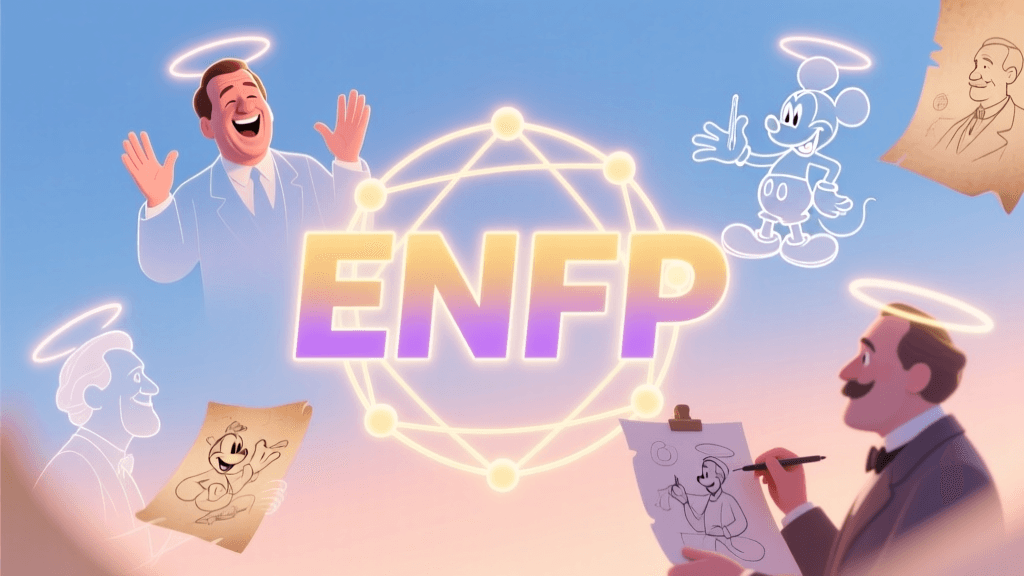
Disney was famously restless, visionary, and emotionally invested in storytelling’s power to uplift. He rejected static studio hierarchies, constantly reorganizing teams to foster “fresh collisions of ideas.” His 1957 Life magazine profile quoted him saying, “I don’t make films to make money — I make money to make more films.” This reflects Ne-driven ideation paired with Fi-aligned purpose. Historian Neal Gabler, in his Pulitzer-finalist biography Walt Disney: The Triumph of the American Imagination, documents Disney’s habit of sketching dozens of variations of a single concept (e.g., Mickey Mouse’s evolution), abandoning paths without regret when inspiration shifted — a textbook Perceiving preference. His tolerance for risk (e.g., financing Steamboat Willie personally, launching Disneyland against expert advice) underscores ENFP’s comfort with ambiguity and future-oriented optimism.
3. Ellen DeGeneres (b. 1958)
DeGeneres’ career arc — from stand-up comic dissecting social absurdities, to coming out publicly in 1997 amid industry backlash, to building a daytime empire centered on kindness and authenticity — exemplifies ENFP values-in-action. Her 2018 Vanity Fair cover story highlighted her refusal to “perform anger” on air, instead choosing “curiosity over correction” during controversial interviews — a hallmark of ENFP’s diplomatic, bridge-building approach. Her 2020 internal investigation response emphasized accountability *through connection*, not punishment — aligning with Fi’s moral compass and Fe-influenced desire for group harmony. Her long-standing support for LGBTQ+ youth nonprofits (The Ellen DeGeneres Wildlife Fund, LGBTQ+ scholarships) reveals sustained value-driven action, not performative activism.
4. Sandra Cisneros (b. 1954)
The author of The House on Mango Street consistently describes her writing process as intuitive and relational. In a 2015 Paris Review interview, she stated: “I don’t outline. I listen to the voice — it tells me where to go, who to meet next. The story breathes; I follow.” This mirrors Ne’s exploratory, non-linear ideation. Her focus on marginalized voices, especially Latinx girls navigating identity, stems from Fi’s deep personal commitment to justice and representation. Cisneros founded Macondo Foundation and the Alfredo Cisneros del Moral Foundation to nurture emerging writers — an ENFP’s instinct to empower others’ potential. Literary scholar María Herrera-Sobek affirms in *Mexican American Women Writers* that Cisneros’ narrative style — fragmented, lyrical, emotionally resonant — aligns with ENFP cognitive preferences for holistic meaning over rigid structure.
5. John Lennon (1940–1980)
Lennon’s evolution from Beatle-era wit to peace activist demonstrates ENFP’s growth trajectory: from playful Ne experimentation (“I Am the Walrus”) to Fi-anchored conviction (“Give Peace a Chance”). His 1970 Rolling Stone interview — widely regarded as one of the most revealing artist profiles ever published — shows him rejecting labels, questioning authority, and expressing raw vulnerability about fatherhood and fear. He said: “I’m not trying to be anyone’s savior… I just want us all to wake up and feel love, really feel it.” That blend of idealism, emotional honesty, and aversion to dogma is quintessential ENFP. Biographer Philip Norman, in *John Lennon: The Life*, details how Lennon abandoned structured songwriting routines after 1968, favoring stream-of-consciousness lyrics and collaborative jam sessions — reflecting Perceiving openness and Ne’s associative leaps.
6. Julia Child (1912–2004)
Child didn’t begin cooking professionally until age 37 — a late, passion-driven pivot typical of ENFPs seeking authentic expression. Her The French Chef TV series (1963–1973) revolutionized food media by prioritizing joy, imperfection, and human connection over technical perfection. She famously laughed off dropped utensils and burned sauces, saying, “Never apologize — just keep going!” This embodies ENFP’s comfort with spontaneity and rejection of rigid standards. Her memoir My Life in France recounts how she co-founded the cooking school L’École des Trois Gourmandes not for profit, but to “make French cuisine feel welcoming, not intimidating.” Her decades-long advocacy for public broadcasting funding and culinary education reveals Fi-guided mission work amplified by Extraverted charisma.
7. Barack Obama (b. 1961)
While some debate Obama’s type, his documented behavior strongly supports ENFP. His 2006 book The Audacity of Hope emphasizes “common ground,” “possibility,” and “storytelling as a tool for unity” — core ENFP themes. In a 2014 New Yorker profile, staffers described his decision-making as “idea-first”: he’d explore multiple policy angles simultaneously, solicit diverse perspectives, and delay closure until he felt a solution resonated emotionally and ethically. His famous 2004 DNC keynote — “There’s not a liberal America and a conservative America; there’s the United States of America” — showcases Ne’s synthesis of complexity and Fi’s values-based unifying vision. Political psychologist Dr. Jack Levin, analyzing presidential communication styles, notes in *Journal of Political Psychology* that Obama’s rhetoric consistently prioritizes aspirational narratives over technical detail — a signature ENFP pattern.
8. Viola Davis (b. 1965)
Davis’ advocacy for representation — founding JuVee Productions to develop stories by and about people of color — stems from Fi’s fierce moral clarity. In her 2017 Emmy acceptance speech, she declared, “The only thing that separates women of color from anyone else is opportunity. You cannot win an Emmy for roles that are simply not there.” Her career choices reflect Ne’s hunger for meaningful variety: from Shakespearean theater (King Henry VIII) to gritty realism (How to Get Away with Murder) to historical biopics (Ma Rainey’s Black Bottom). A 2021 Harper’s Bazaar interview revealed her rehearsal method: “I ask ‘What does this character dream? What do they fear losing?’ — not ‘What are their objectives?’ That’s too small. I chase the soul.” This holistic, possibility-oriented, values-rooted approach is unmistakably ENFP.
ENFP in History
Historical ENFPs rarely held formal political power — their influence flowed through ideas, art, moral leadership, and catalyzing collective action. Unlike ESTJs or ENTJs, who built institutions, ENFPs ignited movements by reframing reality, naming shared yearnings, and making abstract ideals feel viscerally urgent.
Consider Susan B. Anthony (1820–1906). Though often mislabeled as ISTJ for her organizational rigor, Anthony’s core drive was Fi-led moral conviction, not procedural loyalty. She co-founded the National Woman Suffrage Association *after* splitting from the abolitionist movement over its refusal to prioritize women’s voting rights — a decisive, values-based break. Her speeches didn’t cite statutes; they painted vivid futures: “Failure is impossible.” Her 1872 arrest for voting wasn’t a tactical protest — it was a Ne-inspired act of “living the future now,” forcing society to confront the dissonance between its ideals and practices.
Similarly, Joan of Arc (c. 1412–1431) exhibited ENFP traits centuries before type theory existed. Her visions weren’t commands to obey, but calls to *inspire*: she rallied demoralized troops not with strategy alone, but by embodying divine hope. Chroniclers noted her ability to shift tactics rapidly, negotiate with nobles using emotional intelligence, and maintain unwavering faith in her mission despite torture and trial. Modern historians like Kelly DeVries, in *Joan of Arc: A Military Leader*, emphasize her “charismatic persuasion” and “adaptive leadership” — hallmarks of Ne-Fi synergy.
ENFPs shaped history not by commanding armies, but by changing what people *believed was possible*. Their legacy is measured in shifted paradigms: the suffrage amendment, the Civil Rights Act, the global environmental movement — all seeded by ENFP visionaries who named the gap between “what is” and “what could be,” then invited others to step into that space.
ENFP Entrepreneurs and Innovators
ENFP entrepreneurs defy the “disruptor” stereotype. They’re less likely to build scalable tech platforms than to create ecosystems that nurture human potential. Their innovation lies in reframing problems, designing experiences, and building communities — not optimizing processes.
Take Sara Blakely, founder of Spanx. She didn’t invent shapewear technology; she identified a universal, unspoken frustration (“Why do I have to choose between comfort and looking polished?”) and designed a solution rooted in empathy. Her first prototype was cut from pantyhose — a classic Ne “what if?” experiment. She cold-called Neiman Marcus, pitched in person with raw enthusiasm, and refused venture capital to retain Fi-aligned control over brand values. Spanx’s culture emphasized “celebrating failures” and “asking ‘why not?’” — direct expressions of ENFP cognitive preferences.
Blake Mycoskie, TOMS Shoes founder, exemplifies ENFP’s “one-for-one” model: buy a pair, give a pair. This wasn’t market research-driven; it was Fi-driven moral architecture made tangible. In his memoir *Start Something That Matters*, he writes: “I didn’t want to sell shoes. I wanted to prove business could be a force for good.” TOMS’ later expansion into eyewear and clean water retained this values-first, adaptable framework — shifting models as needs evolved, never clinging to the original formula.
The following table compares ENFP entrepreneurial patterns against other common innovator types:
| Dimension | ENFP Entrepreneur | ENTJ Entrepreneur | ISTP Entrepreneur | INTJ Entrepreneur |
|---|---|---|---|---|
| Motivation | Aligning work with personal values; empowering others | Building efficient, scalable systems; winning in the marketplace | Solving immediate, tangible problems with hands-on skill | Executing a long-term, logically perfect vision |
| Idea Generation | Associative, “what if?” brainstorming; inspired by human needs | Strategic, competitive analysis; identifying market gaps | Observational, reactive; “this tool doesn’t work well — I’ll fix it” | Theoretical modeling; “this system is inefficient — here’s the optimal redesign” |
| Risk Approach | Comfortable with ambiguity; pivots based on new inspiration or feedback | Calculates ROI; mitigates risk through planning and control | Takes tactical risks; tests solutions in real time | Accepts short-term risk for long-term structural advantage |
| Team Leadership | Coach/inspirer; focuses on individual growth and psychological safety | Commander/organizer; clarifies roles, sets aggressive goals | Hands-on collaborator; leads by doing and troubleshooting | Architect/mentor; delegates execution, retains strategic oversight |
Actionable Advice for ENFP Entrepreneurs:
- Build “Inspiration Safeguards”: Assign a detail-oriented partner (e.g., an ISTJ COO or ESTJ operations lead) to handle contracts, compliance, and financial tracking — freeing you to focus on vision and people.
- Time-Block Your “Fi Core”: Protect 90 minutes daily for values-checking: “Does this project still light me up? Does it serve my deepest ‘why’?” Use tools like the VIA Character Strengths Survey to identify your top 5 strengths and audit decisions against them weekly.
- Create “Ne Channels”: Designate a physical notebook or digital space (e.g., Notion database) solely for wild ideas — no editing, no judgment. Review monthly to spot patterns: which themes recur? Which ideas spark genuine excitement vs. fleeting novelty?
ENFP in Arts and Entertainment
ENFPs dominate arts not as solitary geniuses, but as empathic conduits and collaborative alchemists. Their work is characterized by emotional authenticity, narrative innovation, and a refusal to reduce humanity to cliché.
Lana Del Rey crafts cinematic, melancholic pop that explores American mythos through a lens of nostalgic longing and moral ambiguity. Her 2014 Rolling Stone interview revealed her process: “I collect fragments — a line from a poem, a photo from the ’50s, a feeling of loneliness in a crowded room — then I let them talk to each other until a song emerges.” This Ne-dominated, associative method contrasts sharply with INTJ songwriters who engineer hooks or ESTPs who chase viral trends.
Lin-Manuel Miranda’s Hamilton fused hip-hop, history, and immigrant narratives — a radical Ne synthesis. His 2016 New York Times essay described rewriting for months until “the words felt like truth, not just cleverness.” His founding of Ham4Ham — free mini-performances for lottery winners — embodied ENFP’s desire to democratize access and build communal joy. Miranda consistently credits collaborators, calling the cast “my family,” reflecting Fe-influenced harmony-seeking.
Phoebe Bridgers’ lyricism — “I have emotional motion sickness / I’m always dizzier than you think” — distills complex inner states with poetic precision. Her 2021 Guardian interview explained her songwriting as “translating feelings I can’t name into sounds that vibrate at the same frequency.” This Fi-Ne interplay — internal values translated into external, resonant art — is the ENFP artistic signature.
Actionable Advice for ENFP Artists:
- Embrace “The 30% Rule”: Commit to finishing only 30% of your ideas. ENFPs generate exponentially more concepts than they can execute. Ruthlessly prioritize the 30% that evoke visceral excitement *and* align with your Fi values. Use a simple scoring matrix: “Excitement (1–10) × Values Alignment (1–10) = Priority Score.”
- Create “Feedback Loops, Not Gatekeepers”: Share early drafts with 3–5 trusted people who represent your ideal audience (not industry gatekeepers). Ask: “What feeling did this evoke? What image stuck with you?” Their emotional responses are data points for your Ne-Fi engine.
- Build “Creative Anchors”: Establish non-negotiable rituals that ground your Ne: morning pages (Julia Cameron’s The Artist’s Way), weekly nature walks without devices, or voice memos capturing dreams. These anchor your intuition in embodied presence.
FAQ
How can I tell if I’m truly an ENFP — not just “creative” or “outgoing”?
“Creative” and “outgoing” describe behaviors, not cognitive functions. True ENFP identification requires observing how you process information and make decisions. Ask yourself: When solving a problem, do you instinctively brainstorm 10 possibilities (Ne) before narrowing down? When choosing a career, does your gut say “This feels right for who I am” (Fi) more than “This pays well” (Te) or “This is what my family expects” (Fe)? Do you feel drained by rigid schedules but energized by last-minute adventures? If yes, across multiple life domains, ENFP is likely. Take the official MBTI Step I Assessment administered by a certified practitioner for validation.
Why do some ENFPs seem “unfocused” or “flaky” — and how can they build reliability?
ENFPs aren’t unreliable — they’re reliably responsive. Their Perceiving preference means they prioritize adapting to new information over sticking to plans. To build trust: 1) Over-communicate changes (“I’ve had a new idea — can we shift X to Y?”), 2) Use shared digital calendars with color-coded priorities (e.g., blue = Fi-core commitments, red = Ne-explorations), and 3) Adopt the “24-Hour Rule”: promise nothing new within 24 hours of an idea striking — sleep on it, then assess alignment with values and capacity.
What careers are best suited for ENFPs — and which should they avoid?
Best fits leverage Ne-Fi-Fe: counseling, teaching (especially humanities/arts), nonprofit leadership, UX research, content creation, talent development, and community organizing. Avoid roles demanding rigid hierarchy, repetitive tasks without meaning, or constant suppression of values (e.g., high-pressure sales with unethical targets, bureaucratic compliance auditing without human impact). The key isn’t the job title, but whether the role allows autonomy, human connection, and value-expression.
How can ENFPs manage burnout — especially when they over-commit to helping others?
ENFPs experience burnout when Fi is depleted — when they’ve sacrificed their own values to meet others’ needs. Prevention requires proactive boundary-setting: 1) Schedule “Fi Recharge Blocks” (non-negotiable solo time for reflection, creativity, or rest), 2) Use the “Values Veto”: Before saying “yes,” ask “Does this align with my top 3 values *right now*?” If not, say “I can’t commit in a way that honors my integrity,” and offer alternatives (e.g., “I can’t chair the committee, but I’ll help brainstorm outreach ideas”). 3) Practice “Compassionate Detachment”: Care deeply, but release responsibility for others’ emotional outcomes — a skill developed through mindfulness apps like Headspace or therapy focused on self-differentiation.
Understanding ENFP through real people — their interviews, choices, and legacies — transforms type theory from abstract labels into a living map. It reveals a pattern: not chaos, but courageous curiosity; not indecision, but reverence for possibility; not naivety, but unwavering belief in human potential. For ENFPs reading this: Your restlessness is data. Your empathy is strategy. Your “impractical” dreams are blueprints. The world doesn’t need you to be less ENFP — it needs you to be more fiercely, authentically, and wisely yourself.