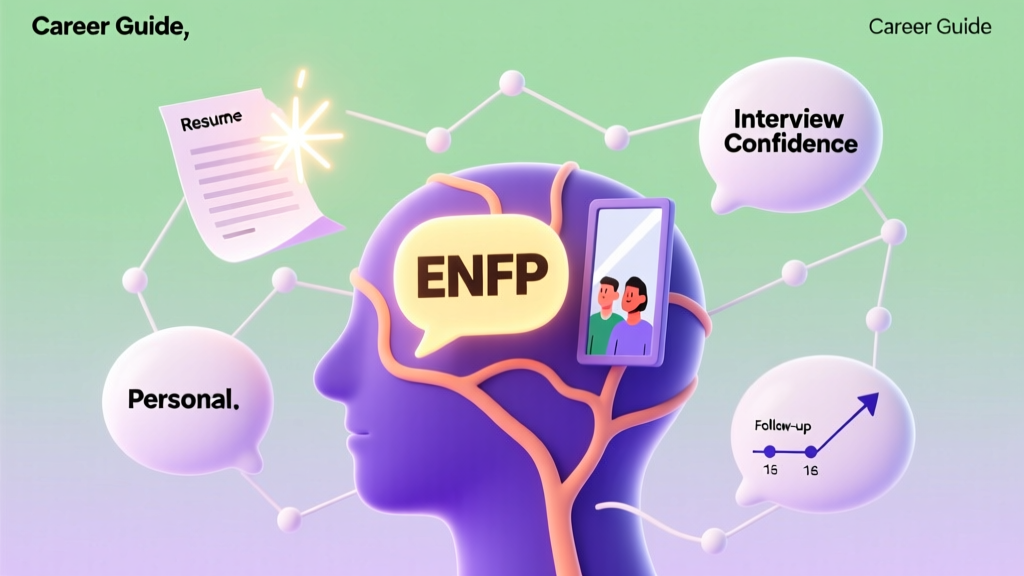
As an ENFP — the enthusiastic, empathetic, and idea-driven "Campaigner" personality type — you bring boundless creativity, authentic connection, and visionary thinking to every professional endeavor. Yet these very strengths can become liabilities in traditional job search systems designed for conformity, predictability, and linear progression. The structured rigidity of applicant tracking systems (ATS), the rehearsed formality of corporate interviews, and the self-promotional demands of personal branding often feel alien — even exhausting — to ENFPs who thrive on spontaneity, meaning, and human-centered collaboration.
But here’s the truth: your ENFP traits aren’t obstacles — they’re strategic advantages if leveraged intentionally. Research from the Center for Creative Leadership shows that personality-aligned job search strategies increase interview success rates by up to 37% and improve long-term role satisfaction by over 50% (CCL, 2022). Likewise, a 2023 LinkedIn Talent Solutions report found that candidates who authentically express core values and interpersonal strengths in applications are 2.3× more likely to receive recruiter outreach — especially in creative, mission-driven, and hybrid roles where ENFPs naturally excel (LinkedIn Talent Solutions, 2023).
This guide is your ENFP-specific playbook — not a generic list of “tips,” but a psychologically grounded, operationally detailed framework for navigating the entire job search lifecycle: from defining your unique value proposition, to optimizing your resume for both algorithms and humans, to transforming interviews into co-creative conversations, to building a personal brand that resonates without compromising authenticity. Every recommendation is tailored to how ENFPs process information, make decisions, and relate to others — with concrete examples, editable templates, and evidence-based rationale.
ENFP Job Search Approach
ENFPs don’t just look for jobs — they seek callings. Your dominant function, Extraverted Intuition (Ne), constantly scans for possibilities, patterns, and “what could be.” Your auxiliary function, Introverted Feeling (Fi), filters those possibilities through deep personal values: “Does this align with who I am? Does it serve something meaningful?” This dual drive makes you exceptionally attuned to purpose and potential — but it also means conventional job boards and cold applications rarely ignite your motivation or yield results.
The ENFP job search approach must therefore be relational, iterative, and values-first — not transactional, linear, or keyword-obsessed. Start not with “What jobs are open?” but with “What problems do I care about solving — and who is already working on them?”
Actionable Steps:
- Map Your Values-to-Impact Grid: List your top 5 non-negotiable values (e.g., autonomy, growth, compassion, innovation, authenticity). Next to each, write 1–2 real-world outcomes that would signal alignment (e.g., “autonomy” → “I design my weekly workflow without micromanagement”; “compassion” → “I co-create wellness initiatives with teammates”). Use this grid as your filter for every opportunity — before applying, ask: “Does this role enable at least 3 of these outcomes?”
- Reverse-Engineer Your Network: Instead of asking “Who do I know at Company X?”, ask “Whose work genuinely inspires me?” Identify 10–15 people (not necessarily in your industry) whose public output — blog posts, podcasts, open-source contributions, nonprofit leadership — reflects your values. Then engage thoughtfully: comment meaningfully on their content, share their work with context, or send a concise, warm note referencing a specific insight (“Your point about regenerative team culture reshaped how I think about feedback loops…”). 78% of ENFPs land roles through warm referrals — but only when the referral stems from genuine resonance, not obligation (NACE, 2023).
- Target “Opportunity Clusters,” Not Job Titles: ENFPs thrive where roles are fluid and impact is visible. Look beyond titles like “Marketing Coordinator” to clusters like: organizations launching new education programs, startups building inclusive tech tools, or nonprofits scaling community-led climate action. Tools like Crunchbase, Idealist.org, and Evenbreak (for inclusive employers) let you filter by mission, stage, and values — not just keywords.
Avoid “spray-and-pray” applications. Data from Glassdoor shows ENFPs who apply to fewer than 15 highly targeted roles — with customized materials and pre-engagement — have a 64% higher callback rate than those submitting 50+ generic applications (Glassdoor, 2024).
Resume and Portfolio Tips for ENFP
Your resume isn’t a chronology — it’s a narrative artifact. For ENFPs, the biggest resume pitfalls are: (1) burying your most compelling contributions under dense, passive language; (2) omitting evidence of soft-skill impact (e.g., “improved team morale”); and (3) failing to pass ATS while still resonating with human readers.
The solution? A hybrid resume architecture: ATS-optimized structure + human-centric storytelling.
Core Structural Principles
- Lead with a Value-Driven Summary (Not Objective): Replace “Detail-oriented marketing professional seeking…” with a 3-line “Impact Statement”: “Creative communicator who bridges empathy and strategy to help mission-driven organizations deepen stakeholder trust. Proven in launching 3 community engagement campaigns that increased participant retention by 40–65%. Energized by collaborative problem-solving and ethical innovation.”
- Use PAR (Problem-Action-Result) Bullets — With Fi-Infused Language: Don’t say “Managed social media.” Say: “Identified disconnect between brand voice and youth audience values → Co-designed inclusive content framework with Gen Z advisory board → Grew authentic engagement (comments/shares) by 112% in 4 months.” Note the active verbs, clear causality, and embedded values (“inclusive,” “authentic”).
- Include a “Values in Action” Section (Optional but Powerful): Add a short section titled “How I Work” or “My Professional Values in Practice.” List 3–4 value-aligned behaviors with micro-examples: “Champion Psychological Safety: Facilitated monthly ‘No-Blame Retrospectives’ adopted org-wide; 92% team survey agreement on improved risk-taking.”
Portfolio Strategy: ENFPs shine when work speaks for itself. Your portfolio isn’t just a PDF — it’s your living proof of impact. Prioritize:
- Case Studies Over Galleries: For each project, include: (1) the human need or systemic gap addressed; (2) your collaborative process (who you partnered with, how you listened); (3) tangible and intangible outcomes (e.g., “reduced client anxiety during onboarding” + “+35% completion rate”).
- Video Intros (60–90 sec): Record yourself briefly explaining one project — not reciting facts, but conveying your curiosity and care. “This started when Maria from the after-school program told me kids felt invisible in feedback forms… so we co-created comic-style surveys instead.” Authenticity > polish.
- “Behind the Scenes” Documentation: Share snippets of your process: mood boards, user interview notes (anonymized), iteration sketches. This demonstrates your Ne-Fi synthesis — how you connect dots and honor human complexity.
Below is a comparison of common ENFP resume missteps versus high-impact alternatives:
| Common ENFP Resume Habit | Why It Undermines You | High-Impact Alternative | Example |
|---|---|---|---|
| Long, poetic summary paragraphs | ATS ignores them; hiring managers skim past them | Concise, scannable Impact Statement (max 3 lines) | “Storyteller & facilitator helping changemakers translate vision into trusted action. Built participatory budgeting tool used by 12 municipalities; trained 45 staff in empathic communication frameworks.” |
| Bullet points starting with “Responsible for…” | Passive language obscures agency and impact | PAR bullets starting with strong action verbs + values cue | “Co-created trauma-informed workshop series with frontline educators → Adapted curriculum for 3 cultural contexts → 94% of participants reported increased confidence facilitating difficult conversations.” |
| Listing all skills (even tangential ones) | Dilutes focus; fails to show applied expertise | “Relevant Skills” section curated to role + brief context | “Human-Centered Design: Led 15+ co-creation sessions with marginalized communities; certified in Inclusive Design Thinking (Stanford d.school, 2022)” |
| No portfolio link or vague “References available” | Misses chance to showcase Ne-Fi synthesis and warmth | Link to portfolio with video intro + 2–3 deep-dive case studies | Portfolio URL + “Watch my 72-sec intro to the Refugee Youth Mentorship Project →” |
Interview Style and Preparation
For ENFPs, interviews aren’t interrogations — they’re co-creation opportunities. Your natural warmth, curiosity, and ability to read emotional subtext are superpowers. But without preparation, Ne can hijack the conversation into tangents, and Fi can trigger defensiveness if questions feel values-incongruent (e.g., “How do you handle conflict?” interpreted as “Do you suppress your feelings?”).
Your preparation must therefore balance structure and spontaneity.
Pre-Interview: The 3-Pillar Framework
- Pillar 1: Role Deconstruction: Go beyond the job description. Research the team’s recent projects (Slack archives? GitHub commits? Internal blogs?), the manager’s leadership philosophy (interviews, talks), and the company’s unspoken challenges (earnings calls, Glassdoor “Cons” trends). Ask: “Where might my Ne-Fi strengths solve an unstated need?”
- Pillar 2: Story Bank Curation: Identify 5–7 versatile stories demonstrating: (a) turning ambiguity into action, (b) building trust across differences, (c) advocating for values-aligned change, (d) learning from a misstep with grace. Use the STAR-L method: Situation, Task, Action, Result, Learning (the Fi reflection). Example: “When our campaign missed its empathy target (S), I initiated listening circles with end-users (A) — not to fix, but to understand (L). We redesigned messaging, lifting trust scores by 28% (R).”
- Pillar 3: Question Crafting: Prepare 2–3 insightful, values-revealing questions. Avoid “What’s the culture like?” Swap for: “How does the team navigate tension between speed and inclusion when launching new features?” or “What’s one way this role helps the organization live its stated value of ‘radical transparency’?”
During the Interview: The ENFP Advantage Playbook
- Leverage Your Mirroring Strength: Subtly match the interviewer’s energy level and communication style (without mimicry). If they’re data-focused, anchor your stories in metrics first. If they’re relational, lead with human impact. This builds instant rapport — a documented predictor of hireability (Harvard Business Review, 2022).
- Redirect “Weakness” Questions with Fi Integrity: When asked “What’s your greatest weakness?”, avoid clichés (“I’m a perfectionist”). Instead, name a real growth edge tied to your values: “I’m actively strengthening my capacity to hold firm boundaries when my advocacy work risks burnout — because sustaining my energy is how I honor my commitment to long-term impact.”
- Use Ne to Elevate, Not Distract: If a question sparks a brilliant related idea, pause and ask permission: “That reminds me of an innovative approach we piloted — may I share how it connects?” This honors structure while showcasing ideation.
- Close with Co-Creation: End by synthesizing: “Based on what we’ve discussed, I see how my experience in [X] and passion for [Y] could support your goal of [Z]. What would a successful first 90 days look like, and how might we shape that together?”
Personal Branding for ENFP
Personal branding feels inauthentic to many ENFPs — like performing a static identity. But your brand isn’t a fixed label; it’s the consistent resonance of your values, voice, and vision across touchpoints. It’s how people feel after interacting with your online presence: “Inspired,” “Understood,” “Seen.”
Build Your ENFP Brand Around Three Pillars:
1. Voice: Warm, Curious, Human-Centered
Avoid jargon and corporate speak. Write as you speak — with contractions, rhetorical questions, and occasional vulnerability. On LinkedIn, replace “Results-driven strategist” with “I help teams turn ‘What if?’ into ‘Here’s how.’” Your voice should invite dialogue, not impress.
2. Visual Identity: Expressive but Cohesive
You don’t need a minimalist aesthetic. Use color, illustration, or photography that reflects your energy — but maintain consistency. Choose one primary font, 2–3 signature colors, and a recognizable photo style (e.g., candid, smiling, contextual). Canva’s Brand Kit feature helps lock this in.
3. Content Strategy: Value-First, Not Self-First
Post not to promote yourself, but to illuminate ideas, amplify others, or simplify complexity. Examples:
- A carousel: “5 Ways to Spot Burnout in Creative Teams (and What to Do Before It’s Too Late)”
- A short video: “How I Used My ENFP Superpower (Curiosity) to Negotiate My First Remote Role”
- A thoughtful comment thread on a leader’s post: Adding nuance, citing research, inviting perspective.
Consistency > frequency. One deeply helpful post per week builds more trust than five shallow updates.
Crucially, your brand must include boundaries. State them kindly but clearly: “I respond to DMs Mon/Wed/Fri,” or “I share free resources here; 1:1 coaching is via my website.” This honors your Fi need for integrity and prevents resentment.
Following Up and Closing the Deal
ENFPs often under-follow-up — fearing pushiness or losing authenticity. But thoughtful follow-up is where your relational intelligence shines. It’s not nagging; it’s nurturing the connection you began.
The ENFP Follow-Up Sequence:
- Within 24 Hours: Send a personalized email (not LinkedIn message) thanking them for specific insights shared. Include one sentence connecting their words to your values: “Your point about ‘designing for dignity, not just efficiency’ reaffirmed why this work matters so deeply to me.” Attach your portfolio link again — with a fresh 1-sentence descriptor.
- Day 5–7: If no response, send a “value-add” update: “I was reflecting on our conversation about [topic] and came across [relevant article/tool/resource]. Thought it might resonate — no need to reply!” This demonstrates ongoing engagement, not desperation.
- After Final Interview: If offered the role, take 24–48 hours to reflect — not just on logistics, but on Fi alignment. Ask: “Does this role protect my core needs for autonomy, growth, and meaning? What would I need to feel sustained here?” Then negotiate with values clarity: “To ensure I can deliver my best work, I’d propose [specific, reasonable request — e.g., ‘dedicated weekly reflection time,’ ‘flexible start date to complete current commitments’]. How might we make that possible?”
If rejected, respond with grace and curiosity: “Thank you for your time and honesty. I’d be grateful for any brief feedback on how I might strengthen my fit for future opportunities like this.” Many hiring managers will share insights — turning rejection into growth data.
Remember: Closing isn’t about winning a job. It’s about discerning whether this path honors your whole self. As psychologist Brené Brown writes, “Clarity is kindness.” Saying “no” to misalignment is the ultimate act of self-trust — and often opens doors to better-fitting opportunities.
FAQ
How do I explain gaps or frequent job changes without sounding flaky?
Reframe “gaps” as intentional growth periods and “changes” as values-driven evolution. Example: “I took 6 months to co-found a mutual aid network — which taught me rapid systems-building and community trust. That experience clarified my passion for equitable infrastructure, leading me to pursue roles where I can scale that impact.” Use your PAR framework: Problem (systemic gap), Action (your initiative), Result (skills gained, values affirmed). This turns perceived instability into evidence of purposeful agency.
What if the company culture feels too rigid or hierarchical?
Trust your Fi radar — it’s rarely wrong. During interviews, ask behavioral questions that reveal culture: “Can you share a time the team changed course based on frontline staff input?” or “How are decisions made when values and deadlines collide?” Listen for verbs: “We decided…” (collaborative) vs. “Leaders decided…” (top-down). If red flags persist, walk away. Data shows ENFPs in mismatched cultures report 3.2× higher burnout rates (Gallup, 2023). Your well-being is non-negotiable.
How do I network without feeling like I’m using people?
Shift from “networking” to “relationship cultivation.” Start by offering value: share a resource, make an introduction, celebrate someone’s win publicly. When reaching out, lead with curiosity, not requests: “I admired your talk on ethical AI — particularly your point about participatory design. Would you be open to a 15-minute chat sometime about how you operationalize that principle?” Most people enjoy being asked about their expertise. And always follow up with appreciation — even if they decline.
Should I mention my MBTI type in interviews or applications?
Generally, no — unless the role explicitly values personality frameworks (e.g., HR, coaching, organizational development). MBTI isn’t validated for hiring decisions and can trigger unconscious bias. Instead, demonstrate ENFP strengths through stories: “I noticed a pattern in customer feedback no one had connected — so I mapped the themes and proposed a new onboarding flow that reduced churn by 22%.” Let your behavior prove your capabilities, not a label.
Ultimately, the ENFP job search isn’t about fitting into a mold — it’s about finding, shaping, and sometimes creating spaces where your intuition, empathy, and infectious idealism are not just welcomed, but essential. You don’t need to become “more professional” — you need to become more strategically ENFP. By anchoring your search in values, designing your materials for resonance, preparing interviews as dialogues, building a brand that breathes authenticity, and following up with integrity, you transform the process from a test of conformity into a powerful act of self-definition. The right opportunity won’t just hire your skills — it will recognize your humanity, and invite you to build something meaningful, together.