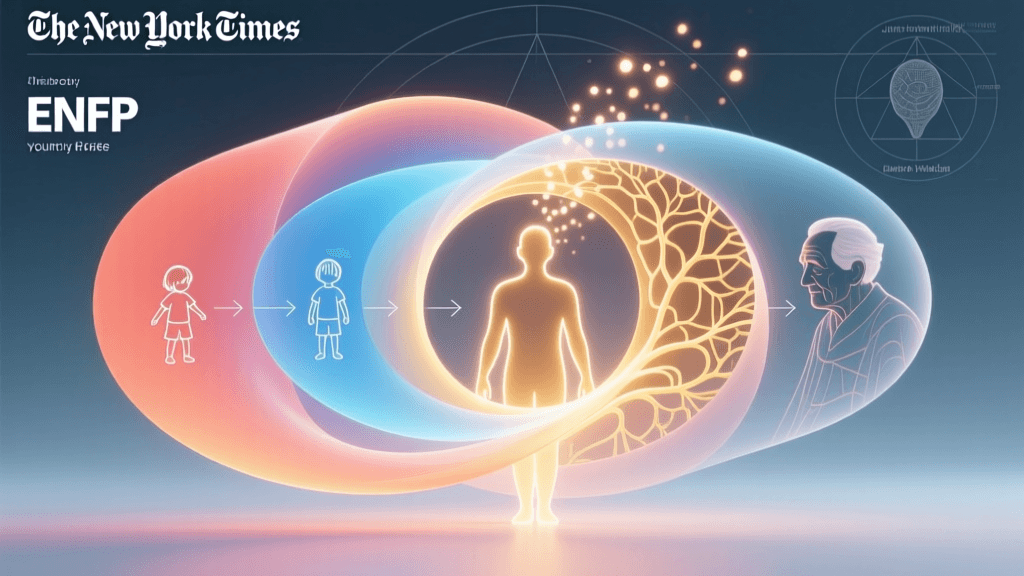
The ENFP — known as the Campaigner — is often described as warm, imaginative, and endlessly curious. Yet this vibrant, people-centered type doesn’t remain static across time. Like a living ecosystem, the ENFP’s cognitive architecture — dominated by Extraverted Intuition (Ne) and supported by Introverted Feeling (Fi), Extraverted Thinking (Te), and Introverted Sensing (Si) — unfolds, adapts, and deepens in response to life’s evolving demands. Understanding how ENFPs grow across the lifespan isn’t just academically interesting; it’s essential for parents, educators, mentors, therapists, and ENFPs themselves seeking self-awareness, resilience, and purposeful growth.
ENFP in Childhood
From toddlerhood through adolescence, the ENFP child radiates an irrepressible sense of wonder. Their dominant function, Extraverted Intuition (Ne), manifests early as a voracious appetite for ‘what if?’ questions, rapid idea generation, and spontaneous storytelling. An ENFP five-year-old might invent an entire civilization of cloud-dwelling squirrels during naptime — complete with politics, dialects, and seasonal migration patterns — then pivot seamlessly to negotiating snack-sharing rules with three peers at once.
Unlike children with strong Si (Introverted Sensing) preferences who find comfort in routine and sensory familiarity, ENFP kids often resist rigid schedules. A fixed bedtime ritual may be met with escalating layers of negotiation (“What if I read *one more* chapter? What if I tell *two* stories instead of one? What if we make up a new lullaby together?”). This isn’t defiance for its own sake — it’s Ne seeking novelty, connection, and meaning in every transition.
Meanwhile, their auxiliary Introverted Feeling (Fi) begins to take root beneath the surface. Though outwardly sociable, ENFP children possess a surprisingly deep inner moral compass. They may become visibly distressed when witnessing unfairness — even in cartoons — or insist on including the ‘left-out’ classmate in games. This Fi-driven empathy can appear precocious: a seven-year-old ENFP might quietly slip a note into a teacher’s mailbox saying, “I think Sam feels sad because no one asked him to play. Can we make sure he’s on our team tomorrow?”
Common Challenges:
- Attention regulation: ENFP children often struggle with sustained focus on rote tasks (e.g., handwriting drills, memorizing multiplication tables) not because they lack intelligence, but because Ne constantly generates more compelling alternatives. Research from the Child Mind Institute notes that while not all ENFPs have ADHD, their neurocognitive profile — high novelty-seeking, low tolerance for monotony — overlaps significantly with traits seen in inattentive presentations, leading to frequent mislabeling.
- Sensory overwhelm: Underdeveloped Si means less natural filtering of environmental stimuli. Loud cafeterias, fluorescent lighting, or scratchy clothing tags can trigger meltdowns that seem disproportionate — yet reflect genuine neurological overload.
- Emotional intensity without vocabulary: Fi’s depth isn’t matched in childhood by the language to articulate complex feelings. Frustration may erupt as tantrums; grief over a pet’s death may manifest as weeks of withdrawn silence or hyperactivity.
Actionable Advice for Parents & Educators:
- Anchor novelty in structure: Instead of eliminating transitions, co-create ‘idea bridges.’ For example: “Before we clean up blocks, let’s imagine where these blocks could go next — a space station? A coral reef? Let’s build the entrance first!” This honors Ne while scaffolding executive function.
- Develop feeling literacy: Use tools like emotion wheels (Cult of Pedagogy’s Emotion Wheel) daily. Ask, “What color does your excitement feel like today? Where do you feel it in your body?” Normalize naming nuanced states (e.g., ‘disappointed-but-hopeful,’ ‘proud-and-nervous’).
- Protect creative incubation time: Schedule 20 minutes daily of unstructured ‘idea time’ — no screens, no prompts, just paper, clay, or silence. This builds Fi-Ne integration and reduces the pressure to perform creativity on demand.
ENFP in Young Adulthood (Ages 18–35)
Young adulthood is where ENFPs often shine brightest — and face their most acute identity crises. With Fi maturing, they begin asking foundational questions: Who am I, authentically? What values will I live by — not just admire? Whose lives do I want to touch, and how? Simultaneously, their tertiary Extraverted Thinking (Te) starts emerging — bringing newfound drive to organize ideas, pursue goals, and navigate systems (colleges, internships, startups, activist networks).
This stage is marked by extraordinary exploration: double majors, gap years abroad, launching passion projects, shifting careers every 2–3 years. A 2022 Gallup study found that 64% of Millennials and Gen Z workers (cohorts rich in ENFPs) reported changing jobs at least once in the prior two years — not out of disloyalty, but a Te-fueled need to align work with evolving Fi values and Ne-inspired possibilities.
Yet this dynamism carries risks. Without conscious development, young ENFPs may fall into the ‘serial starter’ pattern: launching podcasts, Etsy shops, or community gardens with infectious enthusiasm — then abandoning them when the initial novelty fades or logistical friction mounts. This isn’t laziness; it’s Ne outpacing Te’s capacity to execute, and Fi recoiling from commitments that no longer resonate.
Relationships deepen significantly. ENFPs seek partners who are both emotionally safe (Fi-aligned) and intellectually stimulating (Ne-engaging). They’re drawn to authenticity over polish — a partner who cries at dog commercials *and* debates quantum physics is ideal. However, their desire to ‘fix’ loved ones’ pain (a Fi-Ne fusion) can lead to over-identification with others’ struggles, risking burnout or boundary erosion.
Key Developmental Tasks:
- Building Te competence: Learning project management basics (e.g., time-blocking, milestone tracking), accepting constructive feedback, tolerating administrative drudgery as necessary scaffolding for vision.
- Distinguishing inspiration from obligation: Asking, “Does this opportunity light me up *now*, or am I pursuing it because it sounds impressive/expected/noble?”
- Practicing ‘slow yeses’: Delaying commitments for 72 hours. Writing down three potential downsides before saying ‘yes’ to major life moves.
Actionable Advice:
- Create a ‘Values Compass’: List your top 5 non-negotiable Fi values (e.g., ‘authentic expression,’ ‘relational depth,’ ‘creative contribution’). Before accepting a job offer or moving cities, rate the opportunity against each value (1–5). If three or more score ≤2, pause.
- Adopt the ‘90-Minute Rule’: When motivation wanes on a project, commit to 90 focused minutes — then reassess. Often, Te activation unlocks flow; other times, the data confirms it’s time to pivot.
- Design ‘reality-check partnerships’: Identify one grounded friend (ideally ISTJ, ESTJ, or ISTP) who’ll ask, “What’s the step after the vision? Who handles payroll? What’s your backup plan if X fails?” Meet quarterly to review progress.
ENFP in Midlife (Ages 36–55)
Midlife brings a profound recalibration for ENFPs. The relentless ‘what ifs’ of Ne begin to settle into ‘what matters.’ Fi, now more integrated, shifts from asking “What do I believe?” to “How do I embody my beliefs consistently?” This is when many ENFPs move from inspiring others to mentoring them — channeling their gift for seeing potential into cultivating it in others.
Professionally, midlife ENFPs often leave corporate roles to start schools, nonprofits, therapy practices, or creative studios — not for higher income, but for deeper alignment. A landmark 2020 study published in Journal of Management found that leaders with high Ne-Fi profiles were 3.2x more likely than average to launch mission-driven ventures after age 40, citing ‘accumulated clarity about impact’ as the primary driver.
However, midlife also surfaces shadow dynamics. The underdeveloped Introverted Sensing (Si) — long dismissed as ‘boring routine’ — now asserts itself. ENFPs may experience sudden nostalgia, heightened awareness of physical limits (chronic fatigue, slower recovery), or anxiety about aging parents. Ignoring Si leads to burnout; integrating it brings grounding. One ENFP educator described her shift: “At 42, I started keeping a ‘gratitude log’ — not fluffy affirmations, but concrete sensory details: ‘The weight of my favorite mug. The smell of rain on hot pavement. My daughter’s laugh at 7:03 a.m.’ It wasn’t about stopping Ne — it was giving Si a seat at the table.”
Relationships mature. Long-term partnerships deepen through shared history and mutual witnessing of growth. ENFPs become exceptional listeners — not just to words, but to silences, shifts in tone, unspoken needs. Yet they may grieve the loss of earlier ‘electric’ intensity, mistaking steady love for diminished passion.
Developmental Milestones:
- Ne-Si integration: Using past experiences (Si) to inform future visions (Ne) — e.g., “Last time I launched a workshop, registration stalled at 60%. What sensory details (Si) made attendees feel welcome? How can I weave those into the new Ne-designed format?”
- Fiat-to-Fiat leadership: Moving from ‘charismatic influencer’ to ‘wise steward’ — prioritizing sustainability over virality, depth over breadth.
- Grieving unrealized paths: Consciously honoring abandoned dreams (“I wanted to be a marine biologist…”) without letting them sabotage present commitments.
Actionable Advice:
- Conduct a ‘Legacy Audit’: List 3–5 people you’ve profoundly impacted. For each, write: (1) What specific action/word of yours mattered? (2) What Fi value was expressed? (3) How did Ne help you see their potential? Keep this list visible.
- Build Si rituals: Choose one daily anchor — making tea mindfully, walking the same neighborhood route, journaling with pen/paper. Focus entirely on sensory input for 5 minutes. No Ne commentary allowed.
- Reframe ‘decline’ as ‘distillation’: When energy wanes, ask: “What 20% of my activities generate 80% of my fulfillment? How can I protect and amplify those?”
ENFP in Later Years (Ages 56+)
In elder years, the ENFP archetype transforms into something rare and luminous: the Wise Enchanter. With decades of Fi-Ne-Te-Si integration, they wield intuition not as scattered possibility, but as profound pattern recognition. They see connections across generations — how a grandchild’s stubbornness echoes their own at age eight, how current social movements mirror struggles they championed in their twenties.
Research from the National Institute on Aging shows that older adults with high openness (a core ENFP trait) maintain stronger neural plasticity and report higher life satisfaction when engaged in generative activities — passing on stories, mentoring youth, creating art. ENFP elders don’t ‘retire from purpose’; they redirect it. One 72-year-old ENFP founded a ‘Story Bridge’ program, pairing teens with elders to co-create digital oral histories — blending Ne’s love of narrative, Fi’s commitment to truth-telling, Te’s project design, and Si’s reverence for lived experience.
Physical changes become undeniable. Si, once neglected, now offers vital wisdom: pacing, rest, medical advocacy. ENFPs learn to say ‘no’ not as rejection, but as sacred boundary-setting — protecting energy for what truly lights their soul. Grief arrives with greater frequency (loss of peers, mobility, independence), yet Fi’s depth allows them to hold sorrow with startling grace — often transforming pain into poetry, advocacy, or quiet acts of service.
Crucially, ENFP elders rarely succumb to cynicism. Their Ne retains its hopeful tilt, but it’s now tempered by Si’s realism and Fi’s hard-won compassion. They don’t deny darkness — they illuminate pathways through it.
Distinctive Strengths in Later Life:
- Intergenerational translation: Explaining complex social issues to grandchildren using metaphors rooted in shared family stories.
- Presence as radical practice: Sitting with a dying friend without needing to ‘fix’ — holding space with full sensory awareness (Si) and unconditional acceptance (Fi).
- Legacy curation: Organizing photos, letters, and recordings not as archives, but as living invitations for future generations to engage with values, not just facts.
Actionable Advice:
- Create a ‘Wisdom Capsule’: Record 3–5 short audio messages (5 mins each) answering questions like: “What’s one thing I wish I’d known at 30?” “How did I learn to trust my heart?” Store them with instructions for release on specific life events (e.g., a grandchild’s graduation).
- Practice ‘micro-generativity’: Spend 15 minutes weekly teaching a skill to someone younger — baking sourdough, identifying birds, writing haiku. Focus on joy, not perfection.
- Reclaim ‘play’ as spiritual practice: Engage in low-stakes creativity — finger painting, improv games, gardening without harvest goals. Let Ne wander, unburdened by outcome.
The Lifelong ENFP Journey
The ENFP life arc isn’t linear progress, but a spiral — returning to core themes (curiosity, authenticity, connection) at ever-deepening levels of integration. Below is a comparative overview of key developmental shifts:
| Life Stage | Primary Cognitive Focus | Core Question | Risk if Unintegrated | Signature Strength When Integrated |
|---|---|---|---|---|
| Childhood | Ne (dominant) + emerging Fi | “What’s possible? Who am I in this moment?” | Chronic overwhelm, identity diffusion, learned helplessness | Unfiltered imagination, empathic attunement, joyful spontaneity |
| Young Adulthood | Fi (auxiliary) + emerging Te | “What do I truly value? How do I bring this into the world?” | Identity fragmentation, chronic dissatisfaction, relational enmeshment | Charismatic vision-casting, values-driven action, catalytic relationships |
| Midlife | Te (tertiary) + integrating Si | “How do I sustain what matters? What wisdom does my body/history hold?” | Burnout, nostalgia paralysis, ‘legacy anxiety’ | Strategic mentorship, embodied presence, distillation of essence |
| Later Years | Si (inferior, now accessible) + Ne-Fi synthesis | “How do I weave my story into the larger tapestry? What endures?” | Isolation, regret fixation, spiritual bypassing | Interconnected wisdom, compassionate witnessing, generative stillness |
This spiral reflects Jungian individuation theory — the lifelong process of integrating unconscious functions (Si for ENFPs) to achieve psychological wholeness. As Carl Jung wrote, “The meeting of two personalities is like the contact of two chemical substances: if there is any reaction, both are transformed.” For ENFPs, the greatest transformation occurs in the quiet alchemy of integrating their own inner opposites.
It’s vital to emphasize: No stage is ‘better’ than another. The child’s boundless wonder, the young adult’s courageous experimentation, the elder’s serene discernment — each holds irreplaceable value. The tragedy isn’t aging; it’s refusing the invitation each stage extends to deepen one facet of the self.
FAQ
Do ENFPs become more introverted with age?
No — ENFPs remain Extraverted in orientation throughout life. However, their expression of extraversion matures. Young ENFPs may seek stimulation in large groups and rapid social switching; elders often prefer deep 1:1 conversations or small, values-aligned gatherings. This reflects Fi-Ne integration (prioritizing quality over quantity of connection), not a shift to introversion. As noted by the Myers & Briggs Foundation, type preferences are stable; behavior adapts to context and development.
Is it normal for ENFPs to change careers multiple times?
Yes — and it’s often healthy. Career pivots allow ENFPs to align work with evolving Fi values and Ne-inspired growth opportunities. The risk lies not in changing, but in avoiding reflection between transitions. A 2021 Harvard Business Review analysis found that professionals who changed careers with intentional reflection reported 42% higher long-term job satisfaction than those who pivoted reactively. Key: Build ‘transition rituals’ — e.g., writing a farewell letter to your old role, interviewing three people in your new field before committing.
How can ENFP parents support their ENFP children without reinforcing impulsivity?
By distinguishing impulse (Ne-driven reactivity) from inspiration (Ne-Fi synergy). Support inspiration by co-designing ‘idea labs’ — dedicated spaces/time for wild brainstorming — while explicitly teaching impulse regulation: “Let’s try the ‘3-Breath Pause’ before acting on big ideas. Breathe in (what excites me?), breathe out (what might go wrong?), breathe in (what’s one small step?)” This builds Te without stifling Ne.
What are signs an ENFP is neglecting their Si function?
Chronic exhaustion despite adequate sleep, recurring minor injuries (e.g., sprained ankles, forgotten medications), inability to recall specific past events (relying only on emotional impressions), dismissing physical discomfort as ‘not important,’ or romanticizing the past while ignoring concrete lessons learned. Reintegration begins with micro-practices: setting phone reminders for hydration, keeping a ‘body weather report’ journal (‘Today my shoulders felt tight; I drank extra water and stretched’), reviewing old journals to identify tangible patterns.
Can ENFPs develop strong leadership skills despite disliking hierarchy?
Absolutely — and often excel as transformational leaders. Research from the Center for Creative Leadership shows ENFPs rank in the top 15% for ‘inspirational motivation’ and ‘individualized consideration’ — core dimensions of transformational leadership. Their aversion is to rigid, top-down hierarchy, not leadership itself. Effective ENFP leaders create flat, purpose-driven teams, delegate based on strengths (not titles), and measure success by collective growth, not control. As leadership expert Simon Sinek observes, “Leadership is not about being in charge. It’s about taking care of those in your charge.” This resonates deeply with ENFP’s Fi-Ne ethos.
Ultimately, the ENFP life journey is a testament to the human capacity for expansive growth. From the child who sees magic in dust motes to the elder who finds sacred geometry in tree rings, the Campaigner’s path is one of perpetual, compassionate becoming — never arriving, always arriving anew.