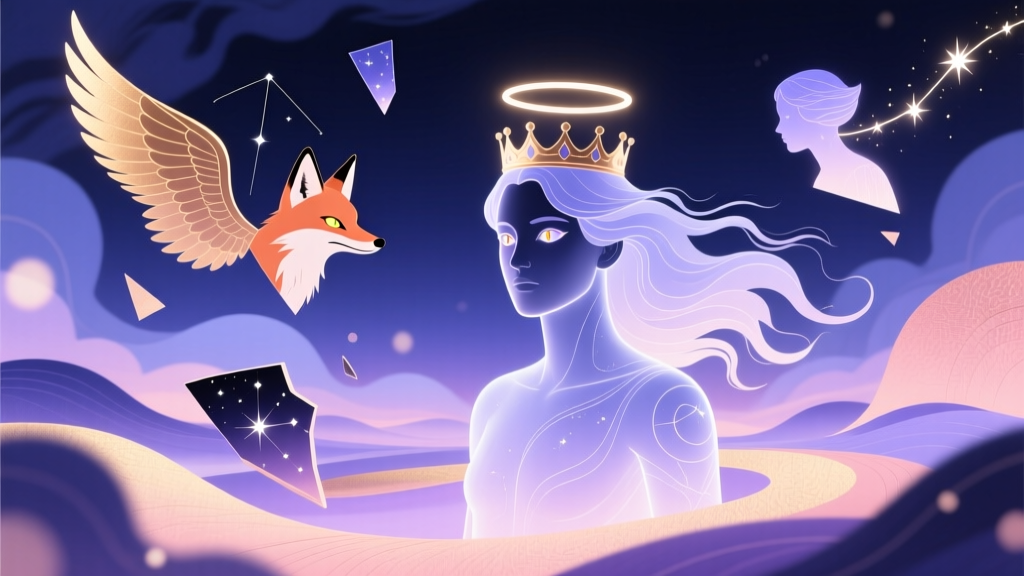
ENFP in Mythology and Folklore
The ENFP (Extraverted, Intuitive, Feeling, Perceiving) personality type—often dubbed the Champion, Advocate, or Inspiring Idealist—is a rare and radiant force in psychological typology. Comprising roughly 6–8% of the global population (Myers-Briggs Foundation), ENFPs are defined by their boundless curiosity, empathic attunement, spontaneous creativity, and unwavering belief in human potential. But long before Isabel Briggs Myers formalized the MBTI framework in the mid-20th century, these same qualities echoed across continents—in fire-stealing gods, shape-shifting tricksters, star-guiding prophets, and boundary-dissolving healers.
Mythology and folklore do not merely reflect culture; they encode enduring psychological patterns. Carl Gustav Jung recognized this when he described archetypes as primordial images residing in the collective unconscious—universal symbols that recur across time and geography because they resonate with fundamental human motivations and capacities. The ENFP’s core functions—Extraverted Intuition (Ne) as dominant, supported by Introverted Feeling (Fi), then Extraverted Thinking (Te), and finally Introverted Sensing (Si)—map uncannily well onto mythic roles that initiate change, bridge worlds, champion the marginalized, and reimagine reality itself.
Unlike the stoic warrior (ISTJ), the meticulous lawgiver (ESTJ), or the detached oracle (INTJ), the ENFP archetype rarely appears as a ruler seated on a throne—but rather as the one who questions the throne, who slips through palace walls to free prisoners, who sings forgotten names back into existence, or who trades riddles with dragons to save a village—not with sword or spell, but with sincerity, metaphor, and unshakable hope. Their power lies not in control, but in catalysis; not in preservation, but in poetic transformation.
This article traces the ENFP signature across three interwoven domains: mythological figures whose stories embody Ne-Fi dynamism; fantasy literature archetypes that codify and evolve those patterns for modern readers; and legendary heroes and creatures from global folklore whose behaviors, motivations, and narrative functions align with ENFP cognitive wiring. We conclude with an FAQ grounded in both typological research and cross-cultural mythography—and offer practical, actionable guidance for ENFPs seeking to honor their mythic inheritance in daily life.
Famous ENFP Mythological Figures
Identifying ENFPs in mythology requires moving beyond surface traits (e.g., “charming” or “talkative”) and examining cognitive function expression: How does the figure generate possibilities (Ne)? What values anchor their choices (Fi)? How do they respond to injustice or suffering (Fe-inflected Fi)? And how do they adapt systems—or dismantle them—when ideals are betrayed (Te)? Below are eight mythological figures whose narratives, motivations, and symbolic roles strongly align with ENFP dynamics—spanning Greek, Norse, Yoruba, Hindu, Slavic, Māori, and Indigenous North American traditions.
| Figure | Culture/Tradition | Core ENFP Expression | Key Narrative Function | Fi-Value Anchor |
|---|---|---|---|---|
| Hermes | Greek | Ne-dominant boundary-crossing: messenger, inventor of lyre, patron of travelers, thieves, and linguists | Mediator between realms (Olympus/Hades, divine/mortal, conscious/unconscious) | Freedom of movement, truth-telling, protection of the vulnerable |
| Eshu (Elegba) | Yoruba (West Africa / Diaspora) | Ne-as-chaos-catalyst: opens paths, confounds logic, reveals hidden meanings through paradox | Divine trickster who initiates transformation via disruption and choice | Authenticity, reciprocity, justice through discernment—not dogma |
| Loki | Norse | Ne-driven improvisation: shapeshifter, verbal acrobat, father of monsters and gods alike | Agent of necessary entropy—forces evolution by destabilizing rigid order | Autonomy, kinship loyalty, resistance to authoritarian control |
| Prajapati | Hindu (Vedic) | Ne-as-creative impulse: self-generating, imagines worlds into being through speech and desire | Primordial creator whose imagination precedes form—embodies srsti (spontaneous emergence) | Sacrifice for wholeness, unity-in-diversity, reverence for life’s unfolding |
| Velez (Veles) | Slavic | Ne-as-underworld intuition: serpent god of dreams, poetry, magic, and cattle—guardian of ancestral memory | Challenger of Perun (sky god); represents cyclical renewal, hidden wisdom, emotional depth | Balance over hierarchy, wisdom in liminality, protection of folk traditions |
| Tāne Mahuta | Māori | Ne-as-relational architect: separates earth and sky to create space for life, names all living things | Divine innovator who brings light, breath, and language—father of forests and birds | Whanaungatanga (kinship), respect for nature’s agency, generative love |
| Coyote | Indigenous North America (e.g., Navajo, Nez Perce, Lakota) | Ne-as-survival-creativity: fails hilariously yet teaches profound truths through embodied paradox | Cultural transformer who steals fire, creates rivers, and blurs sacred/profane boundaries | Humility in learning, communal resilience, laughter as healing |
| Anansi | Akan (Ghana) / Caribbean folklore | Ne-as-story-weaver: outwits stronger beings using wit, empathy, and narrative framing | Bringer of wisdom and storytelling—transforms oral tradition into cultural immune system | Intellectual sovereignty, intergenerational justice, joy as resistance |
What unites these figures is not moral perfection—but relentless relational imagination. Hermes doesn’t enforce Olympian decrees; he negotiates, translates, and expands options. Eshu doesn’t declare right or wrong—he places a crossroads before you and asks: Which path honors your truth? Loki’s betrayals stem less from malice than from Fi-driven intolerance of hypocrisy—even when it costs him everything. These are not ‘heroes’ in the classical sense (no flawless arc, no final triumph), but archetypal ENFPs: catalysts whose greatest gift is making the invisible visible, the impossible imaginable, and the silenced heard.
Importantly, many of these figures were historically demonized or diminished by colonial, patriarchal, or monotheistic frameworks—Loki labeled ‘evil’, Eshu reduced to ‘devil’, Coyote dismissed as ‘silly’. Modern ENFPs often face parallel erasure: their idealism called naïve, their enthusiasm ‘unfocused’, their empathy ‘overly sensitive’. Recognizing these figures as ENFP-aligned validates a profound truth: their so-called flaws are functional adaptations to systems that suppress imagination, emotion, and pluralism.
ENFP Fantasy Literature Archetypes
Fantasy literature serves as mythology’s modern successor—translating ancient archetypes into accessible, psychologically nuanced narratives. Authors like Ursula K. Le Guin, N.K. Jemisin, Susanna Clarke, and Patrick Rothfuss don’t just borrow from myth; they reinterpret its ENFP-coded roles for readers navigating late-capitalist alienation, ecological crisis, and identity fragmentation. Four recurring ENFP-aligned archetypes emerge across high fantasy, magical realism, and speculative fiction:
The Bridge-Walker
Like Hermes and Tāne Mahuta, the Bridge-Walker exists between categories: mortal/magical, colonizer/colonized, rational/mystical. They rarely wield brute power—but possess uncanny fluency in multiple languages, logics, and ontologies. Examples include:
- Spink and Foll (from Robin Hobb’s Realm of the Elderlings): Twin wizards whose magic operates through empathy, memory, and shared dreaming—not incantation or domination. Their strength lies in holding contradictory truths simultaneously.
- Shrike (from N.K. Jemisin’s The Broken Earth Trilogy): A non-linear, multi-temporal being who embodies trauma, prophecy, and radical compassion. Shrike doesn’t ‘solve’ oppression—they reconfigure time and causality to make justice possible.
The Story-Weaver
Direct descendants of Anansi and Prajapati, Story-Weavers understand narrative as ontological infrastructure. They don’t just tell tales—they repair broken cosmologies. Their tools are metaphor, witness, and recursive truth-telling.
- Elphaba (Gregory Maguire’s Wicked): Reimagined as an ENFP intellectual activist, Elphaba’s Fi anchors her in animal rights and educational equity; her Ne generates counter-narratives to Oz’s propaganda. Her ‘wickedness’ is simply refusal to internalize the state’s lies.
- Ursula Le Guin’s Shevek (The Dispossessed): Though technically an INTP in many readings, Shevek’s anarchist pedagogy, linguistic innovation (creating the Pravic language), and commitment to mutual aid reflect ENFP-style world-building through relational ethics—not abstract theory.
The Unbound Healer
Rejecting medicalized, hierarchical healing models, the Unbound Healer works with energy, story, ecology, and ancestral resonance. They treat illness as disconnection—not defect.
- Scholar Lily (Naomi Novik’s A Deadly Education): Rejects the academy’s elitism and lethal traditions, instead building collaborative, adaptive survival knowledge rooted in care—not competition.
- Blue Sargent (Maggie Stiefvater’s The Raven Cycle): Her Ne manifests as ‘seeing ghosts’—perceiving latent connections, emotional residues, and temporal echoes. Her Fi compels her to protect fragile, liminal beings (like the ley line–bound Gansey).
The Joyful Subverter
Where ISTJ bureaucrats maintain order and INTJ strategists optimize systems, the Joyful Subverter dismantles oppressive structures through delight. Their rebellion is contagious, aesthetic, and deeply communal.
- Puck (Shakespeare’s A Midsummer Night’s Dream, reinterpreted in Holly Black’s The Folk of the Air): Not malicious, but mischievous—a reminder that rigidity kills wonder. His chaos creates space for love, transformation, and self-revelation.
- Granny Weatherwax (Terry Pratchett’s Discworld): Though often typed as ISTJ, her deep Fe-infused Fi, fierce advocacy for ‘headology’ (psychological empowerment over spells), and rejection of magical patriarchy mark her as an elder ENFP archetype—using humor and myth to disarm power.
For real-world ENFPs, these archetypes aren’t escapist—they’re operating manuals. If you identify with the Bridge-Walker, your vocation may lie in translation work (literary, cultural, therapeutic). If you resonate with the Story-Weaver, consider community oral history projects, restorative justice facilitation, or ethical AI narrative design. The Unbound Healer calls you toward somatic, decolonial, or eco-therapeutic practice. And the Joyful Subverter invites you to reclaim play, satire, and ritual as legitimate tools of resistance.
Legendary Heroes, Creatures and ENFP
While gods and demigods occupy celestial or archetypal planes, legendary heroes and mythical creatures inhabit the liminal spaces where myth bleeds into local memory—forests, crossroads, riverbanks, attics. These figures reveal how ENFP traits manifest in embodied, culturally grounded forms: not as cosmic forces, but as neighbors, ancestors, or whispered warnings.
Heroes Who Refuse the Sword
Classical heroism glorifies the decisive blow—the slaying of the Minotaur, the beheading of Medusa. ENFP-aligned heroes, however, win through refusal, redirection, and redefinition:
- Ilya Muromets (Slavic): Though famed as a bogatyr (knight), his origin story centers on 33 years of paralysis—awakening only when offered not strength, but purpose. His first act? Negotiating peace between warring principalities—not conquering them. His Fi anchors him in mercy; his Ne, in diplomatic possibility.
- Sun Wukong (Chinese): The Monkey King’s journey—from chaotic rebel to enlightened protector—is a textbook ENFP development arc. His early Ne-fueled pranks (stealing immortality peaches, rewriting death ledgers) reflect undeveloped Fi. His pilgrimage with Tripitaka cultivates compassionate discernment—transforming trickster into bodhisattva.
ENFP Creatures: Embodied Ne-Fi Energy
Mythical beasts often externalize psychological energies. ENFP-aligned creatures share key traits: shape-shifting capacity, association with wind/sky/water (elements of flow and connection), and roles as guides—not threats.
- The Baku (Japanese): A dream-eating chimera (elephant trunk, tiger claws, ox tail) who consumes nightmares and leaves clarity. Symbolizes ENFP’s ability to metabolize collective anxiety into insight—without judgment or suppression.
- The Selkie (Celtic/Norse): Seal people who shed skins to walk on land—embodying fluid identity, emotional depth, and the courage to move between worlds. Their stories emphasize consent, grief, and the sacredness of chosen family—core Fi concerns.
- The Rainbow Serpent (Aboriginal Australian): Creator and destroyer, giver of rain and law, associated with fertility, healing, and initiation. Its cyclical, non-linear presence mirrors ENFP’s comfort with paradox and process over fixed outcomes.
Modern ENFPs can draw direct practice from these beings. Try a Baku-inspired journaling ritual: Before sleep, name one fear or looped thought—then symbolically ‘offer’ it to the Baku (write it, burn it, whisper it to wind). This externalizes Ne’s tendency toward catastrophic ideation while honoring Fi’s need for emotional safety. Or adopt Selkie boundary work: Identify one ‘skin’ you wear socially (e.g., ‘competent professional’) that drains you. Practice shedding it for 20 minutes daily—dancing, singing off-key, lying in grass—reconnecting with unmediated sensation and joy.
Crucially, ENFP-aligned creatures are rarely ‘tamed’. They coexist—or withdraw. This reflects a vital truth: ENFPs thrive not under control, but in ecosystems of trust, reciprocity, and spaciousness. Attempts to ‘manage’ their energy (e.g., rigid schedules, productivity hacking) often trigger Si-inferior stress—leading to burnout, nostalgia loops, or physical symptoms. Instead, structure should serve inspiration: use time-blocking for creative incubation, not output quotas; design environments rich in sensory variety (plants, textures, music); and prioritize relationships that affirm autonomy and depth.
FAQ
Why are so many ENFP mythological figures labeled ‘tricksters’ or ‘chaotic’?
Trickster status reflects Ne’s dominant function—not amorality, but pattern disruption. When systems calcify (e.g., unjust laws, dogmatic religion, ecological exploitation), Ne instinctively generates alternatives—even if it means breaking norms. As scholar Lewis Hyde notes in Trickster Makes This World, tricksters ‘are not destroyers but transformers’ who ‘make the world new by breaking it open’ (Basic Books, 2010). For ENFPs, ‘chaos’ is often the necessary precondition for authentic order.
Can ENFPs be effective leaders in traditional hierarchies?
Yes—but not as top-down commanders. ENFPs excel as relational architects: designing inclusive processes, mentoring emerging voices, reframing missions around shared values. Research from the Center for Creative Leadership shows ENFPs rank highest among types in ‘empowering others’ and ‘vision articulation’—but lowest in ‘administrative oversight’ (CCL, 2022). Their leadership shines in startups, NGOs, education, and creative industries—where influence flows through inspiration, not authority.
How do ENFPs avoid burnout when their empathy feels overwhelming?
ENFPs’ Fi-Fe loop makes them acutely sensitive to others’ pain—but unlike INFJs, they lack auxiliary Te for systemic boundary-setting. Practical antidotes include: (1) Empathy triage: Ask, ‘Does this person have direct access to my time/energy?’ If not, channel care into donation, advocacy, or art—not personal absorption. (2) Fi grounding rituals: Daily 5-minute ‘value check-ins’ (e.g., ‘What mattered most today? Did I honor it?’). (3) Somatic anchoring: When overwhelmed, press palms to earth or hold cold water—engaging Si to interrupt Ne-Fe spirals.
Are there ENFP deities or saints in monotheistic traditions?
While Abrahamic traditions emphasize obedience over imaginative dissent, ENFP resonance appears in figures who prioritize relationship over rule: St. Francis of Assisi (renounced wealth to preach to birds and lepers, seeing divinity in all creation); Rabbi Hillel (famously summarized Torah as ‘What is hateful to you, do not do to another’—centering empathy over legalism); and Sufi poet Rumi, whose ecstatic, boundary-dissolving love poetry mirrors Ne-Fi transcendence. These are not doctrinal authorities—but living bridges between dogma and devotion.
Ultimately, recognizing ENFPs in myth, folklore, and fantasy isn’t about flattery—it’s about reclamation. In a world increasingly optimized for efficiency over meaning, extraction over reciprocity, and certainty over wonder, the ENFP archetype is not quaint or impractical. It is essential infrastructure. Hermes still delivers messages across divides. Eshu still waits at every crossroads. Anansi’s web still holds communities together. And every ENFP who dares to dream aloud, defend the unseen, or rewrite a broken story participates in an ancient, unbroken lineage—one that has always known: the most revolutionary act is to imagine, together, what else is possible.